
Sourcing Functional Herbs and Ayurvedic Botanicals from Sri Lanka
Published: 2026-05-18 Last updated: 2026-05-18
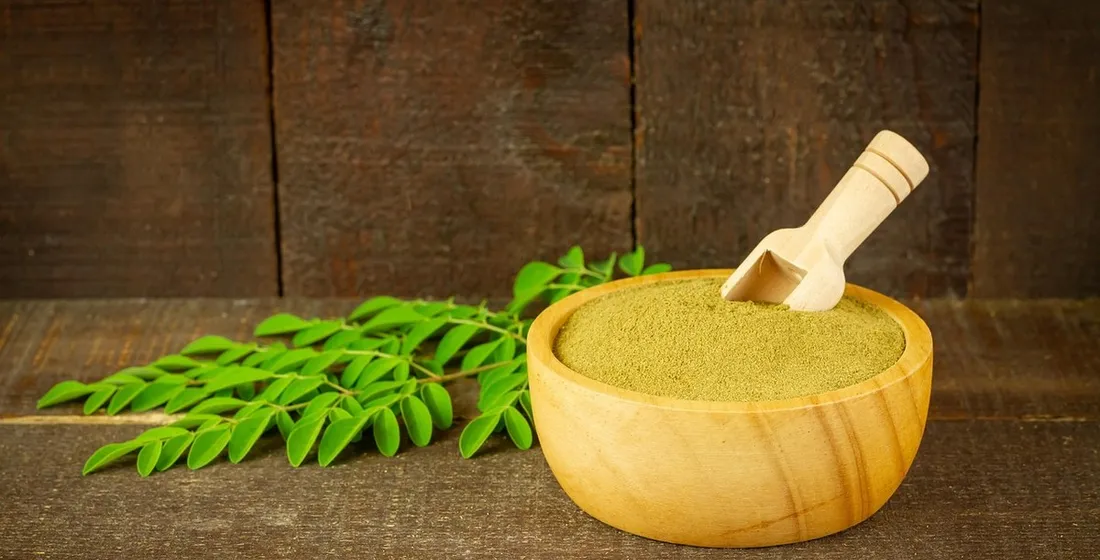
Hero: editorial flat-lay of fine green herbal powder heaped in a plain wooden bowl with an unmarked wooden scoop, alongside a fresh sprig of pinnate green leaves on a dark wood surface. Photographed in editorial trade-publication style.
Buyer’s snapshot
Buyer's snapshot The global adaptogens and functional-herb market is on track to grow from roughly USD 11.9 billion in 2025 to USD 22.5 billion by 2034, an estimated 7.3% CAGR (Fortune Business Insights, 2026). Growth has outrun quality control. A 2025 peer-reviewed review of adaptogenic herbal dietary supplements found lead and nickel levels exceeding safe limits in most products tested, and a separate review of herbal medicines broadly documented the same heavy-metal pattern across markets (PMC, 2025; PMC, 2021). Neither the EU nor the US treats "it's a traditional herb" as a regulatory pass. The EU Novel Food framework and the US New Dietary Ingredient (NDI) notification process both put the burden of proof on the brand, per botanical, before an oral SKU can launch. Silk Route Ventures supplies bulk Ceylon herbs and Ayurvedic botanicals from the BRCGS and FSSC 22000 V6 audited Silk Foods Ceylon facility in Matale, with every batch traceable to farm and species-verified on the Certificate of Analysis. First-order MOQ is 50 kg per SKU; capsule encapsulation runs from 180 bottles per single shift. For wellness and nutraceutical brands, the sourcing spec that wins is the one that treats species verification, contaminant testing, and claim-market status as three separate line items, not one vague "quality" checkbox. |
A functional-herb category built on a nearly 2,000-year Ayurvedic tradition is now competing for shelf space against a testing standard built for pharmaceutical inputs. That gap is not hypothetical. Independent lab reviews of adaptogenic supplements keep finding heavy metals above safe limits, and both the EU and the US have tightened the regulatory path an oral botanical SKU has to clear before launch. For a wellness or nutraceutical brand sourcing Ayurvedic botanicals from Sri Lanka in 2026, the procurement question is no longer “is this herb traditional.” It is “can the supplier prove the species, the contaminant panel, and the claim-market status on paper, per batch.”
This guide covers what Silk Route Ventures (SRV) calls the Ceylon Herbs category: the Ayurvedic and functional botanicals grown and processed in Sri Lanka, supplied bulk or encapsulated from the Silk Foods Ceylon (SFC) facility in Matale. It walks through what the category actually includes, why the heavy-metals and species-verification gap matters more than most RFQs currently account for, how the EU and US regulatory pathways differ for a new botanical, what a defensible RFQ looks like, and where Ceylon herb sourcing sits on price against Indian and Chinese origins.
What does “Ceylon herbs” mean in 2026 B2B sourcing?
Ceylon herbs, in SRV’s catalogue, means the Ayurvedic and functional botanical range grown or processed in Sri Lanka and supplied as bulk raw material, cut, or powder. The working list runs well beyond the handful of household names. It includes ashwagandha, moringa, gotukola (Centella asiatica), triphala, gurmar (Gymnema sylvestre), guduchi, sarsaparilla (iramusu), welpenela (Cardiospermum halicacabum), heenbovitiya, beli (bael), margosa (neem), hibiscus, lemongrass, aloe vera, green coffee bean, papaya leaf, amalaki (amla), licorice, and several less internationally known but well-documented traditional botanicals such as kothalahimbutu, nilkatarolu, and ranawara. Most ship as whole herb, cut, or powder; aloe vera also ships as cube or gel.
Processing runs on the same spice-and-herb line as SRV’s Ceylon spice catalogue, at 100 to 200 kg per hour (roughly 1 to 2 metric tonnes per day), under BRCGS and FSSC 22000 V6, which cover the spice and herb processing lines at the site. For a buyer, the practical implication is that a functional-herb SKU and a spice SKU share the same certification stack, the same COA discipline, and the same species-verification standard. There is no separate, looser tier for botanicals just because the end use is a supplement rather than a seasoning.
For brands that want the finished format rather than bulk powder, the SFC facility encapsulates in-house at 100,000 capsules per single shift, with a 180-bottle capsule MOQ that is low for the category. Bulk botanical powder and cut herbs carry a 50 kg first-order MOQ per SKU, the same floor that applies across Ceylon spices.
Why does heavy-metal and species verification matter more for adaptogenic botanicals?
Two forces are pushing functional herbs toward pharmaceutical-grade scrutiny: the money moving into the category, and the testing record that money is exposing. A 2025 peer-reviewed regulatory-safety review of adaptogenic herbal dietary supplements reported that most products tested carried lead and nickel levels above safe limits, and a broader review of heavy-metal contamination in herbal medicines documented the same pattern of lead, cadmium, arsenic, and mercury turning up across markets and product categories (PMC, 2025; PMC, 2021). Neither review singles out Sri Lankan supply. The point for a procurement team is structural: wild-collected and loosely traceable botanical supply chains carry a real, documented contamination risk that a species name on a label does nothing to control.
Procurement-desk observation SRV procurement-desk observation: brands most often come to the trade desk after a heavy-metals or species-substitution finding from their own third-party lab, not before. The RFQ that follows is always tighter than the first one. Building the contaminant panel and species-verification clause into the RFQ from the start, rather than after a failed batch, is the cheaper version of the same lesson. |
Species substitution compounds the risk. Wildcrafted botanicals move through informal collection networks in most origin countries, and a common-name mismatch (multiple unrelated plants sharing a local or English common name) is a documented failure mode across the global herbal trade, not a Sri Lanka-specific one. The defensible spec is the Latin binomial confirmed in writing on the Certificate of Analysis, plus a heavy-metals panel (lead, cadmium, arsenic, mercury) and a microbial panel (total plate count, yeast and mould, Salmonella, E. coli) on every batch, not just the first sample. SRV supplies Ceylon herbs against this standard from Matale, with traceability to farm and a COA per batch. Brands weighing a specific botanical’s claim strength against its regulatory ceiling can see the pattern worked through in detail in the Welpenela sourcing spec, where the strongest evidence sits with a topical claim and the oral claim carries a novel-food gate.
What is the EU Novel Food and US NDI status for a new Ayurvedic botanical?
A botanical with centuries of traditional use in Sri Lanka is not automatically clear to sell as a food supplement in the EU or the US. Both jurisdictions run a status check that a procurement team should run before, not after, committing to an SKU launch.
In the EU, the Novel Food Regulation applies to any food or food ingredient without a significant history of consumption within the EU before 15 May 1997. The European Commission’s Novel Food status catalogue is a non-binding orientation tool, and the burden of proof sits with the food business operator: if a botanical’s EU consumption history before that date cannot be documented, the ingredient needs Novel Food authorisation before it can be sold as a food supplement, a process that includes a safety dossier under Commission Regulation 2022/2340 for botanical extracts (European Commission, 2025). Several Ayurvedic botanicals with strong traditional use inside South Asia have thin or undocumented pre-1997 EU consumption records, which is exactly the gap that trips up brands mid-launch.
In the US, the relevant gate is the New Dietary Ingredient (NDI) notification under DSHEA. A dietary ingredient not marketed in the US before 15 October 1994 is an NDI, and a supplement containing one must be the subject of an NDI notification filed with the FDA at least 75 days before the product reaches market, with the botanical’s Latin name and a safety rationale included in the filing. The FDA issued fresh educational material on the NDIN process in June 2025 specifically to address common submission errors, which signals the agency is still seeing avoidable mistakes in botanical filings (US FDA, 2025).
Spec snapshot: claim-market gate by botanical status EU food supplement (oral): confirm pre-15-May-1997 EU consumption history in the Novel Food status catalogue before launch. No documented history means a Novel Food dossier is required. US dietary supplement (oral): confirm whether the botanical was marketed in the US before 15 October 1994. If not, an NDI notification is due to FDA at least 75 days before market. Topical / cosmetic: often the cleaner path for botanicals with thin oral-claim documentation, where an established INCI listing carries the claim instead. Neither gate is a Sri Lanka-specific hurdle. It applies to any origin supplying a botanical new to the destination market. |
None of this blocks sourcing. It changes what the RFQ and the supplier relationship need to cover: a defensible species ID, a documented use history the brand’s regulatory counsel can work with, and a supplier willing to hold that documentation on file rather than treat it as the buyer’s problem alone. SRV’s R&D and NPD team supports this stage directly for brands building a new botanical SKU; see the R&D and NPD capability page for how that formulation and documentation work runs alongside production planning.
How does Ceylon herb sourcing compare with Indian and Chinese botanical origins?
Origin comparisons in the functional-herb category are less about the botanical itself, since many of the same species (ashwagandha, moringa, triphala’s three constituent fruits) grow across South and Southeast Asia, and more about the documentation, certification, and testing discipline the origin can put behind the batch.
Ceylon herbs vs main competing origins: a procurement-spec comparison (2026)
| Spec dimension | Ceylon (Sri Lanka) | India | China (TCM-adjacent) |
|---|---|---|---|
| Regulatory registration for herbal processing | Sri Lanka Department of Ayurveda registration | AYUSH ministry framework, more fragmented enforcement | TCM-specific standards, limited GFSI-benchmark overlap |
| GFSI-benchmarked cert availability | FSSC 22000 V6 + BRCGS at site level | Variable, growing but inconsistent across exporters | Variable, often absent for smaller processors |
| Heavy-metals testing published in trade literature | Documented gap across the category broadly (PMC, 2025), not origin-specific | Same documented gap; higher trade volume increases absolute incident count | Same documented gap; less English-language trade transparency |
| Wildcrafted vs cultivated supply mix | Mixed; SRV sources on a cultivated, farm-traceable basis where the species supports it | Mixed, heavier reliance on wildcrafted collection for several adaptogens | Mixed, cultivation more consolidated for high-volume TCM staples |
| Typical first-order MOQ (bulk botanical) | 50 kg per SKU | Varies widely by exporter, often higher minimums outside trading houses | Often higher minimums, frequently trading-house intermediated |
| Certificate of Analysis cadence | Every batch | Varies by exporter | Varies by exporter |
Source: Sri Lanka Department of Ayurveda registration framework; PMC heavy-metals reviews (2025, 2021); SRV procurement-desk sourcing notes (2026).
The honest read for a buyer: species availability rarely differentiates one origin from another in this category, since the same adaptogenic botanicals are grown in multiple countries. What differentiates an origin is whether the supplier can put a GFSI-benchmarked certification, a per-batch COA, and farm-level traceability behind the claim, consistently, without the buyer having to audit every shipment. That is the spec Ceylon herb sourcing competes on, not the species list.
What should a functional herbs RFQ include?
A botanical RFQ that only asks for price and a photo of the powder leaves the two biggest risks in the category unaddressed: species substitution and undisclosed contamination. The checklist below is what a defensible RFQ specifies before a sample ships.
Buyer's checklist: a functional herbs RFQ built for the 2026 claim environment 1. Botanical identity confirmed in writing per SKU, Latin binomial plus common and Sinhala name where relevant. 2. Part of plant specified (root, leaf, aerial part, whole herb): composition varies materially by plant part. 3. Form specified: whole, cut, powder, or ratio extract, with mesh size or extract ratio defined. 4. Heavy metals panel per batch: lead, cadmium, arsenic, mercury, to the destination market's limits. 5. Microbial panel per batch: total plate count, yeast and mould, Salmonella, E. coli. 6. Pesticide MRL panel aligned to the destination market, referenced explicitly on the COA. 7. EU Novel Food status or US pre-1994 marketing history confirmed for the specific botanical before committing to an oral SKU. 8. Standardization marker defined if the brand wants a standardized lot (active-compound assay, not just "potency"). 9. Supplier certification dossier: BRCGS and FSSC 22000 V6, plus USDA Organic or EU Organic transaction certificate where the SKU carries an organic claim. 10. Traceability documentation to farm or collection region. 11. Sample dispatched against the spec before any purchase order. |
Brands formulating a specific botanical benefit from the spec-primer detail already published for individual SKUs in the range: ashwagandha root versus leaf for withanolide-standardized capsule work, gotukola for the honest read on cognitive-claim evidence, triphala for adaptogen-blend ratios, and gurmar and sarsaparilla (iramusu) for two botanicals with narrower, more specific claim windows.
MOQ economics, lead times, and the lean-route argument for functional herbs
Ceylon herb supply moves through the same three service modes as the rest of SRV’s catalogue: bulk ingredient supply against the buyer’s spec, private-label finished capsule or powder SKUs, and full contract manufacturing where SRV’s R&D team develops the formulation. Most wellness brands start with bulk RM for a single hero botanical, then add capsule private label once the formulation and claim strategy are locked.
The MOQ ladder is per SKU, not pooled across a launch. Bulk botanical powder or cut herb starts at 50 kg per SKU, with volume-tier price breaks at 500 kg, 1,000 kg, and 2,500 kg. A brand launching three botanicals in the same production run commits 150 kg minimum total RM. For finished capsules, the floor is 180 bottles per single shift, industry-low for the category, which is what makes it possible for an early-stage wellness brand to launch a functional-herb SKU without committing to commodity volume. Sample dispatch runs 3 to 5 business days by international courier; PO-to-dispatch production lead is 2 to 3 weeks, with formulation work adding 2 to 4 weeks upfront where a custom blend is involved. Sea freight runs 4 to 5 weeks to the US and 3 to 4 weeks to the EU and Australia; air freight is available at 3 to 4 days transit for early formulation iterations.
Where Silk Route Ventures pricing doesn't fit Undocumented wildcrafted powder sold purely on lowest per-kilo price, with no species verification and no heavy-metals COA. For that brief, a commodity trading house quoting on price alone is the more honest fit than a supplier built around per-batch documentation. |
The lean-route argument for functional herbs is the same one that applies across SRV’s ingredient supply model: consolidating a multi-botanical range under one FSSC and BRCGS-audited supplier removes the overhead of qualifying and re-auditing a separate exporter for every SKU. For a wellness brand running five or six botanicals across a supplement line, that is fewer supplier relationships to manage, one COA cadence to trust, and one set of shipping documents per container rather than one per origin.
Frequently asked questions
Does SRV ship bulk Ayurvedic botanicals to the EU and US with a Certificate of Analysis?
Yes. Silk Route Ventures ships bulk Ceylon herbs and Ayurvedic botanicals internationally with a batch Certificate of Analysis, Certificate of Origin, and Phytosanitary Certificate on every order. First-order MOQ is 50 kg per SKU. Buyers should confirm EU Novel Food or US NDI status for the specific botanical before launching an oral SKU in either market.
What is the minimum order quantity for a functional herb SKU?
Bulk botanical powder or cut herb starts at 50 kg per SKU on a first order, with price breaks at 500 kg, 1,000 kg, and 2,500 kg. For finished capsules, the Silk Foods Ceylon facility runs a 180-bottle minimum per single shift, which lets early-stage brands launch without committing to commodity-scale volume.
Can SRV verify the species and test for heavy metals on every batch?
Yes. Every batch ships with species identification and a Certificate of Analysis. Heavy metals (lead, cadmium, arsenic, mercury), microbial, and pesticide MRL panels are available to the destination market’s limits, and buyers can request the specific testing lab and method referenced on the COA.
Can Silk Route Ventures develop a custom botanical blend or capsule formulation?
Yes. The SRV research and NPD team develops custom botanical blends and capsule formulations in-house, working to the buyer’s confirmed regulatory pathway (EU Novel Food status or US NDI status) and defined standardization marker, so the formulation and the documentation are built together rather than in sequence.
Does Silk Foods Ceylon manufacture functional herb capsules under FSSC 22000 V6?
Yes. The Matale facility holds FSSC 22000 V6 covering encapsulation, with USDA Organic and EU Organic available on relevant SKUs. Capsule MOQ is 180 bottles per single shift; bulk botanical MOQ is 50 kg per SKU; samples ship by international courier in 3 to 5 business days.
How Silk Route Ventures can help
Silk Route Ventures (SRV) manufactures nutraceutical capsules and supplies bulk Ayurvedic and functional botanicals, including ashwagandha, moringa, triphala, gotukola, gurmar, sarsaparilla, and welpenela, to wellness brands globally. The Silk Foods Ceylon (SFC) facility holds FSSC 22000 V6 covering encapsulation, with USDA Organic and EU Organic on relevant SKUs and every batch traceable to farm. Capsule MOQ is 180 bottles per single shift; bulk raw-material MOQ is 50 kg per SKU; samples ship by international courier in 3 to 5 business days. For brands without a co-packer relationship or still confirming a botanical’s regulatory pathway, the SRV research and NPD team develops custom blends and formulations in-house. Contact us to send an inquiry or request a sample.
Sources
1. Fortune Business Insights, 2026, “Adaptogens Market Size, Share, Growth Report, 2026-2034”, retrieved 2026-05-18. https://www.fortunebusinessinsights.com/adaptogens-market-110750
2. PMC / National Library of Medicine, 2025, “Heavy Metal Contamination in Adaptogenic Herbal Dietary Supplements: Experimental, Assessment and Regulatory Safety Perspectives”, retrieved 2026-05-18. https://pmc.ncbi.nlm.nih.gov/articles/PMC12650394/
3. PMC / National Library of Medicine, 2021, “Heavy Metal Contaminations in Herbal Medicines: Determination, Comprehensive Risk Assessments, and Solutions”, retrieved 2026-05-18. https://pmc.ncbi.nlm.nih.gov/articles/PMC7883644/
4. European Commission, 2025, “Novel Food status Catalogue”, Food Safety, retrieved 2026-05-18. https://food.ec.europa.eu/food-safety/novel-food/novel-food-status-catalogue_en
5. US FDA, 2025, “New Dietary Ingredient (NDI) Notification Process”, retrieved 2026-05-18. https://www.fda.gov/food/dietary-supplements/new-dietary-ingredient-ndi-notification-process
6. Sri Lanka Export Development Board, 2025, “Ayurvedic and Herbal Products from Sri Lanka”, retrieved 2026-05-18. https://www.srilankabusiness.com/ayurvedic-and-herbal/
Further reading
- World Health Organization, “WHO Guidelines for Assessing Quality of Herbal Medicines with Reference to Contaminants and Residues” -> https://www.who.int/publications/i/item/9789241594448
- CBI / Netherlands, 2025, “Buyer requirements for herbs and spices on the European market” -> https://www.cbi.eu/market-information/spices-herbs/buyer-requirements
- MDPI Molecules, “Application of the Novel Foods Regulation to Botanicals in the European Union” -> https://www.mdpi.com/2075-471X/13/1/10
Written by the Silk Route Ventures Trade Team. Silk Route Ventures (E-Silk Route Ventures Ltd, T/A Silk Route Ventures) is a Sri Lankan B2B supply-chain operator for the Food, Beverage, Wellness, and Nutraceuticals sectors. The Silk Foods Ceylon manufacturing arm in Matale holds BRCGS and FSSC 22000 V6 certifications, with USDA Organic and EU Organic available per SKU. Questions or to request a sample: Contact us or email info@esilkroute.com.lk.