
Welpenela (Love-in-a-Puff) Powder: A Sourcing Spec for Skin-Claim and Adaptogen SKUs
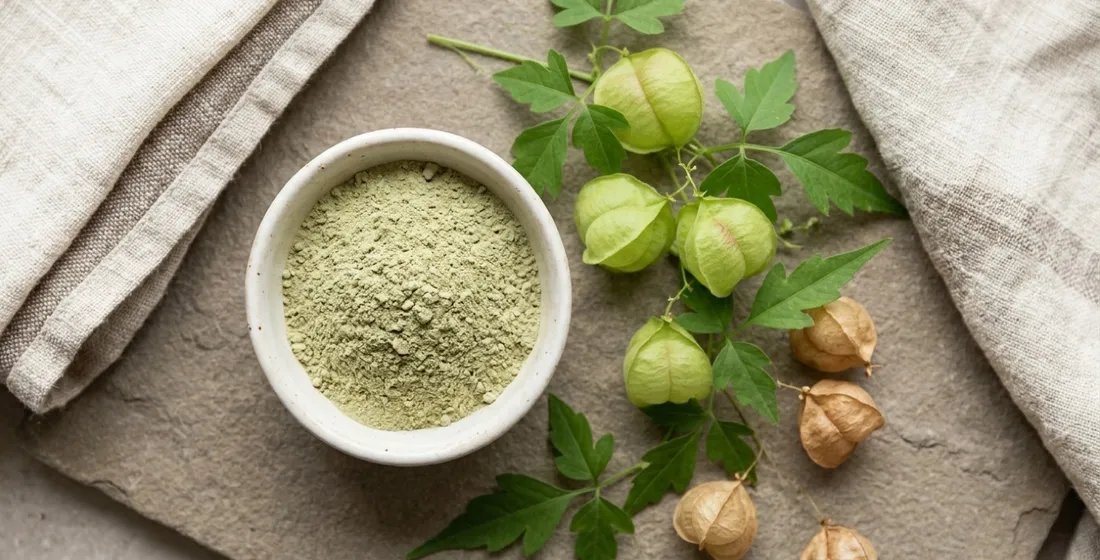
Buyer’s snapshot
- Cardiospermum halicacabum, the balloon vine known in Sri Lanka as Welpenela, is already an accepted European cosmetic ingredient with the INCI name Cardiospermum Halicacabum Flower/Leaf/Vine Extract and the catalogued function “skin conditioning” (COSMILE Europe).
- That means the strongest, most defensible commercial angle for this botanical is a topical or skin-claim SKU, not an oral adaptogen claim.
- The plant contains a cyanogenic glucoside (cardiospermin) and sits in EFSA’s Compendium of Botanicals, so oral supplement use in the EU and US needs a regulatory status check before launch.
- Silk Route Ventures (SRV) supplies Welpenela as a milled botanical powder from Matale, Central Province, with every batch traceable to farm and a full Certificate of Analysis. Bulk raw-material MOQ is 50 kg per SKU.
- The RFQ spec table below gives the exact parameters procurement should pin down before ordering.
For a formulator, Welpenela is one of those Sri Lankan botanicals where the marketing instinct and the regulatory reality point in different directions. The name that sells is “adaptogen.” The claim that holds up is “skin conditioning.” Cardiospermum halicacabum (Sinhala: Welpenela, English: Love-in-a-Puff or balloon vine) has a real, catalogued place in European dermocosmetics and a genuine flavonoid and phenolic profile behind it. It also carries a naturally occurring compound of concern that shapes how, and where, it can be sold as an oral product. This primer separates the two, then gives procurement the spec sheet to source it cleanly.
What is Welpenela, and which part of the plant do buyers source?
Welpenela is a fast-growing low-country climber native across South Asia, including the wet zone of Sri Lanka, where it is used in herbal porridge (kola kenda) and traditional preparations for joint and rheumatic complaints. For nutraceutical and cosmetic supply, the commercial material is the aerial part of the plant, the leaves, stems, and papery balloon-shaped seed pods, dried and milled to a powder or processed into a ratio extract. Specifying “aerial parts” on the RFQ matters, because seed-only and whole-plant lots differ in composition.
The English common names describe the seed pod: an inflated, lantern-like green capsule that gives the plant its “Love-in-a-Puff” and “balloon vine” labels. For a buyer, the useful point is that this is a well-identified species with an established botanical name, which makes species verification on the Certificate of Analysis straightforward.
What actives does Cardiospermum halicacabum powder contain?
A 2013 study in the Journal of Traditional and Complementary Medicine isolated ten flavonoids and seven phenolic acids from Cardiospermum halicacabum and linked them to measurable antioxidant and anti-inflammatory activity. The isolated flavonoids include quercetin, luteolin, kaempferol, apigenin, and chrysoeriol; the phenolic acids include gallic, p-coumaric, and protocatechuic acid. This flavonoid and phenolic profile is the legitimate scientific basis for antioxidant and anti-inflammatory ingredient positioning.
The same paper quantified potency for the strongest constituents. Those are the figures a formulator can actually cite, so they are worth pinning to the specific compounds rather than to the whole herb.
| Constituent | Anti-inflammatory (nitric oxide inhibition, IC50) | Antioxidant (DPPH, ED50) |
|---|---|---|
| Gallic acid | 1.66 μg/mL | 2.45 μg/mL |
| p-Coumaric acid | 2.64 μg/mL | not reported |
| Catechin (reference control) | not reported | 5.43 μg/mL |
Source: Cheng et al., 2013. Gallic acid outperformed the catechin control on the antioxidant assay.
Beyond flavonoids, the species is reported to contain triterpenoids (oleanolic and ursolic acid), phytosterols, and saponins. It also contains cardiospermin, a cyanogenic glucoside, which is the reason the oral-use path needs care. There is no universally agreed standardization marker for this botanical, so if a buyer wants a standardized lot, the assay marker (total flavonoids, quercetin, or total saponins) has to be defined in the RFQ rather than assumed.
The skin-claim SKU: where the evidence is strongest
The clearest commercial route for Welpenela is topical. Cardiospermum halicacabum is a listed European cosmetic INCI ingredient with the catalogued function “skin conditioning,” and its topical anti-inflammatory action, attributed to phytosterol content, is the reason it appears in commercial anti-eczema and atopic-dermatitis creams in Europe. A 2020 clinical investigation published in Dermatologic Therapy studied a Cardiospermum halicacabum cream in dermatitis of varying severity and reported positive effects over a 15-day period.
For a skin-claim SKU, use the INCI name Cardiospermum Halicacabum Flower/Leaf/Vine Extract and keep the claim inside cosmetic rules. Under the EU Cosmetics Regulation, “soothing” and “skin conditioning” are supportable; “treats eczema” or “cures dermatitis” are drug claims and are not. The finished-product house owns the claim substantiation, but the ingredient supplier can support it with a clean species-verified COA and a documented actives profile, which is exactly the file a cosmetic brand’s regulatory team will ask for. Brands building this out often pair it with other Sri Lankan botanicals; the same discipline applies when sourcing gotukola for skin and cognitive SKUs.
The adaptogen and internal-use claim: what is actually defensible
“Adaptogen” is positioning language here, not a substantiated pharmacological category. The traditional record for Welpenela is real: Ayurveda, Siddha, and Unani texts describe use for rheumatism, joint stiffness, and lumbago, and modern reviews consolidate that ethnobotany. What is thin is modern human clinical evidence for internal use. Most anti-inflammatory and analgesic data are preclinical, so “traditionally used” is honest and “clinically proven adaptogen” is not.
The bigger gate for an oral SKU is regulatory. Because the species contains a cyanogenic glucoside and appears in EFSA’s Compendium of Botanicals, oral supplement use in the EU can trigger novel-food scrutiny; the ingredient is not on the Union list of authorised novel foods, so status must be confirmed directly in the EU Novel Food Catalogue before any oral EU launch. In the United States, a dietary-supplement path under DSHEA allows structure and function claims with the FDA disclaimer, but there is no evidence of GRAS status or an established old-dietary-ingredient listing, so a new-dietary-ingredient notification may apply. The honest brief for a product team: this is a strong topical ingredient and a claim-limited oral one. Teams that want a cleaner oral adaptogen story tend to formulate around triphala for adaptogen blends or a withanolide-standardized ashwagandha, and reserve Welpenela for skin.
Spec snapshot: claim discipline by market
- EU cosmetic (topical): cleanest path. Established INCI, “skin conditioning” function. Cosmetic claim rules apply.
- EU food supplement (oral): confirm novel-food status before launch. Cyanogenic glucoside present.
- US dietary supplement (oral): structure and function claims with disclaimer only. Confirm NDI status.
- Defensible language everywhere: “traditionally used,” “rich in antioxidant flavonoids,” topical “soothing” and “skin conditioning.”
How to write an RFQ for Welpenela powder
A clean RFQ removes the two biggest sourcing risks with a wildcrafted botanical: species substitution and lot-to-lot variability. Define the part of the plant, the form, the physical and microbial spec, and the contaminant limits up front. The values below are standard-practice ranges for milled botanicals and should be set as buyer targets to confirm per lot, not treated as fixed properties of this specific herb.
| RFQ parameter | What to specify |
|---|---|
| Botanical identity | Cardiospermum halicacabum L., species-verified on COA |
| Part used | Aerial parts (leaf, stem, pod); state if whole-plant |
| Form | Whole-herb powder, or ratio extract (4:1, 5:1, 10:1, 20:1) |
| Particle size | Typically 95 percent through 80 mesh; set your target |
| Moisture / loss on drying | Target 8 to 10 percent maximum |
| Total ash / acid-insoluble ash | Per pharmacopeial norm; define limits |
| Heavy metals | Lead, cadmium, arsenic, mercury to target-market limits |
| Microbial | Total plate count, yeast and mould, E. coli, Salmonella to AHPA/USP limits |
| Pesticides / MRL | To EU or US import limits for the destination |
| Standardization marker | None established; define assay (total flavonoids, quercetin) if standardizing |
| Documentation | Batch COA, Certificate of Origin, Phytosanitary Certificate |
Silk Route Ventures supplies Welpenela against this kind of spec sheet with every batch traceable to the farm and a full Certificate of Analysis per lot. Bulk raw-material MOQ is 50 kg per SKU on a first order. For a brand that wants finished capsules rather than bulk powder, the Silk Foods Ceylon (SFC) facility encapsulates in-house, where the 180-bottle capsule MOQ applies. The same spec-first RFQ discipline runs across the Sri Lankan herb range, from Gurmar to Iramusu.
Sourcing and traceability: wildcrafted versus cultivated
Welpenela is native and abundant in Sri Lanka’s low country, which is a supply advantage and a traceability problem at the same time. Most balloon vine reaching the market is wild-harvested rather than plantation-grown. Wild collection means seasonality and real lot-to-lot variability in the actives, and it makes organic certification and clean traceability harder to guarantee. That gap is the sourcing story a serious supplier can actually differentiate on.
When a European skincare formulator asked SRV for balloon-vine material two seasons ago, the first question was not price. It was whether the same field and the same harvest window could be documented across repeat orders, because their regulatory file needed batch consistency to hold a “skin conditioning” claim. Commodity wildcrafted powder could not answer that. Cultivated, single-origin, farm-traceable material could. Sourcing Welpenela from Matale, Central Province against a defined spec, with the harvest documented to the farm, is what turns a common weed into an ingredient a claims team will sign off on.
Frequently asked questions
Does SRV ship bulk Welpenela powder to the EU and US?
Silk Route Ventures ships bulk Welpenela (Cardiospermum halicacabum) powder internationally with a batch Certificate of Analysis, Certificate of Origin, and Phytosanitary Certificate per order. Bulk raw-material MOQ is 50 kg per SKU. Buyers should confirm oral novel-food or NDI status for their destination market before launching an ingestible SKU.
What is the minimum order quantity for Welpenela powder?
Bulk raw-material MOQ at Silk Route Ventures is 50 kg per SKU on a first order, with price breaks at 500, 1,000, and 2,500 kg. For finished capsules, the Silk Foods Ceylon facility runs a 180-bottle minimum per single shift, so early-stage brands can launch a skin or wellness SKU without committing to commodity-scale volume.
Can SRV develop a custom Welpenela formulation for a skincare or supplement brand?
Yes. The SRV research and NPD team develops custom blends and formulations in-house, including botanical powder blends and capsule formats. For skin-claim SKUs, the team works to the cosmetic INCI framing; for oral products, it works to the buyer’s confirmed regulatory pathway and defined assay markers.
Is Welpenela better suited to a topical or an oral product?
The evidence base is strongest for topical use. Cardiospermum halicacabum is an established European cosmetic ingredient with a catalogued “skin conditioning” function, supported by clinical work in dermatitis. Oral use rests on traditional record plus a flavonoid profile, and faces novel-food and NDI questions, so it is the more claim-limited route.
How Silk Route Ventures can help
Silk Route Ventures (SRV) manufactures nutraceutical capsules and supplies bulk Ayurvedic and functional botanicals, including Welpenela, gotukola, ashwagandha, triphala, and gurmar, to wellness and skincare brands globally. The Silk Foods Ceylon (SFC) facility holds FSSC 22000 V6 covering encapsulation, with USDA Organic and EU Organic on the relevant SKUs. Bulk raw-material MOQ is 50 kg per SKU; capsule MOQ is 180 bottles per single shift; samples ship by international courier in 3 to 5 business days. For brands without a co-packer relationship, the SRV research and NPD team develops custom blends and formulations in-house.