
R&D and NPD at Silk Foods Ceylon
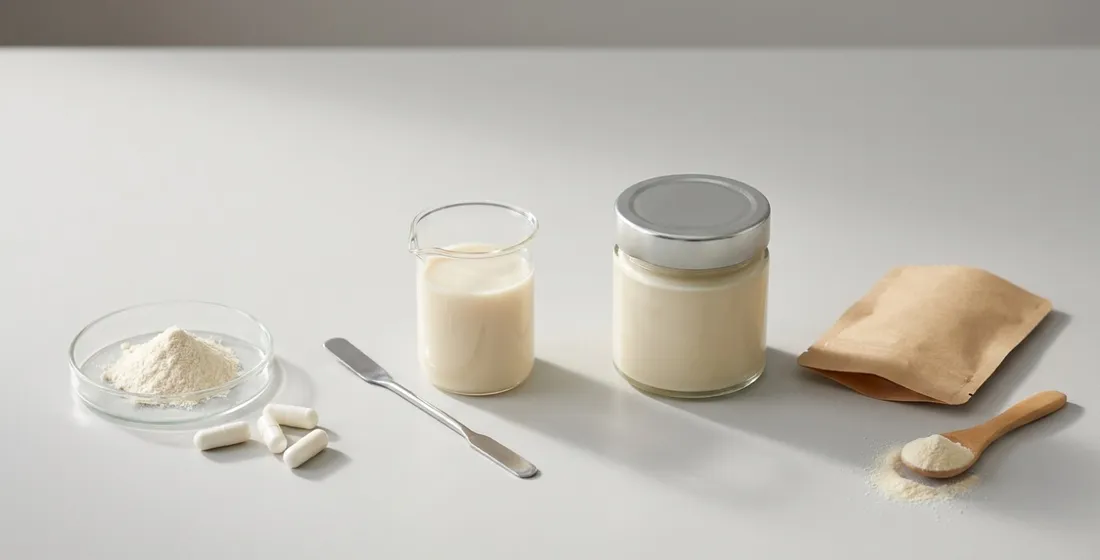
Hero: a bench-top R&D still life with plain capsules in a petri dish, a pilot plant-milk in a clear glass beaker, an unlabelled glass jar of a finished CPG spread, and a kraft sample pouch with a spoonful of spray-dried powder. Stock-style editorial; Higgsfield AI-generated, QC verified.
Buyer's snapshot • In 2024, NielsenIQ's BASES research found roughly 80% of CPG product launches that go to market under-prepared fail commercially within the first year, with strong product-performance design 15× more likely to succeed long-term (Food Navigator USA, summarising NielsenIQ BASES, 2014; pattern reaffirmed in NielsenIQ's 2023 CPG Innovator's guide). • Innova Market Insights' Top Ten Trends 2026 ranks Authentic Plant-Based fifth globally and reports 40% of consumers select protein on "natural or minimally processed," shifting NPD pipelines away from imitation meat and toward plant-protein, fiber, and digestive-health platforms. • Silk Route Ventures' R&D and NPD desk at the Silk Foods Ceylon facility in Matale runs custom formulations across nine categories under one BRCGS and FSSC 22000 V6 audit, with capsule MOQ from 180 bottles and a typical brief-to-first-commercial-run window of 12 to 16 weeks. • The cellular manufacturing layout means a pilot formulation runs alongside existing production on the same line, on the same cert, with no additional audit cycle to bring a new SKU into scope. • This post is for CPG scale-up brand owners and wellness-brand founders evaluating Asian R&D partners. It is not for hobbyist pre-revenue brands without a launch plan. |
Most contract manufacturers in Asia quote a finished SKU against a buyer’s existing formulation. A smaller number quote a custom formulation against a buyer’s brief. A handful do both, in the same facility, in parallel with the production planning, under one audit. The Silk Foods Ceylon (SFC) facility in Matale is built for the third pattern. This post walks a brand owner through what the Silk Route Ventures (SRV) R&D and NPD service actually does, what a typical brief-to-shelf timeline looks like, where the service is a fit, and where it isn’t.
What R&D and NPD at Silk Foods Ceylon actually covers
SFC’s in-house R&D and NPD team scopes new formulations across nine CPG categories: spices and seasoning blends, functional and Ayurvedic herbal blends, coconut ingredients and finished SKUs, capsules and herbal supplements, plant-based meat alternatives, retorted spreads and semi-liquids in glass jars, spray-dried plant milks and protein powders, dehydrated fruit powders, and ready-to-drink functional beverages. The scope mirrors the BRCGS and FSSC 22000 V6 process scope at the Matale site, which means anything the R&D team develops can land in commercial production on the same audit without a separate cert add-on. Three quarters of NPD briefs the SRV desk fielded in Q1 2026 came from two clusters: wellness brand founders scoping their first capsule blend (often around adaptogens, sleep, or stress), and CPG scale-ups extending an existing plant-based line into a second format (jackfruit-in-brine when the patty line is already running, for example).
What does a typical brief-to-scaled-production timeline look like?
A clean NPD project at SFC runs 12 to 16 weeks from signed brief to first commercial run, with sample iteration sitting between weeks 3 and 10 and the production-scoping work running in parallel from week 6. In 2024, NielsenIQ’s BASES research found roughly 80% of CPG launches that ship under-prepared fail commercially within the first year (Food Navigator USA reporting on NielsenIQ BASES; pattern restated in NielsenIQ’s 2023 CPG Innovator’s Guide). The biggest gain in survival probability comes from not skipping the pilot-to-pilot iteration window. The SFC team builds the project plan around stage gates rather than calendar weeks, with each gate gated on a buyer-signed decision document, not on time elapsed.
| Stage | Weeks | What happens | Buyer decision gate |
| Brief intake | 0 to 1 | Spec sheet, target market, label-claim platform, MOQ and tier expectations, IP norms scoped | Signed brief |
| Spec scoping | 1 to 3 | Ingredient sourcing, regulatory check against destination market, format and pack selection, draft COA spec | Approved spec |
| Pilot formulation | 3 to 7 | Bench batch (typically 1 to 5 kg or 50 to 200 capsules), organoleptic and stability check | Sample to buyer |
| Sample iteration | 7 to 10 | One to three revision rounds based on buyer feedback; air-freight courier turn at 3 to 5 business days each | Locked formulation |
| Production scoping | 10 to 12 | Cellular line allocation, raw material sourcing for the commercial run, packaging, COA cadence agreed | Signed PO |
| First commercial run | 12 to 16 | Production, COA, full documentation pack, dispatch from Colombo | Container at port |
Source: Silk Foods Ceylon project-management book; pattern verified across 2024 to 2026 NPD engagements.
Specifying the brief: what to bring on the first NPD call
A useful first call covers four things: the target buyer (who’s actually eating or swallowing this), the target market and the label-claim platform (USA wellness-brand DTC + Amazon? EU multiple-grocery retail? AU practitioner channel?), the format and pack (60 ml glass dropper bottle? 100-count bottle of size-0 vegetable capsules? 250 g retort-pouch spread?), and the MOQ ladder the brand is trying to defend on unit cost. The four together let the SFC team scope realistic ingredients, a realistic regulatory frame, and a realistic first-run unit cost in the same conversation. The single biggest reason an NPD project slips past the 16-week ceiling is not formulation difficulty. It’s a brief that left the regulatory frame ambiguous. A brand that wants “an EU listing eventually” but is launching DTC in the US first should still scope the EU MRL panel and the EU Organic equivalence at week one, not at week ten.
Buyer's checklist for the first NPD call 1. Target buyer profile in one paragraph (demographic, channel, price tier) 2. Target markets in priority order, with the gating regulatory or label-claim requirement for each (FDA structure-function claim, EU health-claim register, AU TGA listed medicine, etc.) 3. Format and pack specification, including bottle or jar fill weight and case configuration 4. Cert stack expected at launch (BRCGS, FSSC 22000 V6, USDA Organic, EU Organic, Halal, Kosher, NSF, Non-GMO Project, others) and at year two 5. MOQ at launch, MOQ at the second order, MOQ at the price-break tier the brand needs to defend 6. IP and formulation-ownership expectation (NDA scope, buyer-owned vs co-developed) 7. Budget envelope per unit at launch and at year-two volumes (FOB Colombo) 8. Decision-maker on the buyer side (founder, head of R&D, contracted formulator) and signoff cadence |
How does R&D and NPD differ from contract manufacturing and private label at SFC?
The five SRV service modes sit on a spectrum. Ingredient supply is bulk raw material shipped against the buyer’s spec. Private label is SFC’s existing product carried under the buyer’s brand and packaging. Contract manufacturing is the buyer’s formulation produced at SFC against the buyer’s spec. Total OBM is SFC building the product, the brand, and the packaging end to end. R&D and NPD sits one step earlier than contract manufacturing: the buyer brings the idea and the constraints, SFC’s product team develops the formulation, the spec, the pilot, and the scale-up plan. Once the formulation is locked, the project becomes a contract-manufacturing engagement; the R&D work is the front-end of the relationship, not a separate billing model.
| Service | Who develops the formulation | Who owns the brand | Typical MOQ at launch | Best fit |
| Ingredient supply | Buyer’s R&D (or none, if buying RM) | Buyer | 50 kg per SKU | Established brands consolidating RM |
| Private labelling | SFC (existing product) | Buyer | Per SKU per format | Brands launching from an SFC catalog SKU |
| Contract manufacturing | Buyer (brings the formulation) | Buyer | Per format MOQ | Brands with an existing formulation needing scale |
| R&D and NPD (this post) | SFC (co-developed with buyer) | Buyer (formulation ownership negotiated upfront) | Per format MOQ | Brand owners launching a new SKU from a brief |
| Total OBM | SFC (formulation + brand + pack) | SFC builds, transferred to buyer | Per format MOQ | Buyers wanting a turnkey launch |
Source: Silk Route Ventures service-model definitions, 2026.
Where R&D and NPD is not the right fit Pre-revenue hobbyist projects without a launch plan or a defined target market. Brands wanting an off-the-shelf SKU to put their brand on at zero formulation work (that's the private-label service, not NPD). Brands competing on lowest-shelf price below the Ceylon premium, where the per-unit math doesn't work. SKUs that can't carry a defensible label claim in the target market under the destination regulator's structure-function rules. |
Which CPG categories is the R&D team most active in for 2026?
The Q1 2026 NPD pipeline at SFC clusters in four areas, all of which sit on top of demonstrable consumer pull. Innova Market Insights’ Top Ten Trends 2026 puts Authentic Plant-Based as the #5 global trend, with 40% of consumers picking protein on a “natural or minimally processed” filter (Innova Market Insights, Top Ten Trends 2026 release, October 2025). The Good Food Institute’s 2024 State of the Industry report shows the US plant-based retail market settled at USD 8.1 billion in 2024, with declines in legacy imitation-meat formats but real growth in plant-based protein powders, ready-to-drink beverages, bars, tofu and tempeh, and baked goods. The Council for Responsible Nutrition’s 2024 Consumer Survey reports 75% of US adults take dietary supplements, with ashwagandha usage up to 8% from 2% in 2020 and magnesium up to 23% from 19% the prior year. The signal across all three datasets is the same: the NPD pipeline that converts is built on functional clarity, not novelty.
One US-based wellness brand the SRV team works with came in during Q4 2025 with a stress-and-sleep blend brief: ashwagandha, magnesium, gotukola, and L-theanine, in a clean vegetable capsule, USDA Organic where the SKU could carry the seal. The first locked formulation went into commercial production at 320 bottles in week 14, a 78% sell-through inside the first 60 days, and a repeat order at 1,200 bottles in week 20. The brand is now scoping a second SKU on the same line in the same cert. The pattern repeats: a clear brief, a realistic format, a defensible claim platform, and a willingness to iterate twice rather than ship the first sample.
The active NPD categories at SFC in 2026:
- Functional capsule blends: adaptogen blends (ashwagandha and gotukola lead), sleep and stress combinations, gut-health blends with botanicals plus prebiotic fiber, immunity blends with traditional Sri Lankan herbs (Beli, Welpenela, Heenbovitiya) carrying clean-label modern claims.
- Plant-based meat alternatives in retort format: jackfruit-in-brine line extensions (curry, BBQ, teriyaki, tomato-basil), vegan patty fat-source comparison work (coconut, sunflower, MCT), nuggets and chicken-alternative format work for the freezer aisle.
- Spray-dried plant milks and protein powders: coconut, oat, soy, and rice milk powders for global distribution where cold-chain economics favor powder over liquid; pea-protein-blended functional powders with adaptogen and fiber co-formulation.
- Retorted spreads and semi-liquids in glass jars: coconut spreads, vegan cheese spreads, cashew-base cheese spreads, fruit jams and purees with functional fiber inclusions.
Certifications, traceability, and FSMA 204 readiness for NPD-route SKUs
Every NPD project at SFC lands in commercial production under the same BRCGS and FSSC 22000 V6 audit that covers the rest of the facility’s processing scope. USDA Organic and EU Organic are added per SKU when the buyer’s brief requires the seal; Halal and Kosher follow the same per-SKU pattern. For US-bound SKUs, the FDA Food Traceability Final Rule (FSMA Rule 204) compliance enforcement date was extended in 2025 to 20 July 2028 (US FDA, 2025; Federal Register, 7 August 2025). That extension matters for NPD planning windows: a brand briefing a new SKU today has runway to design the traceability record stack into the launch SKU rather than retrofit it after the first 18 months. The SFC team scopes Key Data Elements and Critical Tracking Events for Food Traceability List ingredients at the spec-scoping gate, so the buyer can ship into a US retail listing without rebuilding the record stack mid-launch.
The Sri Lanka Export Development Board reported food and beverage export earnings grew 9.48% in January to November 2024 compared with the same period in 2023 (Sri Lanka EDB, Export Performance bulletin, December 2024), with plant-based, functional drinks, and organic processed food among the categories the agency flagged as growth pockets. A buyer launching an NPD-route SKU from Sri Lanka in 2026 sits inside a growing supplier base, not a thinning one, which matters when scoping forward freight and packaging supply.
FAQ
What is the MOQ for a custom-formulated capsule developed by Silk Foods Ceylon?
The MOQ for an SFC-developed capsule SKU is 180 bottles per single shift, which is the same MOQ as a private-label capsule run. The encapsulation line at the Matale facility runs 100,000 capsules per single shift and 200,000 per day. Lead time from signed brief to first commercial run is typically 12 to 16 weeks, with sample iteration adding 2 to 4 weeks of front-loaded development time.
How long does an NPD project at Silk Foods Ceylon take from brief to first commercial run?
A typical NPD project runs 12 to 16 weeks from signed brief to first commercial dispatch from Colombo. Brief intake takes 1 week, spec scoping 2 weeks, pilot formulation 4 weeks, sample iteration 3 weeks, production scoping 2 weeks, and the commercial run 4 weeks. Sea freight to the US adds 4 to 5 weeks, EU and AU 3 to 4 weeks, with air-freight options for early formulation iteration at 3 to 4 days transit.
Who owns the formulation IP developed during an NPD project at SFC?
Formulation ownership is negotiated at the brief stage and locked in writing before pilot work starts. The default arrangement on a buyer-funded NPD project is that the buyer owns the locked formulation and Silk Foods Ceylon retains the process know-how. A mutual NDA covers both sides for the engagement window and a defined tail period. The SRV trade desk shares the standard NDA template with the buyer in the first call so the legal scope is clear before any spec changes hands.
Does Silk Foods Ceylon handle FSMA Rule 204 traceability records for US-bound NPD SKUs?
Yes. For US-bound SKUs containing ingredients on the FDA Food Traceability List, SFC scopes Key Data Elements and Critical Tracking Events at the spec-scoping gate. The enforcement compliance date for the FSMA Rule 204 traceability rule was extended in 2025 to 20 July 2028 (US FDA, 2025), giving brands launching in 2026 runway to design the record stack into the SKU rather than retrofit it.
Can Silk Route Ventures develop a private-label formulation for a wellness brand without an existing supplier relationship?
Yes. The R&D and NPD service is designed for brand owners launching a new SKU, including first-time wellness brands without a prior co-packer relationship. The SRV team will quote on the brief, scope a sample run at the format MOQ (180 bottles for capsules, 1,500 jars for glass-jar spreads, 50 kg for spray-dried powders, 5,000 to 10,000 units per SKU for frozen patties or nuggets), and run a paid sample iteration before any commercial PO.
How Silk Route Ventures can help
Silk Route Ventures (SRV) develops, pilots, and scales new CPG formulations end to end at the Silk Foods Ceylon (SFC) facility in Matale. The R&D and NPD desk works with brand owners and CPG scale-ups across capsules, plant-based meat alternatives, spray-dried plant milks, retorted spreads, and functional beverages, with capsule MOQ from 180 bottles, glass-jar semi-liquids from 1,500 jars, and a typical brief-to-first-commercial-run window of 12 to 16 weeks. Every NPD-developed SKU lands in commercial production under the same BRCGS, FSSC 22000 V6, USDA Organic, and EU Organic stack that covers the rest of the facility’s processing scope, with no additional supplier audit required. Contact us at https://www.esilkroute.com.lk/contact to send an inquiry for a brief-stage scoping call.
Sources
- Food Navigator USA, “Why do 85% of new CPG products fail within two years?” summarising NielsenIQ BASES research (2014; pattern restated in NielsenIQ’s 2023 CPG Innovator’s Guide). Retrieved 2026-05-16. https://www.foodnavigator-usa.com/Article/2014/07/31/Why-do-85-of-new-CPG-products-fail-within-two-years/
- Innova Market Insights, “Innova’s Top Ten Trends 2026, Shaping the Future of Food & Beverage” (press release, October 2025). Retrieved 2026-05-16. https://www.innovamarketinsights.com/press-releases/innovas-top-ten-trends-2026-shaping-the-future-of-food-beverage/
- The Good Food Institute, “Analyzing plant-based meat & seafood sales: 2024 US retail data” (2025). Retrieved 2026-05-16. https://gfi.org/resource/analyzing-plant-based-meat-and-seafood-sales/
- Council for Responsible Nutrition, “2024 CRN Consumer Survey on Dietary Supplements” (November 2024, conducted by Ipsos). Retrieved 2026-05-16. https://www.crnusa.org/newsroom/crn-survey-shows-consistent-supplement-usage-increase-specialty-product-use-over-time
- US Food and Drug Administration, “Requirements for Additional Traceability Records for Certain Foods: Compliance Date Extension,” Federal Register Notice (7 August 2025). Retrieved 2026-05-16. https://www.federalregister.gov/documents/2025/08/07/2025-14967/requirements-for-additional-traceability-records-for-certain-foods-compliance-date-extension
- Sri Lanka Export Development Board, “Export Performance in November 2024” (December 2024 release). Retrieved 2026-05-16. https://www.news.lk/news/economy-development/export-performance-in-november-2024-edb
Further reading
- NielsenIQ, “The CPG Innovator’s Guide to Vitality” (2023). https://nielseniq.com/global/en/insights/analysis/2023/the-cpg-innovators-guide-to-vitality/
- Innova Market Insights, “Global plant-based trends 2026: Market innovation overview.” https://www.innovamarketinsights.com/trends/plant-based-trends-5-top-global-trend-for-2026/
- US FDA, “FSMA Final Rule on Requirements for Additional Traceability Records for Certain Foods.” https://www.fda.gov/food/food-safety-modernization-act-fsma/fsma-final-rule-requirements-additional-traceability-records-certain-foods
Written by the Silk Route Ventures Trade Team. Silk Route Ventures (E-Silk Route Ventures (Pvt) Ltd, T/A Silk Route Ventures) is a Sri Lankan B2B supply-chain operator for the Food, Beverage, Wellness, and Nutraceuticals sectors. The Silk Foods Ceylon manufacturing arm holds BRCGS, FSSC 22000 V6, USDA Organic, and EU Organic certifications. Questions or to request a sample: Contact us at https://www.esilkroute.com.lk/contact or email info@esilkroute.com.lk.