
Triphala Formulation for Adaptogen Blends - Ratios, Particle Size, and Clean-Label Claims
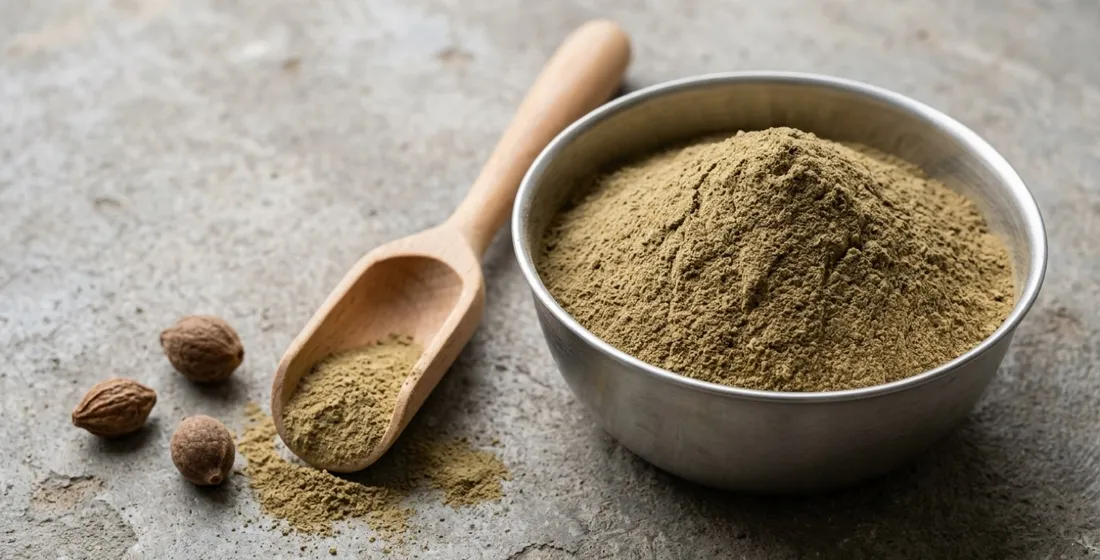
Buyer's snapshot • The global adaptogens market reached USD 11.92 billion in 2025 and is forecast to hit USD 22.46 billion by 2034, with North America holding roughly 34% (Fortune Business Insights, 2025). Triphala is moving from a standalone digestive product into multi-herb adaptogen stacks. • Triphala is not one spec. The classical churna is equal parts (1:1:1) Amalaki, Bibhitaki, and Haritaki, but the Ayurvedic Pharmacopoeia of India also recognises a 1:2:4 ratio, and the ratio changes the tannin load and the taste. • Standardised Triphala runs roughly 17 to 23% total tannins and 3.7 to 5.2% gallic acid (quality-control literature, 2024), the numbers a clean-label brand should specify and verify, not assume. • Peer-reviewed surveillance has found roughly 1 in 5 imported Ayurvedic products positive for lead, mercury, or arsenic, so a per-batch heavy-metals COA is the real gate, not the marketing. • Silk Foods Ceylon (SFC) supplies bulk and private-label Triphala from a Matale facility under BRCGS and FSSC 22000 V6, with a 50 kg per-SKU first-order MOQ and farm-level traceability on organic lots. |
The adaptogens category reached USD 11.92 billion in 2025 and is on track for USD 22.46 billion by 2034 (Fortune Business Insights, 2025). North America buys roughly a third of it. As ashwagandha-led stress formulas crowd the shelf, formulators are reaching for a second and third botanical to differentiate, and Triphala (the three-fruit Ayurvedic blend) keeps showing up on the brief.
The problem is that Triphala gets treated as a single ingredient when it is really a formulation decision. The ratio, the particle size, and the contaminant profile all change what ends up in the capsule. This piece is for wellness and nutraceutical formulators specifying Triphala into a blend who want a defensible spec, not a romantic origin story.
What is Triphala, and why is it showing up in adaptogen blends?
Triphala is a polyherbal Ayurvedic formulation of three dried fruits: Amalaki (Phyllanthus emblica, also called Amla), Bibhitaki (Terminalia bellirica), and Haritaki (Terminalia chebula). It is rich in tannins, gallic acid, chebulagic acid, and chebulinic acid, and a 2017 review in the Journal of Alternative and Complementary Medicine documents antioxidant and gastrointestinal-support uses across centuries of practice.
For adaptogen formulators, Triphala adds something most stress-axis blends lack: a digestion-and-gut angle. A 2018 review in Chinese Medicine looked at Triphala for functional gastrointestinal disorders, and recent metabolome work in Scientific Reports (2024) maps how its polyphenols interact with gut bacteria, promoting strains like Lactobacillus and Bifidobacterium. That makes it a natural, non-stimulant partner to an ashwagandha base. A brand building a daily-wellness stack can use Triphala to round out a stress formula with a gut and antioxidant story that holds up to scrutiny.
The ratio question: 1:1:1, 1:2:4, or something else?
“Triphala” with no ratio is an underspecified order. The classical churna uses equal parts of the three fruits, but it is not the only recognised proportion, and the choice shifts both the tannin load and the astringency a formulator has to manage in a stick-pack or beverage.
| Ratio (Haritaki : Bibhitaki : Amalaki) | Status | When formulators specify it |
| 1:1:1 | Classical churna, balanced across the three doshas | Default for a general digestive and antioxidant claim |
| 1:2:4 | Recognised for churna in the Ayurvedic Pharmacopoeia of India | Higher Amalaki load lifts vitamin C and antioxidant character, softens astringency |
| 1:2:3 | Practitioner variant cited for digestive emphasis | When the brief leans toward digestive positioning |
The practical takeaway is to put the ratio on the RFQ. The ratio is the single most-skipped line on a Triphala sourcing brief, and it is the one that quietly changes taste and active load between two lots that both say “Triphala” on the invoice. For a capsule, palatability is a non-issue and 1:1:1 is the clean default. For a stick-pack or a beverage premix, the higher-Amalaki 1:2:4 is worth testing because it eases the astringent edge.
Particle size: why mesh changes the formulation
Triphala for capsules is milled to a fine churna and typically dosed at 300 to 600 mg per capsule. Particle size (mesh) drives powder flow, fill-weight consistency, dispersibility, and mouthfeel, so it is a format decision, not a default.
A fine, uniform mesh fills a size 0 or 00 capsule cleanly and holds a consistent fill weight, which matters when the COA has to back a per-capsule active claim. A coarser cut suits a traditional churna or a tea-style decoction. An ultra-fine, dispersible cut is what a stick-pack or a beverage premix needs so the powder wets out instead of clumping on the surface.
One detail formulators miss: Triphala’s tannins are hygroscopic, so particle size interacts with moisture. A finer mill with a loose moisture ceiling cakes faster. Tightening the moisture spec alongside the mesh keeps the powder flowing and protects shelf life. The same mesh discipline applies across botanical powders, which is why a moringa leaf powder spec primer and a Triphala spec start from the same questions.
Clean-label claims you can defend, and the ones you can’t
Over 65% of supplement users now prefer products with transparent, short ingredient lists, and clean label has shifted from a premium feature to a baseline expectation (clean-label industry analysis, 2025). For Triphala, a defensible clean-label position rests on three things a buyer can verify.
First, no synthetic excipients or flow agents. If the label says “no fillers,” then the powder flow has to come from particle engineering, not from magnesium stearate or added silica, which puts the mesh decision back at the centre of the formulation. Second, standardised actives stated as a number. Quality-control studies in 2024 put standardised Triphala at roughly 17 to 23% total tannins and 3.7 to 5.2% gallic acid, measured by HPTLC or HPLC against a gallic-acid marker. A number on the COA lets a brand replace “proprietary blend” with a defensible spec. Third, an organic claim that carries through to the finished SKU, which means an organic transaction certificate, not just an organic raw material. The USDA Organic and EU Organic dual-certification path is what keeps that claim valid downstream.
The quality gate most buyers skip: heavy metals and species ID
Peer-reviewed surveillance has found roughly 1 in 5 imported Ayurvedic products contain detectable lead, mercury, or arsenic above acceptable intake, and the US FDA maintains standing warnings about heavy-metal poisoning from unapproved Ayurvedic products (FDA, 2024). For Triphala, this is the line between a shelf-ready clean-label SKU and a recall.
In Q1 2026, the Silk Route Ventures (SRV) procurement desk fielded a recurring request from US wellness brands rebuilding a Triphala spec after a contract lab flagged lead in an existing lot. The 2024 FDA warnings did not just pull product. They rewrote the qualification question to “show me the per-batch heavy-metals COA” on the first call. That is the new baseline, and it favours suppliers who already test.
Two controls close the gap. The first is species verification, confirming all three correct fruits (Phyllanthus emblica, Terminalia bellirica, Terminalia chebula) with no cheaper substitution, which adulteration-prone botanical supply chains invite. The second is per-batch testing with traceability back to the farm. This is where a certified, traceable supply chain earns its premium over a broker lot, and it is the same discipline covered in Sri Lankan herb supply chain transparency.
Spec snapshot: Triphala churna (capsule grade) Composition: Amalaki, Bibhitaki, Haritaki (three verified species) Ratio: specify 1:1:1 (default) or 1:2:4 per the Ayurvedic Pharmacopoeia of India Particle size: fine mill for size 0 or 00 capsule fill; specify mesh to the format Total tannins: typically 17 to 23% (verify per batch) Gallic acid: typically 3.7 to 5.2% (HPTLC or HPLC marker) Moisture: specify a low ceiling (tannins are hygroscopic) Heavy metals: per-batch COA for lead, mercury, and arsenic to destination limits SRV MOQ: 50 kg per SKU first order; samples by courier in 3 to 5 business days |
Building Triphala into an adaptogen stack
The reason Triphala works in an adaptogen blend is that it does not compete with the stress-axis herbs; it complements them. An ashwagandha base carries the stress and sleep story, and Triphala adds the gut and antioxidant layer without a stimulant load. Holy basil, rhodiola, or gotu kola can sit alongside both. The formulation work is in balancing the ratio, the mesh, and the standardised actives so the finished blend is consistent batch to batch.
This is formulation territory, not catalogue picking. The SRV R&D and NPD team scopes the ratio, the particle size, the standardisation target, and the format (capsule, stick-pack, or tablet) against the brand’s claim platform, then runs a sample before any volume commitment. For a brand pairing Triphala with a stress base, the ashwagandha root versus leaf decision and the Triphala spec move together.
Buyer's checklist: specifying Triphala for a clean-label blend 1. Ratio stated (1:1:1 or 1:2:4) 2. Three species confirmed in writing, with no substitution 3. Particle size and mesh matched to the format (capsule, stick-pack, beverage) 4. Standardised tannin and gallic-acid range on the COA 5. Per-batch heavy-metals panel to destination limits 6. Moisture ceiling specified (hygroscopic powder) 7. Organic transaction certificate if the SKU carries USDA or EU Organic 8. Excipient policy agreed (what "no fillers" actually allows) |
Frequently asked questions
What is the correct ratio for Triphala?
The classical churna uses equal parts (1:1:1) of Haritaki, Bibhitaki, and Amalaki, and this remains the default for a general digestive and antioxidant claim. The Ayurvedic Pharmacopoeia of India also recognises a 1:2:4 ratio for churna, which raises the Amalaki and antioxidant load and softens astringency. Specify the ratio on the RFQ rather than assuming it.
What particle size should Triphala be for capsules?
Triphala for capsules is milled to a fine churna and dosed at roughly 300 to 600 mg per capsule. A fine, uniform mesh fills a size 0 or 00 capsule cleanly and holds a consistent fill weight. Coarser cuts suit teas, and ultra-fine dispersible cuts suit stick-packs and beverage premixes. Match the mesh to the format and tighten moisture, because the tannins are hygroscopic.
How do you make a defensible clean-label Triphala claim?
State standardised actives as numbers (roughly 17 to 23% total tannins, 3.7 to 5.2% gallic acid by HPTLC or HPLC), avoid synthetic excipients and flow agents, and carry organic certification through to the finished SKU with an organic transaction certificate. Over 65% of supplement users now prefer transparent, short ingredient lists (clean-label industry analysis, 2025), so the number on the COA is the claim.
Does Silk Route Ventures supply private-label or bulk Triphala?
Yes. Silk Foods Ceylon supplies bulk Triphala for ingredient supply and finished private-label SKUs from its Matale facility under BRCGS and FSSC 22000 V6. First-order MOQ is 50 kg per SKU, samples ship by international courier in 3 to 5 business days, and organic lots carry farm-level traceability with a per-batch Certificate of Analysis.
Can SRV develop a custom adaptogen blend with Triphala?
Yes. The SRV R&D and NPD team develops custom formulations in-house, scoping the ratio, particle size, standardisation target, and format against the brand’s claim platform. Capsule MOQ is 180 bottles per single shift, and a sample run is available before any volume commitment.
How Silk Route Ventures can help
Silk Route Ventures manufactures nutraceutical capsules and supplies bulk Ayurvedic and functional botanicals (Triphala, ashwagandha, moringa, gotu kola, turmeric, garcinia) to wellness brands globally. The SFC facility holds BRCGS and FSSC 22000 V6 covering encapsulation, with USDA Organic and EU Organic on the relevant SKUs and a per-batch Certificate of Analysis with farm-level traceability. Capsule MOQ is 180 bottles per single shift; bulk RM MOQ is 50 kg per SKU; samples ship by international courier in 3 to 5 business days. For early-stage brands without a co-packer relationship, the SRV R&D and NPD team also develops custom blends and formulations in-house. Contact us to send an inquiry or request a sample.
Sources
1. Fortune Business Insights. “Adaptogens Market Size, Share, Growth Report, 2026-2034.” (2025). Retrieved 2026-06-04. https://www.fortunebusinessinsights.com/adaptogens-market-110750
2. Peterson CT, et al. “Therapeutic Uses of Triphala in Ayurvedic Medicine.” Journal of Alternative and Complementary Medicine (2017). Retrieved 2026-06-04. https://pmc.ncbi.nlm.nih.gov/articles/PMC5567597/
3. Tarasiuk A, et al. “Triphala: current applications and new perspectives on the treatment of functional gastrointestinal disorders.” Chinese Medicine (2018). Retrieved 2026-06-04. https://pmc.ncbi.nlm.nih.gov/articles/PMC6052535/
4. “A comprehensive metabolome profiling of Terminalia chebula, Terminalia bellerica, and Phyllanthus emblica to explore the medicinal potential of Triphala.” Scientific Reports (2024). Retrieved 2026-06-04. https://pmc.ncbi.nlm.nih.gov/articles/PMC11685403/
5. “Quality Control of Triphala Churna.” (2024). Retrieved 2026-06-04. https://media.sciltp.com/articles/sciltp/358/pdf/67495481c77aa.pdf
6. US Food and Drug Administration. “FDA warns about heavy metal poisoning associated with certain unapproved ayurvedic drug products.” (2024). Retrieved 2026-06-04. https://www.fda.gov/drugs/fraudulent-products/fda-warns-about-heavy-metal-poisoning-associated-certain-unapproved-ayurvedic-drug-products
7. UniWell Labs. “The Rise of Clean Label Supplements: A 2025 Market Insight.” (2025). Retrieved 2026-06-04. https://uniwelllabs.com/the-rise-of-clean-label-supplements-a-2025-market-insight/
Further reading
- Wikipedia. “Triphala” (classical 1:1:1 and churna ratio variants). https://en.wikipedia.org/wiki/Triphala
- Nutritional Outlook. “Entering the Next Phase of Clean Label Formulation.” https://www.nutritionaloutlook.com/view/entering-next-phase-clean-label-formulation
Written by the Silk Route Ventures Trade Team. Silk Route Ventures (E-Silk Route Ventures Ltd) is a Sri Lankan B2B supply-chain operator for the Food, Beverage, Wellness, and Nutraceuticals sectors. The Silk Foods Ceylon manufacturing arm holds BRCGS and FSSC 22000 V6 certifications. Questions or to request a sample: Contact us or email info@esilkroute.com.lk.