
Ceylon Cinnamon
Ceylon Cinnamon Supplier
We supply true Ceylon cinnamon, Cinnamomum verum, from Sri Lanka to food, beverage and nutraceutical buyers worldwide. Quills, powder, cut and chips across the Alba to C5 grades, in bulk and under your own label, from a BRCGS-certified supply chain.
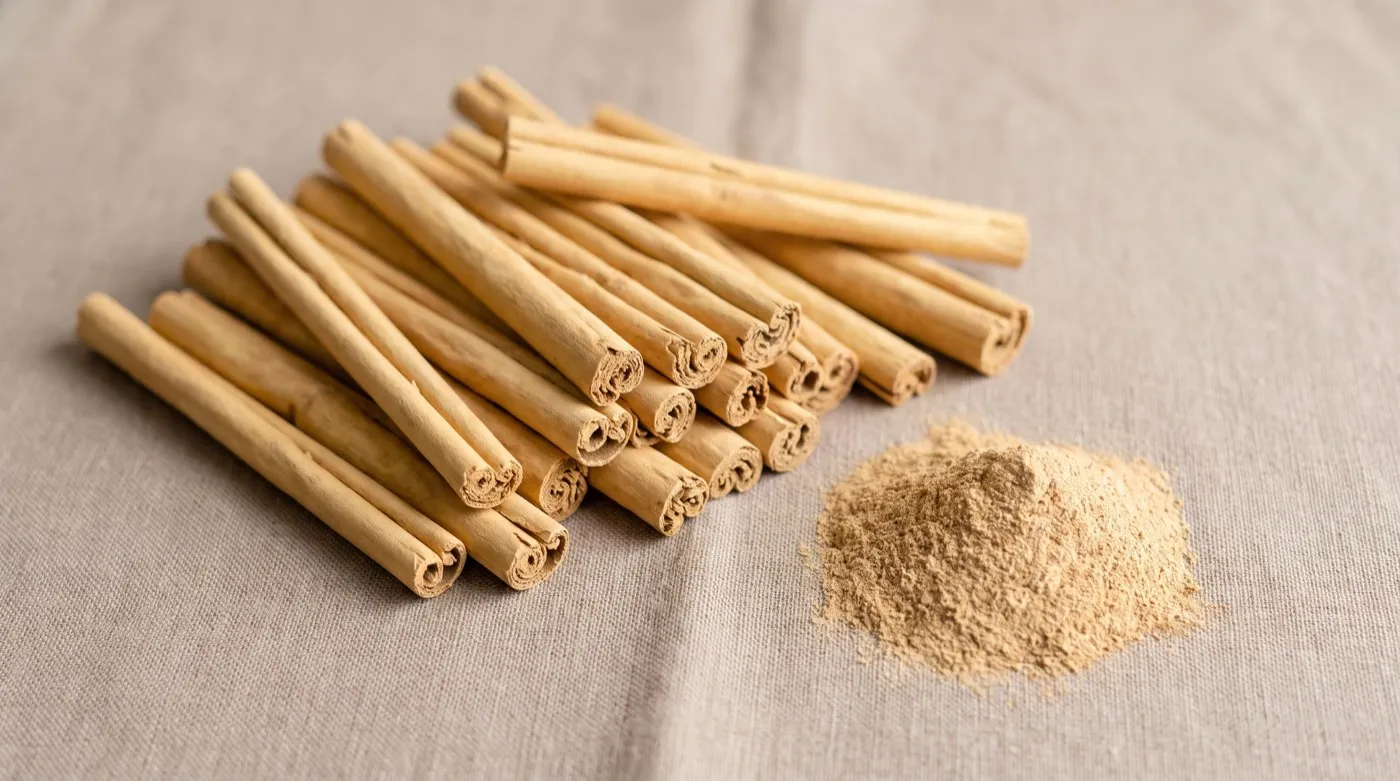
True Ceylon cinnamon, not cassia
"Cinnamon" on a label can mean two very different barks. True cinnamon is Cinnamomum verum, grown in Sri Lanka; most cinnamon traded globally is cassia (Cinnamomum cassia and related species) from elsewhere.
The distinction matters for buyers. Cassia carries far higher coumarin, a compound regulators limit in food, while Ceylon cinnamon is low in coumarin and valued for its lighter, sweeter flavour and thin, brittle quills. When a specification says "Ceylon cinnamon" or "true cinnamon", it means C. verum, and that is what we supply. In specification terms, US and EU buyers commonly cap coumarin at 0.02 percent, or 200 mg/kg; cassia averages around 3,000 mg/kg, roughly fifteen times that line, while authenticated Ceylon quills sit far below it, so the coumarin figure doubles as a species-authentication test. "Ceylon Cinnamon" is a registered EU Protected Geographical Indication (Regulation (EU) 2022/144), a name reserved for cinnamon grown on the island of Sri Lanka.
See Ceylon cinnamon vs cassia for the fuller comparison, and specifying Cinnamomum verum on an RFQ for how to write it into your buying specification.
Ceylon cinnamon is one spice in our wider Ceylon spices range, which spans pepper, cardamom, clove, nutmeg, turmeric and more.
Traceability runs from farm to shipment. Our cinnamon is processed at our Matale facility, and every batch carries its own Certificate of Analysis, so a buyer can trace a specific lot back to harvest year and packing date, the two free-to-request parameters that most protect a volatile oil figure between origin and destination. Buyers qualifying us as a supplier are welcome to ask for the certificate scope statement alongside the certificate number, so it is clear which process, whether grinding, cutting or repacking, sits inside it.
Cinnamon forms we supply
We supply Ceylon cinnamon in the forms buyers actually order:
Cinnamon Sticks
Cut lengths of Ceylon cinnamon bark for infusing curries, drinks and syrups.
Cinnamon Powder
Finely ground Ceylon cinnamon, mild and sweetly fragrant, for baking and blends.
Cinnamon Coarse Cut
Coarsely cut bark for infusing teas, syrups and simmer blends.
Cinnamon Chips
Small chips of bark for brewing, distillation and extraction.
Cinnamon Leaves
Dried leaves with a warm, clove-like aroma for flavouring.
Cinnamon Tea-Bag Cut
Finely sifted tea-bag cut for fast infusion in teas.
Ceylon cinnamon grades
Ceylon cinnamon quills are graded on quill diameter, not chemistry. SLS 81:2021, the Sri Lanka Standards Institution specification, sorts them into 13 grades from Alba at 6 mm to H3 at 38 mm, in two families: the Continental grades (Alba through C3) and the thicker Hamburg grades (M5 special through H3), named after the two European entrepot markets that set the trade's conventions. Because moisture, ash and volatile-oil limits are identical across the ladder, a finer grade like Alba buys appearance, not assay. We supply across the range and match the grade to your application and budget: fine Continental grades for whole-stick retail and visible formats, Hamburg grades and powder for grinding, blends and extraction.
See the Alba to C5 grade spec sheet.
- Alba
- Max 6 mm diameter, nil foxing (ISO 6539:2014)
- C series (C 00000 special to C 0)
- 10 mm to 19 mm diameter, 10 to 25% foxing
- M and H series
- 19 mm to 38 mm diameter, 25 to 65% foxing
- Quillings, cut, powder
- Featherings and broken quills up to 3% by ISO 6539; powder milled to the buyer's mesh
Specifications
Buyers writing a cinnamon spec typically ask for the same handful of parameters. The figures below are the published reference minima and maxima for the commodity; what your Certificate of Analysis reports depends on the grade and lot, and we confirm the exact figures against your written specification before every order.
- Volatile oil
- 0.7 to 1.0 ml/100 g minimum, dry basis (European Spice Association Quality Minima, Rev. 5)
- Moisture
- Up to 14% maximum (ESA Rev. 5); exact figure on request per lot
- Ash / acid-insoluble ash
- Up to 7.0% / 2.0% maximum (ESA Rev. 5)
- Coumarin
- Typically below detection to 190 mg/kg in authenticated Ceylon cinnamon, against roughly 700 to 12,200 mg/kg in cassia (German Federal Institute for Risk Assessment); confirmed per lot on request
- Microbiology
- Total plate count, yeast and mould, Salmonella and E. coli, available on request per lot
- Heavy metals
- Lead, cadmium, arsenic and mercury panel, available on request per lot
See how to write a spice RFQ for the full parameter list and the ISO test methods behind each figure.
Certifications
Our cinnamon supply chain is certified to BRCGS, FSSC 22000, HACCP, ISO 22000 and GMP. USDA Organic and EU Organic certification applies to selected SKUs, so we confirm the organic status of the specific SKU you are interested in.
The commercials
What a first order looks like
- Minimum order
- From 50 kg per SKU. Capsule runs start at 180 bottles.
- Samples
- 3 to 5 business days, door to door.
- Production
- 2 to 3 weeks from purchase order to dispatch.
- Certification
- BRCGS, FSSC 22000, HACCP, ISO 22000 and GMP. USDA Organic and EU Organic on selected SKUs, confirmed for the SKU you need.
Packaging and export logistics
Retail formats ship in kraft pouches from 50 g to 1 kg. Bulk cinnamon ships in 25 kg or 50 kg multiwall sacks with an LDPE inner liner, cased or palletised for container loading; case configuration and pallet pattern are confirmed against your destination market. Cut and powder forms are packed to protect volatile oil in transit, since that is the parameter a poor liner loses first.
Our default pricing basis is FOB Colombo, the cleanest basis for comparing landed cost against other origins; CIF and DDP are quoted on request. Every shipment carries a certificate of origin and a phytosanitary certificate, and a Certificate of Analysis on every batch. Sample dispatch, production lead time and freight transit are three separate clocks worth planning against separately rather than as one number.
Private label and OBM cinnamon
You can take any of these forms under your own brand. We run private-label and own-brand-manufacturing programmes, from your recipe and pack format to a certified export run.
More on private label and OBM.
Where our cinnamon is used
Buyers use Ceylon cinnamon across retail spice lines, foodservice, bakery and beverages, and in nutraceutical formats such as cinnamon capsules.
More on cinnamon capsule sourcing and specifying Cinnamomum verum on an RFQ.
How to order
- Send your specification. Contact us with the grade or form, pack size, volume and destination market. No spec yet? Tell us the application and we will propose one.
- Confirm and sample. We confirm grade, certification and organic status against your SKU and dispatch samples in 3 to 5 business days.
- Approve and place the PO. Once samples are approved, we confirm pricing (FOB Colombo by default), packaging and Incoterm, and issue a pro-forma invoice.
- Production and dispatch. Production runs 2 to 3 weeks from purchase order to dispatch, with a COA on every batch and full export documentation.
FAQ
Ceylon cinnamon: buyer FAQs
Is Ceylon cinnamon the same as true cinnamon?
Which cinnamon grades do you supply?
What is your minimum order quantity?
Is your cinnamon organic certified?
How does Ceylon cinnamon differ from cassia on coumarin?
Can you supply cinnamon under our own brand?
What packaging do you supply cinnamon in?
What Incoterms do you quote?
Sourcing Ceylon cinnamon?
Tell us your grade, form and volume, and we will send a quote and samples.