
Haritaki (Aralu) Powder: A Sourcing Spec for Ayurvedic and Digestive-Support SKUs
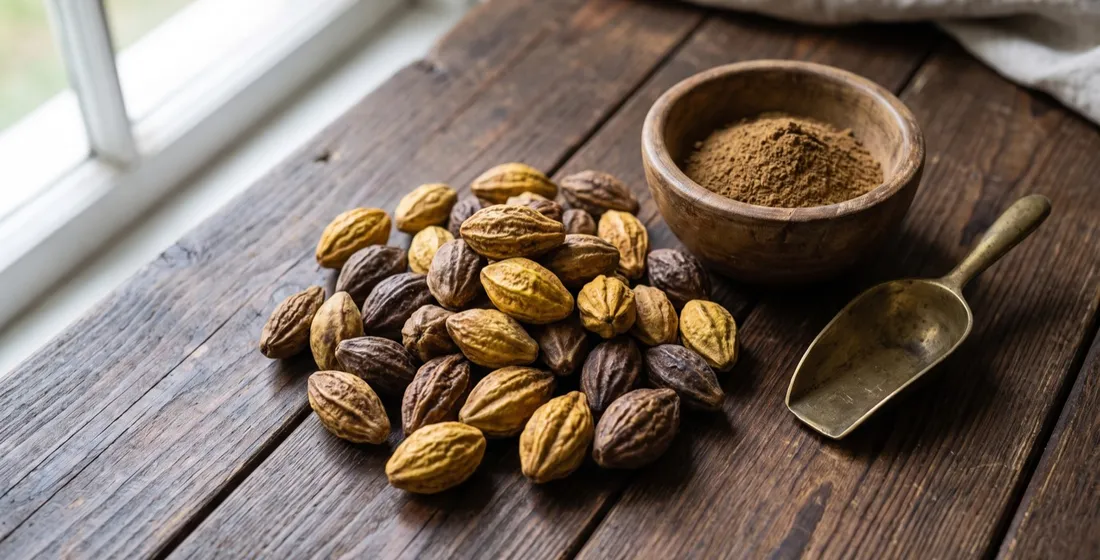
Buyer’s snapshot
- Haritaki is the dried fruit of Terminalia chebula Retz., listed in the WHO Monographs on Selected Medicinal Plants (Volume 4, 2009) as Fructus Chebulae, with a 2024 review in the journal Molecules cataloguing about 149 compounds in the fruit (Molecules, 2024).
- Its quality is driven by hydrolyzable tannins, mainly chebulagic and chebulinic acid, so a spec that says only “haritaki powder” leaves the part that matters undefined.
- The same fruit is one third of triphala, which means a single-herb haritaki SKU and a triphala SKU share the same identity, contaminant and particle-size questions.
- Silk Route Ventures (SRV) supplies haritaki (aralu in Sinhala) as a milled botanical powder from Matale, Central Province, with a batch Certificate of Analysis. Bulk raw-material MOQ is 50 kg per SKU.
- The RFQ table below lists the fields a procurement team should fix before ordering. This post is for Ayurvedic and digestive-support brands, not for buyers who want the lowest price per kilo on an unverified fruit.
Haritaki has an unusual problem for a botanical with such a long record of use: almost every buyer already knows the name, so almost nobody writes a proper specification for it. A purchase order that reads “haritaki powder, 100 kg” will be quoted, shipped, and then argued about, because the tannin content, the particle size, the fruit grade and the contaminant panel were never written down. Terminalia chebula (Sinhala: aralu, Hindi and Sanskrit trade name: haritaki) is the first-named fruit in the Ayurvedic materia medica, and the commercial material is the dried, mature fruit. This primer sets out what to specify, what the evidence supports saying on a label, and how the single-herb SKU differs from the triphala SKU.
What is haritaki, and which fruit grade do buyers source?
Haritaki is the dried fruit of Terminalia chebula Retz., a large deciduous tree of the Combretaceae family found across South and Southeast Asia, including the dry and intermediate zones of Sri Lanka. The 2024 Molecules review of the fruit describes use across Ayurveda, Siddha, Unani and Tibetan medicine, with digestive use, bowel regulation and skin complaints among the most consistently recorded traditional applications (Molecules, 2024).
For a buyer, the fruit itself is the first spec decision. Traditional trade sorts haritaki by maturity and shape, and the powder is made from the whole dried fruit with the stone (seed) either included or removed. Whole-fruit-with-seed and pericarp-only powders do not carry the same tannin concentration, because the pericarp holds most of the hydrolyzable tannins. Write “pericarp, stone removed” or “whole fruit” on the RFQ, never leave it to the supplier’s default.
What actives does Terminalia chebula powder contain?
The markers a chemist can assay are the hydrolyzable tannins. Chebulagic acid and chebulinic acid are the two most cited, alongside gallic acid, ellagic acid, punicalagin, chebulanin and corilagin. Published literature puts total tannins in the fruit at up to about 30 percent by weight, though commercial specification sheets for dried powder commonly set a wider total-tannin band and a separate minimum for the chebulagic plus chebulinic sum.
These figures vary by harvest, altitude, fruit maturity and extraction method, so the table below shows what the market commonly writes into a purchase specification. Treat them as buyer targets to confirm per lot, not as fixed properties of any one supplier’s fruit.
| Parameter | Typical market specification band | Why a buyer cares |
|---|---|---|
| Total tannins (as tannic acid) | Often 40 to 60 percent on commercial sheets | Sets astringency and the base for any standardized claim |
| Chebulagic plus chebulinic acid | Commonly a minimum of 15 to 25 percent, dried basis | The assayable marker for a “standardized” SKU |
| Loss on drying | 8 percent maximum is common | Controls mould risk in transit and shelf life |
| Acid-insoluble ash | 5 percent maximum is common | Flags sand and soil contamination at harvest |
| Particle size | Define a mesh, for example 95 percent through 80 mesh | Governs capsule fill weight and blend uniformity |
Those bands come from published commercial specification sheets and are indicative only. The Ayurvedic Pharmacopoeia of India carries the reference identity monograph for haritaki, and naming it on the RFQ, or a documented in-house equivalent, tells the manufacturer which identity and assay approach applies.
Spec snapshot: Haritaki (Aralu) powder
- Species: Terminalia chebula Retz., verified on the batch Certificate of Analysis
- Part used: dried mature fruit; state “pericarp, stone removed” or “whole fruit”
- Form: milled powder, or ratio extract by agreement
- Origin: Matale and the Central Province growing belt, Sri Lanka
- Markers to define: total tannins and the chebulagic plus chebulinic sum
- Bulk MOQ: 50 kg per SKU on a first order, with price breaks at 500, 1,000 and 2,500 kg
- Documentation: batch COA, Certificate of Origin, Phytosanitary Certificate
Haritaki alone, or as one third of triphala?
Triphala combines amalaki, bibhitaki and haritaki, classically in equal parts. Haritaki carries the heaviest tannin load of the three fruits, which is why a haritaki-heavy blend tastes harsher and reads differently on an assay than an amla-heavy one. A brand choosing between the two products is really choosing between a single-herb claim platform and a classical-formula one.
A single-herb haritaki SKU is easier to defend on identity, because there is one species and one marker set. It is harder to sell, because consumers recognise the triphala name and not the single-fruit one. A triphala SKU sells on tradition, but its assay depends on the ratio, as covered in the guide to triphala capsule formulation, ratio and particle size and the companion piece on triphala for adaptogen blends. Because SRV supplies all three fruits individually, a brand can run a haritaki-only SKU and a house-ratio triphala from one supplier and one audit file.
Claims: what traditional use and cited evidence support
Digestive support is where haritaki’s record is strongest, and it is also where claim discipline matters most. Traditional use is real and widely documented, and the 2024 review summarises a large body of in vitro and animal work on antioxidant, anti-inflammatory and gastrointestinal activity. What it does not provide is a regulator-grade human clinical claim for a finished supplement.
The honest label language therefore stays with “traditionally used to support digestion” and structure and function wording in the US, with the usual FDA disclaimer. In the EU, health claims on botanicals are tightly controlled, and “digestive” claims generally cannot rest on tradition alone, so a brand should confirm what its destination market permits before printing anything. Words such as “treats constipation” or “detoxifies” are medicinal claims and belong nowhere on a supplement SKU.
Haritaki also has a laxative-leaning traditional profile at higher doses, so a formulator should set a dose with the product’s regulatory and safety reviewer, and state any pregnancy and medication cautions the destination market expects. The ingredient supplier cannot own that decision, but it can supply the species-verified COA and the documented assay that the review team will ask for.
How to write an RFQ for haritaki powder
Most haritaki disputes come from three gaps: the part of the fruit, the marker, and the contaminant panel. Fix those on the first email and the quote comes back comparable.
| RFQ parameter | What to specify |
|---|---|
| Botanical identity | Terminalia chebula Retz., species confirmed on COA |
| Fruit part and grade | Whole fruit or pericarp only; mature dried fruit; foreign matter limit |
| Form | Milled powder, or ratio extract (state ratio and carrier) |
| Particle size | Target mesh, for example 95 percent through 80 mesh |
| Moisture / loss on drying | Maximum target, for example 8 percent |
| Ash and acid-insoluble ash | Total and acid-insoluble limits per the monograph you name |
| Assay marker | Total tannins and chebulagic plus chebulinic acid, with method stated |
| Heavy metals | Lead, cadmium, arsenic and mercury to destination-market limits (USP or Ph. Eur. for US and EU) |
| Microbial | Total plate count, yeast and mould, E. coli, Salmonella to AHPA or USP limits |
| Pesticide residues | To EU or US import limits for the destination |
| Documentation | Batch COA, Certificate of Origin, Phytosanitary Certificate |
Terminalia fruit is a known site of dried-fruit substitution and adulteration risk across the whole genus, so identity should be confirmed by the supplier’s test and, for US-bound dietary supplements, independently by the brand under 21 CFR 111. A supplier certificate alone does not satisfy that requirement.
Sourcing from Matale: what a supplier can document
The question the SRV procurement desk hears first from wellness brands is not price. It is whether two shipments, three months apart, will assay within the same tannin band, because the brand’s claims file depends on batch consistency. Commodity powder pooled from several collectors cannot promise that. Fruit traced to a defined harvest window and drying process can. The point of buying from Matale, in Sri Lanka’s Central Province, is not romance. It is the ability to name the origin of a batch and hold it against the written spec.
For brands that want a finished product rather than raw powder, Silk Foods Ceylon (SFC) encapsulates in-house. The capsule route runs a 180-bottle minimum, and the same discipline applies across the wider Sri Lankan herb range, from Beli to Gurmar. Buyers who need a cleaner restatement of the botanical sourcing process can read the guide to sourcing functional herbs and Ayurvedic botanicals from Sri Lanka. The product listing for haritaki (aralu) powder carries the current forms.
Where SRV walks away
Brands that want the lowest-price haritaki on a spot market, with no tannin assay and no batch documentation, are better served elsewhere. SRV’s pricing and process are built for buyers who put a spec on the purchase order and test against it.
Frequently asked questions
Does SRV ship bulk haritaki powder to the EU and US?
Silk Route Ventures ships bulk haritaki (Terminalia chebula) powder internationally with a batch Certificate of Analysis, Certificate of Origin and Phytosanitary Certificate per order. Bulk raw-material MOQ is 50 kg per SKU. Buyers remain responsible for confirming claim wording and, for the US, identity testing under 21 CFR 111.
What is the minimum order quantity for haritaki powder?
Bulk raw-material MOQ at Silk Route Ventures is 50 kg per SKU on a first order, with price breaks at 500, 1,000 and 2,500 kg. For finished capsules, the Silk Foods Ceylon facility runs a 180-bottle minimum per single shift, so an early-stage brand can launch a single-herb or triphala SKU without commodity-scale volume.
Can SRV develop a custom haritaki or triphala formulation?
Yes. The SRV research and NPD team develops custom botanical blends and capsule formulations in-house, including house-ratio triphala built from individually sourced fruits. The R&D promise is 3 to 4 weeks maximum from signed brief to approved formulation.
What should the tannin marker be on a haritaki spec?
Define two lines: total tannins as tannic acid, and the sum of chebulagic and chebulinic acid on a dried basis, with the assay method named. Commercial sheets commonly set the sum at a minimum of 15 to 25 percent. Set the buyer target, then confirm it lot by lot against the COA.
How Silk Route Ventures can help
Silk Route Ventures (SRV) supplies bulk Ayurvedic and functional botanicals, including haritaki, amla, bibhitaki, gotukola and ashwagandha, and manufactures nutraceutical capsules for wellness brands globally. The Silk Foods Ceylon (SFC) facility in Matale operates under BRCGS and FSSC 22000 V6, with USDA Organic and EU Organic on the relevant SKUs. Bulk raw-material MOQ is 50 kg per SKU; capsule MOQ is 180 bottles per single shift; samples ship by international courier in 3 to 5 business days. For brands without a co-packer, the SRV research and NPD team develops formulations in-house within 3 to 4 weeks. Current certifications, MOQs and lead times are on the Sri Lankan herbs supplier page.