
Triphala Capsule Formulation: Three-Fruit Ratio, Particle Size, and Ayurvedic Monograph Alignment
Key takeaways
- Triphala is not one botanical. It is three fruits (Amalaki, Bibhitaki, Haritaki), and the ratio you specify changes the assay: amla carries roughly 1.8 to 2.2 percent gallic acid, several times the level in the other two fruits.
- Capsule weight uniformity is governed by powder flow, not dose alone. A 2013 study found flow properties were the most predominant factor affecting fill weight variability, so particle size and mesh belong on the RFQ.
- US-bound Triphala must clear USP elemental limits and independent identity testing under 21 CFR 111. A supplier certificate of analysis cannot legally satisfy the identity requirement.
Buyer’s snapshot
- US retail herbal supplement sales reached a record 13.23 billion dollars in 2024, up 5.4 percent year on year (American Botanical Council). Ayurvedic botanicals ride that demand.
- For a Triphala capsule, the four RFQ variables that most affect batch consistency are the three-fruit ratio, the particle size (mesh), the standardization marker, and the contaminant panel.
- Silk Foods Ceylon manufactures capsules under BRCGS and FSSC 22000 V6, with USDA Organic and EU Organic on qualifying SKUs. Capsule MOQ is 180 bottles per single shift.
- Use the spec matrix and RFQ checklist below to write a Triphala capsule brief a manufacturer can quote against without a second email.
Most Triphala capsule briefs that reach a contract manufacturer say almost nothing a chemist can act on. They name the product, a dose, a bottle count, and stop. Triphala is a three-fruit formulation with more than a thousand years of documented use, and the parts of it that decide whether two batches match are exactly the parts most requests for quotation leave blank. This primer sets out what a product developer should specify when sourcing Triphala capsules for the United States market: the fruit ratio and its species identity, the particle size that governs fill weight, and the monograph and testing language that keeps the SKU compliant.
What “Triphala” has to mean on a spec sheet
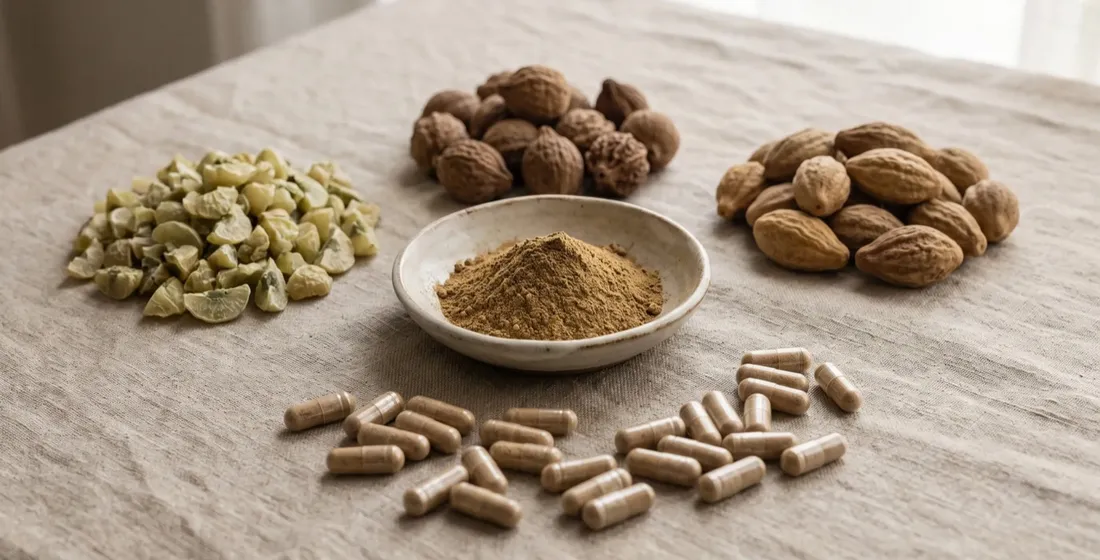
Triphala (Sanskrit for “three fruits”) combines the dried fruit of Amalaki (Emblica officinalis, amla), Bibhitaki (Terminalia bellirica), and Haritaki (Terminalia chebula). Classical Ayurvedic practice combines them in equal parts, a 1:1:1 ratio, though documented regional variants exist, including an amla-heavy 1:2:4 formula (ScienceDirect review literature, accessed 2026). A spec sheet that names only “Triphala” leaves the ratio, and therefore the chemistry, undefined.
Name the three Latin binomials, state the ratio, and reference a monograph. The Ayurvedic Pharmacopoeia of India publishes the reference monograph for Triphala churna; naming it (or a documented in-house equivalent) on the request for quotation tells the manufacturer which identity and assay targets apply. Species identity matters because the Terminalia genus is prone to substitution, covered below. Silk Route Ventures (SRV) supplies the three fruits both as individual bulk botanicals (amla, aralu or bibhitaki, and haritaki) and as a finished Triphala capsule, so a brand can specify a house ratio rather than accept a generic pre-blend. For the wider category, see the guide to sourcing Ayurvedic botanicals from Sri Lanka.
Why the three-fruit ratio drives your assay
The three fruits do not carry equal chemistry. A 2011 study in the Iranian Journal of Pharmaceutical Research measured gallic acid at 1.79 to 2.18 percent in amla, 0.79 to 1.01 percent in Bibhitaki, and 0.28 to 0.80 percent in Haritaki. Amla is the dominant gallic-acid contributor, so shifting the ratio toward or away from it moves the marker level a buyer sees on a certificate of analysis.
This is why “Triphala, 500 mg” is not a specification. If the label or claim platform references a standardized tannin or gallic-acid level, the ratio has to be fixed and disclosed. Gallic acid and total hydrolyzable tannins are the common commercial markers; a fuller identity profile uses HPTLC to resolve chebulinic acid, chebulagic acid, and the galloyl glucoses across a churna sample (Journal of Planar Chromatography, 2012). Ask for the marker, the target range, and the method in writing, the same discipline covered in the note on matching curcumin assay to a label claim.
In sourcing conversations, the most common Triphala reformulation request the SRV research team sees is not a new dose. It is a buyer discovering that a previous supplier never fixed the ratio, so two lots assayed differently and the label claim drifted. Fixing the ratio at the brief stage removes that failure mode before the first purchase order, not after a retailer flags an out-of-spec lot.
Particle size and powder flow decide capsule weight uniformity
For a powder-filled capsule, dose is set by fill weight, and fill weight consistency is a flow problem. A 2013 study in Drug Development and Industrial Pharmacy found powder flow properties were the most predominant factor affecting capsule fill weight and its variability: variability fell as bulk and tapped density rose, and climbed with higher cohesion and compressibility.
Triphala powder is fibrous and can be cohesive, so particle size and mesh belong on the request for quotation, not left to the plant. Specify a target mesh (for example 80 mesh) and, where possible, a bulk and tapped density range so the manufacturer can predict fill weight and confirm the chosen capsule size holds the dose. Uniformity of dosage units is then verified with the standard weight-variation approach. Getting mesh and density onto the brief is the difference between a fill that meets weight-variation limits on the first validation run and one that needs rework.
Matching dose to capsule size and shell
Fill capacity is bounded by shell size. Industry capsule charts put a size 0 capsule at roughly 400 to 800 mg of powder and a size 00 at roughly 600 to 1,100 mg, with the actual milligrams depending on tapped density, so a fluffy botanical fills the low end. A common 500 to 1,000 mg Triphala dose therefore sits in size 0 or 00 depending on density.
Confirm two things with the manufacturer: the capsule size that carries the intended dose at the powder’s real density, and the shell material. Vegetarian HPMC (hydroxypropyl methylcellulose) capsules suit plant-based and Ayurvedic positioning; gelatin is beef-derived and dissolves faster but rules out a vegan claim. State the shell on the request for quotation because it changes both the label and the machine settings. Where volumes are modest, the economics are set out in the note on when a 180-bottle capsule MOQ makes sense, and the category overview sits in herbal supplement capsules from Sri Lanka.
Triphala capsule: what a complete RFQ specifies
| Spec parameter | Under-specified brief | Complete RFQ |
|---|---|---|
| Species identity | ”Triphala” | Amalaki (Emblica officinalis), Bibhitaki (Terminalia bellirica), Haritaki (Terminalia chebula) |
| Three-fruit ratio | not stated | Fixed and disclosed (for example 1:1:1), referenced to a monograph |
| Standardization marker | none | Gallic acid or total tannins, with target range and method |
| Particle size | ”powder” | Target mesh (for example 80 mesh) plus bulk/tapped density range |
| Capsule size and shell | ”capsule” | Size 0 or 00; HPMC (vegetarian) or gelatin |
| Contaminants | assumed | USP <2232> elemental limits, microbial limits, pesticide panel |
| Identity testing | supplier COA | Independent identity verification per 21 CFR 111 |
| Certification | ”certified” | BRCGS, FSSC 22000 V6, USDA Organic and EU Organic as required |
Identity and contaminant testing a US buyer must specify
The Terminalia fruits in Triphala are prone to adulteration; Terminalia pallida can be passed off as Terminalia chebula. A 2016 study using a matK plus ITS DNA barcode reached 94.44 percent species resolution and detected adulterant Terminalia down to trace amounts, which is why identity testing, not just a visual or organoleptic check, protects a Triphala SKU.
US current good manufacturing practice makes this a legal line, not a nicety. Under 21 CFR Part 111, a manufacturer may not rely on a supplier’s certificate of analysis to establish the identity of a dietary ingredient; identity must be independently verified in-house. On contaminants, USP General Chapter <2232> sets permitted daily exposure limits for the four elements of concern (inorganic arsenic 15, cadmium 5, lead 5, and total mercury 15 micrograms per day), and microbial limits follow USP <2021> and <2022>. Put all three, the identity method, the elemental limits, and the microbial limits, on the request for quotation so the quoting manufacturer prices testing in rather than discovering it at receiving. The certification language that carries these into a purchase contract is set out in the buyer’s guide to organic certifications.
Triphala capsule RFQ checklist
- The three Latin species names, not just “Triphala”
- The fruit ratio, fixed and disclosed, with the reference monograph
- Standardization marker (gallic acid or total tannins), target range and method
- Particle size (mesh) and a bulk/tapped density range
- Capsule size (0 or 00) and shell material (HPMC or gelatin)
- Elemental limits (USP <2232>) and microbial limits (USP <2021>/<2022>)
- Independent identity testing per 21 CFR 111
- Certification stack required: BRCGS, FSSC 22000 V6, USDA Organic, EU Organic
- A COA per batch, and an organic transaction certificate if organic
Frequently asked questions
What is the standard three-fruit ratio for Triphala?
Classical Ayurvedic practice combines Amalaki, Bibhitaki, and Haritaki in equal parts, a 1:1:1 ratio, and this is the most common commercial baseline. Documented variants exist, including an amla-heavy 1:2:4 formula (ScienceDirect review literature). Because amla carries the most gallic acid, the ratio should be fixed and disclosed on the spec sheet.
What particle size should Triphala powder be for capsule filling?
There is no single universal mesh, but it should be specified, not left open. A 2013 study in Drug Development and Industrial Pharmacy found powder flow, driven by particle size and density, was the most predominant factor in capsule fill weight variability. An 80 mesh powder with a stated bulk and tapped density range gives a manufacturer enough to confirm uniformity.
How many milligrams of Triphala fit in a capsule?
A size 0 capsule holds roughly 400 to 800 mg of powder and a size 00 roughly 600 to 1,100 mg, depending on tapped density (industry capsule charts). A common 500 to 1,000 mg Triphala dose therefore sits in size 0 or 00, which the manufacturer confirms against the powder’s real density.
Does Silk Route Ventures offer private-label Triphala capsules?
Yes. Silk Foods Ceylon manufactures herbal capsules under BRCGS and FSSC 22000 V6, with USDA Organic and EU Organic on qualifying SKUs, and the Sri Lanka Ayurveda Department registration that gates Ayurvedic manufacture. Capsule MOQ is 180 bottles per single shift; bulk Triphala powder MOQ is 50 kg per SKU. The SRV research team can also fix a custom ratio.
What testing do US buyers need for imported Triphala?
Independent identity verification per 21 CFR Part 111 (a supplier COA does not satisfy the identity requirement), USP <2232> elemental limits, USP <2021> and <2022> microbial limits, and a pesticide panel. Silk Foods Ceylon issues a certificate of analysis on every batch and maintains traceability to farm for organic SKUs.
How Silk Route Ventures can help
Silk Route Ventures (SRV) supplies bulk Ayurvedic and functional botanicals and manufactures nutraceutical capsules for wellness brands worldwide, including the three Triphala fruits (amla, bibhitaki, haritaki) as individual botanicals and as a finished Triphala capsule. The Silk Foods Ceylon (SFC) facility holds BRCGS and FSSC 22000 V6 covering encapsulation, with USDA Organic and EU Organic on qualifying SKUs, and the Sri Lanka Ayurveda Department registration required to manufacture Ayurvedic products. Capsule MOQ is 180 bottles per single shift; bulk powder MOQ is 50 kg per SKU; samples ship by international courier in 3 to 5 business days. For brands still fixing a formula, the SRV research and new-product-development team sets the three-fruit ratio, particle size, and marker target with you before the first purchase order. Request a formulation consultation or sample to start.
Sources
- American Botanical Council, 2024 US Herb Market Report (HerbalGram #144), 2025, retrieved 2026-07-27, https://www.herbalgram.org/news/press-releases/2025/us-sales-herbal-supplements-2024-increase
- Iranian Journal of Pharmaceutical Research, Quantification of Gallic Acid in Terminalia and Emblica fruits, 2011;10(2):233-236, retrieved 2026-07-27, https://pmc.ncbi.nlm.nih.gov/articles/PMC3828909/
- Journal of Planar Chromatography, HPTLC quantification of hydrolyzable tannins in Triphala churna, 2012, retrieved 2026-07-27, https://link.springer.com/article/10.1556/JPC.25.2012.1.6
- Drug Development and Industrial Pharmacy, Effect of powder flow properties on capsule fill weight, 2013 (PMID 23902366), retrieved 2026-07-27, https://pubmed.ncbi.nlm.nih.gov/23902366/
- Capsuline, Empty capsule size chart, retrieved 2026-07-27, https://capsuline.com/pages/empty-capsule-size-chart
- United States Pharmacopeia, General Chapter <2232> Elemental Contaminants in Dietary Supplements, retrieved 2026-07-27, https://www.uspnf.com/notices/general-chapter-elemental-contaminants-dietary-supplements
- US Food and Drug Administration, Dietary Supplement Current Good Manufacturing Practice, 21 CFR Part 111 (Small Entity Compliance Guide), retrieved 2026-07-27, https://www.fda.gov/regulatory-information/search-fda-guidance-documents/small-entity-compliance-guide-current-good-manufacturing-practice-manufacturing-packaging-labeling
- Journal of AOAC International (PMC4971960), DNA-based identification of Terminalia adulteration in Triphala, 2016, retrieved 2026-07-27, https://pmc.ncbi.nlm.nih.gov/articles/PMC4971960/
- ScienceDirect, Triphala overview (pharmacology and pharmaceutical science topic), retrieved 2026-07-27, https://www.sciencedirect.com/topics/pharmacology-toxicology-and-pharmaceutical-science/triphala