
Young Jackfruit Flour for Gluten-Free Bakery: Fibre, Particle Size and Substitution Rates
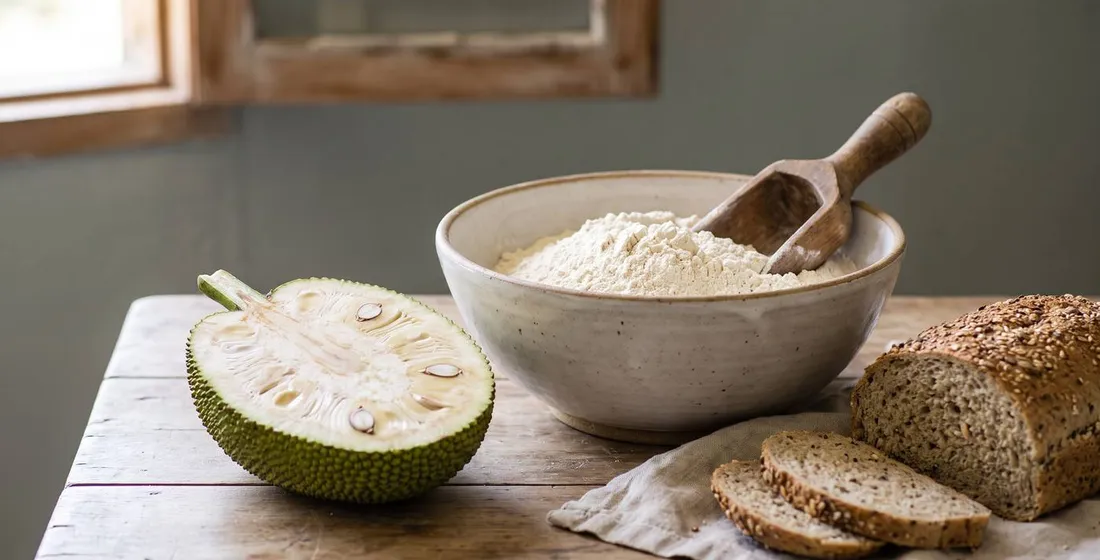
Buyer’s snapshot
- Young jackfruit flour is milled from dried unripe fruit pulp, not from the seed. One green jackfruit flour used in a 2021 randomised trial carried 4 g of dietary fibre per 30 g serving, roughly 13 g per 100 g (Rao et al., Nutrition & Diabetes, 2021). Seed flours and rind flours are different products with different numbers.
- Published bakery work is thin and mostly sensory. In one Malaysian bread study, a 20% jackfruit flour swap scored close to the wheat control, while 40% lowered texture and overall acceptability (Abu Bakar and Mahasan, International Journal of Allied Health Sciences).
- Particle size, moisture and water absorption are the three spec lines that change batter behaviour. None should be left to “standard” on a purchase order.
- Silk Route Ventures (SRV) supplies young jackfruit flour in bulk and for private-label flour ranges, with a 100 kg first-order MOQ per SKU, trial quantities from 10 kg, and a COA available on request.
- This post is for bakery and ingredient formulators writing a first spec. It is not a health-claims brief.
Young jackfruit flour is one of the less documented gluten-free-adjacent flours a bakery formulator can buy. Coconut, cassava and green banana flours each have a body of bakery data behind them. Jackfruit flour has a few trials, a handful of sensory studies, and a lot of retail-label copy. This piece sets out what the evidence supports, which spec lines to put in front of a supplier, and how to run a first substitution trial without over-promising on the label.
What is young jackfruit flour, and how is it different from seed flour?
Young jackfruit flour is made by slicing unripe jackfruit pulp, drying it and milling it to a fine, pale powder. Jackfruit seed flour and rind flour are separate products with their own composition. When a supplier or a paper says “jackfruit flour”, the first question is which part of the fruit was milled, because fibre, starch and water-binding figures do not transfer between them.
The distinction matters in practice. A Sri Lankan study of a seed-flour biscuit reported 3.1% crude fibre and 4.1% dietary fibre in the finished biscuit (Kaushalya and Wijesinghe, Tropical Agricultural Research & Extension, 2024). A Philippine noodle study using rind and core flour reported 6.05% crude fibre in its best blend. Crude fibre and dietary fibre are also different measurements. A spec sheet that quotes one without naming the method cannot be compared with a spec sheet that quotes the other.
The pulp flour sold by SRV is described on its young jackfruit flour product page as a fine, pale, mildly nutty flour that works in batters, doughs and as a thickener for sauces, soups and porridges.
What do we actually know about fibre and starch?
Less than the retail copy suggests. The best-documented figure for a green jackfruit pulp flour comes from a 12-week randomised trial in adults with type 2 diabetes, where participants replaced rice or wheat flour with 30 g per day of the flour. The study reports 4 g of dietary fibre and 1 g of soluble fibre per 30 g serving (Rao et al., 2021). That works out to about 13 g of dietary fibre per 100 g, which is our arithmetic, not a figure the authors state. The trial was funded by the product’s maker, and the corresponding author is the product’s inventor, so it describes that flour, not every jackfruit flour.
Two points follow for a buyer. First, ask for total dietary fibre by an AOAC method on your own lot, with the soluble fraction stated, rather than quoting a literature value on a label. Second, this post makes no glycaemic or health claim. The trial measured blood glucose in a clinical population, and no such claim should reach a bakery label without a study that supports the exact wording in the exact market.
Starch is the other open line. Published figures for jackfruit starch mostly come from seed material, so request a starch and moisture figure from the supplier’s own specification instead of borrowing one.
Spec snapshot: young jackfruit flour (pulp)
Source material: dried unripe jackfruit pulp (not seed, not rind) Appearance: fine, pale powder with a mild, faintly nutty flavour Dietary fibre: confirmed on the lot COA, method stated Particle size, moisture and water absorption: agreed on the quote, tested on the lot Supply: bulk, and private-label flour ranges SRV MOQ: 100 kg per SKU, trial quantities from 10 kg
Which spec lines change how the flour behaves in the batter?
Three numbers decide whether a flour behaves the same from one lot to the next: particle size distribution, moisture and water absorption. Fibre-rich flours take up more water than refined wheat flour, and the finer the grind, the faster that water is taken up. A Sri Lankan study of jackfruit by-product flour found higher water absorption and swelling capacity than wheat flour (Tropical Agricultural Research & Extension, 2024). That is a direct reason a one-to-one swap in a wheat recipe usually fails.
| Spec line | Why it matters in the bakery | What to put on the RFQ |
|---|---|---|
| Particle size distribution | Sets hydration speed, crumb texture and mouthfeel | A sieve spec (for example, the percentage passing a named mesh) and the test method |
| Moisture | Drives shelf life, caking and mould risk in storage | A maximum figure and the method |
| Water absorption | Sets how much liquid the batter needs | Measured on your lot, in your own test |
| Total dietary fibre | Sets labelling options and bulk density | Value and AOAC method on the COA |
| Colour | Shows in pale crumb and white-style bakes | A reference sample and a tolerance |
Source: SRV buyer-side spec practice, 2026.
SRV does not publish a single particle size figure for this flour, because the right grind depends on the application: a fine grind for cake and batter work, a coarser one for rustic breads and thickening. Agree the sieve spec on the quote and confirm it on the lot.
What substitution rates do the studies support?
The honest answer is “start low and test”. The published tests are mostly sensory trials in wheat-based products, not gluten-free systems, and they use different parts of the fruit. They are useful as a boundary, not as a recipe.
| Study | Product and flour | Levels tested | What it found |
|---|---|---|---|
| Abu Bakar and Mahasan, International Journal of Allied Health Sciences | Bread, jackfruit flour | 0%, 20%, 40% | 20% scored close to the control; 40% lowered texture and overall acceptability |
| Philippine noodle study (rind and core flour) | Noodles | 33%, 50%, 67% | 33% was the most acceptable blend |
Source: studies named above, retrieved 29 October 2026.
Read the table with a caution. In a wheat bread, jackfruit flour dilutes gluten, which is why the 40% bread lost texture. In a gluten-free formulation there is no gluten network to dilute, so the flour is one ingredient in a blend that still needs a structure builder, usually a starch and a hydrocolloid. For that reason, the first trial should be a three-point ladder (for example 10%, 20% and 30% of the flour weight), with water added in steps, and a control run on the same day.
For adjacent flours that already carry formulation data, the coconut flour substitution guide, the cassava and arrowroot spec and the green banana flour RFQ spec are the natural companions for a blend.
Can a jackfruit flour carry a gluten-free claim?
A flour made from a fruit contains no gluten-forming cereal, but that does not make a finished product gluten-free for labelling. The Codex standard for foods for special dietary use for persons intolerant to gluten (CXS 118-1979) and the US rule at 21 CFR 101.91 both set the gluten-free threshold at 20 mg/kg (20 ppm) in the food as sold. The brand that puts the claim on the pack carries the responsibility for testing the finished product.
Silk Foods Ceylon (SFC) does not describe its products as gluten-free. For a gluten-free line, ask the supplier for a gluten-test result on request through an external laboratory, ask how the milling line is separated from gluten-containing cereals, and run your own test on the finished bake.
Where SRV’s flour does not fit
A brief that needs a certified gluten-free ingredient with a validated gluten-free claim from the supplier. Brands that need a health or glycaemic claim written into the ingredient copy. For those briefs, a different ingredient, or a supplier with that certification, is the more honest answer.
How do you specify jackfruit flour on an RFQ?
A short RFQ saves a sample round. These are the points a procurement team should put in front of any supplier of this flour.
Buyer’s checklist: young jackfruit flour
- Part of the fruit confirmed in writing: unripe pulp, not seed or rind
- Particle size as a sieve specification and method
- Maximum moisture and the test method
- Total dietary fibre by AOAC method, on the COA
- Microbiology, heavy metals and pesticide residues tested through an external laboratory on request
- Gluten test result on request, and a statement on line separation
- Pack size, liner and storage statement
- A trial-size sample against the spec before any purchase order
SRV supplies this flour as part of its jackfruit range. Brands already buying jackfruit in brine for plant-based SKUs or evaluating retort glass-jar formats can add the flour to the same supplier file.
Frequently asked questions
Does SRV offer private label for young jackfruit flour?
Yes. Silk Route Ventures supplies young jackfruit flour in bulk and for private-label flour ranges. Private-label packaging, custom specifications and organic orders run 4 to 6 weeks from PO to dispatch, and unit minimums for retail packs are confirmed on the quote. Contact SRV with your pack format and target market.
What is the minimum order for young jackfruit flour?
Commercial orders start from 100 kg per SKU, and trial quantities start from 10 kg. Samples are free for evaluation, and the buyer covers the courier. Standard SKUs ship 2 to 3 weeks from PO to dispatch on an FOB Colombo basis, with CFR and CIF on request.
Is young jackfruit flour gluten-free?
It is made from a fruit, not a cereal, but a gluten-free label depends on testing and on line separation. The Codex and US thresholds are 20 mg/kg (20 ppm). SFC does not describe its products as gluten-free, so request a gluten test result on the lot and validate the finished product yourself.
How much jackfruit flour can replace wheat in bread?
In one Malaysian sensory study, 20% replacement scored close to the wheat control, and 40% lowered texture and overall acceptability. Gluten-free blends behave differently because there is no gluten network to dilute. Start with a 10%, 20% and 30% ladder and adjust the water.
How Silk Route Ventures can help
Silk Route Ventures supplies young jackfruit flour in bulk and for private-label flour ranges to bakery and ingredient brands in the US, EU, UK and Australia. First-order MOQ is 100 kg per SKU, trial quantities start from 10 kg, and samples are free for evaluation (you cover the courier). Standard SKUs ship 2 to 3 weeks from PO to dispatch, and the Silk Foods Ceylon facility in Matale holds BRCGS and FSSC 22000 V6, with the scope that applies to this SKU confirmed on request. A COA is available on request, along with a certificate of origin and a phytosanitary certificate where the destination requires it. For a bakery brief, start with the particle size and fibre lines above and the team will quote against them. Contact us to send an inquiry or request a sample. For the wider Ceylon range, see SRV’s Ceylon spices and ingredient supply.
Written by the Silk Route Ventures Trade Team. Silk Route Ventures (E-Silk Route Ventures (Pvt) Ltd) is a Sri Lankan B2B supply-chain operator for the Food, Beverage, Wellness, and Nutraceuticals sectors. The Silk Foods Ceylon manufacturing arm holds BRCGS and FSSC 22000 V6 certifications. Questions or to request a sample: Contact us or email info@esilkroute.com.lk.