
Cassava and Arrowroot Powder Spec for Gluten-Free Baking
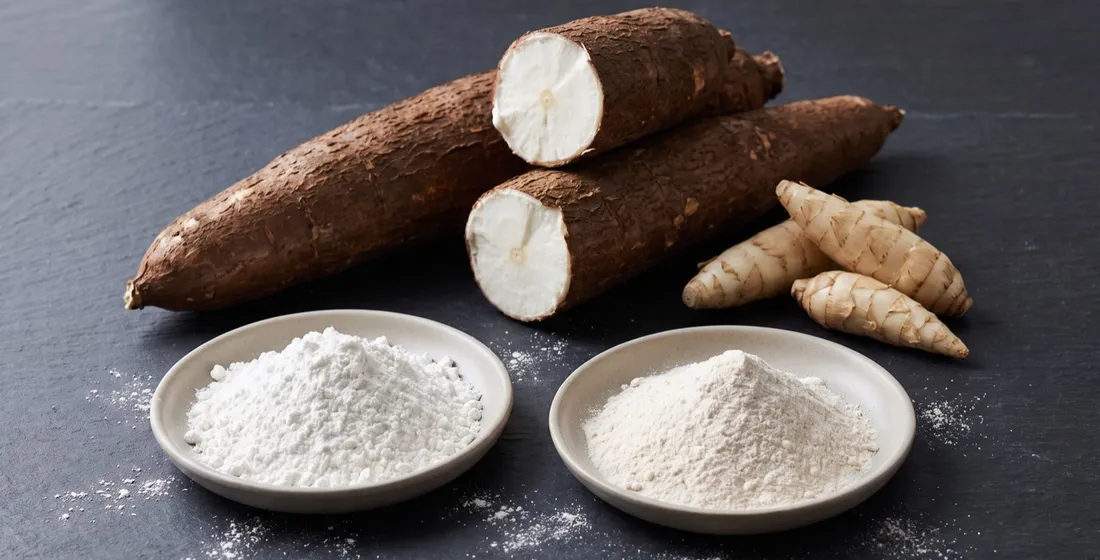
Buyer’s snapshot
- Regulation (EU) 2023/915 caps hydrogen cyanide at 10.0 mg/kg in cassava flour and tapioca flour, and at 50.0 mg/kg in fresh peeled cassava root. This is the one cassava parameter a purchase specification cannot omit.
- Codex Alimentarius CXS 176-1989 does not set a cyanide limit for edible cassava flour, despite being cited across the trade as the source of the 10 mg/kg figure. Its specification annex covers fibre, ash, additives and particle size only.
- Cassava flour and cassava starch are not interchangeable inputs. EAS 740:2010 sets flour at a minimum 60 percent starch and a maximum 2.0 percent crude fibre; EAS 742:2010 sets starch at a minimum 95 percent and a maximum 0.2 percent fibre.
- Arrowroot has no Codex, East African or ISO standard, so every arrowroot purchase is a bilateral specification. Granule size is the cheap authenticity check: arrowroot runs 40 to 75 microns against cassava at 5 to 35 microns.
- Silk Route Ventures (SRV) mills cassava and arrowroot powder at the Silk Foods Ceylon (SFC) site in Matale on a 100 to 200 kg per hour powder line, at a 50 kg first-order minimum per SKU. The full RFQ parameter block sits at the close.
A purchase order for cassava powder and a purchase order for arrowroot powder look almost identical on paper and behave nothing alike in a bakery. Both arrive as fine white powders. Both are naturally gluten-free. Both get called starch in trade conversation. The difference sits in what was removed during processing, and that difference decides crumb structure, water absorption, and in the case of cassava, whether the lot clears an EU border at all. A buyer writing a specification for either ingredient in 2026 is really writing three specifications at once: a botanical one, a safety one, and a functional one. This post covers what belongs in each, with numbers a supplier can be held to.
Cassava powder, tapioca starch and arrowroot powder are three different purchases
Cassava (Manihot esculenta Crantz) is a storage root in the Euphorbiaceae family. Arrowroot (Maranta arundinacea) is a rhizome from a different plant family entirely. The two are unrelated botanically and are routinely sold under each other’s names, which is why the botanical name belongs on the specification line rather than in a footnote.
The second confusion is processing, not botany. Cassava flour is produced by peeling, drying and milling the whole root, so the fibre and the non-starch fraction stay in. Cassava starch, sold in world trade as tapioca starch, is wet-extracted: the root is rasped and the starch granules are washed away from everything else. Same root, two products, and they are not substitutable at the same inclusion rate.
| Parameter | Cassava flour (EAS 740:2010) | Cassava starch (EAS 742:2010) | Arrowroot powder |
|---|---|---|---|
| Starch, percent dry basis | 60 minimum | 95.0 minimum | No published standard |
| Crude fibre, percent dry basis | 2.0 maximum | 0.2 maximum | No published standard |
| Moisture, percent | 12 maximum | 12.0 maximum | Buyer specified |
| Ash | 3.0 maximum, crude ash | 0.6 maximum, sulphated ash | Buyer specified |
| pH | Not specified | 5 to 7 | Buyer specified |
| Hydrogen cyanide, mg/kg | 10 maximum | 10.0 maximum | Not applicable |
| Particle size | 90 percent through 0.25 mm, baking grade | 95 percent through 140 microns | Buyer specified |
| Yeast and mould, CFU per gram | 1,000 maximum | 1,000 maximum | Buyer specified |
| Salmonella | Absent in 25 g | Absent | Buyer specified |
Cassava flour and cassava starch requirements from EAS 740:2010 and EAS 742:2010, East African Community. The arrowroot column reflects the absence of any international standard, checked 2 August 2026.
SRV finding: the single line that separates the two cassava products is fibre. Flour is capped at 2.0 percent crude fibre, starch at 0.2 percent. A tenfold difference in one parameter is the whole functional story, and it is why a formulation built on tapioca starch will not run on cassava flour without reformulation.
What Codex actually specifies for cassava flour, and what it does not
Codex Alimentarius CXS 176-1989, revised in 1995 and amended in 2013, is the international standard for edible cassava flour. Its specification annex carries four rows: crude fibre at 2.0 percent maximum by ISO 5498, ash at 3.0 percent maximum by ISO 2171, food additives deferred to the legislation of the country of sale, and particle size at 90 percent minimum through a 0.60 mm sieve for fine flour or a 1.20 mm sieve for coarse. The body text adds a 13 percent moisture ceiling. Contaminants are handed off to CXS 193-1995.
What the standard does not contain is a cyanide limit, a starch percentage or a pH. Its microbiological requirement is qualitative rather than numeric. A buyer who writes “per Codex CXS 176” on a purchase order and assumes that covers cyanide has bought an unspecified lot.
SRV finding: the 10 mg/kg hydrogen cyanide figure attributed across the trade to Codex CXS 176 is not in the current text. Food Standards Australia New Zealand cites it to the pre-2013 revision, which means the limit was removed or relocated in the 2013 amendment. The live, enforceable 10.0 mg/kg number for cassava flour and tapioca flour sits in Regulation (EU) 2023/915. Specify the regulation, not the standard.
Cyanogenic glycosides: the parameter no cassava specification can omit
Cassava roots contain cyanogenic glycosides that release hydrogen cyanide when the tissue is damaged. Processing reduces them. It does not remove them, and how far it reduces them depends on how the root was handled between harvest and mill. Regulation (EU) 2023/915, applying the cyanide levels introduced by Regulation (EU) 2022/1364 from 1 January 2023, sets 10.0 mg/kg for cassava flour and tapioca flour and 50.0 mg/kg for fresh peeled cassava root. Codex CXS 238-2003 uses the same 50 mg/kg line, on a fresh weight basis, to separate sweet cassava from bitter.
Spec snapshot: hydrogen cyanide ceilings
- Bitter cassava root: above 50 mg/kg fresh weight, per the Codex CXS 238-2003 definition
- Fresh peeled cassava root into the EU: 50.0 mg/kg maximum, Regulation (EU) 2023/915
- Cassava flour and tapioca flour into the EU: 10.0 mg/kg maximum, Regulation (EU) 2023/915
- Cassava flour, East African Community: 10 mg/kg maximum, EAS 740:2010
- Gari: 2 mg/kg maximum as free hydrogen cyanide, Codex CXS 151-1989
- Method: EAS 744 enzymatic assay for total cyanogens, referenced normatively by both EAS 740 and EAS 742
The acute reference dose matters as much as the product limit. The EFSA Contaminants Panel established an acute reference dose of 20 micrograms of cyanide per kilogram of body weight in 2016, applicable regardless of dietary source. That is the toxicological basis a border authority works from when it detains a consignment.
The compliance record here is public and it is not flattering. Food Standards Australia New Zealand tested 134 samples of ready-to-eat cassava chips for hydrogen cyanide between September 2009 and May 2013 and recorded 46 failures, a 34 percent failure rate, across consignments from India, Indonesia, Malaysia, Singapore, Sri Lanka and the United Kingdom. Any procurement manager who searches for cassava and cyanide finds that dataset before they find a supplier brochure. The useful response from a Sri Lankan supplier is not to argue with it. It is to put the limit, the method and the batch cadence in writing before the buyer thinks to ask.
Which particle size actually bakes
Codex fine cassava flour passes 90 percent through a 0.60 mm sieve. That is a milling specification, not a baking specification. EAS 740:2010 adds a third grade that Codex does not carry: a baking grade requiring 90 percent minimum through a 0.25 mm sieve. The gap between 0.60 mm and 0.25 mm is the gap between a flour a mill will happily ship and a flour a bakery can run without grit in the finished crumb. If the RFQ says nothing about sieve, the coarser grade is what arrives, and it is contractually correct.
For starch-class material the mesh is finer again. EAS 742:2010 puts food grade cassava starch at 95 percent minimum through 140 microns. Where the application is a coating, an instant mix or a beverage system rather than a bake, that is the line to specify. The same logic governs every dried powder SKU, which is why particle size and shelf life belong together on a fruit and root powder specification.
Gluten-free at 20 parts per million: what the rule requires and what it leaves to the buyer
The threshold is the same across the three instruments that matter. The United States sets gluten-free at below 20 parts per million under 21 CFR 101.91, final rule published 5 August 2013. The European Union sets 20 mg/kg as sold to the final consumer under Commission Implementing Regulation (EU) No 828/2014, applicable from 20 July 2016, with a separate very low gluten category at 100 mg/kg. Codex CXS 118-1979, revised 2008 and amended 2015, sets the same 20 mg/kg, requires a method with a limit of detection at or below 10 mg gluten per kilogram, and names the R5 Mendez ELISA.
Cassava and arrowroot are gluten-free by nature, so the risk is never the crop. It is cross-contact in milling, conveying and packing. Here the rules go quiet. Codex asks only that the product be prepared with special care under good manufacturing practice to avoid contamination with gluten. Neither Codex, nor the FDA rule, nor the EU regulation prescribes a testing frequency. Frequency is a contractual term, which makes it the buyer’s to write. Specify the method, AOAC Official Method 2012.01, the R5 sandwich ELISA collaboratively studied across 14 laboratories on matrices including starches, then specify how many lots per production run get tested and who pays for the retest.
Arrowroot has no international standard, so specify it bilaterally
There is no Codex standard, no East African standard and no ISO standard for arrowroot starch. That absence is the most important thing to know before issuing an arrowroot RFQ, because it means there is no default position the two parties fall back on when a lot is disputed. Every parameter has to be written, and the buyer who writes them first sets the terms.
Adulteration is the practical consequence. Arrowroot is scarcer and dearer than cassava, and cassava starch substituted into an arrowroot bag is close to invisible by eye. A 2021 report in Current Developments in Nutrition examined three commercial arrowroot starch samples bought from three separate United States distributors, all supplied with certificates of authentication, and found only one matched Maranta arundinacea granule morphology under digital microscopy. Three samples is an illustration, not a prevalence estimate, and it should be read that way. What it does establish is that a certificate of authentication is not a test result.
Granule microscopy is the cheap check. Arrowroot granules run 40 to 75 microns, ovoid to pear-shaped with concentric striations. Cassava granules run 5 to 35 microns. A laboratory with a microscope separates the two in an afternoon at a fraction of the cost of a chromatographic method, and the test belongs in the incoming goods procedure of any buyer paying an arrowroot price.
The functional numbers differ too, and not in the direction the folklore suggests. Measured on native arrowroot starch, Marta and colleagues reported 37.5 percent amylose and a pasting temperature of 74.2 degrees Celsius in Food Chemistry: X in 2025. Cassava and tapioca starch sit at 17 to 24 percent amylose and gelatinise around 60 to 70 degrees Celsius. Higher amylose and a later pasting temperature mean arrowroot sets firmer and sets later. That is a formulation decision, not a quality ranking, and the widely repeated ranges that put arrowroot amylose at 20 to 35 percent do not match the measured value.
What these powders actually do in a gluten-free bake
A systematic review of 43 gluten-free bread studies published in Foods in 2021 used specific volume as its comparison metric. Bread made from cassava flour alone reached 2.24 millilitres per gram: the dough could not retain carbon dioxide and the loaf structure broke down. The same 100 percent cassava flour system rose to 3.93 cubic centimetres per gram once 40 percent egg white protein, 6 percent olive oil, 2.5 percent yeast, 9 percent sucrose and 2 percent salt were added at 100 percent water, with crumb firmness falling from 9.14 newtons to 4.67. Optimised corn and potato starch blends in the same review reached 4.7.
Two operating conclusions follow. Cassava flour is not a one-for-one wheat replacement and no supplier should imply that it is; it needs a hydrocolloid, a protein and a fat to rebuild the structure gluten used to provide. And hydrocolloid selection is close to settled practice, with hydroxypropyl methylcellulose at 2 percent appearing in 21 of the 43 studies reviewed. Water absorption across those systems ranged from 56 to 130 percent on a flour basis, a band wide enough that any single supplier-quoted absorption figure should be treated as indicative and re-run in the buyer’s own pilot. The same caution applies to every alternative flour, including the gluten-free flour substitution ratios published for coconut flour.
A copy-ready RFQ parameter block
Most cassava and arrowroot disputes trace back to an RFQ that named a product instead of describing one. The block below is the minimum that makes a lot rejectable on evidence rather than on argument, and it follows the same discipline as how to write a sourcing RFQ for a botanically confusable spice.
Buyer’s checklist: what to put on a cassava or arrowroot powder RFQ
- Botanical name in full: Manihot esculenta for cassava, Maranta arundinacea for arrowroot. A product name on its own is not a specification.
- Product class stated explicitly: whole-root flour or extracted starch. The two carry different starch and fibre limits and are not interchangeable.
- Hydrogen cyanide limit and method on any cassava item: 10.0 mg/kg against Regulation (EU) 2023/915 for EU-bound goods, tested by the EAS 744 enzymatic assay or an equivalent validated method.
- Sieve tied to the application: 90 percent through 0.25 mm for a bake, 95 percent through 140 microns for a beverage or instant system.
- Gluten below 20 mg/kg by AOAC Official Method 2012.01, with lots tested per production run written into the contract, because no regulation sets a frequency.
- For arrowroot, an identity test: granule morphology by microscopy, with the 40 to 75 micron range as the acceptance criterion.
- Microbiological set: Salmonella absent in 25 g, Escherichia coli absent in 1 g, yeast and mould below 1,000 CFU per gram.
- Certificate of analysis per batch rather than per shipment, and traceability to the collection point.
Origin honesty: Sri Lanka is not a starch-volume origin
Sri Lanka exported 154,034 kg of manioc starch under HS 110814 in 2023, worth USD 59,710, across seven destinations, of which the United Arab Emirates took 149,290 kg. Thailand exported 3.2 million tonnes of native cassava starch in 2024 at USD 1.6 billion, on Krungsri Research figures drawn from the Thai Office of Agricultural Economics. Those two numbers are four orders of magnitude apart and there is no honest way to present Sri Lanka as a volume origin for cassava starch.
The buyer who should be talking to a Sri Lankan supplier is therefore not the buyer moving containers of commodity native starch. It is the specialty bakery, supplement or clean-label brand that needs cassava powder and arrowroot powder in the tens to low hundreds of kilograms, under one audited certification scope, alongside other dried powders, with a certificate of analysis per batch and traceability back to the farm. That is a different economic question, and it is worth evaluating low-MOQ manufacturers on it directly.
Where Silk Route Ventures walks away
- Wet-extracted native or modified tapioca starch at container volume. Silk Foods Ceylon mills dried root into powder and does not run a wet starch extraction line. Thailand, Vietnam and Indonesia are the honest answer for that purchase.
- Any buyer whose specification is written purely on landed price per tonne. The Sri Lankan cost base does not win that comparison, and pretending otherwise wastes both sides a quarter.
- Demeter, Naturland or Bio Suisse certified arrowroot. SRV holds USDA Organic and EU Organic; the biodynamic schemes need a sourcing-partner conversation rather than a quote. The organic certification buyer’s guide sets out which scheme clears which market.
Frequently asked questions
Is cassava flour the same as tapioca flour?
No, although the trade uses the names loosely and reference literature has treated them as interchangeable. Cassava flour is the whole peeled root, dried and milled, at a minimum 60 percent starch and up to 2.0 percent crude fibre under EAS 740:2010. Tapioca starch is wet-extracted, at a minimum 95.0 percent starch and a maximum 0.2 percent fibre under EAS 742:2010.
What cyanide limit applies to cassava flour imported into the European Union?
10.0 mg/kg of hydrogen cyanide, set by Regulation (EU) 2023/915 following the levels introduced by Regulation (EU) 2022/1364 and applicable since 1 January 2023. Fresh peeled cassava root carries a separate 50.0 mg/kg ceiling. Codex CXS 176-1989 sets no cyanide limit, despite being widely cited as the source of the figure.
How do I verify that arrowroot powder is genuinely arrowroot?
Granule microscopy. Maranta arundinacea granules run 40 to 75 microns with concentric striations; cassava granules run 5 to 35 microns. A 2021 report in Current Developments in Nutrition found only one of three United States commercial arrowroot samples matched arrowroot morphology, despite all three carrying certificates of authentication.
Does Silk Route Ventures supply private label cassava and arrowroot powder, and at what minimum?
Yes. Silk Foods Ceylon mills cassava and arrowroot powder at Matale on a line running 100 to 200 kg per hour, under BRCGS and FSSC 22000 V6 certification, with USDA Organic and EU Organic scopes available. First-order minimum is 50 kg per SKU, with volume breaks at 500, 1,000 and 2,500 kg. Samples dispatch door to door in 3 to 5 business days.
How often should gluten be tested on a naturally gluten-free powder?
As often as the contract says, because no regulation sets a frequency. The FDA rule, Regulation (EU) No 828/2014 and Codex CXS 118 all set the same 20 mg/kg threshold and none prescribe a cadence. Codex asks only for good manufacturing practice to avoid contamination. Write the lot frequency and the method, AOAC 2012.01, into the specification.
How Silk Route Ventures can help
Silk Route Ventures supplies cassava powder and arrowroot powder in bulk against the buyer’s written specification, milled at the BRCGS and FSSC 22000 V6 audited Silk Foods Ceylon site at Nalanda in Matale, one kilometre from the Nalanda Gedige. The powder line runs 100 to 200 kg per hour, the first-order minimum is 50 kg per SKU with breaks at 500, 1,000 and 2,500 kg, a certificate of analysis is issued per batch, and traceability runs back to the collection point. USDA Organic and EU Organic scopes are available, and the same site can co-manufacture a finished gluten-free blend or retail powder under the buyer’s own label rather than shipping raw material alone, on the terms set out in the bulk ingredient supply playbook. Contact us to send a specification or request a sample.
Sources
- Codex Alimentarius, CXS 176-1989, Standard for Edible Cassava Flour (adopted 1989, revised 1995, amended 2013). https://www.fao.org/input/download/standards/59/CXS_176e.pdf (retrieved 2 August 2026)
- Codex Alimentarius, CXS 238-2003, Standard for Sweet Cassava. https://www.fao.org/input/download/standards/10368/CXS_238e.pdf (retrieved 2 August 2026)
- Codex Alimentarius, CXS 118-1979, Standard for Foods for Special Dietary Use for Persons Intolerant to Gluten (revised 2008, amended 2015). https://www.fao.org/input/download/standards/291/CXS_118e_2015.pdf (retrieved 2 August 2026)
- Commission Regulation (EU) 2023/915 on maximum levels for certain contaminants in food. https://eur-lex.europa.eu/eli/reg/2023/915/oj/eng (retrieved 2 August 2026)
- Commission Implementing Regulation (EU) No 828/2014 on the provision of information to consumers on the absence or reduced presence of gluten in food. https://eur-lex.europa.eu/eli/reg_impl/2014/828/oj/eng (retrieved 2 August 2026)
- US Food and Drug Administration, 21 CFR 101.91, Gluten-free labeling of food. https://www.ecfr.gov/current/title-21/chapter-I/subchapter-B/part-101/subpart-F/section-101.91 (retrieved 2 August 2026)
- EFSA Panel on Contaminants in the Food Chain, Evaluation of the health risks related to the presence of cyanogenic glycosides in foods other than raw apricot kernels, EFSA Journal 2019;17(4):5662. https://efsa.onlinelibrary.wiley.com/doi/10.2903/j.efsa.2019.5662 (retrieved 2 August 2026)
- Food Standards Australia New Zealand, Imported food risk statement: ready-to-eat cassava chips and hydrocyanic acid. https://www.foodstandards.gov.au/sites/default/files/2023-11/Cassava%20chips%20and%20HCN.pdf (retrieved 2 August 2026)
- East African Community, EAS 740:2010, Cassava flour, Specification. http://law.resource.org/pub/eac/ibr/eas.740.2010.pdf (retrieved 2 August 2026)
- East African Community, EAS 742:2010, Food grade cassava starch, Specification. http://law.resource.org/pub/eac/ibr/eas.742.2010.html (retrieved 2 August 2026)
- Lacorn M. et al., Determination of Gluten in Processed and Non-Processed Corn Products by R5 Sandwich ELISA (AOAC Official Method 2012.01), Journal of AOAC International 2022;105(2):442-455. https://pubmed.ncbi.nlm.nih.gov/34791280/ (retrieved 2 August 2026)
- Marta H. et al., Physicochemical, structural and pasting properties of modified arrowroot starch, Food Chemistry: X 2025;28:102624. https://pmc.ncbi.nlm.nih.gov/articles/PMC12177144/ (retrieved 2 August 2026)
- A Case of Arrowroot Starch Adulteration, Current Developments in Nutrition 2021;5(Supplement 2):862. https://pmc.ncbi.nlm.nih.gov/articles/PMC8182128/ (retrieved 2 August 2026)
- Systematic Review on Gluten-Free Bread Formulations Using Specific Volume as a Quality Indicator, Foods 2021;10(3):614. https://pmc.ncbi.nlm.nih.gov/articles/PMC7999268/ (retrieved 2 August 2026)
- Patindol J.A., Cassava Flour and Starch: Processing, Functional Properties and Food Industry Applications, IntechOpen, 2026. https://www.intechopen.com/online-first/1240777 (retrieved 2 August 2026)
- World Bank WITS / UN Comtrade, Sri Lanka exports of manioc starch, HS 110814, 2023. https://wits.worldbank.org/trade/comtrade/en/country/LKA/year/2023/tradeflow/Exports/partner/ALL/product/110814 (retrieved 2 August 2026)
- Krungsri Research, Thailand Industry Outlook 2025-2027: Cassava. https://www.krungsri.com/en/research/industry/industry-outlook/agriculture/cassava/io/cassava-2025-2027 (retrieved 2 August 2026)