
Green Banana Flour: Resistant Starch, Drying Temperature and RFQ Spec
Buyer’s snapshot
- Resistant starch is why a formulator buys green banana flour, and it is not a fixed number. In a 2009 drying study on Cavendish flour it ranged from 40.9 to 58.5 g/100 g dry basis with air temperature and velocity (Tribess et al., LWT).
- Drying below the starch gelatinization peak, about 68 degrees C for green banana, is what keeps resistant starch in the flour. A supplier who cannot state the drying temperature cannot state the resistant starch.
- The reference method is AOAC 2002.02 (AACC 32-40.01). Ask for it by number on the COA, reported on a dry basis.
- Silk Route Ventures supplies green banana flour milled from unripe Musa x paradisiaca (ash plantain) in Sri Lanka, from a BRCGS and FSSC 22000 V6 audited site, 50 kg per SKU first order. Resistant starch is not on the standard spec, so it goes in the RFQ.
- For gluten-free bakery, snack and functional-food formulators writing a bulk spec. The one authorised EU claim is quoted; no other health claim is made.
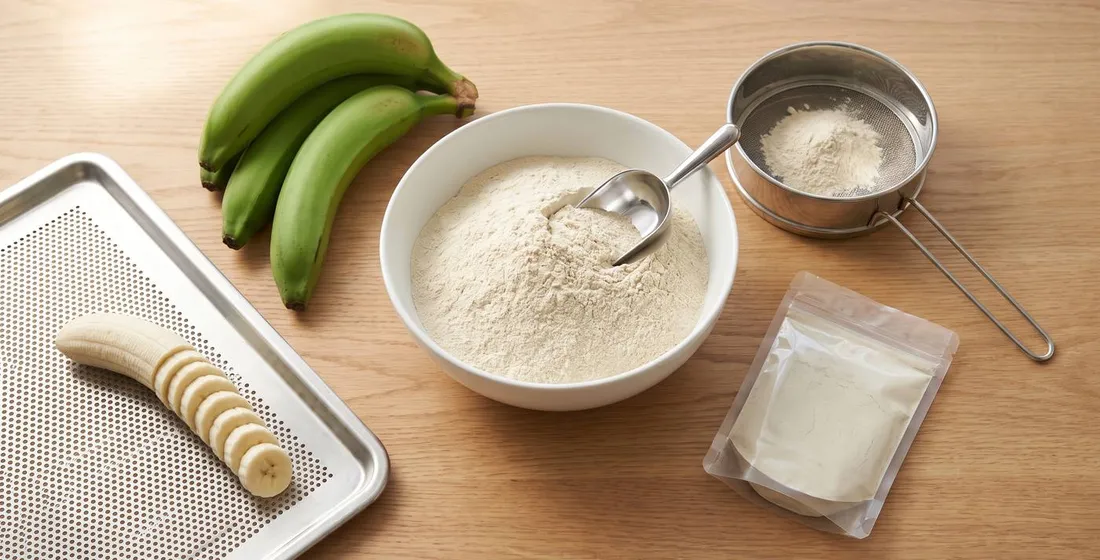
Most green banana flour briefs that reach a supplier read like a wheat flour spec with the word “banana” added: moisture, colour, a sieve size, maybe a microbial panel. The line that justifies the ingredient’s price, resistant starch, is usually missing, because buyers assume it is a property of the fruit. It is mostly a property of the dryer.
Silk Route Ventures (SRV) quotes green banana flour alongside its other fruit powders, and the same gap shows up in most inquiries. This piece covers what resistant starch is, why drying decides how much survives, which method measures it, and which RFQ lines to add. The ripe-versus-green distinction is already in banana powder for CPG: drying method, particle size and shelf life; that post is the hub, this one is the resistant-starch spoke.
What is resistant starch, and why does green banana flour carry so much of it?
Resistant starch is the fraction of starch that resists digestion by pancreatic enzymes in the small intestine and reaches the colon intact. Green banana flour is one of the richest natural sources: in a 2009 study on Musa cavendishii flour, resistant starch ranged from 40.9 to 58.5 g/100 g dry basis across drying conditions (Tribess et al., LWT, 2009). That range is wider than most spec sheets admit.
The starch in an unripe banana sits in native granules whose crystalline structure enzymes cannot easily attack, classed as type 2 resistant starch alongside raw potato starch and high-amylose maize. Ripening converts that starch to sugar, which is why ripe banana powder is a sweetener and green banana flour is a starch ingredient. The ripeness stage at harvest belongs on the spec.
Published values also move with cultivar and test method. A 2024 review put green banana flour near 30 percent resistant starch dry basis, from about 31.5 percent in Cavendish to 49 percent in Ladyfinger (Munir et al., Food Science and Nutrition, 2024). A 2021 study of South African cultivars reported 80 to 86 percent of total starch as resistant (Khoza et al., Foods, 2021), a different basis again. Three papers, three bases. Fix the method and basis before comparing suppliers.
How drying temperature decides the resistant starch number
Green banana starch gelatinizes at a peak of about 68 degrees C (67.95 to 68.63 degrees C by differential scanning calorimetry in the Tribess study). At that point the granule swells, loses its crystalline order and stops being type 2 resistant starch. Drying air hotter than the gelatinization peak converts the ingredient’s selling point into ordinary digestible starch while it is still in the dryer.
The same study found that only drying temperature significantly shifted the gelatinization peak, and that higher air velocity raised resistant starch provided the air stayed below gelatinization, averaging 57.3 g/100 g dry basis. The best combination, about 58 percent dry basis, was 55 degrees C at 1 to 1.4 m/s in a tunnel dryer (Tribess et al., LWT, 2009).
Drying also sets the moisture and water activity the buyer inherits. A 2023 comparison reported 3.96 to 4.55 percent moisture for freeze drying, 6.26 to 6.53 percent for cabinet drying at 60 degrees C, and 7.64 to 7.74 percent for forced-air drying at 50 degrees C, with lightness (L*) falling from 72 for freeze-dried to 50 for microwave-dried flour (Alam et al., Heliyon, 2023). Water activity measured 0.28 for refractance-window-dried flour against 0.39 for hot-air-dried (Padhi and Dwivedi, Future Foods, 2022). Gentler routes protect colour and resistant starch, and cost more.
Spec snapshot: what the drying step controls in green banana flour Resistant starch: highest when air stays below about 68 degrees C; 55 degrees C at 1 to 1.4 m/s gave about 58 g/100 g dry basis (Tribess et al. 2009) Moisture: roughly 4 to 8 percent by method, freeze drying lowest, forced-air oven highest (Alam et al. 2023) Water activity: 0.28 to 0.39 across refractance-window and hot-air drying (Padhi and Dwivedi 2022) Colour: lightness L* from about 72 (freeze-dried) to 50 (microwave-dried) Ask the supplier: drying method, maximum air temperature, and whether resistant starch was measured on the finished flour
If an offer shows a high resistant starch value and no drying temperature, ask for the temperature. If the temperature is above the gelatinization peak and the value is still high, ask which method produced it. The two facts are hard to reconcile.
Which method measures resistant starch, and what should the COA say?
The reference method for resistant starch in food is AOAC Official Method 2002.02, also published as AACC International Method 32-40.01 and recognised as a Codex Type II method, developed by McCleary and Monaghan in 2002. The sample is incubated with pancreatic alpha-amylase and amyloglucosidase at 37 degrees C for 16 hours, and the starch that survives is recovered and measured as resistant starch (McCleary and Monaghan, J. AOAC Int., 2002; Megazyme K-RSTAR protocol).
Three COA details decide whether the result is usable: the method number, because in-house digestions give different values on the same flour; the basis, because an as-is result reads 4 to 8 percent lower than the same flour reported dry; and the sample, because an extracted starch runs far higher than a milled flour.
The SRV position is plain. Resistant starch is not a line on the standard Silk Route Ventures specification for green banana flour. The spec describes the flour as fine, pale and neutral in taste, milled from unripe green bananas with a high resistant-starch content, with botanical identity (Musa x paradisiaca), Sri Lankan origin and HS code 1106.30. A buyer who needs a guaranteed value adds it as an RFQ line with method (AOAC 2002.02), basis (dry) and minimum, and SRV quotes and tests to that line rather than inheriting a number from a paper. Slower than copying a brochure figure, and the only version that survives incoming inspection.
Where the claims stop: gluten-free thresholds and the one authorised resistant starch claim
Banana contains no gluten, but a “gluten-free” claim lives on the finished food and is tested against a threshold. Under US rule 21 CFR 101.91 a gluten-free food must carry less than 20 ppm gluten, including unavoidable cross-contact. The EU sets the same 20 mg/kg ceiling under Implementing Regulation (EU) No 828/2014, with a “very low gluten” tier at 100 mg/kg. Australia and New Zealand are stricter: under Standard 1.2.7, “gluten free” means no detectable gluten, and “low gluten” is capped at 20 mg per 100 g (FSANZ; Coeliac New Zealand).
| Market | Rule | ”Gluten-free” ceiling | Secondary tier |
|---|---|---|---|
| United States | 21 CFR 101.91 | Below 20 ppm | None (synonyms: no gluten, free of gluten, without gluten) |
| European Union | Reg. (EU) No 828/2014 | 20 mg/kg | ”Very low gluten”: 100 mg/kg |
| Australia and New Zealand | FSANZ Standard 1.2.7 | No detectable gluten | ”Low gluten”: 20 mg per 100 g |
Source: eCFR 21 CFR 101.91; EUR-Lex 32014R0828; Coeliac New Zealand summary of Standard 1.2.7, retrieved 4 October 2026
So the buyer’s market decides the gluten line, not the ingredient. A US brand can accept a test to a 20 ppm limit; an Australian brand needs a result reported to the detection limit and a milling line that does not also handle wheat, barley, rye or oats. That is a facility cross-contact question and should be asked as one.
On health claims the evidence is narrower than the marketing suggests. In April 2011 the European Food Safety Authority’s NDA Panel concluded that a cause-and-effect relationship had been established between resistant starch from all sources, when replacing digestible starch in baked foods, and a reduction of post-prandial glycaemic responses. The condition of use is at least 14 percent of total starch as resistant starch in high-carbohydrate baked foods. The Panel declined the “digestive health benefits” and “favours a normal colon metabolism” claims as non-specific (EFSA Journal 2011;9(4):2024). For a formulator that is a usable number: the RFQ minimum must leave the finished bake above 14 percent after the rest of the recipe dilutes it.
Everything beyond that one authorised claim is research, not label copy. The 2024 Munir review is worth a formulator’s time; it is not a permitted EU claim, and this post makes none.
Writing the RFQ: moisture, water activity, microbial and mesh lines
An RFQ a supplier can quote precisely has two halves: the lines the standard spec already answers, and the lines the buyer adds because they depend on the buyer’s process and market. The second half is where most briefs go quiet.
Buyer’s checklist: green banana flour RFQ lines
- Botanical identity and ripeness stage: unripe Musa x paradisiaca (ash plantain) or Musa cavendishii, in writing
- Drying method and maximum air temperature declared by the supplier
- Resistant starch, g/100 g dry basis, by AOAC 2002.02, with the minimum you formulate against
- Moisture ceiling and water activity target, both on the finished flour
- Particle size as a sieve fraction in microns or mesh, matched to the bake
- Microbial panel: total plate count, yeast and mould, Salmonella absent in 25 g, E. coli, at your retailer’s limits
- Gluten test to the destination market’s threshold, plus a facility cross-contact statement
- Certification stack with versions, and a sample tested against the spec before any purchase order
Moisture and water activity are separate lines for a reason. Moisture is what the dryer removed; water activity is what microbes can use. Two flours at the same moisture can sit at different water activities depending on drying and milling, so ask for both on the batch COA, not on a typical-values sheet. Sampling logic is set out in the fruit powder RFQ primer.
Mesh deserves one honest sentence. Green banana flour is milled, not spray-dried, so there is no carrier to declare and particle size is set by the mill and sieve. State it in microns or mesh and match it to the application: a batter wants a finer cut than a bread or snack extrusion. Formulators working with cassava and arrowroot powder or coconut flour know the pattern: the flour that behaves is the one whose sieve was specified, not described.
Buyers writing this spec are usually a gluten-free brand specifying bulk for its own co-packer, or a CPG manufacturer qualifying Sri Lanka as a second origin. Silk Route Ventures supplies both as ingredient supply, and the same Matale site runs private label for brands that want a finished retail SKU.
Frequently asked questions
How much resistant starch does green banana flour contain?
It depends on cultivar, drying and test method. A 2009 study on Cavendish flour reported 40.9 to 58.5 g/100 g dry basis across drying conditions (Tribess et al., LWT), while a 2024 review put typical flour near 30 percent dry basis with cultivars from 31.5 to 49 percent (Munir et al.). Fix the method and basis before comparing offers.
Does drying temperature reduce resistant starch in banana flour?
Yes, once the air exceeds the starch gelatinization peak of about 68 degrees C. In the 2009 LWT study, flour dried at 55 degrees C with air at 1 to 1.4 m/s reached about 58 g/100 g resistant starch dry basis, while hotter drying gelatinized the granules and lowered the value. Ask every supplier for the drying temperature.
Which test method should a COA use for resistant starch?
AOAC Official Method 2002.02, also AACC 32-40.01 and a Codex Type II method, developed by McCleary and Monaghan in 2002. It digests the sample with pancreatic alpha-amylase and amyloglucosidase at 37 degrees C for 16 hours and measures what survives. The COA should name the method and report the finished flour on a dry basis.
Can Silk Route Ventures supply bulk green banana flour with a resistant starch line on the COA?
Yes, as an RFQ line. Resistant starch is not on the standard spec, so the buyer states the method (AOAC 2002.02), the basis and the minimum, and Silk Route Ventures quotes and tests to it. The flour is milled from unripe Musa x paradisiaca at the BRCGS and FSSC 22000 V6 audited Silk Foods Ceylon site in Matale; first orders start at 50 kg per SKU.
How Silk Route Ventures can help
Silk Route Ventures (SRV) supplies bulk green banana flour and the wider fruit-powder range to gluten-free bakery, snack and functional-food manufacturers across the US, EU and Australia. The flour is milled from unripe ash plantain at the BRCGS and FSSC 22000 V6 audited Silk Foods Ceylon (SFC) facility in Matale, with a batch COA on every shipment and resistant starch, gluten and water activity tested to the buyer’s RFQ where requested. First-order MOQ is 50 kg per SKU, production runs 2 to 3 weeks from PO to dispatch, and samples ship by international courier in 3 to 5 business days. Contact us to send an inquiry or request a sample against your spec. The full range, fruit powders included, sits with the rest of the spices and ingredients from Sri Lanka.
Sources
- Tribess, T.B., Hernandez-Uribe, J.P., Mendez-Montealvo, M.G.C., Menezes, E.W., Bello-Perez, L.A., Tadini, C.C., “Thermal properties and resistant starch content of green banana flour (Musa cavendishii) produced at different drying conditions,” LWT - Food Science and Technology, 42(5), 1022-1025 (2009). https://www.sciencedirect.com/science/article/abs/pii/S002364380900005X. Retrieved 4 October 2026.
- Munir, H. et al., “Green banana resistant starch: A promising potential as functional ingredient against certain maladies,” Food Science and Nutrition (2024). https://onlinelibrary.wiley.com/doi/full/10.1002/fsn3.4063. Retrieved 4 October 2026.
- Khoza, M., Kayitesi, E., Dlamini, B.C., “Physicochemical Characteristics, Microstructure and Health Promoting Properties of Green Banana Flour,” Foods, 10(12), 2894 (2021). https://pmc.ncbi.nlm.nih.gov/articles/PMC8700615/. Retrieved 4 October 2026.
- Alam, M. et al., “Quality attributes of the developed banana flour: Effects of drying methods,” Heliyon, 9(7), e18312 (2023). https://pmc.ncbi.nlm.nih.gov/articles/PMC10372653/. Retrieved 4 October 2026.
- Padhi, S., Dwivedi, M., “Physico-chemical, structural, functional and powder flow properties of unripe green banana flour after the application of Refractance window drying,” Future Foods, 5, 100101 (2022). https://www.sciencedirect.com/science/article/pii/S2666833521000915. Retrieved 4 October 2026.
- McCleary, B.V., Monaghan, D.A., “Measurement of resistant starch,” Journal of AOAC International, 85(3), 665-675 (2002); Megazyme Resistant Starch Assay Kit (K-RSTAR), AOAC 2002.02 / AACC 32-40.01. https://www.megazyme.com/resistant-starch-assay-kit. Retrieved 4 October 2026.
- EFSA Panel on Dietetic Products, Nutrition and Allergies, “Scientific Opinion on the substantiation of health claims related to resistant starch and reduction of post-prandial glycaemic responses (ID 681), digestive health benefits (ID 682) and favours a normal colon metabolism (ID 783),” EFSA Journal 2011;9(4):2024. https://efsa.onlinelibrary.wiley.com/doi/10.2903/j.efsa.2011.2024. Retrieved 4 October 2026.
- US FDA, 21 CFR 101.91 Gluten-free labeling of food. https://www.ecfr.gov/current/title-21/chapter-I/subchapter-B/part-101/subpart-F/section-101.91. Retrieved 4 October 2026.
- European Commission, Implementing Regulation (EU) No 828/2014 on the provision of information to consumers on the absence or reduced presence of gluten in food. https://eur-lex.europa.eu/eli/reg_impl/2014/828/oj. Retrieved 4 October 2026.
- Coeliac New Zealand, “FSANZ and CODEX” (summary of Standard 1.2.7 gluten free and low gluten requirements). https://coeliac.org.nz/fsanz-codex/. Retrieved 4 October 2026.
Further reading
- Codex Alimentarius, Standard for Foods for Special Dietary Use for Persons Intolerant to Gluten (CXS 118-1979, revised 2008). https://www.fao.org/fao-who-codexalimentarius/
- Future Market Insights, “Green Banana Flour Market Size and Growth 2025-2035” (USD 714.4 million in 2025 to USD 1,141.8 million by 2035). https://www.futuremarketinsights.com/reports/green-banana-flour-market
- Food Hydrocolloids, “Influence of hot-air drying and freeze-drying on functional, rheological, structural and dielectric properties of green banana flour and dispersions.” https://www.sciencedirect.com/science/article/abs/pii/S0268005X19309907
Written by the Silk Route Ventures Trade Team. Silk Route Ventures (E-Silk Route Ventures (Pvt) Ltd, T/A Silk Route Ventures) is a Sri Lankan B2B supply-chain operator for the Food, Beverage, Wellness, and Nutraceuticals sectors. The Silk Foods Ceylon manufacturing arm holds BRCGS and FSSC 22000 V6 certifications. Questions or to request a sample: contact https://www.esilkroute.com.lk/contact or email info@esilkroute.com.lk.