
Desiccated Coconut vs Coconut Flakes: Format Selection for Snack and Cereal Formulators
Key takeaways
- Codex Alimentarius (CODEX STAN 177-1991) defines three desiccated coconut cuts by sieve: extra-fine, fine and medium. Fine means at least 80% of the weight passes a 1.40 mm sieve, and medium means at least 90% passes 2.80 mm. Flakes and chips fall into a catch-all “other sized” group with no size limits at all.
- That gap is the whole buying problem. “Desiccated” has a defined particle band you can test. “Flakes” has only a supplier’s own dimensions, so the spec has to carry them.
- Per 100 g, the Silk Foods Ceylon (SFC) desiccated coconut and coconut flakes both list 660 kcal and 64 g fat. Switching format changes texture, dispersion and pack look, not the fat or energy line of your nutrition panel.
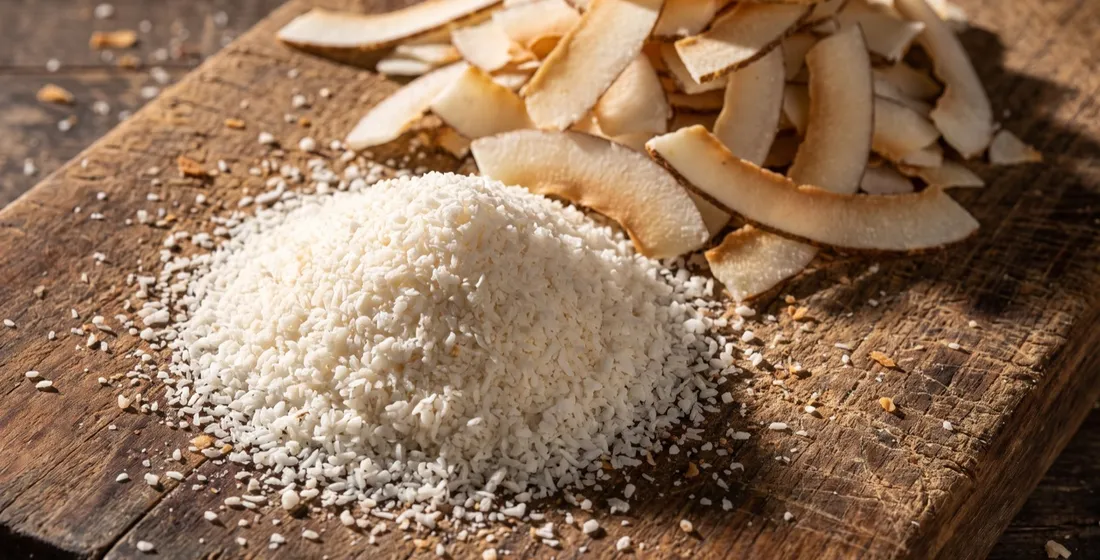
- Fine cuts disperse into a binder or batter. Flakes stay visible, so they suit toppings, clusters and granola where the bite is part of the product.
- First-order MOQ for coconut products is 1 metric tonne, supplied from a BRCGS and FSSC 22000 V6 audited facility in Matale.
A formulator who writes “coconut” into a cereal or snack brief has not yet written a specification. The same kernel can arrive as a fine powder that disappears into a bar binder or as a broad flake that sits on top of a cluster and shows in the pack window. The two are bought on different numbers, tested differently and fail differently. This piece is for the R&D and procurement teams at specialty snack and cereal brands choosing between the formats, and for whoever has to write the line that survives a goods-in check.
Silk Route Ventures (SRV) supplies both through Silk Foods Ceylon (SFC), so the comparison below is drawn from what each format needs on a spec sheet rather than from a sales preference.
What does Codex define, and what does it leave open?
The Codex standard for desiccated coconut classifies product by particle size using square-aperture sieves. Extra-fine means at least 90% of the weight passes 0.85 mm, with no more than 25% passing 0.50 mm. Fine means at least 80% passes 1.40 mm, with no more than 20% passing 0.71 mm. Medium means at least 90% passes 2.80 mm, with no more than 20% passing 1.40 mm.
Everything else, including thin or tender flakes, long chips and shreds, sits under “other sized” desiccated coconut. The standard recognises these as legitimate presentations but sets no sieve test for them. Moisture, at 4% m/m maximum, applies across the board.
| Format | Codex size definition | How you test it | Where the spec has to do the work |
|---|---|---|---|
| Fine | At least 80% passes 1.40 mm; no more than 20% passes 0.71 mm | Sieve analysis | Fat basis, moisture ceiling |
| Medium | At least 90% passes 2.80 mm; no more than 20% passes 1.40 mm | Sieve analysis | Fines fraction, visible flake share |
| Flakes (other sized) | None | Dimension range on the supplier spec | Length, thickness, colour band, broken-flake limit |
A buyer who has only ever bought fine cuts tends to assume flakes arrive with a comparable sieve spec. They do not. The dimensions are the supplier’s, and unless the RFQ states them, the first shipment defines them.
Which format fits which application?
Particle size sets three behaviours that matter on a line: how the coconut disperses, how it takes up liquid, and how it looks in the finished pack.
| Application | Fine desiccated | Flakes |
|---|---|---|
| Bars bound with syrup or nut butter | Disperses evenly, gives a smooth bite | Visible pieces, can feel coarse and shed from the bar edge |
| Granola and clusters | Tends to settle to the bottom of the pack | Holds shape through baking, shows in the pack |
| Cereal coatings and premixes | Flows and coats cleanly | Needs a coating or binder that holds a larger piece, and gentler mixing |
| Baking and confectionery fillings | Bakes into the crumb and keeps fat distribution even | Leaves a chew and a visible texture |
| Topping and decoration | Sprinkles unevenly | Gives the clearest visual cue |
Smaller particles also have more surface per gram, so they pick up moisture and oil faster. That is a benefit in a sticky binder and a risk in a dry cereal premix that sits for weeks. The fat-and-moisture behaviour of the format is covered in the desiccated coconut fat and moisture specification, and the sieve-grade choice for bakery in the desiccated coconut grade selection guide.
Spec snapshot: desiccated coconut and coconut flakes, SFC product pages Energy: 660 kcal per 100 g, both formats Fat: 64 g per 100 g, of which saturated 57 g, both formats Carbohydrate: 23 g, sugars 7 g, fibre 16 g, protein 7 g, both formats Appearance: desiccated is fine, free-flowing and white; flakes are dried, white with a brown edge Shelf life: 12 to 24 months Documents: specification, per-batch Certificate of Analysis, safety data sheet, nutrition facts, process flow MOQ: 1 metric tonne first order
What does the format choice change in a nutrition panel?
Almost nothing, and that is useful to know before a brand argues about it internally. Because both formats are the same dried kernel, the energy and fat figures on the SFC product pages are identical. A 10 g inclusion of either supplies about 6.4 g of fat and about 66 kcal, on the listed 64 g and 660 kcal per 100 g.
What does change is how many grams of coconut fill a given spoon, scoop or pack window, because particle size changes bulk density. Do not assume a gram-for-gram swap gives the same visual coverage, and do not assume a volume-for-volume swap gives the same weight. Ask for bulk density on the spec sheet and run the trial by weight first.
For brands whose pack carries a “reduced fat” or “low fat” story, the fat level is a separate decision from format, and the answer sits in the full-fat versus low-fat formulation guide.
Specifying flakes so the first shipment matches the sample
A short worked scenario shows where this goes wrong. Picture a cereal brand that approves a flake sample, then receives a production lot with a high share of broken pieces. The pack looks like it was filled with fine coconut, the brand’s visual claim of “coconut flakes” is thin, and the supplier’s COA still passes because moisture and fat were in range. Nothing was out of spec, because the spec never described a flake.
The fix is to write the flake into the RFQ. Parameters worth stating, with the numbers coming from your own approved sample rather than a catalogue default:
- Length and thickness range, with the sample retained and sealed as the reference
- Colour band, since flakes can show a brown edge and the brief should say how much is acceptable
- Maximum share of broken pieces or fines, measured on a stated sieve
- Moisture ceiling (4% m/m maximum under Codex) and the method on the COA
- Fat figure with its basis, as received or dry matter
- Foreign matter and total microbial limits, per batch COA
- Pack format and liner, because flakes crush in transit more readily than a free-flowing fine cut
A per-batch Certificate of Analysis and a retained reference sample cover most disputes. The generic RFQ checklist for coconut formats is in the Ceylon desiccated coconut and coconut flour capability brief, and the snack-side options (toasted, roasted, seasoned) are in the coconut chips sourcing spec for snack brands.
When is flake the wrong answer?
Flakes cost the formulator something. They break more in mixing, they separate from a lighter binder, and they show defects a fine cut hides. If the application is a smooth bar, a filling or a coated premix, the visible-flake benefit is not being used, and a fine or medium cut is the more honest and more stable choice.
The reverse is also true. If the pack window or the retail shelf is selling texture, a fine cut will not carry the claim, and no amount of finer sieving will fix that. Decide on the experience first, then pick the format that delivers it.
SRV is not the right supplier for a brief that has no format specification and is bought on price per tonne alone. For brands that will write a size, moisture and fat line and hold a retained sample, the Ceylon coconut supplier page and the product pages for desiccated coconut and coconut flakes list the specification documents, and private-label retail SKUs are covered in the flavoured coconut chips contract manufacturing guide.
Frequently asked questions
What is the difference between desiccated coconut and coconut flakes?
Desiccated coconut is dried, grated coconut sold in sieve-defined cuts: extra-fine, fine and medium under Codex CODEX STAN 177-1991. Flakes are a broader, thinner cut that Codex files under “other sized”, with no sieve limits, so their dimensions come from the supplier spec.
What particle size does fine desiccated coconut have?
Under Codex, fine means at least 80% of the weight passes a 1.40 mm square-aperture sieve, with no more than 20% passing 0.71 mm. Medium means at least 90% passes 2.80 mm, with no more than 20% passing 1.40 mm. Write the cut and the test into the RFQ.
Do desiccated coconut and flakes differ in fat or calories?
On the SFC product pages both list 660 kcal and 64 g fat per 100 g, so the nutrition line does not change with format. Texture, dispersion and bulk density do, so trial by weight and confirm bulk density on the spec.
Does Silk Foods Ceylon supply both formats under private label?
Yes. SFC supplies desiccated coconut and coconut flakes as bulk ingredient and as private-label SKUs from its Matale facility, audited to BRCGS and FSSC 22000 V6, with a per-batch Certificate of Analysis and a 1 metric tonne first-order MOQ for coconut products.
Can SRV develop a custom cut or blend?
The SRV R&D team scopes custom formulation and sample development on a 3 to 4 week timeline from signed brief to approved formulation. Send your target dimensions, fat level and application with the brief.
How Silk Route Ventures can help
Silk Route Ventures (SRV) supplies desiccated coconut and coconut flakes from the Silk Foods Ceylon (SFC) facility in Matale, audited under BRCGS and FSSC 22000 V6, with a per-batch Certificate of Analysis and a 1 metric tonne first-order MOQ. Samples ship door-to-door by international courier (DHL, FedEx, UPS) in 3 to 5 business days, so a snack or cereal team can run both formats through its own line before a purchase order. Production runs 2 to 3 weeks from PO to dispatch, followed by 3 to 4 weeks of sea freight to the EU or Australia, or 4 to 5 weeks to the US. Contact us with your target format, dimensions and application to request a sample pack.
Sources
- Codex Alimentarius, Standard for Desiccated Coconut (CODEX STAN 177-1991), Revision 2011, FAO and WHO. Size definitions for extra-fine, fine, medium and “other sized” cuts; moisture limit. Retrieved October 2026.
- Silk Route Ventures, Desiccated Coconut and Coconut Flakes product pages, esilkroute.com.lk, nutrition and shelf-life figures, retrieved October 2026.
Written by the Silk Route Ventures Trade Team. Silk Route Ventures (E-Silk Route Ventures Ltd) is a Sri Lankan B2B supply-chain operator for the Food, Beverage, Wellness, and Nutraceuticals sectors. The Silk Foods Ceylon manufacturing arm holds BRCGS and FSSC 22000 V6 certifications. Questions or to request a sample: Contact us or email info@esilkroute.com.lk.