
Flavored Coconut Chips: Retail SKU Contract Manufacturing
Buyer’s snapshot
- Coconut stopped being a major food allergen in the United States on 6 January 2025, when the Food and Drug Administration finalised Edition 5 of its allergen labelling guidance. A great deal of coconut snack artwork still carries a “Contains: Tree Nuts” line that is now wrong.
- Inside one European food category, dried coconut is capped at 50 mg/kg sulphur dioxide while dried pineapple sits at 500 mg/kg and dried ginger at 150 mg/kg. A four-inclusion bag has to be specified against the tightest of them.
- Silk Foods Ceylon runs flavored coconut chip retail packs in Matale under BRCGS and FSSC 22000 V6, with first-order quantities set per SKU rather than per order.
- The table below sets the United States and European label rules side by side on the same pack.
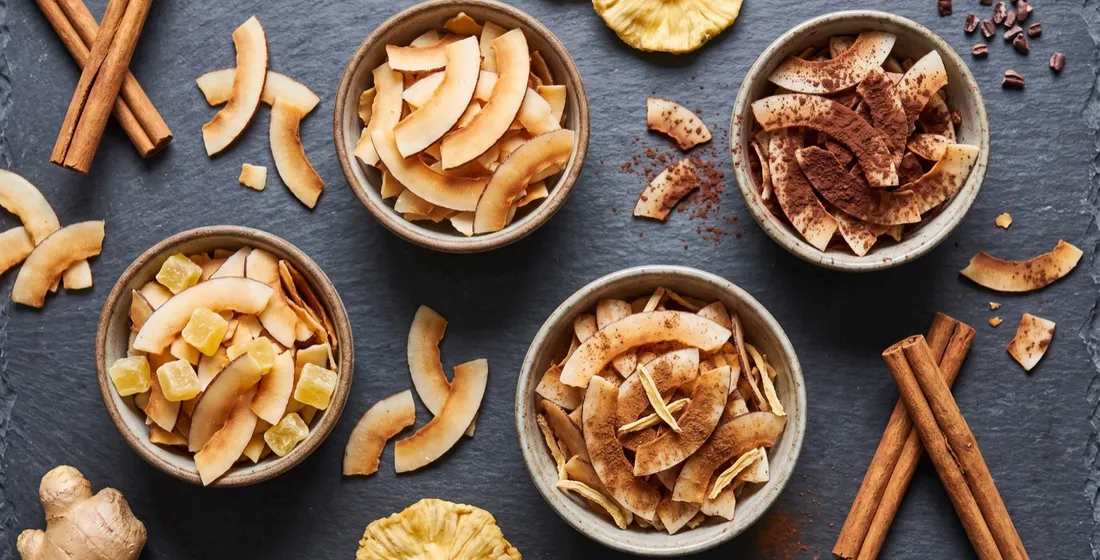
A brand owner asking a contract manufacturer for “coconut chips with cocoa, pineapple, cinnamon and ginger” is asking for four different regulatory outcomes in one pouch. The chip itself is the easy part. The specification for the base material is settled ground, and if you want the moisture, water activity and processing route detail it is already written up in the full coconut chip spec covering the three processing routes. What is not settled, and what almost no supplier page addresses, is what happens to the label, the shelf life and the liability once those four inclusions land in a finished consumer pack that carries your brand name rather than your customer’s purchase order number.
Coconut is the third most common tropical fruit flavor in global food and beverage launches, behind mango and banana, according to Innova Market Insights data reported by the Institute of Food Technologists in July 2026. Pineapple sits close behind in United States introductions. The pairing is commercially obvious. The labelling consequences of the pairing are not.
This is a contract manufacturing brief rather than a sourcing brief. It covers what a brand owner personally owns before tooling up a flavored retail SKU, what the factory owns, and where the two meet.
What changes when a coconut chip becomes a retail SKU
A bulk consignment of toasted coconut chips travels on a certificate of analysis, a packing list and a purchase specification. Nobody outside the buying company reads any of them. A retail pack travels on a printed panel that a regulator, a retailer’s technical team and a consumer can all read, and every claim on it has to be defensible from the batch record backwards.
Three duties transfer to the brand owner at that moment. The first is flavor naming, governed in the United States by 21 CFR 101.22, which prescribes letter heights and qualifying phrases for every characterizing flavor named on the principal display panel. The second is quantitative ingredient declaration, governed in Europe by Article 22 of Regulation (EU) No 1169/2011, which fires whenever an ingredient is named in the product name or emphasised in pictures. The third is the added-sugar record-keeping duty in 21 CFR 101.9(c)(6)(iii), which is triggered specifically where added sugars in a food undergo fermentation or non-enzymatic browning. A toasted, sugar-coated coconut chip browns by design.
None of those three duties exist on a bulk purchase order. All three exist the moment the product is packed for shelf, and all three sit with the brand owner rather than the co-manufacturer unless the supply agreement says otherwise.
Why the 2025 allergen change makes most coconut snack artwork wrong
On 6 January 2025 the Food and Drug Administration finalised Edition 5 of Questions and Answers Regarding Food Allergen Labeling. It cut the working tree-nut list from 23 to 12 species. Coconut came off, along with beechnut, butternut, chestnut, chinquapin, ginkgo nut, hickory nut, palm nut, pili nut, shea nut and kola nut. The twelve that remain are almond, black walnut, Brazil nut, California walnut, cashew, filbert or hazelnut, heartnut or Japanese walnut, macadamia or bush nut, pecan, pine nut, pistachio and walnut.
The practical consequence is that a coconut chip pack sold into the United States should no longer carry coconut in a “Contains: Tree Nuts” statement. Coconut is still declared by its common name in the ingredient list, as any ingredient is. It is no longer a major food allergen. Europe never treated it as one: Annex II point 8 of Regulation (EU) No 1169/2011 lists eight nut species by botanical name, and coconut appears nowhere among the fourteen allergen groups.
Here is the part that catches brand owners out. The allergen work on this particular SKU goes up, not down. Cocoa is not an allergen in either jurisdiction. The carrier system behind a cocoa coating very often is. Compliance Policy Guide Sec. 555.250 requires that a major food allergen present as a component of a flavoring, a coloring or an incidental additive still be declared, either by disclosing the source in the ingredient list or in the “Contains” statement, and treats failure to do so as a section 403(w) violation. A milk-derivative carrier inside a cocoa flavor system is exactly that case. So the delisting removes a line that was never needed and leaves in place a line that is frequently missed.
Buyer’s checklist
- Confirm whether current artwork still names coconut in a “Contains” statement, and remove it if so.
- Ask the flavor house for a written composition statement covering carriers, not only the flavor identity.
- Under 21 CFR 101.22(i)(4), a supplier certification that a flavor contains no artificial flavor must be retained for the period of supply plus a minimum of three years. Decide now who holds that file.
- Check whether the cocoa system introduces milk or soy, and reflect it in the ingredient list before plates are cut.
The sulphite ceiling that governs a four-inclusion bag
Sulphur dioxide is where a flavored coconut chip specification quietly fails. Commission Regulation (EU) No 1129/2011 established the Union list of food additives, and within Annex II Part E food category 04.2.1, covering dried fruit and vegetables, the permitted levels for E 220 to E 228 are not one number. They are ten, and the spread across the inclusions in a single coconut chip bag is tenfold.
| Material in the bag | Maximum SO2 under EU food category 04.2.1 | What it means for a blended SKU |
|---|---|---|
| Dried coconut | 50 mg/kg | The tightest line in the category and the one a coconut-named SKU is measured against |
| Dried ginger | 150 mg/kg | Three times the coconut ceiling, so a sulphited ginger inclusion can carry the finished blend over |
| Dried fruit other than apples, pears, bananas, apricots, peaches, grapes, prunes and figs, which covers dried pineapple | 500 mg/kg | Ten times the coconut ceiling and the largest single contributor risk in this recipe |
| Dried mushrooms, for comparison | 100 mg/kg | Included to show the category is not governed by one number |
| Any of the above | Below 10 mg/kg total | Footnote 3 treats SO2 below 10 mg/kg as not present |
Two things follow. The maximum levels are expressed as total SO2 and relate to the total quantity available from all sources, so the arithmetic is done on the finished blend rather than on each inclusion separately. And 10 mg/kg is not only the analytical floor: Annex II point 12 of Regulation (EU) No 1169/2011 makes sulphur dioxide and sulphites a declarable allergen above 10 mg/kg expressed as total SO2. Cross that line and the pack needs sulphites emphasised in the ingredient list under Article 21.
The United States handles this differently and the asymmetry matters. There is no numeric ceiling for dried coconut in the United States equivalent to the European 50 mg/kg. The control is the declaration threshold in 21 CFR 101.100(a)(4), which requires sulfiting agents to be declared at or above 10 ppm in the finished food, including where they arrive through an ingredient or a processing aid. So a heavily sulphited pineapple inclusion can be legal on a United States pack and simultaneously put the same recipe over the line in Europe. If the plan is one recipe for both markets, the European ceiling is the design constraint, and the pineapple has to be bought unsulphited or lightly sulphited from the outset.
The Netherlands Ministry of Foreign Affairs, through its CBI market information programme, confirmed the 50 mg/kg figure for dried coconut as recently as December 2023. The European Food Safety Authority is running a re-evaluation of sulphur dioxide and sulphites, so the consolidated Annex II should be checked before a specification is signed rather than taken from an article.
Does the Codex desiccated coconut standard cover a flavored chip?
No, and this is worth knowing before a competing supplier tells you otherwise. Section 1 of Codex Standard CXS 177-1991, revised 2011, states in terms that the standard does not cover salted, sugared, flavored or roasted products. A cocoa-dusted, sugar-coated, toasted coconut chip is all four of those things in a single product.
The standard is still useful, just not as a compliance claim for the finished SKU. It gives the base kernel specification that a co-manufacturer should be buying against: moisture no more than 4 percent by mass, total acidity of the extracted oil no more than 0.3 percent by mass measured as lauric acid, oil content at least 60 percent by mass for a full-fat grade, ash no more than 2.5 percent, extraneous vegetable material no more than 15 fragments per 100 g, and no foreign matter in 100 g. Those are the numbers to write into the raw material line of a specification. CBI notes that commercial practice runs tighter than the Codex ceiling on moisture.
What CXS 177 does not do is set a sulphite limit. It delegates additives to the General Standard for Food Additives under food category 04.1.2.2. So a supplier quoting “Codex compliant” on a flavored retail chip is quoting a standard that excludes the product by its own scope clause, and quoting one that would not answer the sulphite question even if it applied.
What each of the four flavor systems adds to the SKU
The four inclusions do not behave alike. Each brings a different declaration trigger, and the differences are what a brand owner needs in front of them before the artwork brief goes out.
| Inclusion | Main declaration trigger | Specification consequence |
|---|---|---|
| Cocoa | Allergen carriers inside the flavor system under Compliance Policy Guide Sec. 555.250; European quantitative ingredient declaration under Article 22 if cocoa is named or pictured | Requires a written flavor composition statement, not only a flavor identity certificate |
| Pineapple | Sulphite contribution against the 50 mg/kg coconut ceiling; quantitative ingredient declaration if pictured on the front of pack | Buy unsulphited or specify a maximum in the purchase order, because the finished blend carries the total |
| Cinnamon | Characterising flavor naming under 21 CFR 101.22(i); quantitative declaration in Europe if named | Distinguish true cinnamon from cassia in the specification, since the two are different botanicals at different price points |
| Ginger | Sulphite contribution at up to 150 mg/kg for the dried inclusion; quantitative declaration if named | Decide crystallised against plain dried, because a crystallised inclusion adds sugar to the added-sugars line |
Layered over all four is the naming arithmetic in 21 CFR 101.22(i). Where a food has no artificial flavor, the common name of the characterizing flavor must appear on the principal display panel in letters not less than one-half the height of the letters used in the name of the food. Where a natural flavor from a different source supplements the named one, “with other natural flavor” must follow it at not less than one-half the height of the characterizing flavor letters. Where an artificial flavor simulates or reinforces the characterizing flavor, “artificial” or “artificially flavored” must appear at the same relative height. And 101.22(i)(3) requires that wherever the characterizing flavor name appears conspicuously on the label, the prescribed words immediately precede or follow it with no intervening written, printed or graphic matter.
Run that across four flavor words on one front panel and the typography brief stops being a design decision. It becomes a constraint the designer has to be given before the first layout.
The pack-size decision is a label decision
Pack format on this category is usually argued on cost per gram. The regulatory thresholds are more binding than the freight maths.
| Rule | United States | European Union |
|---|---|---|
| Coconut as a declarable allergen | No, since 6 January 2025 | No, never listed in Annex II |
| Sulphites declaration threshold | 10 ppm total SO2 in the finished food | 10 mg/kg total SO2 |
| Numeric SO2 ceiling on dried coconut | None specified | 50 mg/kg under food category 04.2.1 |
| Characterising flavor naming | Prescribed letter heights under 21 CFR 101.22(i) | No direct equivalent |
| Quantitative ingredient declaration | Not generally required | Required under Article 22 where named or pictured |
| Minimum print size | No general x-height rule | 1.2 mm x-height, falling to 0.9 mm where the largest surface is under 80 cm² |
| Small pack relief | Not applicable | Under 10 cm² largest surface, the ingredient list and nutrition declaration may be omitted from the pack |
| Dual-column nutrition panel | Required where the pack holds 200 to 300 percent of the applicable reference amount | Not applicable |
The dual-column trigger in 21 CFR 101.9(b)(12)(i) is the one that most often forces a rethink. A single-serve pouch and a large share bag are both straightforward. A mid-size bag sitting between two and three times the reference amount customarily consumed for the snack category has to carry both a per-serving and a per-container column, which costs panel area on a pack that has already spent its front face on four flavor words. Confirm the applicable reference amount in 21 CFR 101.12 before the pack weight is fixed, because moving the fill weight by a few grams is far cheaper than redrawing the panel.
At the European end, the 80 cm² and 10 cm² thresholds in Articles 13 and 16 govern whether a sachet or a small trial pack can carry a compliant panel at all. Both are measured on the largest surface of the pack, not on the printed area.
Shelf life on this product is a rancidity clock
Coconut chips fail on fat, not on water. A 2022 kinetic study of dried coconut chips published in Processes modelled peroxide value change as zero-order with an activation energy of 11.83 kJ per mole, and identified rancidity rather than colour or crispness as the limiting quality attribute. The predicted shelf life came out at 194 days refrigerated, 159 days at room temperature and 115 days at 55 degrees Celsius.
That spread is the code-date conversation in one line. A brand owner who wants an 18-month date on a high-fat toasted chip is asking the barrier structure and the storage chain to do work that the fat chemistry may not support, and the honest answer from a co-manufacturer is a shorter date rather than a heavier film.
The microbiological picture is calmer than the category’s reputation suggests. Food Standards Australia New Zealand assessed dried coconut and Salmonella in November 2016 and did not classify it as a medium or high risk to public health. Of 870 Salmonella tests on imported dried coconut between January 2007 and May 2016, 11 failed, a rate of 1.3 percent. The European rapid alert system recorded nine notifications for Salmonella in desiccated and dehydrated coconut across the same period. The single documented outbreak the review found in a literature sweep from 1990 was in England in 1998 and 1999: 18 cases of Salmonella Java linked to one consignment.
The mechanism still deserves respect. Salmonella does not grow below a water activity of 0.93, which a dried chip sits comfortably beneath, but it survives for months in low-moisture foods, and a high-fat low-moisture matrix protects the organism against thermal inactivation. That is why the validated kill step matters more than the finished-product test. The FSANZ review cites pasteurisation of the coconut meat in a water bath at 80 degrees Celsius for 8 to 10 minutes as effective, applied before drying rather than after. On a private-label brief, the question to ask is not “do you test for Salmonella” but “where in the process is the validated kill step, and what is the record”. A finished-product sampling plan at n=10, c=0, not detected in 25 g, which is the Australian benchmark, is a verification, not a control.
Certification snapshot
- Silk Foods Ceylon holds BRCGS and FSSC 22000 V6 covering the processing scope at the Matale site, which satisfies the Global Food Safety Initiative gating filter most multiple retailers apply before a supplier can be specified into a listing.
- USDA Organic and EU Organic are held per SKU, with traceability enforced to farm level on organic lines.
- Every batch ships against a certificate of analysis. Organic consignments add an organic transaction certificate to the document pack.
How Silk Foods Ceylon runs a flavored retail SKU
Silk Foods Ceylon (SFC) operates a 10,000 square foot cellular manufacturing site at Hapugasyaya, Nalanda, in Matale, around 1 km from the Nalanda Gedige. The cellular layout is the reason a new flavored chip SKU does not require a separate audit cycle to introduce: the certification scope covers the processing range rather than a single line.
Dry processing on spices, herbs and powders runs at 100 to 200 kg per hour, which is 1 to 2 metric tonnes per production day. Sample dispatch by international courier runs 3 to 5 business days. Purchase order to dispatch is 2 to 3 weeks. Sea freight is 3 to 4 weeks to Europe and 4 to 5 weeks to the United States. Bulk coconut lines carry a 1 metric tonne minimum, while spice, herb and powder SKUs carry a 50 kg minimum per SKU rather than per order, which is the distinction that matters on a multi-flavor launch where a brand wants four variants at small volume rather than one variant at large volume. If the launch economics are the sticking point, when a low-MOQ contract manufacturer is worth it works through the trade-off in detail.
Coconut is not a marginal category for Sri Lanka. Coconut-based product exports reached USD 1,233.01 million in 2025, up 42.66 percent year on year, according to the Sri Lanka Export Development Board in January 2026, having passed the billion-dollar mark for the first time within the first ten months of the year. That growth is concentrated in kernel products, oil, cream and milk. Flavored retail chips remain a small share of it, which is precisely why the manufacturing base for them is shallower than the raw material base and why a brand owner should ask about finished-pack capability specifically rather than assuming it follows from coconut capacity.
One recurring pattern from the procurement side is worth naming. Brand owners routinely arrive with a flavor brief, a pack mock-up and a target landed cost, and no sulphite specification on the fruit inclusion. The inclusion is sourced separately, often from a different country to the coconut, and it is the inclusion rather than the coconut that decides whether the finished blend clears the European ceiling. The fix costs nothing at brief stage and costs a rework at artwork stage. Related decisions on coating systems and label naming are covered in private labelling spices and coated flavor systems, and the wider capability picture in coconut sourcing and contract manufacturing in Sri Lanka.
Where Silk Route Ventures walks away
- Briefs that require an 18-month ambient code date on a high-fat toasted chip without a barrier structure and a storage chain to support it.
- Recipes where the fruit inclusion has to be bought sulphited to hit a target cost and the pack is destined for the European Union.
- Requests to describe a flavored retail SKU as compliant with a standard that excludes flavored products by its own scope clause.
Frequently asked questions
Does Silk Route Ventures offer private label for flavored coconut chips?
Yes. Silk Route Ventures runs private label and contract manufacturing for finished coconut chip retail packs from the Silk Foods Ceylon site in Matale, under BRCGS and FSSC 22000 V6. Purchase order to dispatch runs 2 to 3 weeks once the specification and artwork are approved.
Is coconut still a tree nut allergen in the United States?
No. The Food and Drug Administration finalised Edition 5 of its allergen labelling guidance on 6 January 2025 and removed coconut from the tree nut list, which fell from 23 species to 12. Coconut is still named in the ingredient list but should not appear in a “Contains: Tree Nuts” statement.
What sulphur dioxide limit applies to a coconut and pineapple chip sold in Europe?
Dried coconut is capped at 50 mg/kg under food category 04.2.1 of the Union additive list, against 500 mg/kg for the dried fruit line that covers pineapple. The limit is expressed as total SO2 from all sources on the finished blend, and anything above 10 mg/kg must be declared as an allergen.
What is the contract manufacturing minimum for a multi-flavor coconut chip launch?
Spice, herb and powder lines carry a 50 kg minimum per SKU rather than per order, so a four-variant launch is specified as four separate minimums. Bulk coconut lines carry a 1 metric tonne minimum. Samples ship by international courier in 3 to 5 business days.
How long will a flavored coconut chip keep?
A 2022 kinetic study in Processes predicted 159 days at room temperature and 194 days refrigerated for dried coconut chips, with oxidative rancidity rather than moisture pickup as the limiting attribute. Barrier film, fill atmosphere and the storage chain move that figure more than the drying spec does.
How Silk Route Ventures can help
Silk Route Ventures (SRV) contract-manufactures finished retail SKUs, including flavored and coated coconut chip formats, at the Silk Foods Ceylon (SFC) site in Matale. The site holds BRCGS and FSSC 22000 V6 covering the processing scope, with USDA Organic and EU Organic held per SKU, so a co-manufactured pack can be specified into a retail listing without an additional supplier audit. The cellular layout means a new flavor variant does not trigger a separate audit cycle, and the research and new product development team scopes the coating system, the inclusion specification and the sulphite arithmetic alongside the production plan rather than after it. Minimums are set per SKU, which suits a multi-variant launch better than a single high-volume run. Contact us to send an inquiry for a co-manufacturing capability briefing on your pack format and target launch volume. For buyers consolidating several categories under one supplier, the buyer’s guide to organic certifications and the retail SKU packaging economics worked through on glass-bottle coconut formats are the two most useful companions to this piece. Certifications, MOQs and lead times are listed on our coconut products supplier.
Sources
- Food and Drug Administration, Guidance for Industry: Questions and Answers Regarding Food Allergen Labeling (Edition 5), finalised 6 January 2025. https://www.fda.gov/regulatory-information/search-fda-guidance-documents/guidance-industry-questions-and-answers-regarding-food-allergen-labeling-edition-5 (retrieved 9 August 2026)
- Food and Drug Administration, Compliance Policy Guide Sec. 555.250, Major Food Allergen Labeling and Cross-contact. https://www.fda.gov/media/168000/download (retrieved 9 August 2026)
- 21 CFR 101.22, Foods; labeling of spices, flavorings, colorings and chemical preservatives, Code of Federal Regulations 2024 edition. https://www.govinfo.gov/content/pkg/CFR-2024-title21-vol2/pdf/CFR-2024-title21-vol2-sec101-22.pdf (retrieved 9 August 2026)
- 21 CFR 101.9, Nutrition labeling of food, Code of Federal Regulations 2024 edition. https://www.govinfo.gov/content/pkg/CFR-2024-title21-vol2/pdf/CFR-2024-title21-vol2-sec101-9.pdf (retrieved 9 August 2026)
- Commission Regulation (EU) No 1129/2011 establishing a Union list of food additives, Annex II Part E, food category 04.2.1, Official Journal L 295, 12 November 2011. https://eur-lex.europa.eu/LexUriServ/LexUriServ.do?uri=OJ%3AL%3A2011%3A295%3A0001%3A0177%3Aen%3APDF (retrieved 9 August 2026)
- Regulation (EU) No 1169/2011 on the provision of food information to consumers, Articles 13, 16, 21 and 22 and Annex II. https://www.legislation.gov.uk/eur/2011/1169/contents (retrieved 9 August 2026)
- Codex Alimentarius, Standard for Desiccated Coconut, CXS 177-1991, revised 2011, FAO and WHO. https://www.fao.org/input/download/standards/261/CXS_177e.pdf (retrieved 9 August 2026)
- Food Standards Australia New Zealand, Imported food risk statement: dried coconut and Salmonella spp., November 2016. https://www.foodstandards.gov.au/sites/default/files/2023-11/Dried%20coconut%20and%20Salmonella.pdf (retrieved 9 August 2026)
- Choosuk, Meesuk, Renumarn, Phungamngoen and Jakkranuhwat, Kinetic Modeling of Quality Changes and Shelf Life Prediction of Dried Coconut Chips, Processes 2022, 10(7):1392. https://doi.org/10.3390/pr10071392 (retrieved 9 August 2026)
- CBI, Netherlands Ministry of Foreign Affairs, Entering the European market for desiccated coconut, updated 18 December 2023. https://www.cbi.eu/market-information/processed-fruit-vegetables-edible-nuts/desiccated-coconuts/market-entry (retrieved 9 August 2026)
- Sri Lanka Export Development Board, Sri Lanka’s export performance exceeded US$ 17.2 billion in 2025, 26 January 2026. https://www.srilankabusiness.com/news/sri-lankas-export-performance-exceeded-us-17.2-billion-in-2025.html (retrieved 9 August 2026)
- Institute of Food Technologists, The New Tropical Fruit Palette, Food Technology magazine, 22 July 2026, citing Innova Market Insights. https://www.ift.org/food-technology-magazine/the-new-tropical-fruit-palette (retrieved 9 August 2026)