
Coconut Treacle vs Kithul Treacle: Glass-Bottle Retail SKUs and Ingredient-Supply Specs
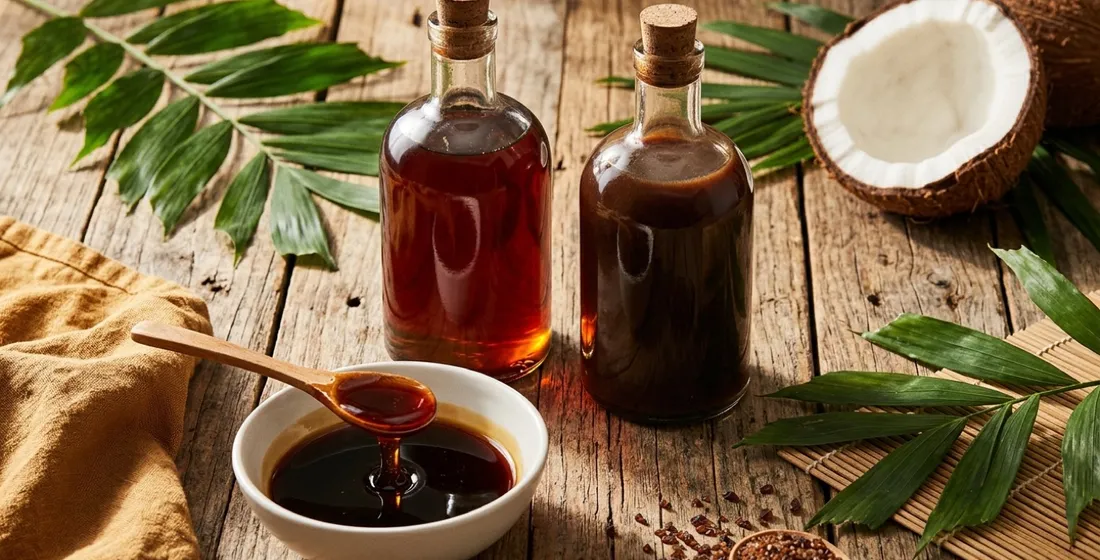
Buyer’s snapshot
- Kithul treacle and coconut treacle are two different dark palm syrups. Kithul comes from the tapped flower sap of the fishtail palm (Caryota urens); coconut treacle from the flower sap of the coconut palm (Cocos nucifera). They look alike in a bottle and diverge on a spec sheet.
- Kithul’s low glycemic position is the better-evidenced of the two. Two peer-reviewed Sri Lankan studies place it at GI 27.8 to 35 (Ceylon Medical Journal, 2022). Coconut sap’s popular GI 35 traces to a single 2010 Philippine study.
- Both are added sugars for US and EU labeling. The US FDA declares syrups under Added Sugars; the EU has not authorised a general low glycaemic index health claim (EFSA, 2010). Low GI is a sourcing story, not a free on-pack claim.
- Kithul treacle is a documented adulteration target. Sap is routinely cut with cane sugar; a 2017 Sri Lankan survey of 304 tappers across all 12 kithul-producing districts mapped the drivers.
- Silk Route Ventures (SRV) supplies both syrups in glass-bottle retail and bulk from a BRCGS and FSSC 22000 V6 audited Matale facility, on a semi-liquid line running 3,000 bottles a day, with a 1,500-bottle private-label MOQ.
Most buyers shopping for a natural low-GI palm syrup treat kithul treacle and coconut treacle as interchangeable. They are not. Different palm, different sap, different evidence behind the health story, and a very different adulteration risk. One of the two gets cut with cane sugar often enough that Sri Lankan scientists built a field test for it. For a brand putting a dark syrup in a glass bottle and a provenance claim on the label, the spec choice starts well before the first sample. This piece is that spec.
What is the difference between coconut treacle and kithul treacle?
Kithul treacle is the boiled flower sap of the fishtail palm, Caryota urens, tapped by hand and reduced to a dark, pourable syrup. Coconut treacle is the same idea from a different tree: the tapped flower sap of the coconut palm, Cocos nucifera, boiled down. Both are single-ingredient palm syrups, and the botanical source is the first thing a certificate of analysis should confirm, because it drives flavour, sugar profile, and the provenance claim.
Kithul is the more distinctly Sri Lankan of the two. The fishtail palm grows across the island’s wetter hill country, and the sap is drawn from the flower before it is boiled, a labour-intensive craft that has stayed largely artisanal (Ceylon Medical Journal, 2022). Coconut treacle sits inside the much larger coconut-sap family that also yields coconut sugar and coconut nectar; the syrup is simply the liquid form before crystallisation.
The flavour gap is real, and it matters for formulation. Kithul carries a deep, slightly smoky caramel note that anchors Sri Lankan desserts like curd and treacle. Coconut treacle is rounder, closer to butterscotch. Neither reads as neutral. A brand dropping either one into a recipe built for cane or maple should expect a flavour shift, not a like-for-like swap.
At a glance: kithul treacle vs coconut treacle
| Parameter | Kithul treacle | Coconut treacle |
|---|---|---|
| Botanical source | Fishtail palm sap (Caryota urens) | Coconut palm sap (Cocos nucifera) |
| Glycemic index evidence | GI 27.8 to 35 across two peer-reviewed studies | GI 35 from one 2010 study; reviews report 35 to 54 |
| Dominant sugars | Glucose-rich; about 28% glucose, about 81% total carbohydrate (dry basis) | Sucrose-dominant, 78 to 89% sucrose; 3 to 4% glucose and fructose |
| Typical moisture | About 28% (Ceylon Medical Journal, 2022) | Comparable boiled-syrup range |
| Flavour | Deep, smoky caramel | Rounder, butterscotch |
| Adulteration risk | High; commonly cut with cane sugar | Present across all palm sugars |
| Supply base | Artisanal, wet-zone Sri Lanka | Broader coconut-sap supply chain |
Source: SRV facility data plus Ceylon Medical Journal 2022 and Foods (MDPI) 2023.
Can a brand put “low GI” on a treacle label?
Not freely, in either major market. The US FDA treats palm syrups as added sugars and requires them declared under Added Sugars on the Nutrition Facts panel (FDA, Added Sugars on the Nutrition Facts Label). In the EU, EFSA assessed general low glycaemic index health claims in 2010 and did not authorise them for lack of substantiation (EFSA Journal, 2010). Glycemic index is a property of a finished food measured in people, not a number that travels on a syrup COA.
The two syrups do not rest on equal evidence, though. Kithul treacle’s low-GI position draws on two separate peer-reviewed Sri Lankan studies, which report GI values between 27.8 and 35 and tie the effect to alpha-glucosidase inhibitory activity in the sap (Ceylon Medical Journal, 2022). Coconut sap’s famous GI 35 comes from a single 2010 Philippine study (Trinidad and colleagues, Journal of Functional Foods), and later reviews stretch the real range to 35 to 54 (Foods, 2023). The contested coconut GI number gets its own breakdown in a separate post.
For a buyer the practical rule is the same for both. Use the GI evidence to choose the ingredient and to brief the sales team, not to print a claim the finished product cannot carry. A syrup that counts against the 50 g Added Sugars Daily Value (FDA, 2016) is a thin base for a front-of-pack health message, whichever palm it came from.
Why the cheaper kithul bottle is often cut with cane sugar
Kithul treacle sells at a premium to cane syrup, and the sap yield is unreliable, so adulteration is common. A 2017 study in the Sri Lanka Journal of Social Sciences surveyed 304 kithul tappers across 101 villages in all 12 producing districts and found cane-sugar cutting rose with rainy-weather harvests and long tapping cycles. To an importer, the premium bottle and the adulterated bottle look identical.
The tell is not in the appearance; it is in the sugar chemistry. Genuine kithul sap is glucose-rich, so a shift in the ratio of reducing to non-reducing sugars flags cane sugar cut into the batch. Sri Lanka’s Industrial Technology Institute built a field test kit on that exact principle to catch cane adulteration in kithul sap and treacle. A standard COA that stops at Brix and microbial counts will pass a cane-cut lot without a flag.
The SRV procurement desk sees the pattern from the buyer side. In 2025 a US specialty-foods brand that had sampled Ceylon kithul treacle from three separate traders sent all three for sugar-profile testing before committing. Two came back consistent with added cane sugar. The one that passed cost more per litre. That gap, more per litre for the un-cut syrup, is the whole sourcing problem in a single line.
What buyers screen a boiled palm syrup on
A treacle spec is short, but each parameter earns its place. Botanical source confirms the buyer is paying for the palm on the label. Brix and moisture govern shelf life and sweetness; the Ceylon Medical Journal reported kithul treacle moisture around 28% in 2022, and a syrup wetter than its spec invites fermentation. Hydroxymethylfurfural, or HMF, rises when a syrup is over-heated or aged, so it works as a processing-quality marker for any boiled sap product. The authenticity test is what separates a real premium lot from a cane-cut one.
Spec snapshot: bulk kithul or coconut treacle
- Botanical source: Caryota urens or Cocos nucifera sap, confirmed in writing
- Total soluble solids (Brix) and moisture: specified per batch (kithul treacle about 28% moisture, Ceylon Medical Journal 2022)
- HMF: monitored as a heat and ageing marker for boiled syrups
- Colour and viscosity: matched to the buyer’s approved reference sample
- Microbial: total plate count, yeast and mould, Salmonella, E. coli
- Authenticity: reducing to non-reducing sugar ratio to screen for cane-sugar cutting
- Certification: BRCGS and FSSC 22000 V6; USDA Organic and EU Organic on selected SKUs, confirmed per SKU
Glass-bottle retail SKUs and the private-label math
Treacle is a glass-bottle retail product first. Both syrups run on the same semi-liquid filling line at the Silk Foods Ceylon (SFC) facility, which fills 3,000 bottles or jars a day. Private-label MOQ for a glass SKU is 1,500 bottles, low enough for a specialty brand to test a launch without booking a full container. The cost drivers are the syrup, the glass, and the fill, in that order.
The retail decision is usually format before flavour. A 250 ml or 350 ml flint-glass bottle with a tamper band reads as premium and shields the dark syrup from light. The same glass-jar SKU economics that govern coconut cream and shelf-stable glass-jar spreads apply here: glass, closure, and labour move the landed cost more than a small change in syrup grade does.
Buyers running this comparison usually split two ways: brand owners specifying ingredient supply against an existing co-packer, and specialty brands wanting a finished private-label bottle. SRV serves both. The spec above holds whether the order is a drum of bulk treacle or a pallet of retail-ready glass, and the certified SKUs ship with USDA Organic or EU Organic transaction certificates where the organic claim needs to survive downstream.
Where SRV’s treacle fit ends
- Lowest-shelf sweetener programmes and buyers who need a neutral, cheapest-per-litre syrup. If the brief is a commodity dark syrup with no provenance or clean-label story, refined cane syrup or a generic blended palm syrup is the more honest answer than premium single-origin treacle at a stretched price.
Which syrup fits which brief?
Choose kithul treacle when the brand story is Sri Lankan provenance, artisanal sourcing, and a better-evidenced low-GI position, and when the supply chain can absorb a higher, more variable raw-material cost. Choose coconut treacle when the brand sits inside a wider coconut range, wants a rounder flavour, and needs a more consistent, scalable supply base.
The two are less competitors than two answers to two briefs. A distributor building a Sri Lankan specialty cabinet wants kithul on the shelf because nothing else carries the same origin story. A coconut-forward brand extending from coconut sugar into a pourable format wants coconut treacle to keep the Ceylon coconut range coherent. The mistake is treating them as one line item and letting price alone decide.
Frequently asked questions
What is kithul treacle made from?
Kithul treacle is the boiled flower sap of the fishtail palm, Caryota urens, tapped by hand across Sri Lanka’s wet-zone hill country. Two peer-reviewed studies place its glycemic index between 27.8 and 35 (Ceylon Medical Journal, 2022), which is why it is positioned as a low-GI natural sweetener rather than a plain syrup.
Is kithul treacle or coconut treacle lower GI?
Kithul treacle has the stronger evidence. Two Sri Lankan studies report GI 27.8 to 35, while coconut sap’s GI 35 rests on a single 2010 Philippine study, with reviews reporting up to 54 (Foods, 2023). Both are added sugars, and the EU has not authorised a general low-GI health claim (EFSA, 2010).
How is kithul treacle adulteration detected?
Genuine kithul sap is glucose-rich, so cane sugar cut into a batch shifts the ratio of reducing to non-reducing sugars. Sri Lanka’s Industrial Technology Institute developed a field test on that principle. A 2017 survey of 304 tappers across all 12 kithul districts (Sri Lanka Journal of Social Sciences) documented how widespread the practice is.
Does SRV offer private label for coconut or kithul treacle?
Yes. Silk Route Ventures runs private-label glass-bottle treacle from the BRCGS and FSSC 22000 V6 audited Silk Foods Ceylon facility in Matale, on a semi-liquid line filling 3,000 bottles a day, with a 1,500-bottle first-run MOQ. Samples ship door-to-door by international courier in 3 to 5 business days.
How Silk Route Ventures can help
Silk Route Ventures (SRV) supplies kithul treacle and coconut treacle in bulk and finished private-label glass to specialty brands and distributors across the US, EU, and Australia. Bulk syrup ships against the buyer’s spec from the BRCGS and FSSC 22000 V6 audited Silk Foods Ceylon (SFC) facility in Matale, with a COA on every batch, reducing to non-reducing sugar-ratio authentication available on premium lots, and USDA Organic and EU Organic transaction certificates on the certified SKUs. The semi-liquid line fills 3,000 bottles a day; private-label MOQ is 1,500 bottles; samples ship by international courier in 3 to 5 business days. For brands ready to launch a treacle SKU under their own label, SRV runs end-to-end private label from the same site. Contact us to send an inquiry or request a sample. For grades, packaging and lead times, see our coconut products supplier.
Sources
- Weeraratne and Ekanayake, “Kithul (Caryota urens) treacle: A healthy natural sweetener?”, Ceylon Medical Journal, 2022. Retrieved 2026-07-08. https://cmj.sljol.info/articles/10.4038/cmj.v67i1.9553
- “Glycemic Index of Caryota urens (Kithul) Treacle and Jaggery”, 2018. Retrieved 2026-07-08. https://www.researchgate.net/publication/322790116
- “Coconut Sugar: Chemical Analysis and Nutritional Profile”, Foods (MDPI) / PMC9964017, 2023. Retrieved 2026-07-08. https://pmc.ncbi.nlm.nih.gov/articles/PMC9964017/
- Trinidad and colleagues, “Glycemic index of commonly consumed carbohydrate foods in the Philippines”, Journal of Functional Foods, 2010. Retrieved 2026-07-08. https://www.researchgate.net/publication/251706338
- US Food and Drug Administration, “Added Sugars on the Nutrition Facts Label”, 2016. Retrieved 2026-07-08. https://www.fda.gov/food/nutrition-facts-label/added-sugars-nutrition-facts-label
- European Food Safety Authority, “Scientific Opinion on low glycaemic index / glycaemic response health claims”, EFSA Journal 8(2):1491, 2010. Retrieved 2026-07-08. https://www.efsa.europa.eu/en/efsajournal/pub/1491
- Seneviratne and Dissanayake, “A study on the practice of adulteration of Kitul (Caryota urens) sap products in Sri Lanka”, Sri Lanka Journal of Social Sciences 39(2), 2017. Retrieved 2026-07-08. https://sljss.sljol.info/articles/abstract/10.4038/sljss.v39i2.7441
Further reading
- Expert Market Research, “Coconut Nectar Syrup Market”, 2025. https://www.expertmarketresearch.com/reports/coconut-nectar-syrup-market
- Perumpuli and colleagues, “Caryota urens: value addition, nutritional and medicinal review”, Food Research, 2021. https://ir.lib.ruh.ac.lk/xmlui/handle/iruor/9111
Written by the Silk Route Ventures Trade Team. Silk Route Ventures (E-Silk Route Ventures (Pvt) Ltd) is a Sri Lankan B2B supply-chain operator for the Food, Beverage, Wellness, and Nutraceuticals sectors. The Silk Foods Ceylon manufacturing arm holds BRCGS and FSSC 22000 V6 certifications. Questions or to request a sample: Contact us or email info@esilkroute.com.lk.