
The Ceylon Cinnamon Crop Calendar: When to Contract 2027 Supply by Grade
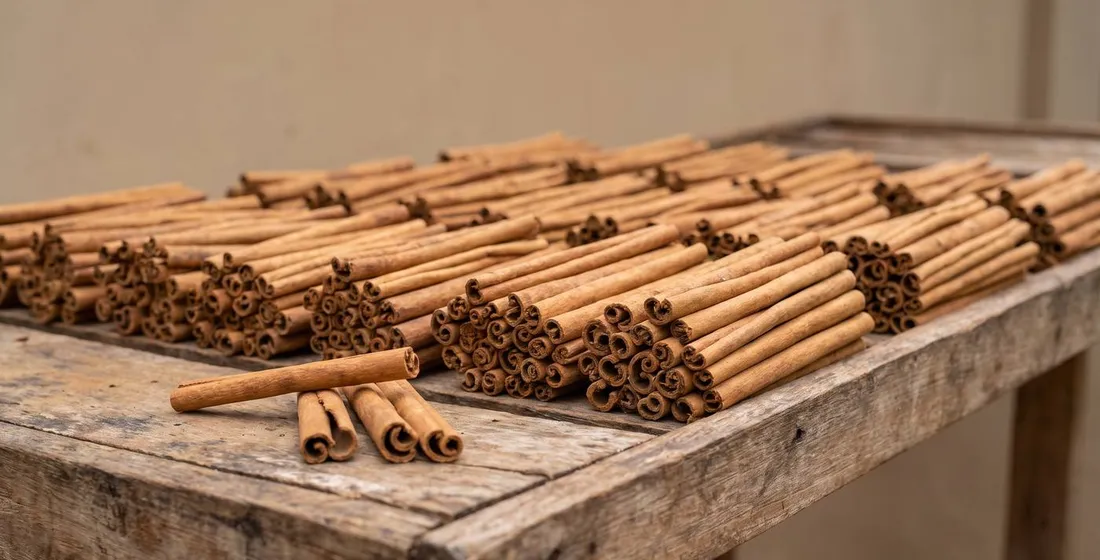
Buyer’s snapshot
- Ceylon cinnamon bark is harvested twice a year, immediately after the two monsoon seasons, and stems must be peeled the same day they are cut (Sri Lanka Export Development Board).
- The crop is labour-limited, not land-limited. A 2017 industry estimate put Sri Lanka at about 30,000 peelers against roughly 50,000 needed to harvest the whole crop (Daily FT, 2017), so fine grades sell through first.
- From PO to port arrival, plan 5 to 8 weeks: 2 to 3 weeks PO to dispatch at Silk Foods Ceylon, then 3 to 4 weeks sea freight to the EU or Australia, or 4 to 5 weeks to the US.
- The practical contracting move is a dated volume schedule by grade, with each release confirmed as its own PO, not a single spot order placed when stock runs low.
- This post is for specialty spice and bakery buyers planning 2027. It gives no price forecast, because none can be sourced honestly.
Most buyers treat cinnamon as a shelf item. It is a bark that people cut and peel by hand within hours, in two windows a year, and the people who do it are in short supply. That changes how a 2027 supply plan should be written. The question is not “what is the price today” but “which grade do I need on which month, and when does my PO have to land to hold it?” This piece lays out what is known about the crop rhythm, what is not, and a back-calendar you can adapt to your own launch dates. The grade definitions themselves sit in the Ceylon cinnamon grade spec sheet, and the wording of the contract clauses in specifying Cinnamomum verum on a sourcing RFQ.
How does the Ceylon cinnamon harvest actually work?
The Sri Lanka Export Development Board states that cinnamon bark is harvested twice a year, immediately after the two monsoon seasons, that stems are ready when the bark has turned brown and the stem is roughly 3 to 5 cm in diameter, and that harvested stems should be peeled the same day (Sri Lanka Export Development Board, processing of Ceylon cinnamon). A first harvest comes about three years after planting. The damp conditions after rain loosen the bark, which is why peeling follows the monsoons rather than a fixed calendar date.
Two consequences matter to a buyer. First, there is no single “harvest month.” The window moves with the monsoon and differs by district. Second, a bush that is not cut in its window is simply cut later, so supply is shaped by when labour is available as much as by when the bark is ready.
Which months are the peeling seasons?
Here the published record is thinner than most supplier brochures imply. The EDB does not name months in its processing guidance. A 2017 EDB industry capability report reproduces a Department of Export Agriculture table of spice seasons by district, but the layout groups several crops in one block, and a buyer should not lift a month list from it for cinnamon without confirmation. A Daily FT report from the same year adds that about 35 percent of the crop is harvested twice a year while about 65 percent is harvested once a year (Daily FT, 2017), which tells you that for most bushes there is effectively one main flush.
Spec snapshot: what to treat as known Harvests per year: two, following the two monsoons (EDB) Peeling: same day as cutting (EDB) Month-by-month availability by grade: not published by a primary source; ask the supplier for a dated statement Share of crop cut twice a year versus once: about 35 percent versus 65 percent (Daily FT, 2017) Planted area: 31,000 hectares (EDB)
The honest position for 2027 planning is this. Treat the monsoon-linked pattern as reliable and the month labels as unconfirmed. Ask your supplier to state, in writing, which grades it expects to hold in stock in each quarter and how far ahead of a delivery month it needs the PO. That one question separates a supplier planning its crop from one quoting what happens to be in the warehouse.
Why do fine grades sell through first?
Cinnamon is rolled from the thin inner bark, and the finest quills take the most skilled hands. Sri Lanka had an estimated 30,000 peelers for 33,000 hectares in 2017, against about 50,000 needed, according to the chairman of the Cinnamon Training Academy quoted in Daily FT (2017). That is a seven-year-old figure, so treat it as direction rather than a current count. The direction is the useful part: the constraint is skilled labour, and skilled labour is spent first on the grades that pay most.
The SRV procurement desk sees the same pattern each year. A buyer names a grade and a delivery month, sends the RFQ late, and then learns that the thin-quill grade the product was designed around is committed and the nearest alternative is one diameter step up. The product still works. The packaging mock-up, the pack count and the shelf price no longer do. Moving the order earlier by a few weeks costs nothing. Moving a label after printing costs a reprint.
Price moves the same way. Alba reached record levels in 2026, as covered in the grade spec sheet, and a fixed annual budget written two years ago is unlikely to hold. This post does not forecast the next move. It recommends writing the contract so that grade and timing are fixed first, and price is confirmed at each PO.
What does the back-calendar look like for a 2027 delivery?
Work backwards from the month the cinnamon has to be in your plant or warehouse. The stage times below are the ones Silk Route Ventures (SRV) and Silk Foods Ceylon (SFC) publish for buyers: samples door to door in 3 to 5 business days, 2 to 3 weeks from PO to dispatch, and 3 to 4 weeks sea freight to the EU or Australia or 4 to 5 weeks to the US.
| Stage | Duration | Cumulative, EU or AU | Cumulative, US |
|---|---|---|---|
| Sample approved against spec | 3 to 5 business days transit, plus your review | Before PO | Before PO |
| PO to dispatch | 2 to 3 weeks | 2 to 3 weeks | 2 to 3 weeks |
| Sea freight | 3 to 4 weeks (EU, AU), 4 to 5 weeks (US) | 5 to 7 weeks | 6 to 8 weeks |
| Port clearance and inland haulage | Your own broker’s figure | Add to plan | Add to plan |
So a US plant that needs quills on 1 March 2027 should have a signed PO by early January 2027 at the very latest (8 weeks), with the sample already approved, and that is before port clearance. A December PO leaves a safer buffer. A December arrival for a festive SKU is the same calculation, covered month by month in the Q4 order-by calendar. The buyer’s own date is the anchor. Add a buffer for fine grades, since those are the ones most likely to be committed early.
How should a buyer structure an annual contract with call-offs?
An annual schedule works when it separates what is fixed from what is not. Fix the species clause (Cinnamomum verum), the grade for each line, the chemical limits, the COA cadence and the indicative volume by quarter. Leave price to the PO. Each call-off then runs as its own order under SRV’s standard terms: orders under $10,000 are paid 100 percent in advance by bank transfer, and orders of $10,000 or above are 50 percent in advance with the balance against scanned shipping documents. SRV does not offer open-account terms, so a schedule is a planning instrument for both sides, not a credit line.
Three clauses are worth including.
- A named fallback grade, with a stated limit on how far down the ladder a substitution may go, and a requirement to ask before shipping a substitute.
- A batch COA with the same parameters every release, including a coumarin assay, so a later lot can be compared with the approved sample.
- A review date each quarter where both sides restate volumes, so a missed window is caught in weeks rather than discovered at dispatch.
If your brand does not need quills at all and mills to powder, the calculation is looser. The Hamburg grades that suit milling are less exposed to the fine-quill squeeze, as the grade spec sheet explains, and the savings are better spent on tighter ash and heavy-metals limits.
Where SRV’s pricing does not fit Lowest-shelf-price retail and brands competing on invoice price below the Ceylon premium. For those briefs, a competent cassia processor is the more honest answer than Ceylon bought at a stretched price. The species and its coumarin difference are set out in the Ceylon cinnamon versus Vietnamese cassia comparison.
Planning checklist for 2027 cinnamon supply
Buyer’s checklist: contracting 2027 Ceylon cinnamon
- List each SKU, its grade, and the month the cinnamon must be in your plant.
- Subtract 5 to 8 weeks (more for the US) plus your clearance time to get the latest PO date.
- Request a sample for each grade and approve it before the PO window.
- Ask the supplier for a written statement of expected grade availability by quarter.
- Name a fallback grade and the substitution limit.
- Fix species, chemistry and COA cadence in the schedule; confirm price per PO.
- Set a quarterly volume review date.
- Check payment timing against your cash plan: 100 percent advance under $10,000, 50 percent advance from $10,000.
Frequently asked questions
When is the Ceylon cinnamon harvest season?
Cinnamon bark is harvested twice a year, immediately after the two monsoon seasons, and stems are peeled the same day (Sri Lanka Export Development Board). Month labels vary by district and are not fixed by a primary source. Ask your supplier for a dated availability statement by grade and quarter instead of relying on a generic calendar.
How far ahead should I order Ceylon cinnamon for 2027?
Plan 5 to 7 weeks from PO to port for the EU or Australia and 6 to 8 weeks for the US: 2 to 3 weeks PO to dispatch plus 3 to 5 weeks sea freight. Add port clearance and haulage. For fine quill grades, place the PO earlier, since those sell through first.
Does Silk Route Ventures supply Ceylon cinnamon against an annual schedule?
SRV quotes each release as its own PO under standard terms, so a schedule works as a volume plan by grade and quarter, not a credit arrangement. First-order MOQ is 50 kg per SKU, and samples ship in 3 to 5 business days. Send an inquiry with grades, volumes and delivery months for a quote.
Does Silk Foods Ceylon supply true Ceylon cinnamon under organic certification?
Yes, on the relevant SKUs. Silk Foods Ceylon supplies quills and milled powder from Matale under BRCGS and FSSC 22000 V6, with USDA Organic and EU Organic available per SKU, and a COA on every batch. Confirm the organic status of a specific grade and lot when you request the sample.
How Silk Route Ventures can help
Silk Route Ventures (SRV) supplies certified-organic, single-origin Ceylon cinnamon to specialty spice brands and bakery formulators across the US, EU and Australia, in quills from Alba through H3 and in powder milled to the buyer’s mesh. Bulk raw material ships against the buyer’s spec from the BRCGS and FSSC 22000 V6 audited Silk Foods Ceylon (SFC) facility in Matale, with a COA on every batch. First-order MOQ is 50 kg per SKU, and samples ship door to door by international courier in 3 to 5 business days. For brands ready to launch a retail SKU under their own label, SRV runs end-to-end private label manufacturing from the same site. Contact us to send an inquiry or request a sample pack. For cuts and packaging, see the Ceylon cinnamon quills listing.
Sources
- Sri Lanka Export Development Board, “Processing of Ceylon cinnamon,” (n.d.). Retrieved 2026-10-08. https://www.srilankabusiness.com/blog/processing-of-ceylon-cinnamon.html
- Sri Lanka Export Development Board, “Updating Ceylon cinnamon production,” (n.d.). Retrieved 2026-10-08. https://www.srilankabusiness.com/blog/updating-ceylon-cinnamon-production.html
- Daily FT, “Labour shortage hits cinnamon industry,” (29 June 2017). Retrieved 2026-10-08. https://www.ft.lk/Agriculture/labour-shortage-hits-cinnamon-industry/31-624902
- Sri Lanka Export Development Board, “Industry capability report: Sri Lankan spices,” (June 2017). Retrieved 2026-10-08. https://www.srilankabusiness.com/ebooks/2017-06-industry-capability-report-sri-lankan-spices.pdf
Further reading
- Sri Lanka Export Development Board, “Ceylon Cinnamon geographical indication” → https://www.srilankabusiness.com/spices/ceylon-cinnamon-geographical-indication.html
- Silk Route Ventures, “The B2B buyer’s guide to Ceylon spices in 2026” → https://esilkroute.com.lk/blog/the-b2b-buyers-guide-to-ceylon-spices-in-2026/
Written by the Silk Route Ventures Trade Team. Silk Route Ventures (E-Silk Route Ventures (Pvt) Ltd) is a Sri Lankan B2B supply-chain operator for the Food, Beverage, Wellness and Nutraceuticals sectors. The Silk Foods Ceylon manufacturing arm holds BRCGS and FSSC 22000 V6 certification. Questions or to request a sample: Contact us or email info@esilkroute.com.lk.