
Private-Label Simmer Sauces in Glass Jars: Retort Process, Fill and MOQ
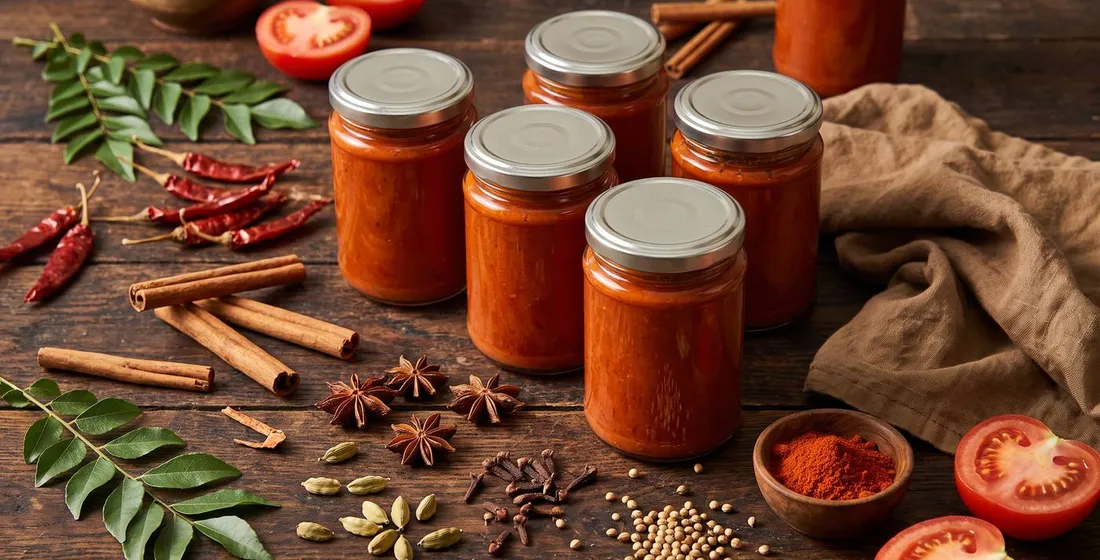
Buyer's snapshot • Global cooking sauce sales were estimated at roughly USD 40 billion to USD 61 billion in 2025, depending on the research house (Techsci Research, 2025; Reports and Data, 2025). The spread tells you the category is large and badly measured, so build your launch case on your own channel data. • A jarred simmer sauce is a thermally processed, shelf-stable food. The recipe is the easy part; the validated retort process and the glass closure are what decide whether a jar survives months on a shelf. • Silk Foods Ceylon (SFC) runs glass-jar sauces on a semi-liquid line of up to 3,000 jars a day (300 g format). Jar unit minimums are confirmed on your quote, and glass tooling adds about one week to a first run. • R&D from signed brief to approved formulation takes 3 to 4 weeks at most. Production is 4 to 6 weeks from PO to dispatch for private label. • Built for brands launching a two to four sauce range. Not built for single-jar hobby runs or the lowest shelf price. |
Most buyers who ask a contract manufacturer for a “simmer sauce” are really asking four separate questions. Can the kitchen recipe survive a scale-up. Can it survive a retort. Will it fill cleanly into glass at line speed. And what does the first order actually commit them to. This piece walks through each in the order a jar experiences them at Silk Foods Ceylon (SFC) in Matale, so a CPG scale-up buyer can see where the weeks and the cost sit before sending a brief.
It covers finished, jarred sauces only. Ingredient choices such as coconut milk fat levels are covered separately in the Ceylon vs Indonesian coconut comparison; this post assumes the recipe is yours and asks what happens when it meets a plant.
What does a simmer sauce need to survive between the kitchen and the shelf?
A shelf-stable simmer sauce has to survive three things a kitchen batch never faces: a scaled mixing step, a heat process that kills spore-forming bacteria, and 12 to 24 months of ambient storage. Each one changes the recipe slightly, which is why a bench sample is a starting point, not a specification.
Most simmer sauces sit above pH 4.6 once cream, coconut, onion and meat-free proteins are in the pot. In the United States that makes them low-acid foods under 21 CFR Part 113, where the scheduled process must be established by a qualified person with expert knowledge of thermal processing (US FDA, 21 CFR 113.83). Tomato-forward sauces can sometimes be acidified below 4.6 and handled under Part 114 instead. Which route a recipe takes is a formulation decision made early, because it changes the heat treatment and the label.
| Recipe trait | Typical effect in a retorted jar |
|---|---|
| Coconut milk or cream base | Fat can separate if the emulsion is not stabilised for heat |
| Whole spices and ground spices | Colour and heat level shift after thermal processing |
| Fresh tomato or onion paste | Acidity decides low-acid or acidified route |
| Starch thickeners | Can thin or turn gluey under long heat; choice matters |
| Particulates (vegetable pieces) | Slow heat penetration, so the process time rises |
Source: Silk Foods Ceylon process notes, 2026.
How does a recipe scale from a kitchen batch to a plant batch?
Scale-up is a reformulation, not a multiplication. A 2 kg kitchen pot loses moisture and spice aroma differently from a 400 kg jacketed kettle, and the order of addition starts to matter. The SFC team re-balances salt, acid and spice dosing against the buyer’s target taste, then locks a batch card so every kettle repeats.
Spice quality at this step is where a Ceylon-origin sauce earns its place. Ground spice particle size, moisture and microbial load all affect how a sauce behaves through retort, which is why many buyers specify their spice base up front. SRV supplies a Ceylon spice base from the same Matale site, and the curry powder and masala blends can be used as the seasoning backbone when a buyer wants a regional profile without developing a new blend. For the blend side of the recipe, see the private label curry powder formulation guide.
The honest limit: a recipe built on fresh, seasonal ingredients with no stabiliser plan is the one most likely to need a second round. Buyers who bring a recipe and a taste target, and allow the R&D team to adjust texture and acidity, finish fastest.
Why does retort validation take the most care?
Retort validation proves that the coldest point in the slowest-heating jar reaches the lethality the scheduled process requires. It is a heat penetration exercise, not a taste test. Jar size, fill weight, headspace, particulate content and sauce viscosity all move the answer, so a new SKU in a new jar needs its own validated process.
For a low-acid sauce, the process is registered and filed with FDA for the US market (Form FDA 2541 and the process filing form for the retorted method), and every container carries an identifying code so a lot can be traced after distribution (21 CFR 113.60(c)). SFC’s glass-jar sauces are retort-sterilised, not aseptically filled, and the process authority’s schedule for each SKU is part of the dossier a US or EU buyer receives on request.
“A new jar size is a new process. The recipe can stay the same and the heat penetration study still starts again, because glass wall thickness and headspace change how fast the centre heats.”
From the Trade Team
That is the reason SFC steers a first launch toward one or two jar sizes, not five. Every extra size multiplies validation work and the minimum order, and rarely changes how the sauce sells.
Which glass jar sizes and fill formats fit a simmer sauce?
The line is set up around a 300 g jar, and the capacity figure of 3,000 jars a day applies to that format. Other jar sizes are available from the standard glass range, listed below, with run rates confirmed per format on your quote.
| Format | Typical use | Notes |
|---|---|---|
| 220 ml jar | Single-serve or sampler | Smaller fill, more jars per kilogram of sauce |
| 330 ml jar | Mainstream retail simmer sauce | Closest to the 300 g line format |
| 420 ml square jar | Premium shelf presence | Needs its own validated process |
| 500 ml jar | Foodservice or family size | Longer heat penetration time |
Product is filled into plain clear glass, closed with a metal lid, then retorted. Headspace is controlled tightly: too much leaves oxygen that dulls colour, too little risks a lid that dishes or leaks during thermal expansion. The retorted-jar approach mirrors the lines already running coconut spread in glass jars and the vegan cheese spread retort programme, so a sauce joins an established process rather than inventing one.
What does the first order look like?
First-order jar unit minimums are confirmed on your quote and set per SKU, not per order. A three-sauce range carries three minimums. Because the line is a cellular, multi-product site, a new sauce does not trigger a separate audit cycle.
| Launch scenario | What you commit to | Notes |
|---|---|---|
| One sauce, one jar size | One SKU minimum | Cleanest pilot; one validated process |
| Three-sauce range, one jar size | Three SKU minimums | Shares the jar and closure; one validation approach |
| Range in two jar sizes | Up to six SKU-size combinations | Each size needs its own validation |
Source: Silk Foods Ceylon MOQ approach, 2026.
Glass tooling is the other lead-time driver. A first run with custom jar decoration or a custom closure adds about one week. Plain stock glass keeps the first run on the shorter side of the 4 to 6 week private label window. The wider arithmetic of how minimums set price is in the low MOQ versus high volume guide.
In practice the SRV procurement desk sees the same sequence repeatedly: a brand arrives with three flavours, the team narrows to two for launch, and the third is added once the first reorder lands. That is a working-capital decision more than a technical one, and it is cheaper to make it before the quote than after.
How long does the whole project take?
R&D runs 3 to 4 weeks at most, from signed brief to approved formulation, and the production clock starts only after approval. Samples are free for evaluation, with the buyer paying the courier. After that the stack is simple.
| Stage | Duration |
|---|---|
| R&D, signed brief to approved formulation | 3 to 4 weeks maximum |
| Production, PO to dispatch (private label) | 4 to 6 weeks |
| Sea freight to the EU or Australia | 3 to 4 weeks |
| Sea freight to the US | 4 to 5 weeks |
Source: Silk Foods Ceylon, 2026.
Pricing is FOB Colombo, with CFR and CIF on request. Orders under USD 10,000 are paid 100% in advance by bank transfer; orders of USD 10,000 or above run 50% advance with the balance against scanned shipping documents. The standard document pack covers the commercial invoice, packing list, bill of lading, certificate of origin and a phytosanitary certificate where the destination requires it; a Certificate of Analysis is available on request. Buyers qualifying a plant should also read the guide to verifying a Sri Lankan contract manufacturer.
Where Silk Route Ventures is not the right fit
Brands competing on the lowest shelf price, single-jar hobby runs, and buyers who need a sauce formulated entirely without a thermal process will find a different supplier more honest. The same applies to recipes the buyer will not adjust: a sauce that cannot tolerate a heat process or a stabiliser change will not be retorted at SFC.
Frequently asked questions
What is the MOQ for a private-label simmer sauce in glass jars?
First-order jar unit minimums are set per SKU and confirmed on your quote, not published as a fixed number. Glass tooling adds about one week to a first run. Private-label production runs 4 to 6 weeks from PO to dispatch, and R&D adds 3 to 4 weeks at most before production starts.
Can Silk Route Ventures develop a simmer sauce recipe from a brief?
Yes. The Silk Foods Ceylon R&D and NPD team scopes a recipe from a signed brief to an approved formulation in 3 to 4 weeks at most, validated against the retort process. The recipe stays the brand’s IP, and a sample ships against the agreed spec before any volume PO. See the R&D and NPD platform guide.
How many jars a day can the line produce?
The semi-liquid glass-jar line runs up to 3,000 jars a day in the 300 g format, shared with spreads and retorted plant-based products. Daily rates for other jar sizes are confirmed on the quote, and a validated process is needed for each size.
Are the sauces aseptically filled or retorted?
Retorted. The jars are filled, sealed and thermally processed in the container to commercial sterility. They are not aseptically filled. The process schedule for each SKU is available as part of the dossier on request.
Does Silk Foods Ceylon manufacture sauces under a food-safety certificate?
The Matale facility holds BRCGS and FSSC 22000 V6, with scope confirmed against the product category. Share your sauce type and the SRV team will confirm which certificate covers it before you commit to a run.
How Silk Route Ventures can help
Silk Route Ventures (SRV) contract-manufactures finished CPG SKUs, including sauces, spreads and semi-liquids in glass jars at up to 3,000 jars a day, under one roof at the Silk Foods Ceylon (SFC) facility in Matale. The site holds BRCGS and FSSC 22000 V6, with scope confirmed against each product category, and the cellular layout means a new sauce does not need a separate audit cycle. The SRV R&D and NPD team scopes your formulation in parallel with the production plan: 3 to 4 weeks at most to approved formulation, then 4 to 6 weeks from PO to dispatch for private label, with jar unit minimums confirmed on your quote. Contact us to send an inquiry for a co-manufacturing capability briefing tailored to your sauce and launch volume.
Sources
1. Techsci Research, “Cooking Sauces Market, Global Industry Size, Share, Forecast 2025-2031,” (2025). Retrieved 2026-11-18. https://techsciresearch.com/report/cooking-sauces-market/23241.html
2. Reports and Data, “Cooking Sauces Market,” (2025). Retrieved 2026-11-18. https://reportsanddata.com/report-detail/cooking-sauces-market
3. US Food and Drug Administration, “21 CFR Part 113: Thermally Processed Low-Acid Foods Packaged in Hermetically Sealed Containers,” (current). Retrieved 2026-11-18. https://www.ecfr.gov/current/title-21/chapter-I/subchapter-B/part-113
4. US Food and Drug Administration, “21 CFR Part 114: Acidified Foods,” (current). Retrieved 2026-11-18. https://www.ecfr.gov/current/title-21/chapter-I/subchapter-B/part-114
5. US Food and Drug Administration, “Establishment Registration and Process Filing for Acidified and Low-Acid Canned Foods (LACF),” (current). Retrieved 2026-11-18. https://www.fda.gov/food/registration-food-facilities-and-other-submissions/establishment-registration-process-filing-acidified-and-low-acid-canned-foods-lacf
Further reading
Tender jackfruit retort SKUs, capability and MOQ -> https://www.esilkroute.com.lk/blog/tender-jackfruit-curry-smokey-bbq-teriyaki-and-tomato-basil-retort-skus-capability-and-moq/
Written by the Silk Route Ventures Trade Team. Silk Route Ventures (E-Silk Route Ventures (Pvt) Ltd) is a Sri Lankan B2B supply-chain operator for the Food, Beverage, Wellness, and Nutraceuticals sectors. The Silk Foods Ceylon manufacturing arm holds BRCGS and FSSC 22000 V6 certifications. Questions or to request a sample: contact us at https://www.esilkroute.com.lk/contact or email info@esilkroute.com.lk.