
Coconut Spread Contract Manufacturing: Glass Jars & SKU Economics
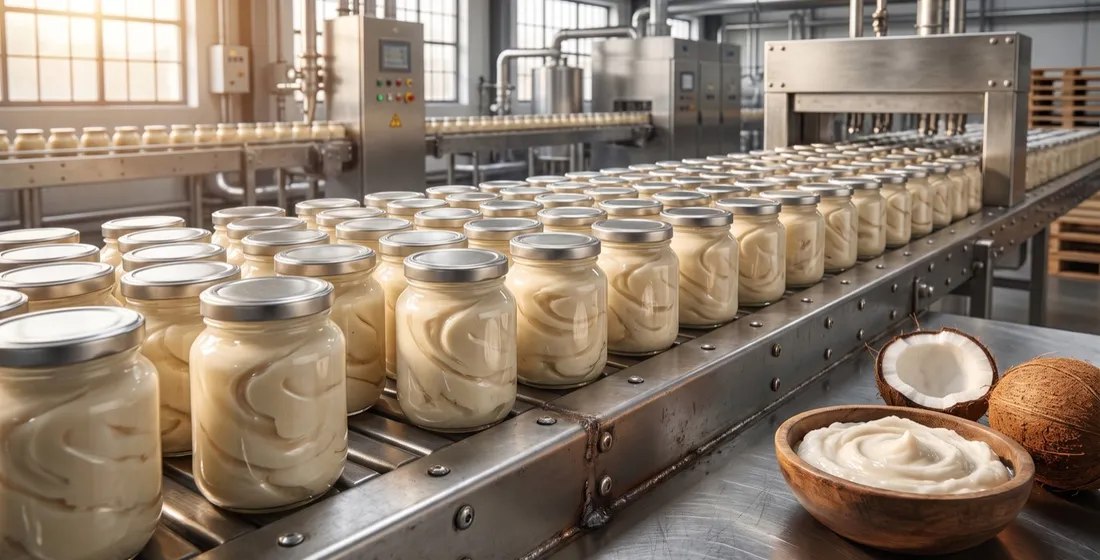
By the Silk Route Ventures Trade Team | 17 July 2026
Buyer’s snapshot
- Format: coconut spread retorted in 220ml or 330ml glass jars for ambient (non-refrigerated) shelf life under FDA acidified/low-acid food rules (21 CFR Parts 113 and 114).
- First-order MOQ: 1,500 jars per SKU (a half-day production run at the Silk Foods Ceylon semi-liquid line’s 3,000-jar-per-day capacity).
- Lead time: 2 to 3 weeks PO to dispatch; sea freight 4 to 5 weeks to the US, 3 to 4 weeks to the EU.
- Certification stack: BRCGS, FSSC 22000 V6, USDA Organic, and EU Organic (per SKU).
- This post is for CPG brand owners moving a coconut spread from a pilot run toward national retail or export container volume, weighing SKU count against MOQ economics. It is not a fit for buyers sourcing a single 5,000-unit run with no repeat-order plan.
Key takeaways
- Ambient shelf stability for a glass-jar coconut spread comes from formulation control (pH, water activity) plus a validated retort process under FDA 21 CFR Parts 113 and 114, not from preservatives alone.
- First-order MOQ for private-label glass-jar coconut spread at Silk Foods Ceylon is 1,500 jars per SKU. SKU count, not total order volume, is usually what breaks a scale-up brand’s unit economics.
- Sri Lanka’s coconut-based exports hit a record 1,233 million US dollars in 2025, a 43% jump, with coconut cream volumes up 93%. The growth sits in value-added glass-jar and retort formats, not bulk oil.
Most Sri Lankan coconut exporters quote bulk oil, desiccated coconut, or milk powder. A smaller number retort a spread into a glass jar and hold the certification stack a US or EU retailer actually asks for. In 2025, Sri Lanka’s coconut-based exports reached a record 1,233 million US dollars, a 43% increase, with coconut cream volumes up 93% and coconut milk powder up 61% (Sri Lanka Export Development Board data, reported by EconomyNext, 2026), growth concentrated in value-added formats rather than raw kernel. For a CPG brand moving a coconut spread from a 5,000-unit pilot run toward national or export volume, the harder problem usually isn’t finding a co-manufacturer. It’s finding one whose MOQ ladder, SKU economics, and shelf-stability process survive that jump, the ground covered in SRV’s broader coconut contract manufacturing guide for CPG buyers.
Formulating a shelf-stable coconut spread for ambient distribution
A coconut spread with sugar, cocoa, or spice inclusions typically lands above pH 4.6 and above 0.85 water activity, the two thresholds that determine which FDA rule applies. Under 21 CFR Part 113, thermally processed low-acid foods in hermetically sealed containers, glass jars included, must follow a filed scheduled process controlling Clostridium botulinum. Under 21 CFR Part 114, a food acidified to pH 4.6 or below follows a simpler validation path. Most coconut spread formulations sit in the low-acid category, which is why the retort process, not the recipe, carries the food-safety burden.
Codex Alimentarius’s standard for aqueous coconut products (CODEX STAN 240-2003) sets compositional parameters for plain coconut milk and cream, but it excludes sweetened or flavored coconut products, the exact category most private-label coconut spreads fall into. That gap matters for buyers: a supplier’s own filed scheduled process and batch COA carry more weight than a category standard that doesn’t cover the finished SKU. Silk Foods Ceylon (SFC) retorts coconut spread on its semi-liquid line (3,000 300g-equivalent jars per day) under FSSC 22000 V6, with a COA on every batch covering fat percentage, moisture, and microbial parameters. The same line and cert scope cover retorted coconut cream and vegan cheese spread manufacturing for buyers running a mixed glass-jar range.
What’s the difference between glass jar, plastic tub, and pouch packaging for coconut spread?
Glass delivers full oxygen and light barrier plus ambient retort stability, at a materials cost and freight-weight penalty a plastic tub or pouch doesn’t carry. The global glass packaging for food and beverages market was valued at 68.8 billion US dollars in 2025, with the category shifting toward rightweighted jars and higher recycled content (FoodNavigator-USA, 2025). For a coconut spread SKU competing on a “clean, minimal-processing” shelf story, glass is doing double duty: barrier performance and a packaging-sustainability claim in the same jar.
| Packaging format | Shelf-stability route | Typical ambient shelf life | Barrier performance | Silk Foods Ceylon capacity note |
|---|---|---|---|---|
| Glass jar (220ml, 330ml) | Retort, hermetic seal | 12 to 18 months | Full oxygen and light barrier | 3,000 jars per day, semi-liquid line |
| Plastic tub (HDPE/PP) | Chilled or modified-atmosphere packaging | 4 to 8 weeks refrigerated | Moderate, gas- and light-permeable | Not a current SFC format for coconut spread |
| Stand-up pouch (retort pouch) | Retort, foil-laminate barrier | 12 to 18 months | High if foil-laminated | Available via Total OBM custom tooling on request |
For a brand specifying “shelf-stable, no refrigeration required” on a US or EU retail listing, glass or a retort pouch are the two formats that clear the bar. A plastic tub almost always means a cold chain, a different distribution model, and a different cost structure entirely. The same particle-and-moisture spec discipline applies one step upstream, in the desiccated coconut grade a formulator chooses as the RM input.
MOQ ladder and SKU economics for private-label coconut spread
The first-order MOQ for glass-jar coconut spread at Silk Foods Ceylon is 1,500 jars per SKU, a half-day run against the 3,000-jar-per-day semi-liquid line. The number that actually drives a scale-up brand’s unit economics isn’t the MOQ, it’s the SKU count multiplied against it. A four-flavor range-set (original, cinnamon, ginger, cocoa) means 6,000 jars minimum, not 1,500, plus roughly one extra week of lead time if any flavor needs new jar or lid tooling.
| SKU launch scenario | Jars required at 1,500/SKU MOQ | Production time at 3,000 jars/day | Lead time from PO |
|---|---|---|---|
| 1 flavor (pilot validation) | 1,500 | 0.5 day | 2 to 3 weeks |
| 2 flavors | 3,000 | 1 day | 2 to 3 weeks |
| 4 flavors (typical retail range-set) | 6,000 | 2 days | 2 to 3 weeks, plus 1 week if new tooling |
| 6 flavors (full range) | 9,000 | 3 days | 2 to 3 weeks, plus 1 week if new tooling |
One US-based plant-based spreads brand co-manufactured at Silk Foods Ceylon scaled from a 5,000-unit pilot run in 2021 to multi-container monthly orders by 2024. The SKU count didn’t grow at the same pace as volume. The brand held at three core flavors through the scale-up and added a fourth only after two years of national distribution data confirmed per-flavor sell-through. That discipline, not the jar count, kept unit economics stable through the move from pilot to export volume. The math is harder than the marketing makes it sound: every flavor added before volume justifies it multiplies committed inventory across the whole range.
Buyers running the price objection usually compare an FOB Colombo quote against a domestic co-packer’s fully loaded per-unit price. The more useful comparison is landed cost per case, factoring 4 to 5 weeks of US sea freight and the documentation pack (invoice, packing list, bill of lading, certificate of origin, phytosanitary certificate, organic transaction certificate where relevant, and batch COA) shipped with every order. SRV’s low-MOQ contract manufacturing guide walks through when a low first-order MOQ is worth the unit-cost trade-off and when it isn’t.
What certifications should I ask a Sri Lankan coconut spread manufacturer for?
Certification snapshot: Silk Foods Ceylon, Matale. BRCGS (covers grinding, mixing, reheating, filtering, packing, and retorting of coconut jam and related products in glass jars), FSSC 22000 V6 (covers creamed coconut, coconut jams, and coconut spreads across the full processing scope), USDA Organic and EU Organic (per SKU), Sri Lanka EDB-registered and US FDA-registered facility.
BRCGS is the standard most UK and EU retail multiples gate on; FSSC 22000 V6 is the GFSI-recognized filter most US and multinational retailers require before an Asian supplier clears a first listing. Holding both from one audited facility means a coconut spread SKU can move from ingredient supply to a full private-label retail run without a second supplier audit. Raw coconut for the spread line is sourced from Sri Lanka’s coconut triangle (Kurunegala, Puttalam, and Gampaha districts) and processed at the Matale facility under the same audit scope as SFC’s other plant-based lines.
Where coconut spread sits in the 2026 plant-based and better-for-you spread category
Plant-based spreads remain a niche category, but 2026 launch activity concentrates on health-forward positioning and creamy, less-processed textures rather than pure imitation (Mintel, 2026). Innova Market Insights names “Authentic Plant-Based” one of its top five trends for 2026, reporting that 64% of global consumers want plant-based products made with less processing (Innova Market Insights, 2026). A coconut spread built on a short ingredient list and a traceable single-origin coconut base fits that shift more directly than a highly processed alternative-fat spread does.
How do I evaluate a coconut spread co-manufacturer before sending an RFQ?
The questions below cover the specifics a retorted glass-jar spread needs. Ask for the filed scheduled process for the specific SKU, not a general food-safety certificate; a retort validated for a different product doesn’t automatically cover a new formulation. Ask for the batch COA parameters tested and the testing cadence. Ask whether the MOQ is quoted per SKU or per total order; the two produce very different unit economics on a multi-flavor launch. Confirm payment terms early: SRV’s terms run 100% advance for orders under 10,000 US dollars, and 50% advance with the balance against scanned shipping documents above that threshold.
Frequently asked questions
What’s the MOQ for private-label coconut spread manufacturing in glass jars?
The first-order MOQ at Silk Foods Ceylon is 1,500 jars per SKU, a half-day run on the 3,000-jar-per-day semi-liquid line. Sample dispatch runs 1 to 2 weeks; PO-to-dispatch lead time is 2 to 3 weeks. A multi-flavor launch multiplies the 1,500-jar floor by SKU count, so a 4-flavor range needs 6,000 jars minimum.
How does a glass-jar coconut spread stay shelf-stable without refrigeration?
Shelf stability comes from formulation control (pH and water activity) plus a validated thermal process. Under FDA 21 CFR Parts 113 and 114, low-acid or acidified foods in hermetically sealed containers, including glass jars, must follow a filed scheduled process controlling Clostridium botulinum risk (US FDA, current regulations).
What certifications should I ask a Sri Lankan coconut spread manufacturer for?
Ask for BRCGS and FSSC 22000 V6 first; these are the two standards UK/EU retail multiples and GFSI-aligned US buyers gate on. USDA Organic and EU Organic matter only if the SKU carries an organic claim. Silk Foods Ceylon holds all four, with FSSC 22000 V6 scope explicitly covering coconut jams and spreads.
Is Sri Lanka’s coconut spread category growing fast enough to justify a new supplier relationship?
In 2025, Sri Lanka’s coconut-based exports reached a record 1,233 million US dollars, up 43%, with coconut cream volumes up 93% (Sri Lanka Export Development Board data, reported by EconomyNext, 2026). That growth concentrates in value-added, retort-ready formats, the category a private-label coconut spread sits in.
Can Silk Foods Ceylon develop a custom coconut spread formulation for a private-label brand?
Yes. The SFC R&D and NPD team develops flavor variants, sugar-reduction versions, and texture adjustments in-house, working alongside the production plan so a formulation pilot doesn’t add a second lead-time queue before the first commercial run.
How Silk Route Ventures can help
Silk Route Ventures (SRV) contract-manufactures coconut spread and related retorted spreads, sauces, and semi-liquids in glass jars at the Silk Foods Ceylon (SFC) facility in Matale, on a semi-liquid line running 3,000 jars per day. The site holds FSSC 22000 V6 covering coconut jams and spreads across the full processing scope, plus BRCGS for the same lines, USDA Organic, and EU Organic on relevant SKUs. First-order MOQ is 1,500 jars per SKU; the SRV R&D and NPD team develops formulation variants in parallel with the production plan for brands moving from a pilot run toward national or export volume. Contact us to send an inquiry for a co-manufacturing capability briefing scoped to your SKU count and target launch volume.