
Vegan Cheese Spread Contract Manufacturing - Retort, Shelf Life, MOQ
Vegan Cheese Spread Contract Manufacturing: Retort, Shelf Life, MOQ
By Silk Route Ventures Trade Team, 5 June 2026
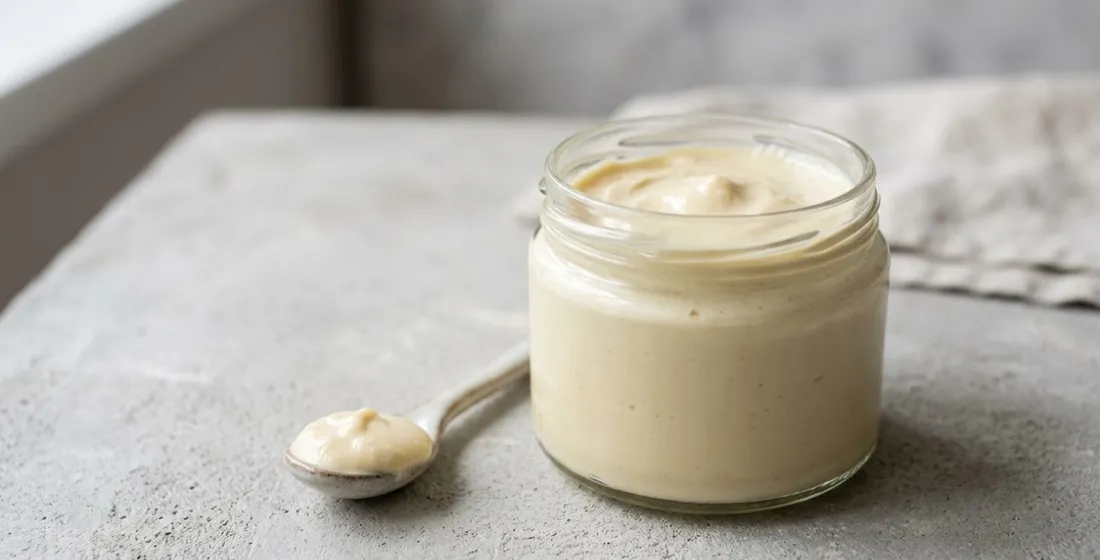
A glass jar of shelf-stable vegan cheese spread, the retort-and-glass-jar format built for ambient export.
Procurement snapshot • In 2025, global retail sales of plant-based milk, cheese, yogurt, and ice cream reached $22.3 billion, up 2% on the year, while US plant-based cheese dollar sales fell 4% (Good Food Institute / Euromonitor and Circana, 2025). The growth is offshore and in private label, not US national brands. • Shelf-stable vegan cheese spread is a low-acid canned food. Under US FDA rules, a low-acid food (finished pH above 4.6 and water activity above 0.85) packed in a hermetically sealed container must reach commercial sterility through a filed thermal process. That is what “retort” means here. • Silk Foods Ceylon (SFC) runs a semi-liquid line at 3,000 × 300 g glass jars per day, with a 1,500-jar first-order MOQ, under BRCGS and FSSC 22000 V6 in Matale. • For buyers, the procurement-actionable content is the retort-vs-chilled decision, the MOQ ladder, and the LACF process-filing requirement for US imports. • This post is for CPG scale-ups and distributors planning an ambient, export-ready spread. Brands committed to a chilled, short-shelf-life domestic SKU should read the format trade-off section first. |
Most plant-based contract manufacturers in Asia quote you a chilled spread with a 60-day shelf life and a cold chain you have to fund all the way to the retail shelf. A smaller number quote a retort line that can hold the same spread shelf-stable for 12 to 18 months at ambient. A handful run that retort line in glass jars, on a dual food-safety audit, next to a vegan patty line and a capsule line on the same floor. For a CPG scale-up buyer evaluating Sri Lanka for a vegan cheese spread, the format decision drives the cost model, the freight model, and the shelf life. Here is the capability matrix and what each choice commits you to.
What does “retort” mean for a vegan cheese spread?
Retort is thermal sterilization of a sealed jar after filling, and for a low-acid spread it is the difference between a 60-day chilled SKU and an 18-month ambient one. The US FDA defines a low-acid food as one with a finished pH above 4.6 and a water activity above 0.85 (FDA, 21 CFR Part 113, Thermally Processed Low-Acid Foods Packaged in Hermetically Sealed Containers). Most cultured nut and soy cheese spreads sit in that range. To sell them shelf-stable, the jar has to reach commercial sterility under a scheduled thermal process, which is exactly what a retort delivers.
The process matters because it changes the whole supply chain, not just the kill step. A chilled spread needs refrigerated trucking, refrigerated warehousing, and a retailer with cold-shelf space, all the way from Matale to the destination market. A retort spread ships in an ambient container, sits on a dry shelf, and survives the 4 to 5 week sea transit to the US without a reefer. For an export-first brand, that single processing choice is often worth more than the unit-cost difference, because it removes the cold chain as a line item and a risk.
How long does a retort vegan cheese spread last in a glass jar?
A correctly retorted, hermetically sealed low-acid spread holds commercial sterility for 12 to 24 months at ambient, with the practical retail window for a glass-jar vegan cheese spread usually set at 12 to 18 months. Shelf life is a function of the thermal process delivered (commonly referenced against an F0 lethality target at 121°C), the seal integrity, and the formulation’s own oxidative stability, not of refrigeration. The FDA’s commercial-sterility standard under 21 CFR 113 is what makes the ambient claim defensible (FDA, 2024).
Glass adds two considerations the buyer should price in. Glass heats and cools more slowly than a pouch, so the come-up and cool-down add minutes to each retort cycle, which caps daily throughput. Glass also needs careful thermal-shock management, which is why glass-jar tooling adds about one week to the first production lead at Silk Foods Ceylon. The payoff is a premium ambient shelf presentation that a retort pouch cannot match, and glass is recyclable in most destination markets, which supports the clean-label positioning these brands usually want.
Spec snapshot: retort vegan cheese spread (glass jar) • Format: 220 ml or 330 ml clear glass jar, lug or twist closure • Process: retort to commercial sterility (low-acid, 21 CFR 113 scheduled process) • Shelf life: 12 to 18 months ambient, no refrigeration • Line capacity: 3,000 × 300 g jars/day (semi-liquid line, Matale) • First-order MOQ: 1,500 jars per SKU • Lead time: 2 to 3 weeks PO to dispatch; glass-jar tooling adds about 1 week on the first run • Certifications: BRCGS, FSSC 22000 V6 |
Chilled vs retort: which format fits your launch?
The format decision is a trade between shelf life, capital, and texture, and it should be made before the formulation is locked because retort heat changes mouthfeel. A chilled spread keeps a fresher, looser texture and a shorter ingredient legend, but carries a 30 to 90 day shelf life and a cold chain. A retort spread trades a slightly firmer set and a tuned formulation for 12 to 18 months ambient and container-friendly export economics. For a brand selling into distant markets, the retort route usually wins on landed economics even when the per-jar process cost is higher.
| Factor | Chilled spread | Retort spread (glass jar) |
| Shelf life | 30 to 90 days | 12 to 18 months ambient |
| Cold chain required | Yes, end to end | No |
| Export sea freight | Reefer container only | Standard dry container |
| Texture | Fresher, looser set | Firmer; formulation tuned for heat |
| US regulatory path | Standard food | LACF process filing (21 CFR 113) |
| Best fit | Domestic, fast-moving, local distribution | Export, distributor, private label, long tail |
Source: SRV facility data + FDA 21 CFR Part 113.
There is a real cost to getting the formulation wrong here. Retort heat can split an emulsion, dull a culture-driven flavor, or weep oil if the stabilizer system was built for a chilled product. That is why a retort spread should be developed as a retort spread from the first bench batch, not adapted from a chilled recipe after the line is booked.
What is the MOQ and capacity for a vegan cheese spread co-pack?
The first-order MOQ for a retort vegan cheese spread at Silk Foods Ceylon is 1,500 jars per SKU, roughly a half-day on the semi-liquid line, which runs at 3,000 × 300 g jars per day. That floor is set low on purpose, so a scale-up brand can validate a SKU in market before committing to volume. The line is GFSI-aligned under BRCGS and FSSC 22000 V6, so a US or EU retail listing does not trigger a separate supplier audit for the spread.
Capacity scales in a way the buyer can plan against. A 1,500-jar pilot, a 3,000-jar full day, and multi-day runs for a launch order all sit on the same line and the same audit. Because Silk Foods Ceylon uses a cellular manufacturing layout rather than one dedicated mono-line, a new spread SKU can be introduced alongside an existing co-manufacturing run without re-validating the whole facility. For a scale-up brand juggling several SKUs, that is the structural reason the same supplier can carry the next three launches.
Procurement MOQ ladder: glass-jar semi-liquids • Pilot / market validation: 1,500 jars (about half a day) • Full-day run: 3,000 jars • Launch order: multi-day, scheduled against the line calendar • Volume pricing: improves with run length; the per-jar process cost falls as the batch lengthens • Note: MOQ is per SKU. A three-flavor launch is three times the floor. |
In Q1 2026, the Silk Route Ventures (SRV) trade desk fielded a recurring request from plant-based brand founders: they wanted an ambient cheese spread for export but had only ever costed a chilled product, and the reefer freight had quietly killed two of their target markets. The fix was not a cheaper jar. It was moving the format to retort so the cold chain came off the cost sheet entirely. The brands that re-modeled landed cost on an ambient SKU found markets that a chilled product could never reach profitably.
How is the market for vegan cheese actually moving?
The headline US numbers look soft, but the export and private-label picture is where a contract-manufactured spread belongs. In 2024, US plant-based cheese dollar sales fell 4% and household penetration slipped, yet the repeat-purchase rate rose from 48% to 54% (Good Food Institute, reporting Circana data, 2025). The category is consolidating around buyers who actually like the product. In 2025, global plant-based milk, cheese, yogurt, and ice cream sales reached $22.3 billion, up 2%, and private-label volume drove much of the European growth, with Germany’s own-brand plant-based volume up 41.4% between 2022 and 2024 (Good Food Institute Europe / Euromonitor, 2025).
For a contract manufacturer, that mix is the opportunity. Private-label and distributor programs need a producer who can run someone else’s spread to spec, hold the certifications for a retail listing, and ship ambient across an ocean. The vegan cheese market overall was valued at roughly $3.5 to $3.8 billion in 2025, with double-digit forecast growth (market research consensus, 2025). The growth is real; it is just moving toward the format and channel that a shelf-stable, dual-cert co-pack is built to serve.
What does a US importer need beyond the spread itself?
A shelf-stable low-acid spread bound for the US triggers a specific compliance chain that the buyer and the manufacturer share, and it should be scoped before the first PO. Under FDA rules, a commercial processor of low-acid canned foods must register the establishment and file the scheduled thermal process with the FDA before the product can enter US commerce (FDA, Establishment Registration and Process Filing for Acidified and Low-Acid Canned Foods). The retort manufacturer holds the process authority’s filing; the importer confirms it is in place.
Beyond the LACF filing, every Silk Foods Ceylon order ships with a standard documentation pack: commercial invoice, packing list, bill of lading, certificate of origin, batch COA, and a phytosanitary certificate where the destination requires it, plus an organic transaction certificate for organic SKUs. For a buyer used to chasing documents from a broker, the single-supplier document pack is part of what makes the lean route work. The spread is the product; the paperwork is what gets it cleared.
Frequently asked questions
What is the contract manufacturing MOQ for vegan cheese spread?
The first-order MOQ for retort vegan cheese spread at Silk Foods Ceylon is 1,500 jars per SKU, about half a day on a semi-liquid line that runs 3,000 × 300 g jars per day in Matale. The floor is per SKU, so a multi-flavor launch multiplies it. Lead time is 2 to 3 weeks from PO to dispatch.
How long does retort vegan cheese spread last without refrigeration?
A correctly retorted, hermetically sealed low-acid spread holds commercial sterility for 12 to 24 months at ambient, with the practical retail window usually set at 12 to 18 months for a glass-jar product. Shelf life depends on the thermal process delivered and seal integrity, not refrigeration, per the FDA commercial-sterility standard in 21 CFR Part 113 (FDA, 2024).
Does Silk Foods Ceylon manufacture vegan cheese spread under BRCGS and FSSC 22000?
Yes. The vegan cheese spread and other glass-jar semi-liquids run under BRCGS and FSSC 22000 V6 at the Matale facility, on a cellular manufacturing layout. The dual certification covers the GFSI gating filter most US and EU retailers require, so a retail listing does not trigger a separate supplier audit for the spread.
Can SRV develop a custom vegan cheese spread formulation for retort?
Yes. The SRV R&D and NPD team develops retort-stable spread formulations from the bench, building the emulsion and stabilizer system for heat rather than adapting a chilled recipe. Sample iterations ship door to door by international courier in 3 to 5 business days, and formulation work typically adds 2 to 4 weeks ahead of the production schedule.
What is the difference between a chilled and a retort vegan cheese spread?
A chilled spread keeps a fresher texture but carries a 30 to 90 day shelf life and an end-to-end cold chain. A retort spread is thermally sterilized to 12 to 18 months ambient, ships in a standard dry container, and suits export and private-label programs. For a US-bound low-acid spread, the retort route requires an FDA LACF process filing (21 CFR 113).
How Silk Route Ventures can help
Silk Route Ventures (SRV) contract-manufactures finished CPG SKUs (spreads, sauces, and semi-liquids in glass jars; vegan patties at 15,000 units/day; vegan nuggets at 30,000 units/day; spray-dried plant milks; jackfruit-in-brine for plant-based meat formats; functional beverages) under one roof at the Silk Foods Ceylon (SFC) facility in Matale. The retort vegan cheese spread line runs at 3,000 × 300 g jars per day with a 1,500-jar first-order MOQ, under BRCGS and FSSC 22000 V6 covering the relevant lines. The cellular manufacturing layout means a new spread SKU does not require a separate audit cycle, and the SRV R&D and NPD team scopes the retort formulation in parallel with the production plan. Contact us (https://www.esilkroute.com.lk/contact) to send an inquiry for a co-manufacturing capability briefing tailored to your SKU and target launch volume.
Sources
1. US Food and Drug Administration, “21 CFR Part 113, Thermally Processed Low-Acid Foods Packaged in Hermetically Sealed Containers,” (2024). Retrieved 2026-06-05. https://www.ecfr.gov/current/title-21/chapter-I/subchapter-B/part-113
2. US Food and Drug Administration, “Establishment Registration & Process Filing for Acidified and Low-Acid Canned Foods (LACF),” (2024). Retrieved 2026-06-05. https://www.fda.gov/food/registration-food-facilities-and-other-submissions/establishment-registration-process-filing-acidified-and-low-acid-canned-foods-lacf
3. Good Food Institute, “Plant-based retail market overview (US dollar sales, household penetration, repeat rate),” reporting Circana data, (2025). Retrieved 2026-06-05. https://gfi.org/marketresearch/
4. Good Food Institute Europe, “European plant-based sales data (private-label volume growth 2022 to 2024),” reporting Euromonitor data, (2025). Retrieved 2026-06-05. https://gfieurope.org/european-plant-based-sales-data/
5. Good Food Institute, “State of the Industry: Plant-based meat, seafood, eggs, dairy, and ingredients (global retail sales 2025),” reporting Euromonitor data, (2025). Retrieved 2026-06-05. https://gfi.org/resource/plant-based-meat-eggs-and-dairy-state-of-the-industry/
Further reading
FactMR, “Plant-based Cheese Market Size and Share Forecast Outlook 2025 to 2035” → https://www.factmr.com/report/4549/plant-based-cheese-market
Codex Alimentarius (FAO/WHO), “Code of Hygienic Practice for Low-and Acidified Low Acid Canned Foods (CXC 23-1979)” → https://www.fao.org/fao-who-codexalimentarius
Written by the Silk Route Ventures Trade Team. Silk Route Ventures (E-Silk Route Ventures (Pvt) Ltd) is a Sri Lankan B2B supply-chain operator for the Food, Beverage, Wellness, and Nutraceuticals sectors. The Silk Foods Ceylon manufacturing arm holds BRCGS and FSSC 22000 V6 certifications. Questions or to request a sample: Contact us (https://www.esilkroute.com.lk/contact) or email info@esilkroute.com.lk.