
Private-Label Organic Ceylon Cinnamon: Pack Formats, Organic Labelling and First-Run MOQ
Buyer’s snapshot
- Sri Lanka’s cinnamon and related products earned nearly Rs. 80 billion, about US$260 million, in 2025, a record year (Daily Mirror, 2026). Own-label brands are competing for a growing, well-supplied category, so the pack and the claim carry the differentiation.
- An organic claim is decided per SKU and per market, not per brand. Cinnamon powder is on the current USDA Organic certificate. Quills and cut sticks are not assumed organic until they are confirmed in writing.
- Silk Route Ventures runs private-label cinnamon from an FSSC 22000 V6 audited site in Matale: first-order MOQ 100 kg per SKU, trial quantities from 10 kg, 4 to 6 weeks from purchase order to dispatch for private-label and organic orders.
- The table of three markets below shows what each pack must carry. Skip to it if your launch date is fixed.
- This is for brand owners launching an own-label cinnamon line. It is not for buyers whose brief is the lowest price per kilo.
Most first briefs for own-label cinnamon arrive as one line: “organic Ceylon cinnamon, retail pouch, 100 g.” It sounds complete. It is three decisions folded into one, and each of them changes the quote. Silk Route Ventures (SRV) works through the same three with new brand owners: the format (sticks or powder, and the pack around them), the claim (what “organic” is allowed to mean on that pack in the destination market), and the first-run size (what 100 kg of raw material turns into on a shelf).
This piece covers those three for cinnamon specifically. Grade definitions sit in the Alba to C5 spec sheet, the wider private-label workflow is in private labelling spices, and barcodes, artwork and the export pallet are in own-brand labels and the certified pallet. Nothing here repeats them.
Sticks or powder: which format should an own-label cinnamon line start with?
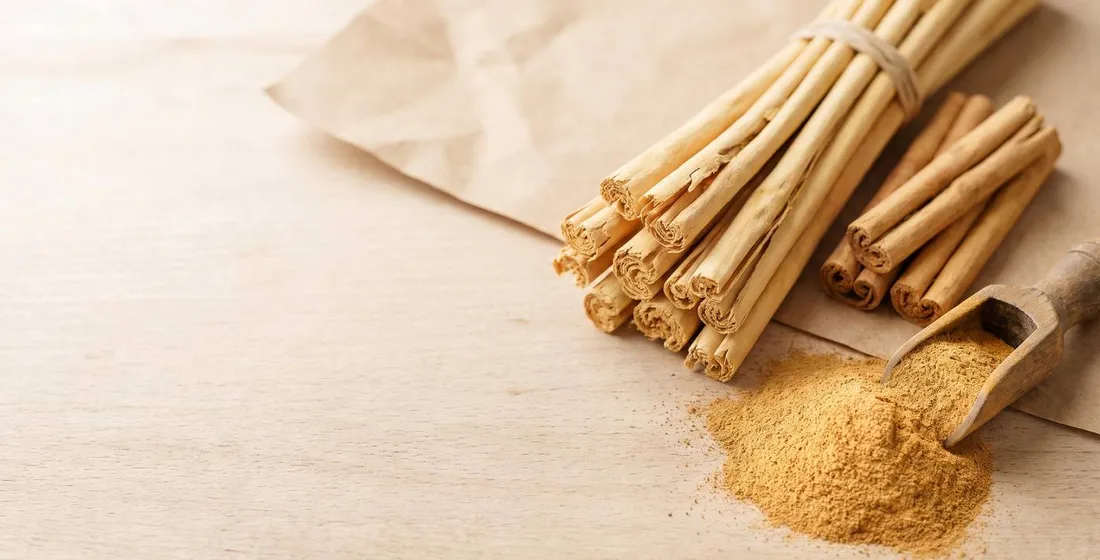
Start with the format your end customer uses at the point of purchase, not the one that looks best in a render. Powder is bought for baking, porridge and blends, and sells by the jar. Sticks are bought for infusing drinks, syrups and curries, and sell by the bundle, often with a window so the quill can be seen.
The two behave differently on a production line and on a label. Powder is milled to the buyer’s mesh, so particle size is a spec line. Sticks are cut from quills graded by diameter under SLS 81:2021, so grade and cut length are the spec lines. A brand that wants both is running two SKUs, and the minimum applies to each.
| Cinnamon powder | Cut cinnamon sticks | |
|---|---|---|
| What the buyer specifies | Mesh size, grade of bark milled, moisture | Grade (quill diameter), cut length, bundle weight |
| Typical retail packs | Kraft or foil zip pouch 50 g to 250 g, glass spice jar | Kraft window pouch, tin, tea-cut sachet |
| Shelf signal | Colour and aroma, so a sealed barrier pack matters | The quill itself, so a window pouch helps |
| Organic status | On the current USDA Organic certificate | Confirmed per SKU before it is quoted as organic |
| Species check | Coumarin assay is the authentication test | Visual check of the feathery multi-layer quill, plus assay |
Species is the question a Ceylon cinnamon brand cannot afford to get wrong. “Ceylon Cinnamon” is a registered EU Protected Geographical Indication (Regulation (EU) 2022/144), a name reserved for Cinnamomum verum grown in Sri Lanka. If your pack says it, the spec behind it must say Cinnamomum verum in writing. The RFQ guide to specifying Cinnamomum verum lists the lines to include, and the comparison with Vietnamese cassia explains why the assay matters.
What pack formats work for cinnamon, and what do they cost you?
Silk Foods Ceylon (SFC) fills kraft pouches from 50 g to 1 kg, kraft window pouches, foil zip pouches, 40 g glass spice jars, round tins and tea-bag formats. For cinnamon the practical shortlist is shorter.
A 50 g or 100 g kraft or foil zip pouch is the standard first SKU for powder. It has the lowest packaging cost in the menu and ships flat. A 40 g glass spice jar costs several times more per unit than a pouch, which is why it suits a gifting or table-top range and rarely a launch SKU. Sticks in a kraft window pouch show the quill and need no printed photography, which saves artwork cost on a first run.
The pack also sets the barrier. Ground cinnamon loses aroma faster than whole quills, so a powder pouch deserves a foil or lined film. Ask for the shelf-life basis in writing and make sure the best-before date on the pack matches it, a point the own-brand labels post covers in detail.
Spec snapshot: private-label Ceylon cinnamon, Silk Foods Ceylon, Matale Species: Cinnamomum verum, confirmed in writing per shipment Forms: quills (Alba to H2, H3 on request), cut sticks, powder to the buyer’s mesh Retail packs: kraft or foil zip pouch 50 g to 1 kg, kraft window pouch, 40 g glass spice jar Organic: USDA Organic and EU Organic on selected SKUs, confirmed per SKU MOQ: 100 kg per SKU, trial quantities from 10 kg, unit minimums confirmed on the quote Lead time: 4 to 6 weeks from PO to dispatch for private label and organic orders
What does “organic” have to mean on the pack in each market?
The claim has to match the certificate for that SKU and the rules of the market where it is sold. The facility does not carry the claim. The product does.
At the SRV trade desk the pattern is consistent: a brand owner writes “organic” into the brief for the whole range, and the answer comes back SKU by SKU. Powder can be offered as organic against the current USDA certificate. Sticks go through a confirmation step first. A brand that learns this at quote stage reorders its range. A brand that learns it after artwork is printed reprints it.
| Market | What governs the pack | What to ask the supplier for |
|---|---|---|
| USA | 7 CFR 205.301 sets the labelling tiers: 100 percent organic, organic (95 percent or more), and “made with organic” (at least 70 percent). 7 CFR 205.303 requires the certifier’s name on the information panel. | Current USDA Organic certificate listing the SKU, and the NOP Import Certificate for each shipment |
| EU | Regulation (EU) 2018/848, Article 32, requires the control body code number on the pack, plus an origin statement for the agricultural raw material. | Current EU organic certificate listing the SKU, and the electronic certificate of inspection through TRACES for each consignment |
| UK | GB runs its own import regime: a GB Certificate of Inspection per consignment, and an importer certified by a UK control body. | GB Certificate of Inspection, issued by the exporter’s control body |
| Australia | No mandatory domestic organic standard applies to a retail label. The Australian Consumer Law applies, and the ACCC expects any organic claim to be provable. AS 6000-2015 is voluntary, and a claim to meet it must be true. | The certificate and transaction records that prove the claim, kept on file |
For a single-ingredient product the tiering is straightforward. A cinnamon powder that is certified organic and contains nothing else can be labelled on the 100 percent organic or organic tier. The tiers bite when a brand adds a blend, for example cinnamon with ginger and cardamom, where every ingredient has to be on a current certificate for the same claim to hold.
The import side is covered separately. For US shipments see USDA organic import certificates after SOE, for Great Britain see GB organic and labelling rules, and for Australian biosecurity and labelling see importing Ceylon spices into Australia. The organic certification buyer’s guide sets the three systems side by side.
Buyer’s checklist: before you write “organic” on cinnamon artwork
- The exact SKU (powder or sticks, grade, pack) named on the current certificate
- The market-specific import document the destination requires, confirmed for your port
- Control body or certifier name and code, formatted as the destination market requires
- A written species statement, Cinnamomum verum, if the pack says Ceylon
- A shelf-life basis in writing, matched to the best-before date
- Sign-off from your own labelling adviser for the destination market
How big is a first run of private-label cinnamon at 100 kg per SKU?
The minimum is 100 kg of raw material per SKU, and it applies to each SKU separately. Powder and sticks are two SKUs, so a two-SKU launch commits at least 200 kg. Trial quantities start at 10 kg for evaluation, and unit minimums for retail packs are confirmed on the quote.
What 100 kg turns into depends on the pack. The figures below are raw-material ceilings before fill loss and finishing, and they show the shape of the decision rather than a quoted yield.
| Pack | Content per pack | Pack count from 100 kg (ceiling) |
|---|---|---|
| Kraft or foil zip pouch | 50 g | 2,000 |
| Kraft or foil zip pouch | 100 g | 1,000 |
| Kraft or foil zip pouch | 250 g | 400 |
| Glass spice jar | 40 g | 2,500 |
A launch of 1,000 pouches at 100 g is a real first run for a specialty grocer, a direct-to-consumer site and a handful of foodservice accounts. It is not a warehouse. The lean-route argument applies here: SRV works without a broker layer, so the minimum is set by the plant’s run economics and not by a middleman’s margin. The reasoning is set out in low-MOQ versus high-volume contract manufacturing.
Volume matters at the second run. Cinnamon is a crop-calendar product, and the second order is where grade and price move. The Ceylon cinnamon crop calendar shows when to contract 2027 supply by grade.
Where SRV’s pricing doesn’t fit Brands whose first priority is the lowest cost per kilo, or whose plan is a sub-minimum test run to see whether the product sells. For those briefs, buy a 10 kg trial for evaluation first, and decide on the full minimum after the pack has been through a shelf test.
From purchase order to dispatch: how long does the first run take?
Plan for 4 to 6 weeks from a confirmed purchase order to dispatch, because private-label and organic orders both sit in that band. Standard unbranded SKUs run 2 to 3 weeks. The extra time is artwork approval, pack sourcing and, for organic, the document set.
After dispatch, add sea freight: 3 to 4 weeks to the EU and Australia, 4 to 5 weeks to the US. A brand that wants shelf stock for a spring launch therefore needs a signed brief by the end of the preceding year. Pricing basis is FOB Colombo, with CFR and CIF on request. SRV does not quote DDP.
Samples are free for evaluation, and the buyer pays the courier. Ask for samples of both forms against your spec before artwork is commissioned.
Frequently asked questions
Does SRV offer private label for organic Ceylon cinnamon? Yes, for SKUs on a current certificate. Cinnamon powder is on the current USDA Organic certificate, and EU Organic status is confirmed per SKU at quote. Sticks are confirmed individually. Private-label orders run 4 to 6 weeks from purchase order to dispatch, with a 100 kg per SKU minimum.
What is the minimum order for private-label cinnamon pouches? The raw-material minimum is 100 kg per SKU, which is a ceiling of about 2,000 pouches at 50 g. Trial quantities start at 10 kg. Retail-pack unit minimums are confirmed on the quote, so ask for the pack count with the price.
Can an Australian brand label cinnamon as organic without a domestic standard? There is no mandatory domestic organic standard for a retail label, but the ACCC treats organic claims under the Australian Consumer Law, and a business must be able to prove them. A claim to meet AS 6000-2015 must be true. Keep the certificate and transaction records for every lot.
Which documents travel with an organic cinnamon shipment? A certificate of origin, a COA on request, a phytosanitary certificate where the destination requires it, and the organic import certificate the destination needs: the EU or GB Certificate of Inspection, or the USDA NOP Import Certificate.
How Silk Route Ventures can help
Silk Route Ventures (SRV) supplies private-label Ceylon cinnamon to specialty brands across the US, EU, UK and Australia, with powder, cut sticks and quills packed at the FSSC 22000 V6 audited Silk Foods Ceylon (SFC) facility in Matale, and USDA Organic and EU Organic on selected SKUs, confirmed per SKU. First-order MOQ is 100 kg per SKU, with trial quantities from 10 kg and retail-pack unit minimums confirmed on the quote; lead time is 4 to 6 weeks from purchase order to dispatch for private-label and organic orders. Start from the cinnamon powder specification and tell the team your target market and pack size. Contact us to send an inquiry or request a free evaluation sample.
Sources
- Sri Lanka targets cinnamon export growth, Daily Mirror, reporting 2025 earnings of nearly Rs. 80 billion. Retrieved 4 November 2026.
- 7 CFR 205.301, Product composition, eCFR. Retrieved 4 November 2026.
- 7 CFR 205.303, Packaged products labeled “100 percent organic” or “organic”, Cornell Legal Information Institute. Retrieved 4 November 2026.
- Regulation (EU) 2018/848 on organic production and labelling, Article 32, EUR-Lex. Retrieved 4 November 2026.
- Organic claims, Australian Competition and Consumer Commission. Retrieved 4 November 2026.
- The department’s role in the domestic organic and biodynamic food industry, Australian Department of Agriculture. Retrieved 4 November 2026.
- Importing organic food to the UK, Defra and GOV.UK. Retrieved 4 November 2026.
Written by the Silk Route Ventures Trade Team. Silk Route Ventures (E-Silk Route Ventures (Pvt) Ltd) is a Sri Lankan B2B supply-chain operator for the Food, Beverage, Wellness, and Nutraceuticals sectors. Questions or to request a sample: Contact us or email info@esilkroute.com.lk.