
Private-Label Coconut Oil Spec Sheet for EU Importers
Buyer’s snapshot
- Europe imported 662,000 tonnes of coconut oil in 2023, more than 40 percent of world imports, but CBI records retail-packed imports as insignificant because almost all consumer jars are re-packed inside Europe.
- Codex CXS 210-1999 sets no free fatty acid limit for coconut oil. It sets an acid value. A spec sheet that quotes a Codex FFA figure is quoting something that does not exist.
- The same pallet needs two artwork versions for the EU and Great Britain: different organic control body code formats, different origin wording, and a UK business address that has been mandatory since 1 January 2024.
- Silk Foods Ceylon fills retail glass from 50 ml to 1 litre under FSSC 22000 V6, with a per-batch COA and organic certification on qualifying lines.
- The spec matrix, the contaminant table and the EU versus GB compliance grid below are built to be pasted straight into an RFQ.
Coconut oil is one of the few grocery categories where the origin country supplies the oil and Europe supplies the jar. CBI, the market intelligence programme of the Netherlands Enterprise Agency, put European coconut oil imports at 662,000 tonnes in 2023, down from a 745,000 tonne peak in 2022, with long term growth forecast at 2 to 4 percent a year. Processed oil now accounts for 46 percent of those imports, up from about a third in 2019. Retail-packed oil barely registers in the trade data.
That gap is the commercial opportunity for an own-label importer, and it is also where most sourcing projects stall. A buyer who can specify bulk oil competently will still find that the retail jar version pulls in a second body of rules: consumer labelling, contaminant ceilings written for product placed on the market for the final consumer, and an organic regime that now diverges between Brussels and London. This is a spec sheet for that jar, not for the drum. For the underlying grade decision, the difference between virgin and RBD coconut oil in formulation is covered separately and is not repeated here.
What does a private-label coconut oil spec sheet actually have to lock down?
A retail coconut oil specification runs on three tiers of number: the Codex quality and composition figures, the tighter virgin oil figures published by the coconut producing community, and the commercial limits a buyer writes into contract. Codex Alimentarius standard CXS 210-1999, revised through 2019, gives the composition envelope. It does not give a free fatty acid limit for coconut oil, and confusing acid value with FFA is the most common error on a coconut oil RFQ.
| Parameter | Codex CXS 210-1999 | APCC virgin standard | Measured virgin range, Ghani 2018 |
|---|---|---|---|
| Acid value, refined | 0.6 mg KOH/g max | not specified | not applicable |
| Acid value, virgin and cold pressed | 4.0 mg KOH/g max | not specified | not applicable |
| Free fatty acid | no coconut limit set | 0.2 percent max | 0.17 to 0.53 percent |
| Peroxide value, refined | 10 meq active oxygen/kg max | not applicable | not applicable |
| Peroxide value, virgin | 15 meq active oxygen/kg max | 3 meq oxygen/kg max | 2.2 to 4.2 |
| Moisture and volatile matter at 105 C | 0.2 percent m/m max | 0.3 percent max | 0.10 to 0.17 percent |
| Insoluble impurities | 0.05 percent m/m max | not specified | not measured |
| Iodine value, Wijs | 6.3 to 10.6 | 4.1 to 11 | not measured |
| Saponification value | 248 to 265 mg KOH/g | 248 to 265 mg KOH/g | 259 to 271 |
| Unsaponifiable matter | 15 g/kg max | not specified | not measured |
Codex, APCC and measured values for coconut oil. Codex figures from CXS 210-1999 Table 2 and its supplementary quality section; APCC figures and measured values as tabulated in Ghani and colleagues, Food Science and Nutrition, 2018.
The gap in that table is where private-label negotiations are actually won and lost. Codex allows a virgin oil up to 15 meq peroxide value. The Asian and Pacific Coconut Community standard allows 3. That is a five-fold difference in the same product category, and a buyer who signs a contract quoting only Codex has agreed to accept oil five times more oxidised than the segment norm. The 2018 peer-reviewed survey that benchmarked four virgin production routes against the APCC figures found two of four samples outside the FFA limit and two outside the peroxide limit, so the tighter number is a real screen rather than a formality.
Spec snapshot: what a jar spec must state that a drum spec does not
- Fill weight in grams alongside nominal volume, because coconut oil is sold as a solid and density at fill temperature moves the fill.
- Closure torque and cap liner compatibility for the specific jar and lid combination.
- Headspace tolerance, since the oil contracts on solidifying and an under-filled jar reads as short measure on shelf.
- Set point appearance, meaning the agreed look of the solidified surface after the pack has been through a temperature cycle.
- The oxidation panel measured at the end of stated shelf life rather than at fill.
Which contaminant limits apply to a jar of coconut oil in the EU?
Commission Regulation (EU) 2023/915 sets the maximum contaminant levels, and coconut oil sits in named categories rather than the generic vegetable oil catch-all. Two of those entries are coconut-specific and both are easy to miss.
| Contaminant | Category as published | Maximum level |
|---|---|---|
| Sum of 3-MCPD and 3-MCPD fatty acid esters, as 3-MCPD | coconut, maize, rapeseed, sunflower, soybean, palm kernel and olive oils | 1,250 µg/kg |
| Glycidyl fatty acid esters, as glycidol | vegetable oils placed on the market for the final consumer | 1,000 µg/kg |
| Glycidyl fatty acid esters, as glycidol | oils for infant and young child food production | 500 µg/kg |
| Benzo(a)pyrene | coconut oil for the final consumer | 2.0 µg/kg |
| Sum of 4 PAH | coconut oil for the final consumer | 20.0 µg/kg |
| Sum of 4 PAH | other oils and fats for the final consumer | 10.0 µg/kg |
| Erucic acid | vegetable oils for the final consumer | 20.0 g/kg |
Contaminant ceilings applicable to retail coconut oil under Regulation (EU) 2023/915, Annex sections 2.1.1, 5.1.11, 5.1.12 and 5.3.
Coconut oil carries its own polycyclic aromatic hydrocarbon line at 20.0 µg/kg for the sum of four PAH, double the 10.0 µg/kg that applies to other retail oils. That allowance exists because copra is traditionally smoke dried, and it is a genuine sourcing lever: a supplier drying to hot air or solar rather than open smoke should be able to test well inside the coconut line, which matters if the finished blend is later sold into a category governed by the tighter general limit.
Where Silk Route Ventures walks away
The 3-MCPD and glycidyl ester limits are the ones buyers argue about. Both compounds form during high temperature deodorisation, so a genuine virgin oil should not contain them, and CBI states the position plainly: processing contaminants should not be present in virgin coconut oil. That is a practical exemption, not a legal one. Nothing in Regulation (EU) 2023/915 exempts virgin coconut oil from either ceiling. A private-label programme that omits both from the release COA because the oil is virgin has created a documentation gap that a retailer technical audit will find. Silk Route Ventures (SRV) will not quote a retail organic programme that asks for those two parameters to be dropped from the batch panel to save analysis cost.
What must an EU retail label carry under Regulation 1169/2011?
Regulation (EU) No 1169/2011 sets the mandatory particulars, and a single-ingredient jar is genuinely simpler than most buyers expect. Article 19(1)(e) exempts foods consisting of a single ingredient from the ingredient list where the name of the food is identical to the ingredient name or clearly identifies its nature. A jar named Virgin Coconut Oil needs no ingredient list at all.
| Particular | Article | Note for a coconut oil jar |
|---|---|---|
| Name of the food | 9(1)(a), 17 | Legal, customary or descriptive name; grade wording sits here |
| Ingredient list | 9(1)(b), 18 | Exempt under 19(1)(e) for a single-ingredient jar |
| Allergens | 9(1)(c), Annex II | Coconut is not listed in Annex II; any statement is contractual, not legal |
| Net quantity | 9(1)(e), 23 | Grams for a solid fat presentation |
| Date of minimum durability | 9(1)(f), 24 | Best before, set by the operator on validated stability data |
| Storage conditions | 9(1)(g) | Relevant given the melt transition near 24 C |
| Operator name and address | 8(1), 9(1)(h) | The clause that splits EU and GB artwork |
| Country of origin | 9(1)(i), 26 | |
| Nutrition declaration | 9(1)(l), 30 | No Annex V exemption applies to retail coconut oil |
| Minimum x-height 1.2 mm | 13(2), Annex IV |
Mandatory particulars for a prepacked retail coconut oil jar under Regulation (EU) No 1169/2011.
One rule gets misapplied constantly. Annex VII Part A point 8, the provision requiring refined vegetable oils to be declared with their specific vegetable origin, is a grouping rule for compound foods. It is why a biscuit label reads vegetable oils (coconut, rapeseed) rather than vegetable oil. It has no application to a single-ingredient jar, which is governed by Article 17 naming and the Article 19(1)(e) exemption. Buyers who insist on adding an ingredient list to a plain coconut oil jar are usually reacting to point 8 without reading its scope.
Coconut is also absent from Annex II. The declarable tree nut list at point 8 of that annex covers almonds, hazelnuts, walnuts, cashews, pecans, Brazil nuts, pistachios and macadamias. Coconut is botanically a drupe. Most European retailers still require a cross-contact statement by contract, which is a commercial requirement rather than a labelling obligation, and the distinction is worth holding onto during artwork sign-off.
How do EU and GB organic rules differ on the same pallet?
This is where a single production run turns into two SKUs. The EU applies Regulation (EU) 2018/848. Great Britain did not adopt it and continues to run the retained 834/2007 framework. Both markets will accept the same oil, from the same tank, on the same day, under different labels.
| Requirement | European Union | Great Britain |
|---|---|---|
| Governing law | Regulation (EU) 2018/848 | Retained Regulations 834/2007, 889/2008, 1235/2008 |
| Control body code format | AB-CDE-999, for example LK-BIO-123 | GB-ORG-XX, for example GB-ORG-02 |
| Organic logo | Mandatory on prepacked organic food, Article 32(1) | No GB logo exists; the EU logo is optional |
| Origin statement | EU Agriculture, non-EU Agriculture, or EU/non-EU Agriculture | UK Agriculture, non-UK Agriculture, or UK/non-UK Agriculture |
| Named country permitted | Yes, where all agricultural raw material is farmed there | Named region requires 98 percent sourcing from that location |
| Import certificate | Certificate of Inspection issued in TRACES NT | GB COI required now for non-EU origin; EU origin from 1 February 2027 |
| Operator address | EU address | UK address mandatory since 1 January 2024 |
EU and GB organic and labelling divergence for an imported coconut oil retail SKU, from Regulation (EU) 2018/848 Article 32 and GOV.UK guidance updated August 2025.
Two of those rows are worth money. Article 32(2) allows the EU and non-EU wording to be replaced by a country name where all of the agricultural raw material was farmed in that country. A single-origin Sri Lankan virgin coconut oil can therefore carry Sri Lanka Agriculture on the pack rather than the anonymous non-EU Agriculture. For a category where CBI records Sri Lanka as the dominant supplier of certified organic virgin coconut oil to Europe, and where organic already exceeds 10 percent of the virgin segment against roughly 2 percent of coconut oil imports overall, that single line of permitted text is the cheapest provenance claim on the pack. The broader mechanics are set out in the buyer’s guide to EU Organic and USDA certification.
The second is the UK address. GOV.UK guidance is explicit that prepacked food sold in Great Britain has required a UK address for the food business operator since 1 January 2024, and that where the operator is outside the UK the importer’s UK address must appear. The widely circulated 1 October 2022 date was superseded. In practice a Sri Lankan packer running one European own-label programme is printing two label versions, and the artwork brief should say so before the plate charge is quoted.
In the first quarter of 2026 the SRV trade desk fielded three separate European enquiries that arrived at the same point: an own-label coconut oil already listed in one market, blocked from a second because the pack had been designed once for the whole of Europe. Two of the three had costed a single artwork. All three needed a second one.
What does the jar format do to MOQ economics?
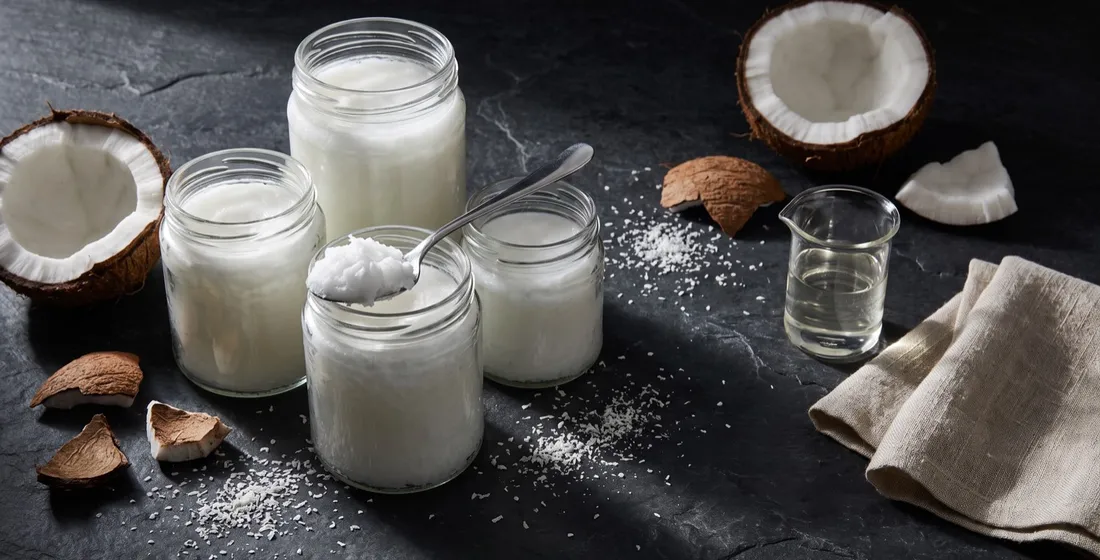
Coconut oil melts near 24 C, and CBI notes that European supermarket floors usually sit below 25 C, so the product is on shelf as a solid fat. That single physical fact drives the pack. A scoopable solid needs a wide mouth, which rules out a narrow-neck bottle whatever the design team prefers, and CBI records glass jars as the preferred European retail format on consumer perception grounds, with 200 to 500 ml the common size band.
Buyer’s checklist: costing a retail coconut oil SKU
- Count SKUs, not tonnes. First-order MOQ at Silk Foods Ceylon (SFC) runs at 1 MT per coconut SKU, so a virgin plus refined launch across two jar sizes is four SKUs and four MOQ floors, not one.
- Add the second artwork if Great Britain is in scope, and settle it before plate charges.
- Price the analysis panel at the retail specification, including 3-MCPD and glycidyl esters, rather than at the bulk panel.
- Confirm fill weight against nominal volume at the agreed fill temperature.
- Allow for the organic certificate of inspection routing in the shipping timeline, not after it.
Available retail glass runs 50 ml, 220 ml, 330 ml, 500 ml, 1 litre and a 420 ml square jar, with custom formats handled under the Total OBM route. Samples dispatch in one to two weeks with courier transit of three to five business days, production runs two to three weeks from purchase order to dispatch, and sea freight to European ports takes three to four weeks. The economics of committing to a low first order are set out in more detail in the note on when a low-MOQ contract manufacturer is worth it, and the packaging discipline carries across to sister categories in the coconut jam private label glass jar spec and the coconut treacle glass-bottle retail SKU spec. Brands building a wider own-label coconut range alongside the oil will find the same SKU-count arithmetic in the coconut chips flavour format sourcing spec.
One more spec line belongs on the sheet even though no regulation demands it. FEDIOL, the EU vegetable oil and protein meal industry association, publishes a fatty acid and sterol profile for coconut oil, with total sterols between 400 and 1,200 mg/kg and erucic acid at or below 0.02 percent of total fatty acids. That profile is the standard authenticity test for palm oil adulteration, which CBI names as a recurring coconut oil fraud. Asking for it on the certificate of analysis costs very little and closes the one failure mode that no amount of labelling diligence would catch.
Frequently asked questions
Does a retail jar of coconut oil need an ingredient list in the EU?
No. Article 19(1)(e) of Regulation (EU) No 1169/2011 exempts single-ingredient foods where the name of the food is identical to the ingredient or clearly identifies it. A jar named Virgin Coconut Oil carries no ingredient list. The nutrition declaration under Article 30 still applies, since no Annex V exemption covers retail coconut oil.
Is coconut a declarable allergen in Europe?
No. Coconut does not appear in Annex II of Regulation (EU) No 1169/2011, whose tree nut entry covers almonds, hazelnuts, walnuts, cashews, pecans, Brazil nuts, pistachios and macadamias. Coconut is botanically a drupe. Many European retailers still require a cross-contact statement as a contract term, so treat it as a commercial specification rather than a legal one.
Do the 3-MCPD limits apply to virgin coconut oil?
Yes, in law. Regulation (EU) 2023/915 section 5.3.1.1 names coconut oil at 1,250 µg/kg for the sum of 3-MCPD and its esters, and the only carve-out in that row is virgin olive oil. Because both compounds form during deodorisation, CBI notes they should not be present in virgin coconut oil, but the batch COA still has to report them.
Can Silk Route Ventures pack a private-label coconut oil jar for both the EU and the UK?
Yes. Silk Foods Ceylon fills retail glass from 50 ml to 1 litre under FSSC 22000 V6 with organic certification on qualifying lines, and the SRV trade desk builds the EU and GB artwork variants as separate SKUs from the same production run. First-order MOQ is 1 MT per SKU, with samples in one to two weeks.
How Silk Route Ventures can help
Silk Route Ventures (SRV) supplies and private-labels Ceylon coconut oil for European own-label programmes, working with its manufacturing arm Silk Foods Ceylon (SFC) at Hapugasyaya, Nalanda, in Matale, one kilometre from the Nalanda Gedige. Silk Foods Ceylon is audited to BRCGS, the UK retail-driven standard most multiples require of own-label suppliers, across its processing scope. The oil line operates under FSSC 22000 V6, which satisfies the GFSI gating filter European retailers use to qualify Asian suppliers, with USDA Organic and EU Organic held on qualifying SKUs for US and European organic claims. Bulk buyers can review specs on our coconut products supplier.
Retail glass is available at 50 ml, 220 ml, 330 ml, 500 ml, 1 litre and 420 ml square, with custom formats under the Total OBM route. First-order MOQ is 1 MT per SKU, samples dispatch in one to two weeks, production runs two to three weeks from purchase order, and sea freight to European ports takes three to four weeks. Every batch ships with a certificate of analysis, traceability runs to farm level, and the SRV trade desk will build the EU and GB label variants and the release panel against the destination specification before artwork is committed. Buyers weighing origin and manufacturing capability more broadly can start with the overview of coconut sourcing and contract manufacturing in Sri Lanka.