
Coconut Jam Private Label in Glass Jars: Naming, Brix, Shelf Life
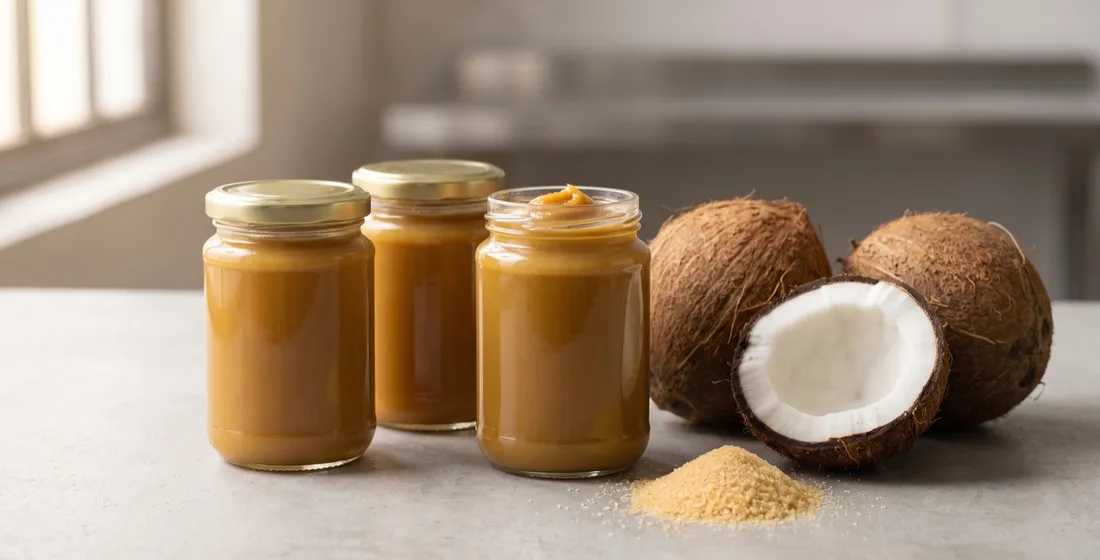
Buyer’s snapshot
- Coconut appears in neither the EU fruit list (Council Directive 2001/113/EC, Annex III) nor the US permitted-fruit groups (21 CFR 150.160), so a coconut spread cannot carry the standardised name “jam” in either market.
- Codex Alimentarius CXS 296-2009 uses an open fruit list and permits nuts as ingredients, which is why the identical jar can ship as “jam” into several non-EU, non-US markets.
- The formulation window sits on two regulatory lines: finished equilibrium pH of 4.6 and water activity of 0.85 (21 CFR 114.3). A reduced-sugar reformulation can push the SKU across both.
- Silk Foods Ceylon runs spreads and sauces at 3,000 jars per day, with a 1,500-jar first-order MOQ for private label.
- Naming, Brix and process-filing comparisons are tabled below; the RFQ checklist sits at the close.
Sinhala-style coconut jam is one of the easier Sri Lankan retail formats to land in a specialty aisle and one of the harder ones to name correctly on the label. The product itself is straightforward: coconut kernel and coconut milk cooked down with a coconut-derived sweetener until the mass sets. The regulatory position is not. In 2026 a buyer importing this SKU into the EU or the US is handling a non-standardised food, which changes the product name, the Nutrition Facts panel, and in some formulations the process filing. This post covers the three decisions that sit upstream of a purchase order: what the jar can legally be called, where the Brix and water activity have to land, and what a foreign co-packer has to file before the first US container moves.
What Sinhala-style coconut jam actually is
Coconut jam in the Sri Lankan sense is a cooked coconut-and-sugar mass, not a fruit preserve with coconut added. The sweetener is usually coconut-derived, which keeps the ingredient declaration short and gives the product a single-origin story that survives a retail buyer’s questions. That is a different formulation from Southeast Asian kaya or srikaya, which conventionally carry egg and pandan, and a different product again from the cocoa-and-spice coconut spreads covered in the coconut spread contract manufacturing piece.
Silk Route Ventures (SRV) lists natural coconut jam in five variants: original, pineapple, cocoa, ginger and cinnamon. The base is common to all five, so a private-label programme can carry two or three flavours on one production run without a separate formulation cycle. Sweetener selection is the first real spec decision, and it is worth reading the coconut treacle versus kithul treacle comparison before locking it, because the two behave differently in a cooked matrix and price differently per kilogram of solids.
Why the jar cannot say “jam” in the EU or the US
The EU defines jam under Council Directive 2001/113/EC. Annex III fixes what counts as “fruit” for the purpose of that directive and then lists the only non-fruits admitted to the category: tomatoes, rhubarb stalks, carrots, sweet potatoes, cucumbers, pumpkins, melons, water-melons and ginger. Coconut is not in that list, and nuts are not in that list. A coconut spread therefore falls outside the directive entirely and must be named descriptively under Regulation (EU) No 1169/2011.
The US position lands in the same place by a different route. 21 CFR 150.160(b) sets out an exhaustive Group I and Group II of permitted fruits for jams and preserves, running from blackberry through youngberry and from apricot through currant. Coconut is in neither group. The consequence is that a coconut spread is a non-standardised food in the US, labelled by its common or usual name.
Codex Alimentarius is the outlier and the reason this confuses buyers. CXS 296-2009 defines fruit as “all of the recognised fruits and vegetables that are used in making jams, including but not limited to those fruits mentioned in this Standard”, an open list, and it explicitly permits nuts as ingredients. Markets that align to Codex rather than to the EU or US standards of identity will accept the word.
| Standard | Minimum soluble solids | Coconut eligible as “fruit”? | Name the jar can carry |
|---|---|---|---|
| EU, Council Directive 2001/113/EC (as amended by Directive (EU) 2024/1438) | 60% or more | No, absent from Annex III | Descriptive name only, for example “coconut spread” |
| US, 21 CFR 150.160 | Not less than 65% | No, absent from Groups I and II | Common or usual name, non-standardised food |
| Codex, CXS 296-2009 | Between 60 and 65% or greater | Yes, open list, nuts permitted as ingredients | ”Jam”, or “jam (or preserve or conserve or fruit spread)” at the lower tier |
Naming eligibility and minimum soluble solids across the three standards a coconut spread meets in export.
The practical answer for a multi-market private-label programme is one formulation and two label artworks, not two formulations.
Where Brix, water activity and pH have to land
The stability of a coconut jam is a sugar-and-water problem before it is a thermal problem. Two numbers in the US rule define the boundaries. 21 CFR 114.3 classifies acidified foods as low-acid foods with acid added that have water activity greater than 0.85 and a finished equilibrium pH of 4.6 or below; low-acid foods are those with pH above 4.6 and water activity above 0.85.
A coconut and sugar mass finished at 60 to 65 degrees Brix normally sits below 0.85 water activity, which places it outside both definitions on the water-activity test alone. Jams, jellies and preserves are separately named exclusions from Part 114 in any case. That is the comfortable position, and it is the position a reduced-sugar reformulation walks out of. Cut the sugar or raise the coconut milk fraction, moisture rises, water activity climbs past 0.85, and with a pH above 4.6 the SKU becomes a low-acid canned food under 21 CFR 113, which is a materially heavier process burden than acidified foods under Part 114.
The organism that decides the argument in this category is Zygosaccharomyces rouxii, the reference spoilage yeast for acidic, sweet, intermediate-moisture foods, which tolerates low water activity, low pH and organic acids better than any other yeast studied (Food Microbiology, 2015). No published shelf-life study exists for coconut jam specifically. Any shelf-life claim on the label has to come from the brand’s own accelerated and real-time study on the finished formula, not from a citation, and that study belongs in the development timeline rather than after the first production run.
Spec snapshot: what to fix in the RFQ
- Finished soluble solids, in degrees Brix, with the measurement method named
- Finished equilibrium pH, measured on the product in the sealed jar
- Water activity at 25 degrees Celsius, with the target and the maximum
- Fill weight, jar size and closure type
- Declared shelf life, and who owns the validation study
What a foreign co-packer files before the first US shipment
This is the step that most often surfaces late. Under 21 CFR 108.25(c), a commercial processor of acidified foods must register on Form FDA 2541 within 10 days of first engaging in manufacture and file scheduled processes on Form FDA 2541e within 60 days of registration and before packing any new product. Personnel controlling acidification, pH and heat treatment must be supervised by someone who has completed a school approved by the Commissioner, in practice the Better Process Control School. The rule states plainly that foreign processors shall register before any offering of foods for import into the United States.
The obligation sits on the processing plant, not on the importer, distributor or broker. A brand owner buying private label therefore inherits the consequence of the co-packer’s filing status without holding the filing itself, which is a reasonable question to put in writing during supplier qualification.
Two dated changes reset this file in the last eighteen months. On 6 January 2025 the FDA issued Edition 5 of its food allergen labelling guidance, which reduced the recognised tree nut list from 23 species to 12 and removed coconut, a change confirmed by Food Allergy Research and Education in February 2025. Then on 14 June 2026 the transitional period under Directive (EU) 2024/1438 closed, raising minimum fruit content for EU jam from 350 to 450 grams per kilogram and for extra jam from 450 to 500 grams, while retaining the 60% soluble dry matter minimum. Neither change makes coconut a jam. Both change the artwork a buyer signed off in 2024.
Hot-fill-hold and the glass jar spec
For the acidified route, University of Georgia Cooperative Extension published current hot-fill-hold guidance in June 2025: product is typically heated to 82 to 93 degrees Celsius, filled, the containers inverted to sterilise the headspace, and held two to five minutes at temperature in the container, with the specified hold temperature taken as the lowest product temperature recorded during the hold. The method applies where equilibrium pH in the container is 4.6 or lower and water activity is above 0.85.
Traditional open-pan cooking sets its endpoint differently. The FAO small-scale processing manual gives 64 to 65 degrees Brix, or a product temperature of 104 degrees Celsius, as the boil endpoint for marmalade, which is the closest published anchor for a cooked sugar spread of this type.
On fill, Codex CXS 296-2009 requires that the container be well filled, with product occupying not less than 90% of the water capacity of the container, minus necessary headspace. That is the only Tier 1 packaging number worth writing into a specification. Closure oxygen-ingress figures circulating in vendor literature do not trace back to published studies and should not be relied on. The glass-jar format economics themselves are covered in the coconut cream 22% versus 24% fat analysis and in the vegan cheese spread retort and MOQ piece.
The coconut fat spec worth writing into the agreement
Coconut fat is the reason this format holds up. Codex CXS 210-1999 puts lauric acid at 45.1 to 53.2% of coconut oil’s fatty acid profile, with linoleic acid at only 1.0 to 2.5% and linolenic at not detected to 0.2%. The very small polyunsaturated fraction is the mechanistic reason coconut fat resists oxidation far better than seed oils in the same sugar matrix.
The same standard gives the quality ceilings that belong in a private-label agreement rather than in a marketing sheet: peroxide value up to 10 milliequivalents of active oxygen per kilogram for refined oils and up to 15 for cold-pressed and virgin, with acid value at 0.6 mg KOH per gram refined and 4.0 for cold-pressed and virgin. Those numbers give a buyer something enforceable on the fat fraction. Related fat-tier decisions across the coconut range are set out in the coconut milk powder fat percentage guide.
Allergen and added-sugars labelling in 2026
Coconut is now outside the declarable allergen list in both major markets. In the EU it never was inside it: Annex II of Regulation (EU) No 1169/2011 names eight nuts, from almonds through macadamia, and coconut appears nowhere in it. In the US, FDA guidance from January 2025 removed coconut from the tree nut list, so the ingredient declaration still names coconut but a “Contains: Tree Nuts” statement is no longer triggered. One caution: that is guidance, not a statutory amendment to FALCPA, and US artwork printed before 2025 still carries the old statement. Existing spec sheets and label files need a review pass rather than an assumption.
Added sugars is the harder panel. 21 CFR 101.9(c)(6)(iii) sets the definition, with a Daily Reference Value of 50 grams for adults and children aged four and over. The carve-out that lets fruit-juice-derived sugars escape the added-sugars line is conditioned on the product being formulated in accordance with a standard of identity in 21 CFR 150. Because a coconut spread is not standardised under Part 150, that carve-out is unavailable. At 65 degrees Brix, a 20-gram serving carries roughly 13 grams of sugars, close to 25% of the Daily Reference Value, and essentially all of it declares as added sugars. Reduced-sugar variants exist to move that number, and they are exactly the variants that push water activity back toward the 0.85 line discussed above. That tension is the real formulation brief.
MOQ, capacity and lead time
The line matters more than the recipe once a brand moves from sampling to a purchase order. Silk Foods Ceylon (SFC) runs spreads and sauces at 3,000 jars per day in 300 g glass from a 10,000 square foot cellular manufacturing floor at Nalanda, Matale. First-order MOQ for the spreads line is 1,500 jars, which is one production half-day, so a first private-label run does not have to be a container. Samples dispatch in 3 to 5 business days by international courier. Purchase order to dispatch runs 2 to 3 weeks, with sea freight at 3 to 4 weeks to Australia and the EU and 4 to 5 weeks to the US. Every batch ships with a certificate of analysis.
Certification snapshot
- The Nalanda site holds BRCGS and FSSC 22000 V6, with USDA Organic and EU Organic certification available on qualifying SKUs.
- For a US or EU retail buyer, those two food-safety schemes clear the GFSI gate at supplier onboarding without a separate second-party audit.
- Certificate copies, scopes and validity go out with the certification dossier on RFQ rather than being published on the site.
Where SRV walks away
- Sub-MOQ trial quantities below 1,500 jars.
- Marketplace arbitrage listings with no label ownership.
- Any brief that asks for a declared 24-month ambient shelf life before a validation study exists. That is not a commercial position, it is a recall waiting for a date.
Sri Lanka’s coconut and coconut-based exports reached US$1,233.01 million in 2025, up 42.66% on 2024, according to the Sri Lanka Export Development Board in January 2026. Meanwhile US private label reached a record US$282.8 billion in 2025 at 21.3% dollar share, per PLMA and Circana data published in January 2026. A coconut format with a genuine origin story and an ambient-stable glass SKU sits at the intersection of those two lines. Buyers building a broader coconut programme can start from the coconut sourcing and contract manufacturing overview and the Total OBM route.
FAQ
Can a coconut spread be sold as “coconut jam” in the United States?
No. 21 CFR 150.160 lists permitted fruits exhaustively in Groups I and II, and coconut is in neither. The product is a non-standardised food and must carry a common or usual descriptive name such as coconut spread. Codex CXS 296-2009 is more permissive, so the same jar may use “jam” in Codex-aligned markets.
What water activity and pH keep a glass-jar coconut jam shelf-stable?
The regulatory boundaries are water activity 0.85 and finished equilibrium pH 4.6 under 21 CFR 114.3. A 60 to 65 degrees Brix coconut and sugar mass typically sits below 0.85, outside both the acidified and low-acid definitions. Reduced-sugar versions can cross back above 0.85 and require reassessment.
Does the co-packer or the importer register with FDA for acidified foods?
The processing plant does. 21 CFR 108.25(c) requires registration on Form FDA 2541 and process filing on Form FDA 2541e, and states that foreign processors must register before offering food for import into the US. Importers, distributors and brokers are not required to file.
Does Silk Route Ventures run private-label coconut jam for export buyers?
Yes. SRV runs private label and contract manufacturing for coconut jam in glass at the BRCGS and FSSC 22000 V6 certified Silk Foods Ceylon site, with a 1,500-jar first-order MOQ, five flavour variants, and buyer-owned artwork. Samples dispatch in 3 to 5 business days.
How Silk Route Ventures can help
Silk Route Ventures (SRV) manufactures private-label coconut jam and coconut spreads in glass at the BRCGS and FSSC 22000 V6 audited Silk Foods Ceylon (SFC) site in Matale, across original, pineapple, cocoa, ginger and cinnamon variants. First-order MOQ is 1,500 jars on the spreads line, which runs at 3,000 jars per day, and samples ship door to door by international courier in 3 to 5 business days. Distributors consolidating a multi-category coconut programme can move spreads, treacle, oils, flour and powders onto one supplier, one certification set and one freight schedule. Contact us to request a sample pack, the certification dossier, and a private-label quote against your spec.
Sources
- Council Directive 2001/113/EC, Annex I and Annex III. legislation.gov.uk (retrieved 1 August 2026)
- Food Safety Authority of Ireland, on Directive (EU) 2024/1438, 2024. fsai.ie (retrieved 1 August 2026)
- US Code of Federal Regulations, 21 CFR 150.160, standards of identity for jams and preserves. law.cornell.edu (retrieved 1 August 2026)
- US Code of Federal Regulations, 21 CFR 114.3, acidified foods definitions, 2024 edition. govinfo.gov (retrieved 1 August 2026)
- US Code of Federal Regulations, 21 CFR 108.25, registration and process filing, 2024 edition. govinfo.gov (retrieved 1 August 2026)
- US Code of Federal Regulations, 21 CFR 101.9, nutrition labelling and added sugars, 2024 edition. govinfo.gov (retrieved 1 August 2026)
- FAO and WHO Codex Alimentarius, CXS 296-2009, Standard for Jams, Jellies and Marmalades, 2009. fao.org (retrieved 1 August 2026)
- FAO and WHO Codex Alimentarius, CXS 210-1999, Standard for Named Vegetable Oils, revised 2015. fao.org (retrieved 1 August 2026)
- Regulation (EU) No 1169/2011, Annex II, allergen list, 2011. legislation.gov.uk (retrieved 1 August 2026)
- US FDA, Guidance for Industry: Questions and Answers Regarding Food Allergen Labeling, Edition 5, 6 January 2025. fda.gov (retrieved 1 August 2026)
- Food Allergy Research and Education, update to FDA guidance on food allergen labeling, February 2025. foodallergy.org (retrieved 1 August 2026)
- Casulli, K., University of Georgia Cooperative Extension, Producing Shelf-Stable Acidified Foods Using Hot-Fill-Hold, C1328-02, 16 June 2025. caes.uga.edu (retrieved 1 August 2026)
- FAO, Technical manual on small-scale processing of fruits and vegetables, Chapter 7. fao.org (retrieved 1 August 2026)
- Food Microbiology, growth and no-growth models for Zygosaccharomyces rouxii in acidic, sweet, intermediate moisture foods, 2015. sciencedirect.com (retrieved 1 August 2026)
- Sri Lanka Export Development Board, export performance 2025, published 26 January 2026. srilankabusiness.com (retrieved 1 August 2026)
- Private Label Manufacturers Association with Circana Unify+ data, US private label reached $282.8 billion in 2025, 20 January 2026. plma.com (retrieved 1 August 2026)
Silk Route Ventures (SRV) is the trade and export arm of the E-Silk Route Ventures group, supplying Ceylon spices, herbs, coconut products and plant-based foods to buyers in the US, EU and Australia. The Silk Foods Ceylon (SFC) manufacturing arm in Matale is audited to BRCGS and FSSC 22000 V6. Questions or to request a sample: Contact us or email info@esilkroute.com.lk.