
Plant-Based Mince and Patty: Protein Input and Freeze Rate
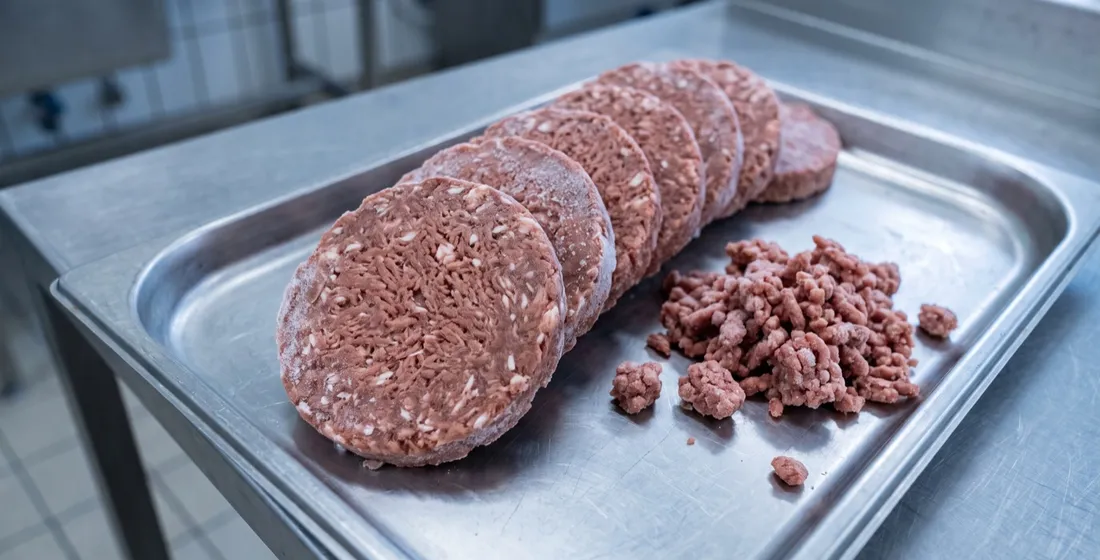
Buyer’s snapshot
- US retail sales of plant-based meat and seafood fell to $1.0 billion in 2025, down 10% in dollars and 11% in units, and 70% of what sold was frozen (Good Food Institute, SPINS data).
- A shrinking category makes unit cost the whole argument, which puts the protein input and the freezing step under harder scrutiny than the recipe.
- The Silk Foods Ceylon line in Matale runs 15,000 plant-based patties a day and 30,000 nuggets a day on a shared frozen line, under BRCGS and FSSC 22000 V6.
- First-run MOQ for a frozen formed format is confirmed on your quote, with 2 to 3 weeks from purchase order to dispatch for standard SKUs.
- Read the format-selection table below before writing the protein and freezing lines of a co-manufacturing brief.
A plant-based brand shopping for a co-manufacturer in 2026 is not shopping in a growth market. Retail dollar sales of plant-based meat and seafood in the United States came to $1.0 billion in 2025, a 10% decline in dollars and an 11% decline in units, according to Good Food Institute analysis of SPINS retail data. Conventional meat moved the other way on price.
That changes what a brief has to do. When the category was expanding, a co-manufacturing brief could be vague about inputs and process and get fixed on the line. Now the cost base decides whether a SKU survives its second year, and two lines of the brief carry most of that cost: which textured protein goes in, and how fast the formed unit gets through the freezer.
Silk Route Ventures (SRV) publishes the format economics for the patty and mince line elsewhere. This piece covers the two specifications that briefs most often leave blank.
What belongs on the protein line of a co-manufacturing brief
Textured protein is the structural decision in a patty or a mince. It carries the bite, sets the water-holding behaviour, and drags the allergen declaration along behind it. Innova Market Insights reported in its 2026 meat trends analysis that wheat gluten remains the most widely used protein in meat alternatives, with textured vegetable protein, mycoprotein, and fava emerging as the faster-growing inputs. Wheat is the incumbent, not the default answer.
The useful thing to know is what a co-manufacturer cannot supply from a category label. “TVP” describes a process, not a specification. Textured soy flour and textured soy protein concentrate hydrate differently, hold water differently, and finish at different bite. Published ranges for protein content and hydration ratio circulate widely online without a traceable primary source, and specifying against one of those ranges produces a sample that misses.
The defensible route is to name the material. A brief that carries the supplier name, the grade, the technical data sheet reference, and the hydration ratio from that data sheet gives the plant something to reproduce. A brief that says “soy TVP, 60% protein” gives it something to guess at.
SRV finding: across the frozen formed formats run at the Matale site, the specifications that reach a repeatable first sample are the ones that name the protein by supplier grade rather than by category. Where a brief names only the protein type, the bench stage adds iterations before the production plan can be fixed.
The allergen consequence follows the protein choice rather than the other way round. A soy protein and wheat gluten formulation declares two allergens in both the United States and the European Union. That is a labelling decision made at the protein line of the brief, and the seitan and pre-minced mix co-manufacturing guide sets out how the wheat-gluten formats handle it.
Why the freezer, not the former, sets the throughput ceiling
Forming is the fast step. A patty former stamps units at a rate that rarely limits a day’s output. The freezer is where the line meets its actual constraint, because freezing rate is a quality specification before it is a throughput number.
European law defines the requirement precisely. Council Directive 89/108/EEC requires that quick-frozen foodstuffs undergo a process in which “the zone of maximum crystallization is crossed as rapidly as possible,” and that the product temperature, after thermal stabilisation, is held continuously at minus 18 degrees Celsius or lower at all points. Two obligations sit in that sentence: speed through a specific temperature band, and a core temperature target measured after the product has settled, not at the freezer exit.
The physics behind the legal wording is straightforward. Crossing the crystallisation band quickly produces many small ice crystals rather than fewer large ones, which limits damage to the protein matrix and reduces drip when the unit thaws. Slow freezing produces the opposite. Precise crystal-size and drip-loss figures circulate in equipment marketing without a citable published source, so the honest statement is directional: faster through the band, better texture on the plate.
The throughput consequence is that residence time in the freezer, not former speed, sets units per day. A thicker patty needs longer to reach core temperature than a mince crumble at the same belt loading. Two SKUs on the same line can therefore quote different daily outputs from identical forming equipment, and a brief that specifies patty thickness without asking about freezer residence time has not yet costed the run.
Cold chain obligations continue past the plant. The Food and Agriculture Organization sets out the standard ladder for frozen distribution: cold store at minus 18 degrees Celsius or below, distribution at minus 15, retail display at minus 12. The plant hits the first number so that the other two remain achievable.
What a shared frozen line actually gives a scale-up brand
Capability snapshot: frozen formed formats, Matale
- Plant-based patty line: 15,000 units per day
- Nugget line: 30,000 units per day
- Shared frozen line also runs vegan sausage, chicken alternative, seitan, and the pre-minced mix
- Pack formats: frozen, vacuum-packed in buckets, or retort glass jars
- Certification: BRCGS and FSSC 22000 V6
- Batch release: certificate of analysis available on request, in-house standard panel, with testing against the buyer’s destination parameters through an external laboratory on request
The Silk Foods Ceylon (SFC) facility sits at Hapugasyaya, Nalanda, in Matale, roughly 1 km from Nalanda Gedige at the geographic centre of Sri Lanka. The 10,000 sq ft processing floor is laid out for cellular manufacturing, which is why more than 400 product variants run from one site under one certification scope rather than requiring a separate audit cycle for each new introduction.
For a brand at the scale-up stage, the shared line matters more than the headline capacity figure. A patty SKU and a mince SKU that share forming, freezing, and packing infrastructure can be planned into the same production window, which is a different proposition from booking two runs at two plants and reconciling two sets of documents.
Capacity at the category level is not the constraint people assume. Good Food Institute analysis put global plant-based meat production capacity at roughly 2.2 million metric tons in 2022, with Europe holding 41% and North America 34%, and found that retrofitting an existing facility takes about one third the lead time and one fifth the capital of building new. Capacity exists. Certified capacity that will take a first run at launch volume is the scarcer thing.
Patty or mince: what changes between the two formats
| Specification | Formed patty | Mince or crumble |
|---|---|---|
| Forming step | Stamped to fixed weight and thickness | Extruded and cut, no fixed unit weight |
| Freezing constraint | Core temperature through thickness sets residence time | Faster to core, higher belt loading possible |
| Portion control | Unit count is the sales unit | Weight is the sales unit |
| Pack format | Frozen, vacuum-packed in buckets, or retort glass jars | Frozen, vacuum-packed |
| Typical first-run MOQ | Confirmed on your quote | Quoted by weight against the same line window |
| EU naming exposure | Lower, since burger and patty denominations survived the March 2026 agreement | Higher, since species-linked mince denominations are restricted |
The naming column is the one that has moved recently, and it moved in the brand’s favour on the patty side. The plant-based patty contract manufacturer guide covers the March 2026 European position and the January 2025 FDA draft guidance on plant-based statements of identity in detail, so this piece does not restate it. The point for the spec sheet is that the format choice and the denomination choice are now the same decision.
How large does a first run need to be
First-run MOQ for a frozen formed format at the Matale site is confirmed on your quote, and lead time from purchase order to dispatch is 2 to 3 weeks for standard SKUs (4 to 6 weeks for private label, custom specifications and organic orders). Sea freight adds 3 to 4 weeks to European ports and 4 to 5 weeks to the United States. Orders under $10,000 are payable in full in advance by bank transfer; orders of $10,000 or above run 50% advance with the balance against scanned shipping documents.
Those numbers are worth stating plainly because almost nobody publishes them. Directory listings and co-packer landing pages describe minimums qualitatively and leave the buyer to discover the real figure in a call.
One anonymised example shows what the ladder looks like when it works. A plant-based brand that placed a 5,000-unit first run in 2021 was ordering multi-container volumes monthly by 2024. The first run was small enough to be a test rather than a bet, which is the only reason the second and third ones happened.
Private label is the competitive pressure behind that maths. Innova Market Insights found that 29% of new meat-alternative launches now carry a private label, which means a branded SKU is increasingly priced against a retailer’s own version of the same format. European retail data from Good Food Institute Europe and Circana shows how sharply that plays out: in 2025 French plant-based meat volumes rose 16.8% on a 2.8% average price cut, while UK volumes fell 9.4% on a 2.3% price rise. Where does the cost come out? Mostly from the input specification and the run size, which is where this brief started.
For brands weighing whether a low first-run minimum is worth the per-unit premium, the low-MOQ contract manufacturing analysis works through the arithmetic, and the supplier qualification guide covers the audit and documentation checks that come before a first order.
Where the fat system and the adjacent formats fit
Fat is the third structural decision after protein and freezing, and it has its own published comparison. The patty fat system comparison covers coconut, sunflower, and MCT against melting-point behaviour and the saturated fat declaration. What matters for the freezing question specifically is that a fat that is solid at chiller temperature behaves differently through the crystallisation band than one that is liquid.
Brands running a broader plant-protein range on one supplier can also look at the nugget line at 30,000 units a day and the jackfruit-in-brine retort formats, both of which sit inside the same certification scope described in the plant-based and functional food manufacturing overview.
Frequently asked questions
What is the contract manufacturing MOQ for plant-based patties and mince?
First-run MOQ for a frozen formed format at Silk Foods Ceylon is confirmed on your quote, against a patty line running 15,000 units a day. Lead time from purchase order to dispatch is 2 to 3 weeks for standard SKUs. Contact SRV for a co-manufacturing capability briefing scoped to your launch volume.
Does the freezing method change the finished texture?
Yes. Council Directive 89/108/EEC requires quick-frozen products to cross the zone of maximum crystallisation as rapidly as possible and hold minus 18 degrees Celsius at all points after thermal stabilisation. Faster passage through that band produces smaller ice crystals, which limits matrix damage and reduces drip on thaw.
What protein information does a co-manufacturer need before quoting?
Name the material rather than the category. Supplier, grade, technical data sheet reference, and the hydration ratio from that sheet let the plant reproduce a target bite. Innova Market Insights reported for 2026 that wheat gluten remains the most used protein in meat alternatives, with textured vegetable protein and fava growing fastest.
Can one facility run both a patty SKU and a mince SKU?
Both formats run on the same frozen line at the Matale site, alongside vegan sausage, chicken alternative, and seitan formats. The cellular manufacturing layout means a new SKU introduction sits inside the existing certification scope rather than triggering a separate audit cycle.
Which certifications cover the plant-based meat alternative lines?
The site holds BRCGS and FSSC 22000 V6, with the FSSC scope covering the full processing range from spices and herbs through plant-based meat alternatives. For US and EU retail buyers, that combination satisfies the gating filter most multinational retailers apply to Asian suppliers.
How Silk Route Ventures can help
Silk Route Ventures (SRV) contract-manufactures finished CPG SKUs (spreads, sauces, and semi-liquids in glass jars; vegan patties at 15,000 units per day; vegan nuggets at 30,000 units per day; spray-dried plant milks; jackfruit-in-brine for plant-based meat formats; functional beverages) under one roof at the Silk Foods Ceylon (SFC) facility in Matale. The site holds BRCGS and FSSC 22000 V6, with the FSSC scope covering the full processing range. The cellular manufacturing layout means new SKU introductions do not require a separate audit cycle, and the SRV research and new product development team scopes the formulation in parallel with the production plan. Contact us to send an inquiry for a co-manufacturing capability briefing tailored to your SKU and target launch volume. The full range sits on our Sri Lanka coconut products.
Sources
- Good Food Institute and SPINS. Analyzing plant-based meat and seafood sales. Retrieved 2026-08-24. https://gfi.org/resource/analyzing-plant-based-meat-and-seafood-sales/
- Good Food Institute Europe and Circana. European plant-based sales data. Retrieved 2026-08-24. https://gfieurope.org/european-plant-based-sales-data/
- Innova Market Insights. Meat Trends 2026: Global Market Overview. Retrieved 2026-08-24. https://www.innovamarketinsights.com/trends/meat-trends-2026-global-market-overview/
- Council Directive 89/108/EEC on quick-frozen foodstuffs for human consumption, Article 1. Retrieved 2026-08-24. https://www.legislation.gov.uk/eudr/1989/108/article/1
- Food and Agriculture Organization of the United Nations. Freezing of Fruits and Vegetables (Y5979E), Chapter 1. Retrieved 2026-08-24. https://www.fao.org/4/y5979e/y5979e03.htm
- Good Food Institute. Plant-based meat manufacturing capacity and pathways for expansion. Retrieved 2026-08-24. https://gfi.org/resource/plant-based-meat-manufacturing-capacity-and-pathways-for-expansion/