
Plant-Based Seitan and Pre-Minced Mix Co-Manufacturing: Format, MOQ, and Freezer Logistics
Key takeaways
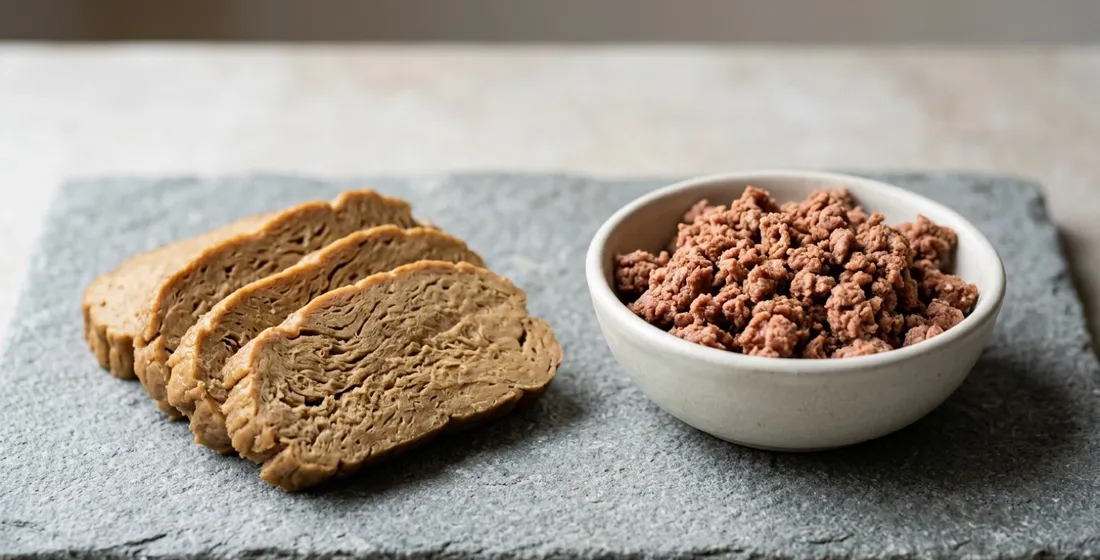
- Seitan is a firm, whole-cut wheat-gluten product (vital wheat gluten is about 75% protein), while a pre-minced mix is a loose, crumbly ground format; the two need different forming steps but run on the same frozen line.
- Silk Foods Ceylon co-manufactures both formats frozen, at a 5,000 to 10,000 unit first-run MOQ per SKU, under FSSC 22000 V6, on the shared cellular line that also produces vegan patties and nuggets.
- Because both formats are 100% wheat-gluten based, they must carry a prominent wheat and gluten allergen declaration in both the US (FALCPA) and the EU (Regulation 1169/2011), and plant-based naming rules are tightening in both markets.
Buyer’s snapshot
- Frozen made up about 69% of US plant-based meat and seafood retail sales in early 2025, worth roughly 782 million dollars, while the refrigerated segment fell 12.1% (SPINS data, via AgFunderNews, 2025). Format is now a survival decision, not a preference.
- For a buyer, that shifts the co-manufacturing brief. A frozen line and a working reefer cold chain matter as much as the recipe, because the format that sells is the format that ships and holds at minus 18 degrees Celsius.
- Silk Foods Ceylon (SFC) co-manufactures frozen seitan meat and pre-minced plant-based mix on the same cellular line that runs vegan patties at 15,000 units a day and nuggets at 30,000 units a day, under FSSC 22000 V6.
- First-run MOQ is confirmed on your quote. Lead time from PO to dispatch is 2 to 3 weeks for standard SKUs; sea freight runs 3 to 4 weeks to the EU and 4 to 5 weeks to the US.
- This post is for plant-based brands and foodservice buyers scaling a frozen seitan or minced SKU. For a chilled, short-shelf-life product sold within one metro, an export co-manufacturer is the wrong tool.
Most contract manufacturers in Asia that quote plant-based meat quote one thing: a formed, frozen patty against the buyer’s recipe. A smaller number can form a whole-cut. Fewer still run a seitan whole-cut and a pre-minced ground format on the same audited line, then hand the buyer a reefer plan that survives four weeks at sea. Seitan and minced mix are where a plant-based range gets interesting, and where the freezer logistics quietly decide whether the SKU is viable. This piece maps both formats: what they are, how they run, the MOQ and lead time, and the cold-chain math that a frozen export product lives or dies on.
What is seitan, and why is it the base for plant-based meat?
Seitan is cooked wheat gluten. Vital wheat gluten, the isolated protein used to make it, runs about 75 grams of protein per 100 grams, roughly 75% protein by weight (USDA FoodData Central, item 168147). That density is the reason seitan holds a firm, layered, sliceable structure that reads as a whole-cut on the plate, where a soy or pea isolate needs extrusion to get there. For a formulator building a deli slice, a strip, or a roast-style center, gluten is the shortest path to bite.
The pre-minced mix is the other half of the same protein story. Instead of a formed whole-cut, the gluten base is worked into a loose, crumbly ground texture, seasoned, and frozen as a bulk crumb that a downstream kitchen or co-packer turns into bolognese, taco filling, or a formed patty. One base protein, two finished formats, two different forming steps. The buyer picks the format by where the SKU sits on the shelf, not by the protein.
The trade-off is allergen exposure. A gluten-based product is, by definition, a wheat product, and that carries a hard labelling consequence in every export market. More on that below, because it shapes the spec before the recipe does.
Seitan whole-cut versus pre-minced mix: two formats, one protein
The two formats share a raw material and split at the forming stage. A whole-cut seitan runs through a texturizing and setting step that builds the grain; a minced mix skips forming and freezes as a free-flowing crumb. That single difference drives the packing format, the thaw behavior, and the downstream use, so it is worth putting side by side before a buyer writes the brief.
| Attribute | Seitan whole-cut (frozen) | Pre-minced mix (frozen) |
|---|---|---|
| Texture | Firm, layered, sliceable grain | Loose, crumbly ground crumb |
| Protein base | Vital wheat gluten (about 75% protein) | Vital wheat gluten, seasoned |
| Typical use | Deli slice, strip, roast, steak-style | Bolognese, taco filling, formed patty base |
| Pack format | Vacuum-packed pieces or retail portions | Bulk bag or vacuum block for further processing |
| Downstream step | Slice, sear, or heat and serve | Buyer forms, cooks, or portions |
| Allergen | Wheat and gluten (mandatory declaration) | Wheat and gluten (mandatory declaration) |
Source: Silk Foods Ceylon format data, 2026; protein figure USDA FoodData Central item 168147.
A brand rarely needs both on day one. The common pattern is a whole-cut hero SKU for retail and a minced bulk format for foodservice or for a co-packer that finishes the product closer to the end market. Running both from one supplier means one spec conversation, one certification scope, and one freight schedule instead of three.
Inside the shared frozen line in Matale
Silk Route Ventures (SRV) co-manufactures both formats at the Silk Foods Ceylon facility in Hapugasyaya, Nalanda, Matale, 1 km from Nalanda Gedige at the geographic center of Sri Lanka. The frozen seitan and the pre-minced mix run on the same cellular line that produces vegan patties at 15,000 units a day and vegan nuggets at 30,000 units a day, inside a 10,000 sq ft processing floor, under FSSC 22000 V6. The patty and nuggets formats on that floor also carry BRCGS, so a buyer moving from a minced crumb to a formed retail patty stays inside a familiar audit scope.
The cellular layout is the part that does not show on a capacity sheet but changes the math for a scale-up. Because formats share a floor rather than sitting on dedicated long-run lines, the team runs a seitan whole-cut for one brand alongside a minced pilot for another in the same week, on the same certification scope. A new SKU does not trigger a separate facility audit. For a brand planning a whole-cut and a minced format across two seasons, that removes a re-audit cost a single-format plant would pass back.
In the first half of 2026, the SRV procurement desk fielded a recurring request: brands that had launched a chilled seitan slice domestically and hit a wall the moment they tried to export it, because the chilled shelf life would not survive the transit. The fix was almost always the same, a reformulation for a frozen whole-cut and a minced companion SKU, scoped by the R&D and NPD team in parallel with the production plan. The format change, not the recipe, was what made the export work.
What is the MOQ and lead time for frozen seitan and minced co-manufacturing?
First-run co-manufacturing MOQ for the frozen plant-based formats is confirmed on your quote, set per product rather than across the order. A buyer launching a seitan slice and a minced bulk format is committing to a first run of each, not a shared minimum split between them. Sample runs are available before a volume commitment, which is how most brands validate the texture and the thaw behavior before they lock a PO.
| Format | Line capacity | First-run MOQ (per SKU) | Pack |
|---|---|---|---|
| Frozen seitan whole-cut | Shared cellular line | Confirmed on your quote | Vacuum pieces or portions |
| Pre-minced mix (frozen) | Shared cellular line | Confirmed on your quote | Bulk bag or vacuum block |
| Vegan patties (frozen) | 15,000 units/day | Confirmed on your quote | Vacuum pack or retort jar |
| Vegan nuggets (frozen) | 30,000 units/day | Confirmed on your quote | Vacuum pack |
Source: Silk Foods Ceylon capacity and MOQ data, 2026.
Lead time from PO to dispatch is 2 to 3 weeks for standard SKUs once a formulation is locked (4 to 6 weeks for private label, custom specifications and organic orders). Where the R&D team develops or adjusts a formulation, add 2 to 4 weeks upfront for the development cycle. Samples are free for evaluation (you cover the courier), so the validation loop can run before the production lead begins.
Freezer logistics: reefer, minus 18 degrees, and the cold-chain math
Frozen is not a preference in this category, it is where the volume is. Frozen made up about 69% of US plant-based meat and seafood retail sales in early 2025, roughly 782 million dollars, while the refrigerated segment fell 12.1% over the same window (SPINS data, reported by AgFunderNews, 2025). For an export product, frozen is also the only honest option, because a chilled shelf life cannot absorb a multi-week ocean transit. The format that sells and the format that ships are the same format.
The number that governs the whole chain is minus 18 degrees Celsius, the internationally recognized holding temperature for frozen food under the Codex Alimentarius code of practice. A standard reefer sea container holds that band comfortably and a deep-freeze unit runs colder still, so the constraint is rarely the container. It is the handoffs: the blast-freeze after production, the cold store before the vessel, the port dwell, and the buyer’s receiving dock. Each handoff is a place the chain can break, and a broken chain shows up as freezer burn or a texture defect, not as a temperature log a buyer sees in time.
| Destination | Sea freight transit | Freight mode |
|---|---|---|
| European Union | 3 to 4 weeks | Reefer container, minus 18 C |
| United States | 4 to 5 weeks | Reefer container, minus 18 C |
| Australia | 3 to 4 weeks | Reefer container, minus 18 C |
Source: Silk Foods Ceylon shipping data, 2026; minus 18 C holding standard per Codex Alimentarius.
Spec snapshot: frozen seitan and pre-minced mix
- Protein base: vital wheat gluten (about 75% protein, USDA FoodData Central 168147)
- Formats: seitan whole-cut (sliceable) and pre-minced mix (crumb)
- Storage and transit: frozen, held at or below minus 18 C
- Certification scope: FSSC 22000 V6 (shared line also holds BRCGS for patties and nuggets)
- MOQ: first-run minimum confirmed on your quote
- Lead: 2 to 3 weeks PO to dispatch for standard SKUs; samples free for evaluation (you cover the courier)
The documentation is the other half of freezer logistics. Dispatched orders carry a commercial invoice, packing list, bill of lading and a certificate of origin, with a certificate of analysis available on request, and a phytosanitary certificate and the organic import certificate the destination requires (EU or GB Certificate of Inspection, USDA NOP Import Certificate) where the SKU and market require them. For a frozen product crossing a border, the paperwork is what keeps the container moving through the port rather than sitting in a yard losing cold-chain margin.
How do you label seitan and minced mix for the US and EU?
Because both formats are entirely wheat-gluten based, they must carry a prominent wheat allergen declaration in every major export market. In the US, wheat is one of the major allergens named under the Food Allergen Labeling and Consumer Protection Act (FALCPA, 2004), and it must be declared on the packaged label. In the EU, cereals containing gluten sit in Annex II of Regulation 1169/2011, and Article 21 requires the allergen be emphasized in the ingredient list, typically in bold. This is not a nuance to resolve at artwork stage. It shapes the spec, the pack copy, and the buyer’s own due diligence from the first sample.
Compliance snapshot: seitan and minced mix, US and EU
- Wheat and gluten: mandatory allergen declaration (US FALCPA 2004; EU Regulation 1169/2011 Annex II)
- EU: allergen must be emphasized in the ingredient list (Article 21)
- Naming: US state meat-labelling laws restrict terms like meat, burger, and sausage in at least 16 states (Missouri was first, 2018)
- EU naming: Parliament rejected a plant-based meat-name ban in 2020, then voted in October 2025 to restrict such terms, a position still moving through the EU process
Naming is the second live issue. In the US, at least 16 states have passed laws governing how the word meat and related terms appear on plant-based products, with Missouri the first in 2018. In the EU, the European Parliament rejected a proposed ban on terms like burger and sausage for plant-based products in 2020, then reversed course in October 2025 with a vote to restrict meat-style names, a position still working through the EU legislative process. None of this changes the seitan or the minced mix in the bag. It changes the label, and a co-manufacturer that scopes the destination market into the artwork brief saves a buyer a re-print.
Frequently asked questions
Does Silk Route Ventures offer contract manufacturing for frozen seitan?
Yes. Silk Foods Ceylon co-manufactures frozen seitan whole-cut and pre-minced plant-based mix on the shared cellular line in Matale, under FSSC 22000 V6. First-run MOQ is confirmed on your quote, with sample runs available before a volume commitment. Lead time from PO to dispatch is 2 to 3 weeks for standard SKUs.
What is the minimum order quantity for pre-minced plant-based mix?
The first-run MOQ for the frozen pre-minced mix is typically 5,000 to 10,000 units per SKU, set per product rather than across the total order. A buyer launching a minced format and a seitan whole-cut commits to a first run of each. Contact SRV for a co-manufacturing briefing tied to your target launch volume.
What temperature is frozen seitan shipped at, and how long is transit?
Frozen seitan and minced mix ship in reefer containers held at or below minus 18 degrees Celsius, the Codex Alimentarius holding standard for frozen food. Sea freight runs 3 to 4 weeks to the EU and Australia and 4 to 5 weeks to the US, with full cold-chain documentation on every shipment.
Does seitan need a wheat allergen label?
Yes. Seitan is made from wheat gluten, so it must carry a wheat allergen declaration under US FALCPA (2004) and be emphasized in the ingredient list under EU Regulation 1169/2011, Annex II. Silk Foods Ceylon scopes the destination market’s allergen and naming rules into the spec before production.
Can Silk Route Ventures develop a custom seitan or minced formulation?
Yes. The SRV R&D and NPD team develops and adjusts frozen plant-based formulations in parallel with the production plan. A buyer can arrive with a locked recipe or a one-line brief and a target price. Formulation work adds 2 to 4 weeks upfront before the production lead (2 to 3 weeks for standard SKUs).
How Silk Route Ventures can help
Silk Route Ventures (SRV) contract-manufactures frozen plant-based formats, including seitan whole-cut, pre-minced mix, vegan patties at 15,000 units a day, and vegan nuggets at 30,000 units a day, under one roof at the Silk Foods Ceylon (SFC) facility in Matale. The site holds FSSC 22000 V6 covering the plant-based meat scope, plus BRCGS for the patty and nuggets lines. The cellular manufacturing layout means new SKU introductions do not require a separate audit cycle, and the SRV R&D and NPD team scopes the formulation in parallel with the production plan. First-run MOQ is confirmed on your quote, with reefer freight held at minus 18 degrees Celsius and full cold-chain documentation. Contact us to send an inquiry for a co-manufacturing capability briefing tailored to your SKU and target launch volume. Certifications, MOQs and lead times are listed on our Sri Lankan spices supplier.
Sources
- Good Food Institute, “State of the Industry Report: plant-based food,” (2025). Retrieved 2026-07-05. https://gfi.org/marketresearch/
- AgFunderNews, “Plant-based meat by the numbers,” (2025). SPINS retail data. Retrieved 2026-07-05. https://agfundernews.com/plant-based-meat-by-numbers-grim-reading-for-the-us-retail-market-brighter-spots-in-foodservice-and-globally
- USDA FoodData Central, “Vital wheat gluten,” item 168147. Retrieved 2026-07-05. https://fdc.nal.usda.gov/
- US Food and Drug Administration, “Food Allergen Labeling and Consumer Protection Act of 2004 (FALCPA).” Retrieved 2026-07-05. https://www.fda.gov/food/food-allergensgluten-free-guidance-documents-regulatory-information/food-allergen-labeling-and-consumer-protection-act-2004-falcpa
- European Union, “Regulation (EU) No 1169/2011 on the provision of food information to consumers,” Annex II. Retrieved 2026-07-05. https://eur-lex.europa.eu/legal-content/EN/TXT/?uri=CELEX:32011R1169
- Euronews, “European Parliament vote on plant-based meat names,” (8 October 2025). Retrieved 2026-07-05. https://www.euronews.com/my-europe/2025/10/08/when-is-a-sausage-no-longer-a-sausage-european-parliament-answers-after-long-grilling-sess
- National Agricultural Law Center, “State meat-labelling laws.” Retrieved 2026-07-05. https://aglaw.psu.edu/research-by-topic/issue-tracker/meat-labeling-law-new-version/
Further reading
- Codex Alimentarius, “Code of Hygienic Practice for the Processing and Handling of Quick Frozen Foods (CAC/RCP 8-1976).” https://www.fao.org/fao-who-codexalimentarius/
- Private Label Manufacturers Association (PLMA), “Private label sales data,” (2024). https://plma.com/
Written by the Silk Route Ventures Trade Team. Silk Route Ventures (E-Silk Route Ventures (Pvt) Ltd) is a Sri Lankan B2B supply-chain operator for the Food, Beverage, Wellness, and Nutraceuticals sectors. The Silk Foods Ceylon manufacturing arm holds BRCGS and FSSC 22000 V6 certifications. Questions or to request a sample: Contact us at https://www.esilkroute.com.lk/contact or email info@esilkroute.com.lk.