
Organic Ceylon Black Tea for Private Label: Grades, Scope, Packs
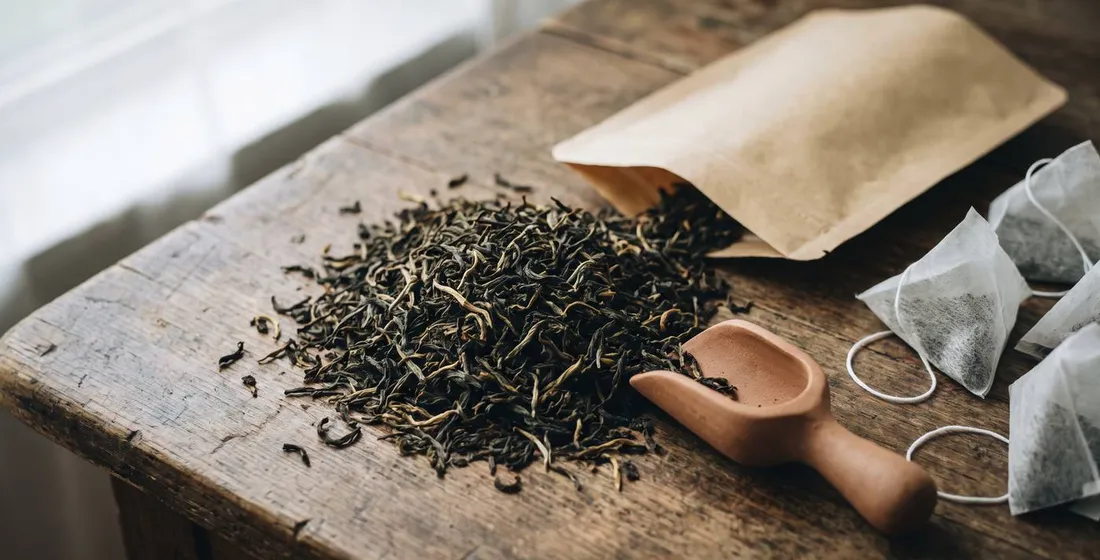
Buyer’s snapshot
- Sri Lanka exported 257.44 million kg of tea for USD 1.51 billion in 2025, an average FOB of USD 5.85 per kg (Daily Mirror Business, 2026). Organic black tea is a small, specific slice of that trade, and it is sold lot by lot against certificates.
- Organic is a property of a certified SKU, not of a supplier or a category. Since 19 March 2024, every organic shipment entering the United States must be tied to an electronic NOP Import Certificate (USDA AMS, 2024).
- Grade still follows format: broken and tippy grades for loose-leaf packs, fannings for standard bags. Organic status does not change that ladder.
- Silk Foods Ceylon (SFC) packs Ceylon tea at its Matale facility under FSSC 22000 V6, with a 100 kg first-order MOQ per grade and 4 to 6 weeks from PO to dispatch on organic and private-label orders.
- This post is for private-label and specialty tea brands that want an organic claim they can document. For a conventional breakfast blend, the BOP and FBOP grade primer is the faster read.
Most private-label tea briefs treat “organic” as an adjective added to a grade. It behaves more like a document. A black tea lot is organic for your label only if the SKU sits inside a current certificate scope, the processing and packing steps are covered, and the right import certificate exists before the container sails. Get those three right and the pack claim holds up at the border and at the retail listing review. Miss one and the claim becomes a liability. This piece sets out how grade, organic scope and pack format fit together for Ceylon black tea, and what Silk Route Ventures (SRV) confirms before it quotes.
How should you match grade to a loose-leaf or tea-bag SKU?
Grade should follow format, because leaf size controls brew speed, liquor strength and how the tea behaves in a bag. Loose-leaf retail packs reward broken grades with visible tip, while standard bags reward small fannings. Organic status changes the paperwork on the lot, not the physics of the particle, so the format logic from conventional tea carries over unchanged.
Ceylon black tea is sorted into size fractions after manufacture, and ISO 3720:2011 sets the compositional floor every grade must clear (International Organization for Standardization, 2011). The full ladder is covered in the BOP and FBOP grade primer. The table below keeps only what matters for an organic private-label brief.
| Private-label format | Grade family to specify | Why it fits | Watch-out |
|---|---|---|---|
| Loose-leaf retail pack | FBOP, or BOP for a stronger cup | Broken leaf with visible tip reads well on shelf and brews round | Tip content raises the price per kg |
| Standard paper tea bag | BOPF or Dust1 | Small particles brew fast and strong inside the bag | Little visible leaf identity |
| Pyramid or specialty bag | FBOP or fine BOP | Room to move, so leaf shows through the mesh | Bag size limits the particle you can use |
| Foodservice or catering | BOP | Strength and colour hold up to milk and volume | Less aromatic nuance |
Source: SRV facility grade range and Sri Lanka Tea Board grade nomenclature.
Ask for availability by grade at quote stage rather than assuming every grade is on offer in every organic lot. A three-SKU range, for example a loose-leaf pack, an everyday bag and a catering pack, usually needs three grade lines, and each line carries its own first-order MOQ.
What does “organic scope” actually mean for a black tea SKU?
Organic scope is the list of products and activities a certifier has approved on an operator’s certificate. A black tea SKU can be sold as organic only when that product, in that form, appears on the certificate in force on the day of sale. Facility-wide or category-wide organic claims are not a valid shortcut.
Tea adds a second layer, because tea bagging and repacking are processing steps. A certificate that covers the leaf does not automatically cover the cutting, blending, bagging or retail packing done on top of it. That is why the question to put to any supplier is not “do you have organic tea?” but “is this exact SKU, in this exact pack format, on your current certificate?”
Buyer’s checklist: confirming organic scope on a black tea SKU
- The SKU named in writing by grade and pack format, not just “organic black tea”
- A copy of the current certificate showing the product on its scope page
- Confirmation that blending, bagging or retail packing is inside the same scope
- The certifier’s name and the certificate validity window
- The transaction document for your destination (see the next section)
- A COA on request, with a pesticide residue panel aligned to the destination market
- Written statement of what is not organic in the range, so labels never overreach
SRV confirms organic status per SKU against the certificate scope in force before it issues a quote, and says so plainly when a requested black tea SKU is not on it. USDA Organic and EU Organic apply to selected SKUs, confirmed per SKU. The wider logic is laid out in the buyer’s guide to organic certifications.
Which documents travel with an organic lot?
An organic lot needs a transaction-level import document in addition to the certificate itself. The United States requires an electronic NOP Import Certificate and the EU requires a certificate of inspection issued in TRACES. Both are tied to the individual consignment and have to exist before the goods ship, which is why organic orders carry a longer lead time.
On 19 March 2024 the Strengthening Organic Enforcement rule made the electronic NOP Import Certificate mandatory for every organic shipment entering the United States. The certificate is issued from the Organic Integrity Database by the exporter’s certifier, and its data is linked to the entry in the customs system (USDA AMS, 2024; Federal Register, 2023). For importers, the claim stopped being a line on an invoice and became a record with an identifier.
For the EU, Delegated Regulation (EU) 2021/2306 requires a certificate of inspection issued in TRACES for each organic consignment, and the importer submits an extract of it per batch under Implementing Regulation (EU) 2021/2307 (European Commission, 2021). Britain runs its own organic import rules, covered in the GB organic and labelling guide.
| Destination | Organic transaction document | Issued by | Timing |
|---|---|---|---|
| United States | NOP Import Certificate (electronic) | Exporter’s accredited certifier, via the Organic Integrity Database | Before export |
| European Union | Certificate of inspection in TRACES | Control body or authority in the exporting country | Before the consignment enters the EU |
| Any market | Certificate of origin, COA on request, phytosanitary certificate where required | Issued per lot | Part of the shipping set |
Source: USDA AMS; Federal Register 2023-00702; Commission Delegated Regulation (EU) 2021/2306.
The practical consequence is simple. These certificates are requested and issued per lot, so the paperwork sits inside the 4 to 6 weeks SRV quotes for organic and private-label orders.
What pack options exist, and what do they cost in lead time?
Ceylon black tea can be supplied as bulk leaf by grade, as finished tea bags or as retail loose-leaf packs under the buyer’s own label. Bulk leaf is the simplest on paperwork and the lowest in unit cost. Finished bags and retail packs move the packing step into scope, which is where organic confirmation matters most.
| Pack option | Format | Minimum order | What to confirm |
|---|---|---|---|
| Bulk leaf | Sacks or cartons by grade | 100 kg per grade for a first order | Grade availability, lot COA on request |
| Finished tea bags | Pyramid, round paper, string and tag | Confirmed on the quote | Packing step inside organic scope, bag material |
| Retail loose-leaf packs | Buyer’s pack and label | Confirmed on the quote | Packing scope, label wording |
Bag material is its own decision. EU Regulation 2025/40 makes permeable tea bags industrially compostable from 12 February 2028, and the trade-offs between pyramid, paper and string-and-tag are covered in the tea bag formats guide.
Spec snapshot: private-label Ceylon black tea at SFC Origin: Sri Lanka, packed at the Matale facility Standard: ISO 3720:2011 compliance, COA on request Facility certification: FSSC 22000 V6 covers the tea line Organic: USDA Organic and EU Organic on selected SKUs, confirmed per SKU MOQ: from 100 kg per grade (bulk); pack-format minimums on the quote Lead time: 4 to 6 weeks PO to dispatch for organic and private-label orders Pricing basis: FOB Colombo; CFR and CIF on request
Samples are free for evaluation and the buyer pays the courier. Approve the sample against the written spec before the first purchase order.
What does the timeline look like from approved sample to shelf?
The production window for an organic private-label tea order is 4 to 6 weeks from purchase order to dispatch, followed by sea freight of 3 to 4 weeks to the EU or Australia and 4 to 5 weeks to the United States. Budget the whole chain, not one leg, when setting a launch date.
Work backwards from the shelf date. Take off freight first, then the 4 to 6 weeks of production and certification paperwork, and the date by which the sample must be approved lands earlier than most briefs assume.
This is where a single supplier for tea, spices and herbs helps. The same documentation set, the same certification stack and one freight schedule cover a multi-category range, as set out in the supplier consolidation guide and across the wider botanicals supplier range. Silver tips is white tea with its own scope question, covered in the silver tips spec guide.
Where SRV’s offer does not fit Brands that want an organic claim on the pack for a SKU that is not on the current certificate. Buyers comparing an organic quote with a conventional price per kg. Orders below the 100 kg bulk minimum with no plan to scale. For those briefs, a conventional Ceylon grade with an honest origin claim is the better answer than a stretched organic one.
Frequently asked questions
Can Ceylon black tea be sold as organic?
Yes, when the specific SKU sits inside a current organic certificate scope and the packing steps are covered. Organic is a property of the certified SKU, so SRV confirms it per SKU before quoting and says so if a requested black tea SKU is not on the certificate. The destination also needs its import certificate (USDA AMS, 2024).
Which grade suits organic tea bags and which suits loose-leaf packs?
Fannings such as BOPF and Dust1 suit standard bags because small particles brew fast and strong. Broken grades with visible tip, such as FBOP, suit loose-leaf retail packs and pyramid bags where leaf shows. Organic status does not change this ladder, but availability by grade is confirmed on the quote.
Which documents come with an organic black tea lot?
The set depends on destination. US-bound lots need an electronic NOP Import Certificate issued by the exporter’s certifier before export. EU-bound lots need a certificate of inspection in TRACES (European Commission, 2021). A certificate of origin, a COA on request and a phytosanitary certificate where required complete the shipping set.
What is the MOQ and lead time for private-label organic black tea?
Bulk leaf starts at 100 kg per grade for a first order. Tea-bag and retail-pack minimums are confirmed on the quote. Lead time is 4 to 6 weeks from PO to dispatch for organic and private-label orders, then 3 to 5 weeks of sea freight depending on destination. Samples are free, with the courier paid by the buyer.
Does Silk Foods Ceylon pack tea under a food-safety certificate?
Yes. The Matale facility holds BRCGS and FSSC 22000 V6, and the tea line is covered under FSSC 22000 V6. USDA Organic and EU Organic apply to selected SKUs and are confirmed per SKU. Contact SRV with the grade, format and destination so the right certificate scope can be checked before a quote.
How Silk Route Ventures can help
Silk Route Ventures (SRV) supplies Ceylon black tea by grade and builds private-label tea programmes from origin, including finished bags and retail packs under the buyer’s own label. The Silk Foods Ceylon (SFC) facility in Matale holds BRCGS and FSSC 22000 V6, with USDA Organic and EU Organic on selected SKUs, confirmed per SKU. First-order MOQ is 100 kg per grade, lead time is 4 to 6 weeks for organic and private-label orders, and pricing is FOB Colombo with CFR and CIF on request. For the organic black tea range, send the grade, pack format and destination and SRV will confirm certificate scope before quoting. Contact us to send an inquiry or request a sample.
Sources
- Daily Mirror Business, “Tea Industry Overview for the period January to December 2025,” republished by History of Ceylon Tea, 2026. Retrieved 2026-11-16. https://www.historyofceylontea.com/ceylon-publications/ceylon-tea-articles/tea-industry-overview-january-december-2025.html
- USDA Agricultural Marketing Service, National Organic Program, “Strengthening Organic Enforcement” and NOP Import Certificate guidance, 2024. Retrieved 2026-11-16. https://www.ams.usda.gov/node/43636
- Federal Register, “National Organic Program (NOP); Strengthening Organic Enforcement,” 2023-00702, 19 January 2023. Retrieved 2026-11-16. https://www.federalregister.gov/documents/2023/01/19/2023-00702/national-organic-program-nop-strengthening-organic-enforcement
- European Commission, Delegated Regulation (EU) 2021/2306 and Implementing Regulation (EU) 2021/2307 on organic imports and the certificate of inspection, 2021. Retrieved 2026-11-16. https://eur-lex.europa.eu/eli/reg_del/2021/2306/oj
- International Organization for Standardization, “ISO 3720:2011 Black tea, Definition and basic requirements,” 2011. Retrieved 2026-11-16. https://www.iso.org/standard/51541.html
Further reading
- Sri Lanka Export Development Board, “Ceylon Tea Quality Standards and Quality Assurance” → https://www.srilankabusiness.com/tea/about-tea/quality-assurance.html
- Tea Exporters Association of Sri Lanka, “Tea Grade” → https://teasrilanka.org/tea-grade
Written by the Silk Route Ventures Trade Team. Silk Route Ventures (E-Silk Route Ventures (Pvt) Ltd, T/A Silk Route Ventures) is a Sri Lankan B2B supply-chain operator for the Food, Beverage, Wellness, and Nutraceuticals sectors. The Silk Foods Ceylon manufacturing arm holds BRCGS and FSSC 22000 V6 certifications. Questions or to request a sample: Contact us or email info@esilkroute.com.lk.