
Coconut Water Powder: Spray-Drying Yield, Carriers, and Cost
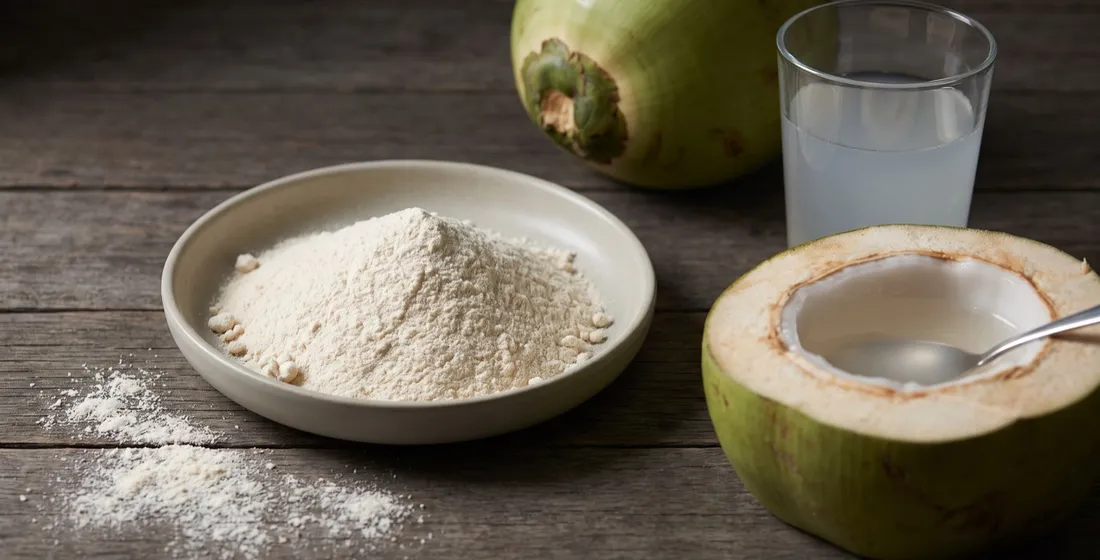
Buyer’s snapshot
- Codex sets a minimum of 5.0 degrees Brix for coconut water, in the General Standard for Fruit Juices and Nectars (CXS 247-2005). It is not in CXS 240-2003, which covers coconut milk and cream and lists coconut water only as an optional ingredient.
- At that Brix, a kilo of genuinely carrier-free coconut water powder takes roughly 15 to 19 litres of fresh coconut water. A kilo carrying 30% maltodextrin takes about 10 to 13 litres.
- In 2025, Sri Lanka exported 50,833 metric tonnes of coconut water, up 40% on 2024, while desiccated coconut volume fell 33% (Coconut Development Authority, Export Performance of Coconut Products).
- Silk Foods Ceylon runs spray drying at 50 kg of finished powder per day from its Matale facility under BRCGS and FSSC 22000 V6, with a 100 kg per SKU first-order MOQ on spray-dried powders.
- The comparison tables below carry the yield math, the carrier loading, and the spec parameters to put on an RFQ. If you need 20 metric tonnes a month of commodity-grade powder, this is not the right supply position.
Most quoted prices for coconut water powder are not comparable, and the reason is not currency or freight. It is that two suppliers quoting “coconut water powder” can be selling products that differ by a factor of two in actual coconut content. One is spray-dried against a maltodextrin carrier at 30% to 50% of total solids. The other is closer to carrier-free and costs what the drying physics says it should cost. Neither supplier is necessarily lying. The spec sheet just does not say which one you are holding. This piece is the yield math, the carrier arithmetic, and the parameters that make the two quotes comparable.
Which standard actually governs coconut water?
Codex Alimentarius sets a minimum of 5.0 degrees Brix for coconut water, in the Annex to the General Standard for Fruit Juices and Nectars (CXS 247-2005). The entry sits under Cocos nucifera L. with a footnote defining the product as coconut water extracted directly from the nut, without expressing the meat. Brix is measured by refractometry (ISO 2173, AOAC 983.17). That single number is the anchor for every yield and dilution calculation further down this page.
A large share of trade content cites the wrong standard. CXS 240-2003, the Standard for Aqueous Coconut Products, opens by stating that it applies to packaged coconut milk and coconut cream. Coconut water appears in it only in Section 3.1.2, as an optional ingredient, listed alongside maltodextrin and sodium caseinate. Anyone quoting a CXS 240 compositional band at you for coconut water is quoting the coconut milk table.
Two more absences matter for buyers. Coconut is not in the EU fruit juice Brix annex: Annex V of Directive 2001/112/EC, as replaced by Directive 2012/12/EU, lists 19 fruits, and Cocos nucifera is not one of them. Coconut is likewise absent from the United States Brix table at 21 CFR 101.30(h)(1), which means percent juice has to be computed on soluble solids content instead. In the US, coconut water is still a juice for food-safety purposes: 21 CFR 120.24 requires a validated 5-log pathogen reduction on the juice stream.
Why coconut water is one of the harder liquids to spray dry
Coconut water is a dilute solution of low molecular weight sugars, organic acids, and minerals. That combination is close to the worst case for a spray dryer. Stickiness in the drying chamber, both particle to particle and particle to wall, tracks the content of low molecular weight sugars and the product temperature (Advances in spray drying of sugar-rich products, Drying Technology, 2020).
The mechanism is glass transition. Published anhydrous glass transition temperatures for the relevant sugars run near 14 degrees C for fructose, 38 degrees C for glucose, and 68 degrees C for sucrose. Water plasticises those solids further, pulling the transition temperature down as moisture rises. When the particle surface sits above its glass transition temperature it behaves as a rubbery syrup rather than a solid, and it deposits on the chamber wall instead of falling to the collection point.
Nut maturity decides which sugar dominates, and therefore how badly the liquid behaves. Data compiled in the Tetra Pak Coconut Handbook from Tan et al. (2014) shows fructose falling from 39.04 to 21.48 mg/mL and glucose from 35.43 to 19.06 mg/mL between 5 to 6 months and 12 months, while sucrose climbs from 0.85 to 14.37 mg/mL. Young nut water is dominated by exactly the two sugars with the lowest transition temperatures. It is the sweeter feedstock and the harder one to dry.
No published glass transition value exists for whole coconut water solids. Any supplier quoting one should be asked for the method and the moisture basis.
How much coconut water does a kilo of powder actually take?
Take a finished powder at 3% moisture, so 970 g of solids per kilo, and coconut water at a density of about 1.02 kg/L. The rest is arithmetic against the Codex Brix floor and the two commercial Brix levels above it.
| Powder composition | Coconut solids per kg | Feed at 5.0 Bx (Codex minimum) | Feed at 5.5 Bx | Feed at 6.5 Bx |
|---|---|---|---|---|
| Carrier-free | 970 g | 19.0 L | 17.3 L | 14.6 L |
| 30% maltodextrin | 679 g | 13.3 L | 12.1 L | 10.2 L |
| 50% maltodextrin | 485 g | 9.5 L | 8.6 L | 7.3 L |
Read the top row first. A carrier-free kilo needs 15 to 19 litres of fresh coconut water, and roughly 16.6 kg of water has to be evaporated to get there. That is the number a buyer should hold in their head when a quote arrives, because it is the number that sets the floor on raw material cost.
Now read the table sideways. Supplier claims of “1 kg of powder from 9 litres” are common. At the Codex minimum Brix, 9 litres carries about 460 g of coconut solids. A kilo of powder built from that is more than half carrier by dry weight. The claim is not impossible. It is simply incompatible with the phrase “100% coconut water powder” printed on the same page.
How much maltodextrin is in your coconut water powder?
Carriers are not a shortcut. They are how the product gets made at all. The published optimum for spray-dried tender coconut water is 30% maltodextrin plus 1.5% Moringa oleifera gum at a 120 degrees C inlet temperature, reporting 94.86% encapsulation efficiency (Manikantan et al., Food and Bioprocess Technology, 2017). Work on coconut sugar, the closest sugar-rich analogue, found the powder reached a non-hygroscopic state only at the highest maltodextrin ratio tested. Freeze-drying trials on coconut water used maltodextrin and polydextrose at 4% to 8% w/v with xanthan gum at 0.1% to 0.3%, and landed on polydextrose at 8% as the optimum (Tanongkankit et al., Scientific Reports, 2023).
At 30% carrier on total solids, a kilo of powder holds about 679 g of coconut water solids and 291 g of starch hydrolysate. That has three consequences a formulator should price in.
Potassium falls proportionally. Using the maturity series in the Tetra Pak Coconut Handbook, coconut water solids run about 3.9% potassium in young nuts and about 7.1% in mature nuts. A carrier-free powder therefore lands somewhere near 3,800 to 6,900 mg per 100 g. Put 30% maltodextrin in it and the band drops to roughly 2,600 to 4,800 mg per 100 g. A supplier claiming 6% natural potassium on a maltodextrin-carried powder is either working at the extreme top of the mature-nut range with almost no carrier, or has added potassium chloride. Ask which.
Reconstitution stops meaning what the label implies. Rebuilding one litre at 5.5 degrees Brix takes about 56 g of coconut water solids. A carrier-free powder does that at roughly 58 g/L. Dose the 30% powder at the same 58 g/L to hit the same Brix and you have delivered about 70% of the coconut content. The drink measures right on a refractometer and is short on everything the refractometer does not see.
The label claim gets harder. In the US, the 100% juice declaration under 21 CFR 101.30 is available only where added ingredients do not diminish juice soluble solids or change volume. Maltodextrin is soluble solids that are not coconut water. The EU is more explicit still: Directive 2001/112/EC states that the minimum Brix in Annex V is exclusive of the soluble solids of any added optional ingredients and additives. Nor does a carrier at 20% to 40% qualify as a processing aid. The incidental additive exemption at 21 CFR 101.100(a)(3) covers substances present at insignificant levels with no technical or functional effect, and a carrier at that loading fails both tests.
Buyer’s checklist: comparing two coconut water powder quotes
- Carrier type and percentage of total solids, stated as a number, not “minimal”
- Brix of the feed coconut water and the nut maturity it was drawn from
- Reconstitution ratio in g/L, plus the target Brix that ratio is meant to hit
- Potassium in mg/100 g, with a statement on whether any potassium salt was added
- Drying route: spray, freeze, or drum, and whether the feed was pre-concentrated
- Moisture, water activity, and the storage condition the shelf life is quoted against
- Full microbiological panel with limits, since no statutory limit exists for this category
- Sample retained against the same lot as the COA
Spray drying, freeze drying, and the pre-concentration question
Industrial spray dryers average 4.87 GJ per tonne of water evaporated, about 1.35 kWh/kg, across a survey of dryers from 0.1 to 12 t/h (Baker and McKenzie, Drying Technology, 2005). Freeze drying is an order of magnitude worse: the drying stage alone runs 5.2 to 19.5 kWh/kg depending on cycle length, with up to 2.3 kWh/kg more for freezing (Sustainability, 2021).
Apply the first figure to a carrier-free kilo. Removing 16.6 kg of water in a spray dryer, straight from 5.5 degrees Brix, needs about 22.5 kWh of thermal energy per kilo of powder. That is the real cost of drying a liquid that is 94.5% water.
This is why pre-concentration decides the economics, not the dryer. Mechanical vapour recompression evaporators remove water at about 0.012 kWh/kg, roughly 80 to 100 kg of water per kWh (Tetra Pak Dairy Processing Handbook). Concentrate the feed to 45% solids first and the evaporator takes out 15.5 kg at 0.19 kWh, leaving the dryer only 1.2 kg to remove at 1.56 kWh. Total: about 1.75 kWh against 22.5 kWh.
State the caveat plainly, because a technically literate buyer will find it otherwise. The dryer figure is thermal energy and the evaporator figure is electrical, so the two are not interchangeable on cost or on carbon. Coconut water is also heat-sensitive and acidic, which limits how far it can be concentrated before flavour and amino acid losses show up in the cup. The 45% figure above is a dairy benchmark used here to size the effect, not a coconut water process spec. The direction is what matters: most of the energy question is settled upstream of the spray dryer, and a quote that does not mention pre-concentration has not answered it.
Specifying coconut water powder on an RFQ
There is no statutory microbiological specification for this product in the EU. Regulation (EC) No 2073/2005 Annex I carries no entry for fruit or vegetable powders. The nearest categories are unpasteurised fruit and vegetable juices, where entry 1.20 requires Salmonella absent in 25 g across five samples, and process hygiene entry 2.5.2 sets E. coli at m = 100 cfu/g, M = 1,000 cfu/g. Neither applies to a powder. That gap is contractual, not regulatory, which means the limits in your RFQ are the only limits that exist.
| Parameter | What to specify | Anchor |
|---|---|---|
| Coconut water solids | % of total solids, carrier declared separately | Directive 2001/112/EC excludes added optional ingredient solids from Brix |
| Brix on reconstitution | Minimum 5.0 Bx of coconut-derived solids | Codex CXS 247-2005, Annex |
| Moisture | Typically 3% to 6% for spray-dried; 5.94% to 8.39% reported for freeze-dried | Tanongkankit et al., 2023 |
| Water activity | Below 0.6, with the storage temperature stated | Tanongkankit et al., 2023 |
| pH on reconstitution | 4.8 to 5.7, tightening as nut maturity is fixed | Tetra Pak Coconut Handbook, from Tan et al., 2014 |
| Potassium | mg/100 g, with added potassium salts declared | Derived from the maturity series above |
| Particle size and bulk density | Both, since inlet temperature and carrier ratio move them together | Manikantan et al., 2017 |
| Solubility and hygroscopicity | Method and time to full dispersion at a stated water temperature | Carrier ratio drives hygroscopicity |
| Microbiological | Full panel with your own limits: TPC, yeast and mould, Enterobacteriaceae, E. coli, Salmonella in 25 g | No EU criterion exists for this category |
| Heavy metals | Against the finished-product category the powder ends up in | Commission Regulation (EU) 2023/915 |
| Pathogen reduction | 5-log validation on the juice stream for US-bound product | 21 CFR 120.24 |
Two parameters on that list are where most disputes start. The first is coconut solids as a percentage of total solids, because it is the only line that makes two quotes comparable. The second is the microbiological panel, because a supplier with no statutory limit to meet will default to the loosest panel their laboratory offers. If you are already running a per-lot testing programme, the same COA discipline applies here, and the per-lot heavy metal and pesticide testing guide covers how to read what comes back.
What the Sri Lankan supply position looks like in 2026
In 2025, Sri Lanka exported 50,833 metric tonnes of coconut water worth Rs 12,759.48 million, against 36,348 tonnes in 2024: a 40% jump in volume in a single year (Coconut Development Authority, Export Performance of Coconut Products, published August 2026). In the first half of 2026 the trend held, with 27,301 tonnes against 22,011 tonnes over the same period in 2025. Over the same window, desiccated coconut volume fell 33%, from 40,250 to 26,786 tonnes. The nut is being reallocated toward liquid and value-added streams.
The unit values explain why. Bulk coconut water exported in 2025 worked out near Rs 251/kg. Coconut milk powder over the same year averaged near Rs 2,100/kg. That gap of roughly eight times is the entire commercial case for drying, and it is also why the category attracts suppliers who quietly widen the carrier ratio to reach a price point.
Raw material is not comfortable. The Coconut Development Authority put 2024 national production at 2,792.03 million nuts across 1,095,982 acres, with household consumption taking 1,414.01 million of them before industry gets a look. Auction prices ran hard through early 2025. Any 2026 quote that assumes 2024 nut costs has not been rebuilt.
The procurement desk in Matale has watched this land on buyers in a specific way. Through the first half of 2026, the pattern in inbound briefs was not new-product enquiries. It was existing beverage brands re-testing an incumbent supplier’s powder and finding the reconstituted Brix on spec while the potassium came back low. In every case the carrier ratio had moved and the spec sheet had not. The lesson is dull and expensive: if the contract does not state coconut solids as a percentage of total solids, there is nothing to breach.
Where Silk Route Ventures does not fit Commodity-grade coconut water powder at 20 metric tonnes a month. Buyers who need the lowest per-kilo invoice price and are indifferent to carrier ratio. Anyone who wants a “100% coconut water powder” declaration on a product that carries a declared maltodextrin. The spray-drying line in Matale runs at 50 kg of finished powder per day, which is a development and specialty volume, not a commodity one.
Frequently asked questions
Is coconut water powder covered by Codex CXS 240-2003?
No. CXS 240-2003 applies to packaged coconut milk and coconut cream, and lists coconut water only as an optional ingredient in Section 3.1.2. The applicable Codex reference for coconut water is the General Standard for Fruit Juices and Nectars (CXS 247-2005), whose Annex sets a minimum of 5.0 degrees Brix for Cocos nucifera L.
How many litres of coconut water make one kilogram of powder?
At 3% finished moisture and the Codex minimum of 5.0 degrees Brix, a carrier-free kilogram needs about 19 litres. At 6.5 degrees Brix it falls to about 14.6 litres. A powder carrying 30% maltodextrin needs about 10 to 13 litres across the same Brix range, which is why carrier percentage has to be disclosed before two quotes can be compared.
Can a coconut water powder with maltodextrin be labelled 100% coconut water?
Not defensibly. Under 21 CFR 101.30 the 100% juice declaration requires that added ingredients not diminish juice soluble solids, and Directive 2001/112/EC states that the Annex V minimum Brix excludes the soluble solids of added optional ingredients. A carrier at 20% to 40% of solids also fails the incidental additive test at 21 CFR 101.100(a)(3).
What is the contract manufacturing MOQ for spray-dried powders at Silk Foods Ceylon?
The spray-drying line at the Matale facility runs 50 kg of finished powder per day, with a 100 kg per SKU minimum on first orders and a 2 to 3 week lead time from purchase order to dispatch for standard SKUs (4 to 6 weeks for private label, custom specifications and organic orders). Samples are free for evaluation (you cover the courier). Contact Silk Route Ventures for a formulation and carrier-ratio briefing.
How Silk Route Ventures can help
Silk Route Ventures (SRV) contract-manufactures spray-dried powders, plant-based formats, retorted spreads, and functional beverages under one roof at the Silk Foods Ceylon (SFC) facility in Matale, in the Central Province growing belt. The site holds BRCGS and FSSC 22000 V6 covering the processing scope, with USDA Organic and EU Organic on selected SKUs, confirmed per SKU. The spray-drying line runs at 50 kg of finished powder per day with a 100 kg per SKU first-order MOQ, which suits pilot batches and specialty volumes rather than commodity tonnage, and the cellular manufacturing layout means a new SKU does not trigger a separate audit cycle. The SFC R&D and NPD team scopes carrier ratio, reconstitution target, and spec panel alongside the production plan rather than after it. Contact us to send an inquiry for a co-manufacturing briefing on your target format and launch volume. The full range sits on our coconut products supplier. See the coconut water base page for grade and packaging options.
Related reading
- Coconut milk powder fat percentage: a selection guide for CPG R&D
- Spray-dried plant milk powder: oat, soy, rice and coconut compared
- Pineapple powder for beverage and bakery: spray-dried vs freeze-dried
- Coconut sourcing and contract manufacturing in Sri Lanka
- Ceylon desiccated coconut and coconut flour: a CPG capability brief
- Single-serve plant milk co-packing: 200 ml glass bottle economics
- R&D and NPD at Silk Foods Ceylon
Sources
- Codex Alimentarius, General Standard for Fruit Juices and Nectars (CXS 247-2005), Annex, retrieved 2026-08-19, https://www.fao.org/input/download/standards/10154/CXS_247e.pdf
- Codex Alimentarius, Standard for Aqueous Coconut Products (CXS 240-2003), retrieved 2026-08-19, https://www.fao.org/input/download/standards/10401/CXS_240e.pdf
- European Union, Directive 2001/112/EC relating to fruit juices, Annex V as replaced by Directive 2012/12/EU, retrieved 2026-08-19, https://www.legislation.gov.uk/eudr/2012/12/annex/data.xht?view=snippet&wrap=true
- US FDA, 21 CFR 101.30 Percentage juice declaration, retrieved 2026-08-19, https://www.law.cornell.edu/cfr/text/21/101.30
- US FDA, 21 CFR 101.100 Incidental additives exemption, retrieved 2026-08-19, https://www.law.cornell.edu/cfr/text/21/101.100
- US FDA, 21 CFR Part 120 Subpart B, pathogen reduction for juice, retrieved 2026-08-19, https://www.ecfr.gov/current/title-21/chapter-I/subchapter-B/part-120/subpart-B
- European Commission, Regulation (EC) No 2073/2005 on microbiological criteria for foodstuffs, Annex I, retrieved 2026-08-19, https://www.legislation.gov.uk/eur/2005/2073/annex/I
- European Commission, Commission Regulation (EU) 2023/915 on maximum levels for certain contaminants, retrieved 2026-08-19, https://eur-lex.europa.eu/eli/reg/2023/915/oj/eng
- Coconut Development Authority of Sri Lanka, Export Performance of Coconut Products (Sri Lanka Customs data, published August 2026), retrieved 2026-08-19, https://www.cda.gov.lk/web/images/pdf/export_perfo/2026/2026_JUN_Comparison.pdf
- Coconut Development Authority of Sri Lanka, Sri Lanka Coconut Industry 2024, In a Nut Shell, Table 01, retrieved 2026-08-19, https://www.cda.gov.lk/web/images/pdf/export_perfo/2025/2024_STATISTIC_BOOK_-_T1.pdf
- Tetra Pak, Coconut Handbook, Chemistry of Coconut Water (compiling Tan et al., 2014), retrieved 2026-08-19, https://coconuthandbook.tetrapak.com/chapter/chemistry-coconut-water
- Tetra Pak, Dairy Processing Handbook, Evaporators, retrieved 2026-08-19, https://dairyprocessinghandbook.tetrapak.com/chapter/evaporators
- Baker, C. G. J. and McKenzie, K. A., Energy Consumption of Industrial Spray Dryers, Drying Technology 23(1-2), 2005, retrieved 2026-08-19, https://www.tandfonline.com/doi/abs/10.1081/DRT-200047665
- Advances in spray drying of sugar-rich products, Drying Technology, 2020, retrieved 2026-08-19, https://www.tandfonline.com/doi/full/10.1080/07373937.2020.1832513
- Manikantan, M. R. et al., Spray drying of tender coconut water, Food and Bioprocess Technology, 2017, retrieved 2026-08-19, https://link.springer.com/article/10.1007/s11947-017-1934-z
- Tanongkankit, Y. et al., Freeze drying of coconut water with encapsulating agents, Scientific Reports 13:20148, 2023, retrieved 2026-08-19, https://pmc.ncbi.nlm.nih.gov/articles/PMC10656528/
- Shi, X. et al., Coconut water: composition and processing, Foods 14:1503, 2025, retrieved 2026-08-19, https://pmc.ncbi.nlm.nih.gov/articles/PMC12072132/
- Energy and quality aspects of freeze-drying, Sustainability 13:2035, 2021, retrieved 2026-08-19, https://www.mdpi.com/2071-1050/13/4/2035
Written by the Silk Route Ventures Trade Team. Silk Route Ventures (E-Silk Route Ventures (Pvt) Ltd) is a Sri Lankan B2B supply-chain operator for the Food, Beverage, Wellness, and Nutraceuticals sectors. The Silk Foods Ceylon manufacturing arm holds BRCGS and FSSC 22000 V6 certifications. Questions or to request a sample: Contact us or email info@esilkroute.com.lk.