
Single-Serve Plant Milk Co-Packing: 200 ml Glass Bottle Economics
Buyer’s snapshot
- US retail plant milk ran to $2.7 billion across 684 million units in the 52 weeks to 30 November 2025, with dollar sales down 2%. Coconut was the only format growing, at +23% units and +27% dollars (SPINS data, published by the Good Food Institute).
- Single-serve and occasion-based formats are one of Innova Market Insights’ ten food and beverage trends for 2026. In premium hospitality, airline, and grab-and-go channels, that occasion is usually a 200 ml glass bottle.
- In the EU, oat and soy drinks cannot legally be called milk. Coconut milk is specifically exempt. That one carve-out decides which SKU a Sri Lankan co-packer should lead with.
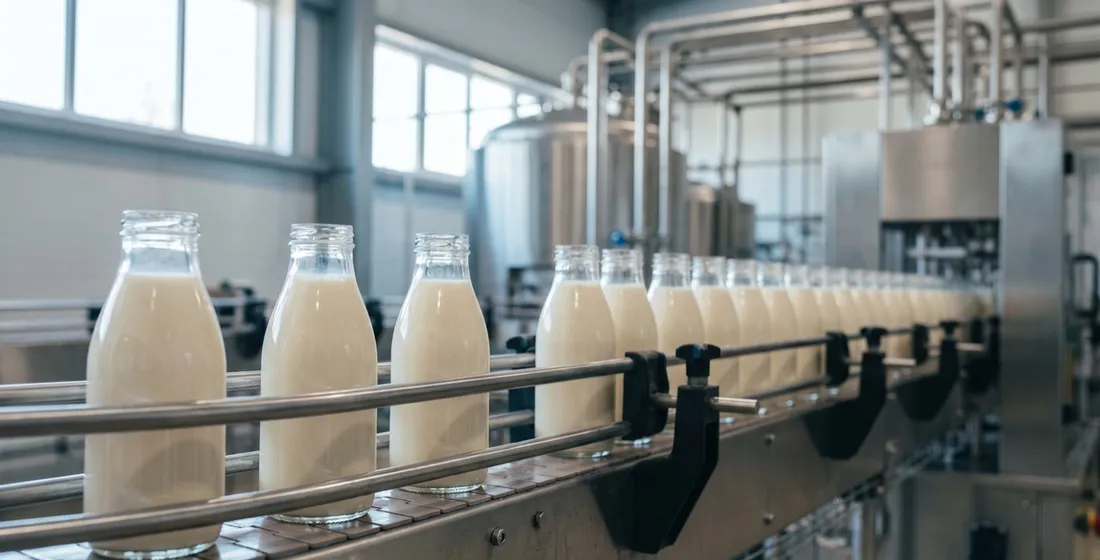
- Silk Foods Ceylon fills 200 ml glass at 2,500 bottles per day, MOQ 1,250 bottles for a first run, from a BRCGS and FSSC 22000 V6 audited site in Matale.
- The freight table below is the number most brand owners miss. Glass roughly halves the units you get into a container.
Most Sri Lankan co-packers quote plant milk as a powder. A smaller number quote wet ready-to-drink in a carton. A handful quote wet ready-to-drink in 200 ml glass, which is a different line, a different thermal process, and a different landed-cost equation from either of the other two. This piece is the capability matrix for a CPG brand owner evaluating the single-serve glass format for the first time, and the SKU economics that decide whether the format earns its place on your range plan.
How many 200 ml bottles a day can a co-packer actually fill?
Small and mid-scale glass beverage monoblocs, the rinse-fill-cap units that most contract sites run, sit somewhere between 2,000 and 12,000 bottles per hour on nameplate ratings. Those ratings are almost always quoted against a 500 ml bottle. A 200 ml format runs slower than nameplate, because valve pitch, neck handling, and the extra bottles per litre of product all work against you. The high-speed reference points you find in equipment literature, Sidel’s EvoFILL Glass at over 80,000 bottles per hour, are built for national dairy and soft-drink volumes, not for a brand launching a two-flavour range into specialty retail.
Silk Foods Ceylon (SFC) runs the 200 ml glass beverage format at 2,500 bottles per day, single shift, in Matale. First-run MOQ is 1,250 bottles. Lead time from purchase order to dispatch is 2 to 3 weeks. Those are deliberately small numbers. A brand testing a single-serve oat or coconut drink into a hotel group or an airline catering contract does not need 80,000 bottles per hour. It needs 1,250 bottles that pass the buyer’s spec, on a certificate stack the buyer already accepts, without a separate audit cycle.
Spec snapshot: 200 ml single-serve plant milk co-packing
- Format: 200 ml glass bottle, single-serve, ambient or chilled route
- Line capacity: 2,500 bottles per day, single shift
- First-order MOQ: 1,250 bottles
- Lead time: 2 to 3 weeks, purchase order to dispatch
- Sea freight: 3 to 4 weeks to the EU, 4 to 5 weeks to the US
- Bases available: coconut, oat, soy, rice, blends
- Certification: BRCGS and FSSC 22000 V6, with USDA Organic and EU Organic per SKU
Why does glass change the thermal process for plant milk?
Plain oat, soy, almond, and coconut drinks sit at roughly pH 6.5 to 7.0. Under US rules that makes them low-acid foods, which means a shelf-stable version falls under 21 CFR Part 113 and requires a filed scheduled process before a single bottle can be exported. A product labelled “keep refrigerated” avoids that filing. This is the first fork in the decision, and it is regulatory before it is technical.
The second fork is the container. Glass conducts heat differently from a carton and it fractures under thermal shock, so the cooling profile does the constraining. BevSource puts the practical ceiling at around a 22°C gradient between cooling zones, because bottles are more sensitive coming down than going up. Heating gradients well above that are routine. Cooling gradients are not. Glass containers are tested for exactly this under ASTM C149.
| Thermal route | Typical shelf life | Fit for 200 ml glass plant milk |
|---|---|---|
| Hot fill at 85 to 95°C | 6 to 12 months ambient | Works in glass, lowest capital cost, hardest on delicate oat and almond flavour |
| Tunnel pasteurisation | 6 to 12 months ambient | Works in glass, cooling gradient is the binding constraint |
| Retort | 12 months and beyond | Works in glass with a metal closure, harshest on plant protein, cooked and caramel notes |
| UHT plus aseptic fill | Up to about 12 months ambient | Best flavour retention, highest capital cost, feasible in glass with peroxide container sterilisation |
| Extended shelf life (ESL) | Chilled only | Rules itself out for sea-freighted export from Colombo |
For a Sri Lankan site shipping 3 to 5 weeks by sea, the ESL row is the one that disqualifies itself first. Whatever route you pick, the EU stability test is the same: Regulation (EC) No 2073/2005 asks for microbiological stability after 15 days at 30°C, or 7 days at 55°C. That test, not the marketing claim, is what your buyer’s technical team will ask you to evidence.
What can you legally call it in the EU and the US?
This is the section most co-packing pages skip, and it is worth more to a brand owner than any capacity number on this page.
In the EU, “milk” is reserved to mammary secretion under Regulation (EU) No 1308/2013. The Court of Justice settled the argument in Case C-422/16, TofuTown, decided 14 June 2017: a qualifier does not cure the problem, so “soy milk” and “tofu butter” are both unlawful. Oat, soy, almond, and rice all have to sell as drinks.
Coconut is the exception. Commission Decision 2010/791/EU lists the products carved out of the dairy-name reservation, and coconut milk is on that list in multiple languages, including English, French, and German. The exemption is language-specific, so the permitted name follows the listed language rather than travelling with the product. The US takes the opposite position: FDA draft guidance issued in February 2023 accepts “oat milk” and “soy milk” and merely recommends a voluntary nutrient statement, and that guidance was still in draft through 2025.
| Base | EU legal name | US legal name |
|---|---|---|
| Coconut | Coconut milk (exempt under 2010/791/EU) | Coconut milk |
| Oat | Oat drink | Oat milk |
| Soy | Soya drink | Soy milk |
| Almond | Almond drink | Almond milk |
| Rice | Rice drink | Rice milk |
Read that table as a range-planning document rather than a compliance footnote. A Sri Lankan co-packer supplying an EU buyer can put coconut milk on a 200 ml bottle and keep the category word that consumers search for. Every other base loses it at the border.
The freight arithmetic glass never escapes
A 200 ml glass bottle weighs somewhere near 185 g empty, going by published container-catalogue weights for the format. An aseptic carton of the same fill volume is roughly an order of magnitude lighter. Once filled, the comparison is 385 g of shipped weight per glass unit against about 210 g per carton unit.
Run that against a weight-limited 20-foot container at 24 tonnes of payload, and it comes out at roughly 62,000 filled glass units against roughly 114,000 carton units. That is SRV’s own arithmetic rather than a published statistic, and it assumes water-equivalent product density and ignores secondary packaging, but the shape of the answer holds: glass costs you close to half your units per container.
In the first half of 2026, the SRV trade desk fielded the same conversation three times from brand owners who had already committed to glass on the brand deck before anyone had run the container math. In every case the fix was the same and it was not a packaging change. It was moving the glass SKU onto the channels that pay for it, hospitality and premium retail, and running the volume channels in a lighter format from the same facility. Glass is a positioning decision with a freight bill attached, and the bill is roughly 45% of your container.
Where SRV’s 200 ml glass format does not fit
Price-led grocery private label. Long-haul volume programmes competing on landed cost per litre. Brands that need six-figure monthly unit volumes from day one. For those briefs, a carton format from a high-speed aseptic site, or a spray-dried plant milk powder reconstituted in-market, is the more honest answer than glass at a stretched price.
Keeping a 200 ml SKU from separating on a five-week sea leg
A plant drink is an unstable emulsion by nature. Palsgaard’s technical work on plant-based drinks names sedimentation, flocculation, and fat separation as the constant failure modes, and reports that 70% of surveyed consumers had seen visible particles in a plant-based beverage. In a clear glass bottle, every one of those failures is visible from the shelf. That is the specific penalty glass adds over a carton, and it moves stabilisation from a formulation nicety to a launch-blocking spec.
Two controls carry most of the load. The first is homogenisation. A 2025 review in Food Engineering Reviews by Ransmark and colleagues at Lund University found that the major equipment manufacturers recommend roughly 20 to 60 MPa, so 200 to 600 bar, for plant-based materials, with whole beverage lines often running two homogenisers, one after the first grind and one at final heating. Published experimental work backs the lower half of that range: He and Xu, working at 300 bar, brought oat particle size down from 33.5 to 11.2 microns and reported visibly better suspension after refrigerated storage.
The second is the hydrocolloid system. Gellan gum is the workhorse for vegan systems because it builds its network independently of protein, which matters when there is no casein to react with. Typical industry usage for plant-based drinks runs around 0.02 to 0.06%, hydrated at 80 to 90°C and cooled to set. Calcium and magnesium form that gel far more efficiently than sodium or potassium, which is why a calcium-fortified SKU almost always needs its stabiliser system re-tuned rather than copied across from the unfortified version.
Where the 200 ml format actually pays
The category headline reads badly. US retail plant milk fell 2% in dollars and 5% in units over the 52 weeks to 30 November 2025, on SPINS data published by the Good Food Institute, and it holds 13% of total retail milk dollars. Almond still takes 49% of units and oat 21%. Coconut takes 7%.
That last number is the one worth acting on. Coconut grew 23% in units and 27% in dollars while the category shrank. It is the only format in growth, it is the format that keeps its category word in the EU, and it is the format Sri Lanka already owns on the raw material side. Sri Lankan coconut-based product exports rose 42.66% to US$1,233 million in 2025 on Export Development Board figures, with coconut cream up 93.16% and coconut milk powder up 61.47%.
A brand owner reading those three facts together gets a fairly specific instruction. Lead the 200 ml glass range with coconut, where the growth, the naming freedom, and the origin advantage all point the same way. Use oat and soy as range extensions rather than as the launch SKU, and specify them as drinks for any EU-bound artwork.
Certification snapshot: Silk Foods Ceylon, Matale
- BRCGS (covers the beverage, plant-based, spice, herb, coconut, and retorted lines)
- FSSC 22000 V6 (covers the full processing scope, including the beverage line)
- USDA Organic and EU Organic (per SKU)
- Sri Lanka EDB-registered, US FDA-registered facility
The facility runs a cellular manufacturing layout across a 10,000 sq ft processing floor, which is why a 200 ml plant milk SKU can sit alongside vegan kombucha co-packing and coconut treacle in glass bottles on the same audit. Brands that want the powder route instead, for reconstitution in-market, can compare oat, soy, rice, and coconut powder bases and the underlying fat-percentage economics before committing to wet.
Frequently asked questions
What is the MOQ for 200 ml glass bottle plant milk co-packing?
Silk Foods Ceylon sets a first-run MOQ of 1,250 bottles for the 200 ml glass beverage format, against a line capacity of 2,500 bottles per day on a single shift. Lead time from purchase order to dispatch is 2 to 3 weeks. Brands can run a sample batch against the finished spec before committing to a production volume.
Can plant milk in glass be made shelf stable without refrigeration?
Yes, by hot fill, tunnel pasteurisation, retort, or UHT with aseptic filling. Each holds ambient shelf life in the 6 to 12 month range or longer for retort. Extended shelf life systems are chilled only and are unsuitable for 3 to 5 week sea freight. Shelf-stable product for the US requires a filed scheduled process under 21 CFR Part 113.
Why can oat milk not be called milk in the EU?
Regulation (EU) No 1308/2013 reserves “milk” to mammary secretion, and the Court of Justice confirmed in Case C-422/16 (2017) that a qualifier does not cure the restriction. Oat, soy, almond, and rice must be sold as drinks. Coconut milk is separately exempt under Commission Decision 2010/791/EU.
Does SRV private-label single-serve plant milk for export brands?
Yes. Silk Route Ventures private-labels and contract-manufactures 200 ml single-serve plant milk in coconut, oat, soy, rice, and blended bases at the Matale facility, under BRCGS and FSSC 22000 V6, with USDA Organic and EU Organic available per SKU. The same audit covers adjacent plant-based beverage and spread SKUs.
What stabiliser system does a plant milk in clear glass need?
Gellan gum at roughly 0.02 to 0.06% is the usual base, because it suspends particles through a network that does not depend on protein. It pairs with two-stage homogenisation in the 200 to 600 bar range. Clear glass shows sedimentation that a carton hides, so the specification is tighter than for an equivalent carton SKU.
How Silk Route Ventures can help
Silk Route Ventures (SRV) contract-manufactures and private-labels single-serve plant milk in 200 ml glass at the Silk Foods Ceylon (SFC) facility in Matale, across coconut, oat, soy, rice, and blended bases. The beverage line runs at 2,500 bottles per day on a single shift with a 1,250-bottle first-run MOQ, under BRCGS and FSSC 22000 V6, with USDA Organic and EU Organic available per SKU. The cellular manufacturing layout means a second flavour or a second format does not restart the audit clock, and the SRV R&D and NPD team scopes the stabiliser system and the thermal route alongside the production plan rather than after it. Contact us to send an inquiry for a co-manufacturing briefing tailored to your base, target market, and launch volume.
Sources
- Good Food Institute, “US retail market insights for the plant-based industry” (2026), citing SPINS data for the 52 weeks ending 30 November 2025. Retrieved 2026-08-05. https://gfi.org/marketresearch/
- Court of Justice of the European Union, Case C-422/16, Verband Sozialer Wettbewerb eV v TofuTown.com GmbH, judgment of 14 June 2017. Retrieved 2026-08-05. https://eur-lex.europa.eu/legal-content/EN/TXT/?uri=celex%3A62016CJ0422
- European Commission, Commission Decision 2010/791/EU of 20 December 2010 (products exempt from the dairy-name reservation). Retrieved 2026-08-05. https://eur-lex.europa.eu/eli/dec/2010/791/oj/eng
- European Commission, Regulation (EC) No 2073/2005 on microbiological criteria for foodstuffs. Retrieved 2026-08-05. https://eur-lex.europa.eu/eli/reg/2005/2073/oj/eng
- US Food and Drug Administration, 21 CFR Part 113, “Thermally processed low-acid foods packaged in hermetically sealed containers” (eCFR, current). Retrieved 2026-08-05. https://www.ecfr.gov/current/title-21/chapter-I/subchapter-B/part-113
- US Food and Drug Administration, “Draft guidance for industry: labeling of plant-based milk alternatives and voluntary nutrient statements” (2023). Retrieved 2026-08-05. https://www.fda.gov/regulatory-information/search-fda-guidance-documents/draft-guidance-industry-labeling-plant-based-milk-alternatives-and-voluntary-nutrient-statements
- Sri Lanka Export Development Board, “Sri Lanka’s export performance exceeded US$17.2 billion in 2025” (2026). Retrieved 2026-08-05. https://www.srilankabusiness.com/news/sri-lankas-export-performance-exceeded-us-17.2-billion-in-2025.html
- Ransmark, E., Sorensen, H., Gomez Galindo, F. and Hakansson, A., “Break-up of plant cell structures in high-pressure homogenizers”, Food Engineering Reviews 17(2): 408-449 (2025). Retrieved 2026-08-05. https://doi.org/10.1007/s12393-025-09397-7
- He, A. and Xu, B., “High-pressure homogenisation improves food quality of plant-based milk alternatives”, International Journal of Food Science and Technology 59(1): 399-407 (2024). Retrieved 2026-08-05. https://doi.org/10.1111/ijfs.16822
- BevSource, “Beverage preservation 101: tunnel pasteurization vs. hot filling”. Retrieved 2026-08-05. https://www.bevsource.com/news/beverage-preservation-101-part-i-tunnel-pasteurization-vs-hot-filling
Further reading
- FoodNavigator, “Top 10 food and beverage trends for 2026” (Innova Market Insights) -> https://www.foodnavigator.com/Article/2025/12/09/top-10-food-and-beverage-trends-for-2026/
- Palsgaard, “How to control stability in plant-based drinks” -> https://www.palsgaard.com/en/food-emulsifiers-and-stabilisers/insights/plant-based-products/how-to-control-stability-in-plant-based-drinks/
- Silk Route Ventures, “Working with low-MOQ contract manufacturers” -> https://www.esilkroute.com.lk/blog/working-with-low-moq-contract-manufacturers-when-its-worth-it-and-when-it-isnt
Written by the Silk Route Ventures Trade Team. Silk Route Ventures (E-Silk Route Ventures (Pvt) Ltd) is a Sri Lankan B2B supply-chain operator for the Food, Beverage, Wellness, and Nutraceuticals sectors. The Silk Foods Ceylon manufacturing arm holds BRCGS and FSSC 22000 V6 certifications. Questions or to request a sample: Contact us or email info@esilkroute.com.lk.