
Spray-Dried Plant Milk Powder: Oat, Soy, Rice, Coconut Compared
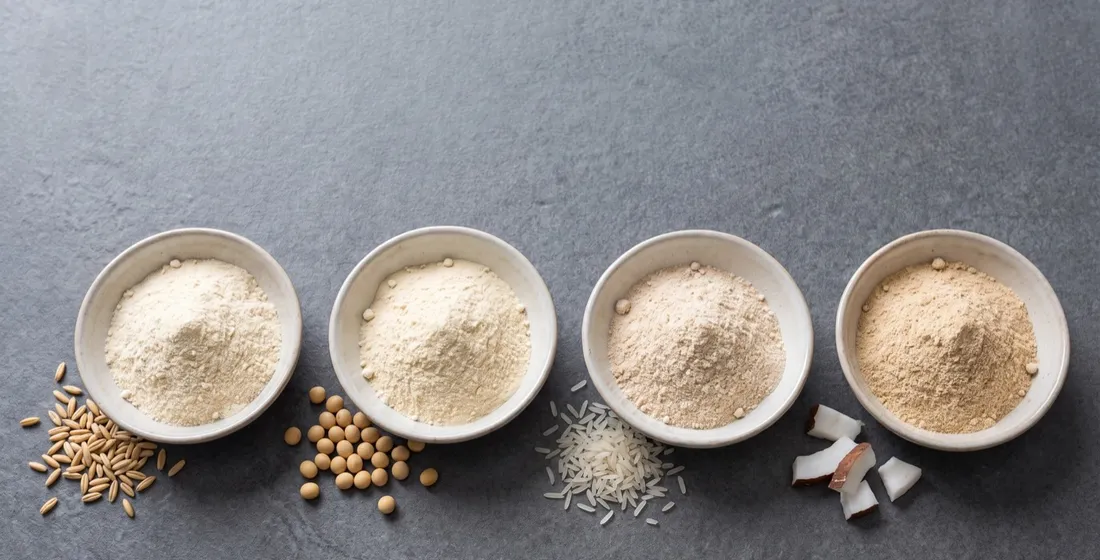
Buyer’s snapshot
- Protein separates the four bases before price does. Across 1,042 US plant-based milk alternatives, mean protein ran 2.82 g per 100 g for soy, 1.35 g for oat, 0.70 g for coconut and 0.50 g for rice (Nutrients, 2022).
- Rice carries a hard numeric ceiling. Regulation (EU) 2023/915 caps inorganic arsenic at 0.15 mg/kg in non-parboiled milled rice, 0.25 mg/kg in rice flour, and 0.10 mg/kg in rice for infant and young-child food.
- Carrier load is a dial, not a switch. A 2025 spray-drying trial lifted oat milk powder solubility from 71.34% to 84.07% with 5% maltodextrin, then only to 85.43% at 10%.
- Coconut is the outlier because it is a fat powder. Surface lipids block wetting, so the fix is agglomeration or a surface-active coating, not more carrier.
- Silk Foods Ceylon spray-dries all four bases on one BRCGS and FSSC 22000 V6 audited line in Matale at 50 kg per day, with a 50 kg MOQ per SKU. For a lowest-price tender with no origin or certification requirement, this is not the right supplier.
Most sourcing briefs for plant milk powder arrive with the base already chosen. The brand picked oat because oat is what the category is drinking, or coconut because the flavour profile fits the dessert line, and the RFQ asks for a price per kilogram against a spec copied off a liquid product. That is the wrong order.
The four bases that Silk Route Ventures (SRV) spray-dries, oat, soy, rice and coconut, behave differently in three places that decide whether the powder works in a finished SKU: how much protein it carries, how much carrier it needs to reconstitute cleanly, and which contaminant or allergen ceiling it drags into the destination market. Get those three right and the price conversation is short. Get them wrong and the reformulation happens after the first container has landed.
What actually separates the four plant milk powder bases?
Protein is the sharpest divider. A 2022 analysis in Nutrients of 1,042 US plant-based milk alternatives found mean protein of 2.82 g per 100 g for soy, 1.35 g for oat, 0.70 g for coconut and 0.50 g for rice. Only 11.2% of those products met the proposed nutrient standard, and the ones that did were mostly fortified soy.
That single column reorders a lot of briefs. A brand that wants a protein claim on a rice base is committing to a fortification premix, not to a base ingredient, and the premix cost belongs in the landed-cost model from the first quote rather than the second.
| Base | Protein (g per 100 g, liquid basis) | Glycemic index | Carrier need | Regulatory watch-out | Best-fit application |
|---|---|---|---|---|---|
| Oat | 1.35 | 59.61 | Moderate; 5% maltodextrin lifts solubility about 13 points | Gluten cross-contact if a gluten-free claim is carried | Barista bases, creamers, cereal drinks |
| Soy | 2.82 | 47.53 to 61.50 | Low to moderate; the protein acts as its own wall material | Declarable allergen in the EU and the US | Protein-forward RTD, nutrition powders |
| Rice | 0.50 | 97.74 to 99.96 | Moderate | Inorganic arsenic ceilings under EU Regulation 2023/915 | Free-from and hypoallergenic SKUs |
| Coconut | 0.70 | 96.82 | High on full-fat grades; carrier is structural, not optional | Fat oxidation and vegan carrier selection | Culinary, dessert, coffee whitener |
The glycemic column is the one buyers misread most often. A 2023 study in Foods put rice drink at a glycemic index of 97.74 to 99.96 with a glycemic load of 16.85 to 18.33 per 250 g, and coconut drink at a glycemic index of 96.82 with a glycemic load of just 4.81. Near-identical index, roughly a quarter of the load, because the coconut drink carries far less carbohydrate per serve. If the label claim is about blood sugar, the load is the number that survives scrutiny, not the index.
For the coconut leg specifically, the fat percentage decision sits upstream of all of this and is covered separately in the SRV guide to coconut milk powder fat percentage.
How much maltodextrin does a plant milk powder actually need?
Less than most specs assume. A 2025 trial in Current Research in Nutrition and Food Science took spray-dried oat milk powder through 0%, 5% and 10% maltodextrin and recorded solubility of 71.34%, 84.07% and 85.43%. The first five points of carrier bought thirteen points of solubility. The second five bought one and a third.
| Maltodextrin (% w/w) | Moisture (%) | Water activity | Solubility (%) | Wettability (seconds) |
|---|---|---|---|---|
| 0 | 3.93 | 0.60 | 71.34 | 15.67 |
| 5 | 3.13 | 0.40 | 84.07 | 11.67 |
| 10 | 2.70 | 0.34 | 85.43 | 9.50 |
The water activity column is doing quiet work here. At zero carrier the powder sat at 0.60, which is not a number that supports a long ambient shelf life in a tropical supply chain. At 5% it dropped to 0.40. So the carrier is buying shelf stability as much as it is buying dispersibility, and a clean-label brief that strips maltodextrin out entirely has to replace that function with packaging, a desiccant, or a shorter stated shelf life.
There is a native route for oat that avoids added carrier. Alpha-amylase cleaves the alpha-1,4 bonds in gelatinised oat starch to cut viscosity so the slurry can be atomised, and beta-glucanase is dosed to stop the beta-glucan gelling without stripping the fibre out of the finished powder. The hydrolysate then acts as its own carrier. The trade-off is that the same reaction generates the sugars that show up on the nutrition panel, so the brief has to choose between a shorter ingredient list and a lower sugar figure. It rarely gets both.
Clean-label pressure on this exact decision is real. FoodNavigator reported in December 2025 that whole ingredients and protein boosts were the two named formulation vectors for plant-based milk in 2026. The carrier conversation and the clean-label conversation are the same conversation. Further background on the format sits in the SRV overview of spray-dried plant milk powder for global distribution, and the three-base version of this comparison is covered in oat vs soy vs rice milk powder sourcing.
Why do high-fat coconut powders resist reconstitution?
Because the fat migrates to the particle surface during drying and forms a film that water cannot get past. A 2025 review in Foods reported whole milk powder, at 87% surface lipids, needing 68 seconds to wet, against 35 seconds for skim powder at 23% surface lipids. The mechanism transfers directly to coconut, which is the fattiest of the four bases by a wide margin.
Adding more maltodextrin does not remove that film. The two fixes that do work are agglomeration, which builds larger porous particles that rehydrate through interconnected channels, and a surface-active coating such as lecithin, which the same review found improved wettability and solubility on dairy powders.
There is a formulation trap on the coating side. Sodium caseinate is the classic wall material for high-fat coconut milk powder and it performs well, but it is milk-derived. It fails a vegan claim and it triggers a milk allergen declaration, which for a plant milk SKU is a commercial contradiction rather than a technical one. The specification needs to name the permitted carrier list at RFQ stage, not at first production.
One more spec discipline for coconut: state fat on the powder, not on the reconstituted drink. Codex standard CXS 240-2003 sets aqueous coconut milk at not less than 10% fat and coconut cream at not less than 20% fat, and a full-fat powder concentrates that several times over. Two suppliers quoting “full fat” against different bases are not quoting the same product. The reconstitution arithmetic is worked through in the SRV note on coconut milk fat formats and reconstitution math.
Which base clears your destination market’s gate?
Rice carries the tightest numeric ceiling of the four. Regulation (EU) 2023/915 caps inorganic arsenic at 0.15 mg/kg for non-parboiled milled rice, 0.25 mg/kg for husked and parboiled rice and rice flour, and 0.10 mg/kg for rice intended for infant and young-child food. The 2025 amendment to that regulation changed limits for fish and seafood, not for rice, so the rice figures still stand in 2026.
EFSA tightened the underlying science in 2024, adopting a reference point of 0.06 micrograms of inorganic arsenic per kg of body weight per day and naming rice and rice-based products among the main exposure contributors. For a rice milk powder aimed at a free-from or toddler SKU, that assay belongs on the batch COA before the first sample ships, not after a customer complaint.
| Base | Primary compliance gate | What the spec has to state |
|---|---|---|
| Oat | Cereals containing gluten under EU allergen rules | Segregated supply chain plus a gluten result per batch if a gluten-free claim is carried |
| Soy | Named allergen in Annex II of Regulation (EU) No 1169/2011, emphasised in the ingredient list | Allergen declaration and, where the brand claims it, non-GMO identity preservation |
| Rice | Inorganic arsenic limits under Regulation (EU) 2023/915 | Inorganic arsenic on the COA against the correct product-form limit |
| Coconut | Fat basis and carrier identity | Fat percentage stated on the powder, permitted carrier list, oxidation and peroxide value |
Oat has an upside on the same axis. The EU authorised health claim for oat beta-glucan, cleared under Commission Regulation (EU) No 432/2012 on an EFSA opinion, attaches to a daily intake of 3 g of beta-glucans for maintenance of normal blood cholesterol. That is achievable in a powder only if the beta-glucanase dose during processing is controlled, which puts a nutrition claim and a viscosity decision on the same process parameter.
For the US, labelling is still unsettled. The FDA published draft guidance on the labelling of plant-based milk alternatives in the Federal Register in February 2023. It does not prohibit the word milk in the product name, and it recommends a voluntary nutrient statement benchmarked against fluid milk. It remains draft, so a brand writing artwork in 2026 should build for the recommendation rather than against it.
Certification snapshot
- BRCGS covers the repacking and finished-pack lines, which is the standard most UK and EU multiple grocers gate a listing on.
- FSSC 22000 V6 covers the full processing scope, including liquid and powder plant milk formats and spray-dried powders.
- USDA Organic and EU Organic are held separately, which matters because the two schemes are not interchangeable for every SKU.
- Every batch ships with a COA, and traceability runs to farm level, enforced on organic SKUs.
Which of those a buyer actually needs depends on the retail channel rather than the ingredient, and the SRV buyer’s guide to organic certifications maps the schemes against destination markets.
Where is the category volume actually going?
Coconut is the growth line. Good Food Institute retail data for 2025 put US plant-based milk at USD 2.7 billion, down 2% in dollars and 5% in units, holding 13% of total milk dollar sales. Unit share ran almond 49%, oat 21%, soy 8% and coconut 7%. Coconut was the only base growing, up 23% in units and 27% in dollars.
Foodservice points the same way. FoodNavigator reported in December 2025, citing Tastewise data, that coconut appeared in 65% of US alternative-milk menu listings against almond at 37%, oat at 28% and soy at 11%. Menu presence tends to lead retail reformulation by a season or two, which is why a coconut line extension is currently an easier internal sell than a fifth almond SKU.
Consumer resistance is running against processing, not against the category. FoodNavigator reported Mintel data in July 2025 showing that 67% of UK and 52% of German consumers find processed ingredients in dairy alternatives off-putting. That figure is the commercial argument for holding carrier load at 5% rather than 10%, and it is worth more to a brand than the one and a third solubility points the extra carrier buys.
On the supply side, Sri Lanka’s coconut export earnings reached a record USD 1,233 million in 2025, up from USD 864.3 million in 2024, with coconut milk powder among the fastest-growing lines at 61% growth for the year according to Export Development Board data reported by EconomyNext. Availability of the coconut leg is improving while the oat and soy legs are traded on global commodity terms.
What a 50 kg trial batch actually buys
A US plant-based spreads brand placed its first order with Silk Route Ventures in 2021 at 5,000 units. It was a small run against a formulation that had not been produced outside a kitchen. By 2024 that brand was ordering multiple containers a month and had become the largest customer on the SRV book by order count. Nothing in the first purchase order predicted that, which is the argument for making the first run cheap enough to be wrong.
The spray-dry line at Silk Foods Ceylon (SFC) runs 50 kg per day, and the minimum order for spray-dried plant milk powder is 50 kg, a single-day batch. The MOQ is per product, not per total order. A brand launching an oat base, a coconut base and a rice base needs 50 kg of each, so 150 kg of finished powder in total. Volume breaks sit at 500, 1,000 and 2,500 kg per SKU.
- Samples ship in 3 to 5 business days, courier, door to door.
- PO to dispatch runs 2 to 3 weeks.
- Sea freight is 3 to 4 weeks to the EU and Australia, 4 to 5 weeks to the US. Air freight transit is 3 to 4 days, airport to airport.
- Orders under USD 10,000 are settled 100% in advance. Orders of USD 10,000 and above are 50/50 against shipping documents. There are no NET terms, regardless of tenure.
A 50 kg batch is enough to run a real shelf-life study, a retail-format sensory panel and a customer sampling programme without committing to a container. When that maths does not work, the SRV note on working with low-MOQ contract manufacturers sets out the cases where a larger co-packer is the better call. SRV’s pricing is built for buyers competing on origin and certification, not for the lowest-shelf segment.
Frequently asked questions
What is the minimum order quantity for spray-dried plant milk powder?
50 kg per SKU, which is one full day on the Silk Foods Ceylon spray-dry line at its 50 kg per day capacity. The minimum applies per product, not per order, so a three-base launch needs 150 kg in total. Volume price breaks begin at 500 kg per SKU.
Which plant milk base carries the most protein?
Soy, by a wide margin. A 2022 Nutrients analysis of 1,042 US plant-based milk alternatives found mean protein of 2.82 g per 100 g for soy against 1.35 g for oat, 0.70 g for coconut and 0.50 g for rice. Any protein claim on the other three bases needs fortification.
Is there an arsenic limit on rice milk powder?
Yes. Regulation (EU) 2023/915 sets inorganic arsenic maximums of 0.15 mg/kg for non-parboiled milled rice, 0.25 mg/kg for rice flour and husked rice, and 0.10 mg/kg for rice used in infant and young-child food. The assay should appear on every batch COA for EU-bound rice powder.
Can Silk Route Ventures contract-manufacture a plant milk powder under a US or EU brand?
Yes. SRV runs private label and full contract manufacturing on the spray-dry line for oat, soy, rice and coconut bases, with BRCGS and FSSC 22000 V6 covering the processing scope. The R&D and NPD team scopes the formulation alongside the production plan rather than after it.
How much maltodextrin does a spray-dried plant milk powder need?
Around 5% w/w captures most of the benefit. A 2025 trial recorded oat milk powder solubility of 71.34% at zero carrier, 84.07% at 5% and 85.43% at 10%, with water activity falling from 0.60 to 0.40 to 0.34. Past 5%, the return on added carrier drops sharply.
How Silk Route Ventures can help
Silk Route Ventures (SRV) contract-manufactures spray-dried plant milk powder in oat, soy, rice and coconut bases at the Silk Foods Ceylon (SFC) facility in Matale, alongside finished CPG formats including spreads and sauces in glass jars, vegan patties at 15,000 units a day and vegan nuggets at 30,000 units a day. The site holds BRCGS on the relevant lines and FSSC 22000 V6 across the full processing scope, which covers both liquid and powder plant milk formats. The cellular manufacturing layout means a new SKU introduction does not require a separate audit cycle, and the SRV R&D and NPD team scopes carrier selection, allergen segregation and the contaminant panel in parallel with the production plan. The minimum is 50 kg per SKU, one day on the line. Contact us to request a co-manufacturing capability briefing for your base, carrier spec and target launch volume.
Sources
- European Commission, Commission Regulation (EU) 2023/915 on maximum levels for certain contaminants in food, 2023. https://eur-lex.europa.eu/legal-content/EN/TXT/HTML/?uri=CELEX:32023R0915 (retrieved 29 July 2026)
- EFSA, updated risk assessment of inorganic arsenic in food, EFSA Journal 22(1):e8488, 2024. https://pmc.ncbi.nlm.nih.gov/articles/PMC10794945/ (retrieved 29 July 2026)
- Drewnowski A., analysis of 1,042 US plant-based milk alternatives in the USDA Branded Food Products Database, Nutrients 14(22):4767, 2022. https://pmc.ncbi.nlm.nih.gov/articles/PMC9695877/ (retrieved 29 July 2026)
- Shkembi B. and Huppertz T., glycemic index and glycemic load of milk and plant-based drinks, Foods 12(3):453, 2023. https://pmc.ncbi.nlm.nih.gov/articles/PMC9914410/ (retrieved 29 July 2026)
- Bhokarikar S., Gurumoorthi P. and Athmaselvi K.A., drying technique and maltodextrin carrier effects on oat milk powder, Current Research in Nutrition and Food Science 13(2), 2025. https://www.foodandnutritionjournal.org/volume13number2/impact-of-drying-techniques-and-maltodextrin-as-a-carrier-on-the-flow-properties-and-reconstitution-properties-of-oat-milk-powder/ (retrieved 29 July 2026)
- Jiang et al., review of the rehydration of instant powders, Foods 14(16):2883, 2025. https://pmc.ncbi.nlm.nih.gov/articles/PMC12385211/ (retrieved 29 July 2026)
- Li et al., spray drying of enzymatically hydrolysed soy milk, Foods 14(5):906, 2025. https://pmc.ncbi.nlm.nih.gov/articles/PMC11899159/ (retrieved 29 July 2026)
- Good Food Institute, US retail market data for plant-based milk, 2025. https://gfi.org/marketresearch/ (retrieved 29 July 2026)
- FoodNavigator, plant-based milk formulation trends for 2026, reporting Tastewise data, 17 December 2025. https://www.foodnavigator.com/Article/2025/12/17/whole-ingredients-protein-boosts-plant-based-milk-trends-for-2026/ (retrieved 29 July 2026)
- FoodNavigator, plant-based milk market slowdown, reporting Mintel data, 7 July 2025. https://www.foodnavigator.com/Article/2025/07/07/plant-based-milk-market-faces-slowdown-as-dairy-makes-a-comeback/ (retrieved 29 July 2026)
- EconomyNext, Sri Lanka coconut export earnings for 2025, reporting Export Development Board data, 27 January 2026. https://economynext.com/sri-lankas-coconut-based-exports-hit-record-high-in-2025-rubber-dips-tea-edges-up-259000/ (retrieved 29 July 2026)
- European Union, Regulation (EU) No 1169/2011 on the provision of food information to consumers, Annex II allergens. https://eur-lex.europa.eu/legal-content/EN/TXT/?uri=CELEX%3A32011R1169 (retrieved 29 July 2026)
- European Commission, Commission Regulation (EU) No 432/2012 establishing a list of permitted health claims, and EFSA Journal 2010;8(12):1885 on oat beta-glucan. https://www.efsa.europa.eu/en/efsajournal/pub/1885 (retrieved 29 July 2026)
- US Food and Drug Administration, draft guidance on the labeling of plant-based milk alternatives, Federal Register, 23 February 2023. https://www.federalregister.gov/documents/2023/02/23/2023-03513/labeling-of-plant-based-milk-alternatives-and-voluntary-nutrient-statements-draft-guidance-for (retrieved 29 July 2026)
- Codex Alimentarius (FAO/WHO), CXS 240-2003 Standard for Aqueous Coconut Products, adopted 2003, amended 2024. https://www.fao.org/input/download/standards/10401/CXS_240e.pdf (retrieved 29 July 2026)
Written by the Silk Route Ventures Trade Team. Silk Route Ventures (E-Silk Route Ventures (Pvt) Ltd) is a Sri Lankan B2B supply-chain operator for the Food, Beverage, Wellness, and Nutraceuticals sectors. The Silk Foods Ceylon manufacturing arm holds BRCGS and FSSC 22000 V6 certifications. Questions or to request a sample: Contact us or email info@esilkroute.com.lk.