
Coconut Milk Fat Formats: Reconstitution Math and Applications
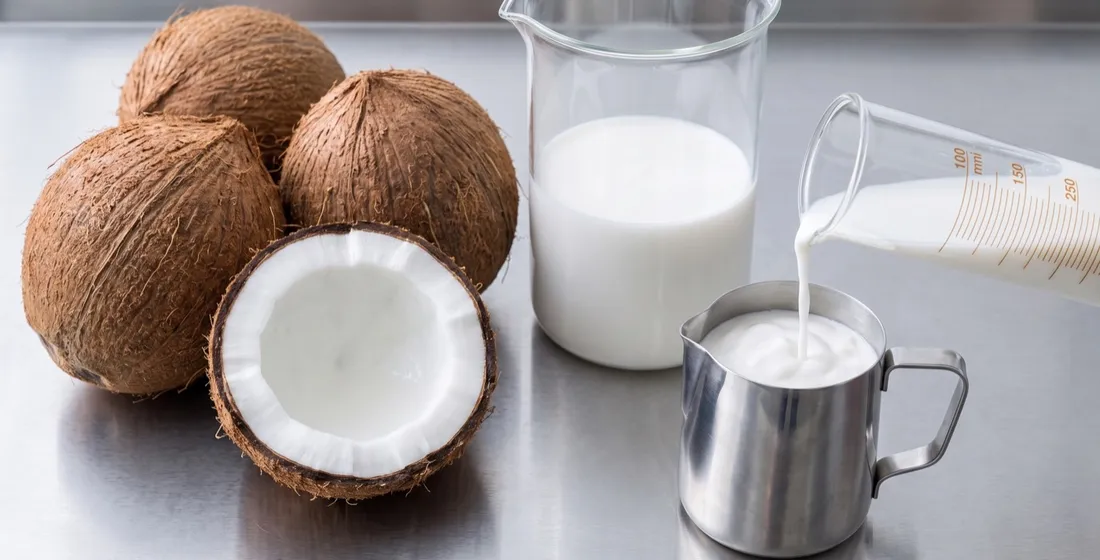
Buyer’s snapshot: Coconut milk liquid ships in four standard fat formats: 7%, 11%, 17%, and 18%, with custom blends available under Total OBM. Standard MOQ starts at 1 metric tonne per SKU, with a 500 kg pilot tier for trial runs and a 2,500 kg tier for better pricing. Lead time runs 2 to 3 weeks PO-to-dispatch, sea freight adds 3 to 4 weeks to AU/EU and 4 to 5 weeks to the US, and every batch ships with a certificate of analysis (COA). The Matale, Central Province facility runs BRCGS on retort and packaged coconut lines, FSSC 22000 V6 across the full process, and USDA Organic or EU Organic on certified-organic runs.
The reconstitution math a formulator actually needs
Coconut milk fat formats are not four separate raw materials. They are one base, diluted to four different targets. A processor starts from a higher-fat coconut cream, typically 20% to 24% fat, and adds water (or a water and stabilizer blend) until the finished batch lands on spec. The math is a simple mass balance: target fat percentage equals base fat percentage multiplied by the ratio of base mass to total batch mass.
Written out: target_fat% = base_fat% × (base_mass ÷ total_mass). Rearranged to solve for the batch to build: total_mass = base_mass × (base_fat% ÷ target_fat%), and the water to add is total mass minus base mass. A procurement team asking a co-manufacturer “how do you hit 11% from a 24% cream” is really asking for this ratio, not a different SKU. See how 22% and 24% fat coconut cream specs are chosen for the glass jar SKU, since retort cream is usually the base a liquid line dilutes down from.
What Codex actually classifies as coconut milk
The Codex Alimentarius Standard for Aqueous Coconut Products, CXS 240-2003 (adopted 2003, last amended 2024), sets four fat bands: light coconut milk at a minimum 5% fat, coconut milk at a minimum 10%, coconut cream at a minimum 20%, and coconut cream concentrate at a minimum 29% (FAO/WHO Codex Alimentarius, CXS 240-2003, 2024 amendment). This is a regulatory floor, not a commercial menu, and it matters for labeling.
| Codex classification | Minimum fat content |
|---|---|
| Light coconut milk | 5% |
| Coconut milk | 10% |
| Coconut cream | 20% |
| Coconut cream concentrate | 29% |
The practical catch: a commercial 7% fat format, common in beverage blends, sits below the Codex 10% floor for “coconut milk” and technically falls in the “light coconut milk” band. A brand labeling that SKU as plain “coconut milk” should check whether its target market enforces the Codex bands. The 11%, 17%, and 18% formats all clear the 10% floor comfortably. The International Coconut Community ran a 2025 workshop to harmonize national coconut milk, cream, and powder standards into one regional reference (International Coconut Community, “International Workshop on Quality Standards of Coconut Products,” 2025); the same bands apply to coconut milk powder fat percentage selection once reconstituted.
The application matrix: matching fat format to end use
Fat percentage is chosen by application, not tradition. A beverage blend needs a thin, pourable base; a dessert base needs body that holds up under heat and freeze cycles. Fortune Business Insights’ 2026 analysis prices the global coconut milk category at roughly USD 3.44 billion, with beverage and dairy-alternative formats pulling demand beyond the traditional curry base (Fortune Business Insights, “Coconut Milk Market Size, Share and Trends,” 2026), which is why the 7% and 11% formats now move as much volume as 17% and 18%.
| Fat format | Primary end use | Typical body / Brix behavior | Formulation notes |
|---|---|---|---|
| 7% | Beverages, coconut water blends, RTD drinks | Thin, pourable, low Brix | Coconut aroma and light mouthfeel without added fat load |
| 11% | Retail soups, curries, ready meals | Light to medium body | Supports “reduced fat” claims while keeping flavor carry-through |
| 17% | Curry bases, HORECA and foodservice bulk | Medium body, coats a spoon | The default foodservice bulk spec chefs expect |
| 18% | Desserts, ice cream bases, sauces | Thicker, higher body | Stability and mouthfeel for frozen or reduction-heavy use |
Brix tracks fat content because coconut solids scale with the cream fraction used to build the batch, though the ratio shifts with non-fat solids in the base (Tetra Pak, Coconut Handbook, “The Chemistry of Coconut Milk and Cream,” retrieved 2026). Buyers speccing a new SKU should ask for both numbers.
Worked example: taking a 24% fat coconut cream to spec
Start with 100 kg of a 24% fat coconut cream base, within the Codex cream-to-concentrate range. Using total_mass = base_mass × (base_fat% ÷ target_fat%), here is what each of the four standard formats requires.
| Target fat % | Total batch mass needed | Water to add | Yield multiplier |
|---|---|---|---|
| 18% | 133.3 kg | 33.3 kg | 1.33x |
| 17% | 141.2 kg | 41.2 kg | 1.41x |
| 11% | 218.2 kg | 118.2 kg | 2.18x |
| 7% | 342.9 kg | 242.9 kg | 3.43x |
The 7% format nearly triples the batch mass off the same base cream, which is why it prices lower per liter despite an identical raw material. One caveat: diluting fat also dilutes protein and non-fat solids, so a straight water addition thins viscosity faster than the fat percentage alone suggests. Most co-manufacturers recalibrate a stabilizer system, commonly guar gum or carrageenan, at each target rather than using one dose across all four formats. The same logic applies to spray-dried plant milk powder for buyers weighing a powder format instead.
Packaging, MOQ, and lead time ladder
Format choice and volume commitment move together. The table below sets out the standard packaging options at Silk Route Ventures (SRV) alongside the MOQ and lead time at each tier.
| Packaging format | Typical pack sizes | MOQ (first order) | Standard volume tier | PO-to-dispatch lead time |
|---|---|---|---|---|
| Retort tin can | 400 ml | 500 kg pilot / 1 metric tonne standard | 2,500 kg+ | 2 to 3 weeks |
| Glass jar | 220 ml, 330 ml, 500 ml, 1 L | 500 kg pilot / 1 metric tonne standard | 2,500 kg+ | 2 to 3 weeks |
| Bulk / bag-in-box (foodservice) | Custom under Total OBM | 1 metric tonne standard | 2,500 kg+ | 2 to 3 weeks, plus freight |
Sea freight adds 3 to 4 weeks to Australia and the EU, 4 to 5 weeks to the US; air freight on samples runs 3 to 4 days. Every batch ships with a COA covering fat content, total solids, and microbiological results, so moving from the 500 kg pilot to 2,500 kg scales the spec rather than re-qualifying it. A curry-base program often sources more than one coconut format from the same co-manufacturer; see virgin versus RBD coconut oil spec and desiccated coconut grade selection.
Where the math meets the shelf: a private label scenario
A mid-size plant-based beverage brand approached a co-manufacturer wanting a “lite” retail coconut milk line at 11% fat, matched to a competitor’s nutrition panel, without losing the category’s expected texture. Private label demand is climbing: private label dollar sales reached an estimated USD 277 billion in the first half of 2025, up 4.4%, per WholeFoods Magazine’s 2026 contract manufacturing and private label trend report. The reconstitution math got the fat number right on the first batch. The texture did not survive: non-fat solids dropped along with the fat, and the sample came back thin next to the competitor’s can.
The fix was a stabilizer blend recalibrated for the 11% dilution point, tested across three iterations before viscosity matched the benchmark at the same fat percentage. That is the part of reconstitution a spec sheet will not show: the ratio gets the fat number right, and the stabilizer system gets the can right. The wider coconut sourcing and contract manufacturing guide walks through this intersection across coconut milk, cream, and powder lines.
The certification stack behind the fat formats
Certifications answer a specific procurement question: what does an auditor verify, and how often. BRCGS covers SRV’s retort and packaged coconut lines, meaning the thermal process a 400 ml tin can or glass jar goes through is checked against a Global Food Safety Initiative (GFSI) benchmark with unannounced-audit provisions. FSSC 22000 V6 sits across the full coconut milk liquid processing scope, including the reconstitution and stabilizer stages, letting one audit cover multiple product categories at the same site.
USDA Organic applies where the finished product contains at least 95% certified-organic ingredients by weight, the threshold for the seal; EU Organic follows Regulation 2018/848 and removes import-compliance overhead for EU-bound buyers. A buyer sourcing an organic 17% fat curry base should confirm which scheme their import market requires, since the two are not always interchangeable on a customs form. Procurement teams weighing the wider certification question can start with the buyer’s guide to organic certifications.
FAQ
What is the difference between coconut milk and coconut cream? Under Codex Alimentarius CXS 240-2003, coconut milk requires a minimum 10% fat and coconut cream a minimum 20%, with light coconut milk (5%) and coconut cream concentrate (29%) as the bands above and below. Commercial formats like 7%, 11%, 17%, and 18% are application-driven choices layered on that floor.
How does a buyer choose the right fat percentage for a formulation? Match the format to the end use: 7% for beverages and coconut water blends, 11% for retail soups and reduced-fat curries, 17% for curry bases and foodservice bulk, 18% for desserts and ice cream bases. Brix and viscosity should be specified alongside fat percentage, since dilution affects both.
Can SRV custom-blend a fat percentage outside the standard range? Yes. Silk Route Ventures (SRV) builds custom fat percentages and stabilizer systems under its Total OBM and contract manufacturing programs, scoped by the SRV R&D and NPD team against a target Brix or nutrition panel. Custom runs follow the same COA-per-batch discipline as the four standard formats.
What MOQ applies to a private label coconut milk liquid run? The standard MOQ is 1 metric tonne per SKU, with a 500 kg pilot tier for trial runs before committing to full volume. A 2,500 kg tier is where per-kilogram pricing typically improves, and lead time holds at 2 to 3 weeks across all three tiers.
Does SRV supply organic-certified coconut milk in these fat formats? Yes, in the formats where organic raw material supply supports it. Organic runs carry USDA Organic (minimum 95% certified-organic content) or EU Organic under Regulation 2018/848, alongside the same BRCGS and FSSC 22000 V6 coverage as conventional runs.
How Silk Route Ventures can help
Silk Route Ventures (SRV) contract-manufactures coconut milk liquid across all four standard fat formats, plus custom blends, at the Silk Foods Ceylon (SFC) facility in Matale, Central Province. The site holds BRCGS on retort and packaged coconut lines, FSSC 22000 V6 across the full processing scope, and USDA Organic or EU Organic on certified-organic runs. Cellular manufacturing means a new SKU or custom fat percentage does not require a separate audit cycle, and the SRV R&D and NPD team scopes the reconstitution ratio and stabilizer system alongside the production plan. Contact SRV to request a co-manufacturing capability briefing for a specific fat percentage, pack format, or private label volume.