
Ceylon Cloves, Nutmeg and Mace: The Procurement Spec Primer
Buyer’s snapshot
- The European Spice Association Quality Minima Document (Rev. 5) sets minimum volatile oil at 14 ml/100g for cloves, 5 to 6.5 ml/100g for nutmeg depending on grade, and 5.0 ml/100g for mace. Those three numbers do more sourcing work than any grade name.
- Regulation (EU) 2023/915 names nutmeg (Myristica fragrans) in its aflatoxin entry at 5.0 µg/kg for B1 and 10.0 µg/kg total. Cloves and mace are not named in that entry. Ochratoxin A caps at 15 µg/kg across dried spices.
- ASTA cleanliness limits are not uniform across the three: mace allows 2.00% mould by weight, cloves 1.00%, and whole nutmeg carries a zero tolerance on extraneous matter.
- Sri Lanka supplies roughly 5% of global nutmeg demand and 7% of global mace demand, grown mainly in Kandy, Matale and Kegalle (Sri Lanka Export Development Board).
- The RFQ section near the end is the part to forward to procurement.
Most cloves, nutmeg and mace enquiries that reach a Sri Lankan supplier arrive with a grade name and a price target and nothing else. “ABCD nutmeg, 80/85 count.” “Hand-picked selected cloves.” Neither phrase is a specification. Both are trade shorthand that different origins define differently, and neither commits the seller to a volatile oil floor, a moisture ceiling, or a cleanliness standard. This piece is the spec sheet that belongs underneath the grade name: the volatile oil ranges, the size and grade nomenclature, the ASTA and EU limits that actually gate a shipment, and the MOQ ladder for retail against industrial packs.
Why these three spices get specified together
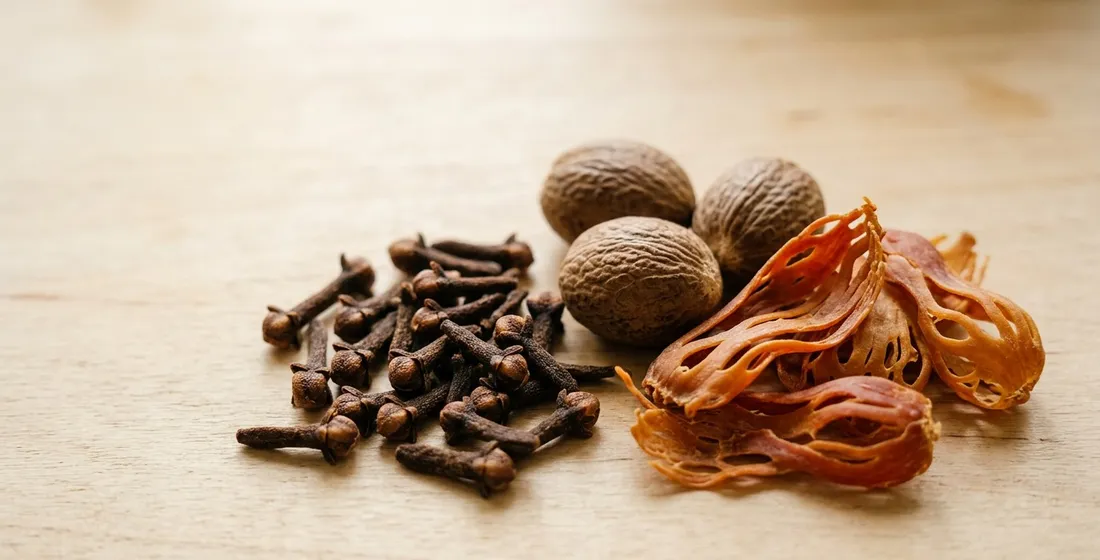
Nutmeg and mace come off the same fruit. Myristica fragrans produces a single seed, the nutmeg, wrapped in a scarlet lacy aril, the mace. One tree, one harvest, two commodities with different price curves and different specs. Cloves are unrelated botanically, the dried unopened flower bud of Syzygium aromaticum, but they travel in the same procurement bundle because the same bakery, beverage and seasoning formulators buy all three, usually from the same origin, on the same shipping document.
That bundling is where spec discipline slips. A buyer who writes a tight Cinnamomum verum clause and then accepts “good quality nutmeg” three lines below has left the harder ingredient unspecified. Nutmeg carries the aflatoxin exposure. Mace carries the widest quality spread. Cloves carry the easiest fraud vector. All three deserve their own parameters. The same discipline runs across the wider Ceylon range, set out in the 2026 B2B buyer’s guide to Ceylon spices.
In Sri Lanka the geography is compact. Nutmeg cultivation runs to 2,788 hectares across Matale, Kegalle and Kandy, with roughly 80% of plantations in Kandy district and mostly in small and mid-scale farmer hands (Sri Lanka Export Development Board). Ceylon nutmeg carries geographical indication status. For a buyer, small-holder structure means the aggregation and cleaning step at the processor matters more than the estate name.
What volatile oil content tells you that a grade name does not
Volatile oil is the single parameter that separates a working spec from a marketing description. It is measurable, it is destructive to fake, and it degrades in ways that grade names conceal.
The European Spice Association publishes the floor most EU buyers write into contracts. Its Quality Minima Document Rev. 5, adopted October 2015 and reviewed March 2018, sets the following for the three:
| Parameter | Cloves | Nutmeg | Mace |
|---|---|---|---|
| Total ash, % w/w max | 7.0 | 3.0 | 4.0 |
| Acid-insoluble ash, % w/w max | 0.5 | 0.5 | 0.5 |
| Moisture, % w/w max | 12 | 10 | 10 |
| Volatile oil, ml/100g min | 14 | 5 to 6.5 (depending on grade) | 5.0 |
Source: European Spice Association Quality Minima Document Rev. 5, Appendix I. Ash, acid-insoluble ash and volatile oil are expressed on a dry basis.
Read the clove row again. Whole clove buds typically carry 15% to 20% essential oil by weight, with eugenol running around 72% to 82% of that oil in published compositional analyses (Molecules, 2021). The ESA floor of 14 ml/100g therefore sits just under the natural range. That is deliberate. A clove lot testing below 14 has usually been through something: steam distillation for oil recovery, prolonged warm storage, or blending with spent material. Distilled cloves look almost identical to sound cloves in a photograph. They fail on volatile oil, and only on volatile oil.
Nutmeg is the opposite problem. Its 5 to 6.5 ml/100g range is grade-dependent, which means a supplier can quote “ESA compliant” against the bottom of the range while the buyer assumed the top. Write the number, not the standard.
How Ceylon cloves, nutmeg and mace are graded and size-sorted
Grade nomenclature in this category is trade convention rather than statute, and it varies by origin. Cardamom behaves the same way, and the cardamom grading tiers show how far apart two lots sharing one grade name can sit. Treat every grade name in an offer as a label that needs a parameter behind it.
Cloves. The commercial distinction is hand-picked selected material against general fair average quality, and the practical difference shows up as stem content, headless buds and mould-affected buds. The US position is explicit: FDA Compliance Policy Guide Sec. 525.250 treats cloves as adulterated at an average of 5% or more stems by weight. A buyer specifying for the US market should write a stem ceiling well inside that, because the defect action level is an enforcement threshold, not a quality target.
Nutmeg. Sizing is by count per pound and it drives price directly. Counts around 60/65 are large premium nuts, 80/85 is the widely traded European standard, and 100/110 covers the smaller nuts that suit grinding rather than whole retail. Shelled sound nuts sorted for uniformity trade as ABCD or AB. Broken, shrivelled and wormy material trades separately and belongs nowhere near a retail SKU. Count and grade are two different clauses; specify both.
Mace. Quality tracks colour and blade integrity. Whole flat blades in bright orange-red sit at the top, broken blades below, and fragments and siftings below that. Mace is where the widest price spread in the bundle sits, and where a vague RFQ costs the most.
Spec snapshot: Ceylon cloves, nutmeg and mace
- Species: Syzygium aromaticum (cloves), Myristica fragrans (nutmeg and mace)
- Origin: Kandy, Matale and Kegalle growing belt, Central Province and adjacent districts
- Volatile oil: cloves 14 ml/100g minimum, nutmeg 5 to 6.5 ml/100g, mace 5.0 ml/100g
- Moisture: cloves 12% maximum, nutmeg and mace 10% maximum
- Formats: whole, powder, tea-bag cut, pyramid cut
- First-order MOQ: 50 kg per SKU, samples by international courier at 3 to 5 business days
What are the cleanliness limits for cloves, nutmeg and mace?
Two regimes matter for a US-bound or EU-bound container, and they are not interchangeable. ASTA cleanliness specifications are the trade standard buyers write into contracts. FDA defect action levels are the enforcement threshold at the border.
The ASTA limits differ meaningfully across the three spices:
| ASTA parameter | Cloves | Nutmeg (whole) | Nutmeg (broken) | Mace |
|---|---|---|---|---|
| Whole insects, dead (count) | 4 | 4 | 4 | 4 |
| Mammalian excreta, mg/lb | 5 | 0 | 5 | 3 |
| Other excreta, mg/lb | 8.0 | 0.0 | 1.0 | 1.0 |
| Mould, % by weight | 1.00 | see ASTA footnote | see ASTA footnote | 2.00 |
| Insect-defiled or infested, % by weight | 1.00 | see ASTA footnote | see ASTA footnote | 1.00 |
| Extraneous or foreign matter, % by weight | 1.00 | 0.00 | 0.50 | 0.50 |
Source: ASTA Cleanliness Specifications for Spices, Seeds and Herbs.
Whole nutmeg carries a zero on excreta and on extraneous matter. That is the tightest line in the table and it is easy to miss when a buyer copies a generic spices clause across every line item in an RFQ.
On the FDA side the numbers are separate again. Whole nutmeg becomes actionable at an average of 10% or more insect-infested or mouldy pieces by count. Ground nutmeg becomes actionable at an average of 100 or more insect fragments per 10 g sample, or an average of 1 or more rodent hairs per 10 g. Mace becomes actionable at 3% or more insect-infested or mouldy pieces by weight, at 3 mg or more mammalian excreta per pound, or at 1.5% or more foreign matter through a 20-mesh sieve (FDA Food Defect Levels Handbook).
Note the shape of that: for mace, the FDA mould threshold and the ASTA mould limit are close together, so a lot sitting comfortably inside ASTA has very little headroom left at the border.
The aflatoxin asymmetry buyers keep missing
Here is the part that catches procurement teams writing one clause for all three spices. Regulation (EU) 2023/915 lists specific aflatoxin maximum levels by named spice. Entry 1.1.14 covers Capsicum spp., pepper (Piper spp.), nutmeg (Myristica fragrans), turmeric (Curcuma longa), and mixtures containing any of them, at 5.0 µg/kg for aflatoxin B1 and 10.0 µg/kg for the sum of B1, B2, G1 and G2. Cloves and mace do not appear in that entry. Ochratoxin A is handled separately at 15 µg/kg for dried spices generally under entry 1.2.17.
That asymmetry is not permission to skip testing on cloves and mace. General food law still prohibits placing unsafe food on the market, and most EU importers apply the named-spice numbers to the whole consignment as a contractual matter. What the asymmetry actually means is narrower and more useful: nutmeg is the line item where a specific numeric limit can be enforced against you directly, and it is also the line item where the RASFF notification history is concentrated, largely on Indonesian-origin material.
In the first half of 2026, the Silk Route Ventures procurement desk saw the same request three times from different US and EU buyers: split the aflatoxin clause by line item rather than applying one number to the whole spice PO. Each of those buyers had been through an FSMA or importer-due-diligence review where a blanket clause was flagged as unspecific. The fix took one line of contract language and it changed which lots the supplier could offer against the order.
Practically, that means a nutmeg RFQ should carry a per-lot aflatoxin B1 and total aflatoxin result on the certificate of analysis, tested to the destination market’s limit, and cloves and mace should carry a mycotoxin result on a defined sampling frequency rather than on every lot. Different exposure, different testing cost.
Moisture is the parameter that decides whether the other numbers hold
Moisture reads like a minor clause and behaves like the master one. Volatile oil is lost through prolonged drying and through warm humid storage. Mould growth in transit is a water activity problem before it is a hygiene problem. The ESA ceilings, 12% for cloves and 10% for nutmeg and mace, are the practical control point, and the association separately recommends a water activity target of maximum 0.65 for dried herbs and spices.
For containerised sea freight from Colombo, which runs 3 to 4 weeks to EU ports and 4 to 5 weeks to the US, the difference between shipping at 9.5% moisture and shipping at the 10% ceiling is the difference between arriving inside spec and arriving as a claim. Specify the moisture at dispatch and ask for the packing configuration, liner type and desiccant to be stated on the PO.
Buyers who want the same discipline applied to a related ingredient can compare the approach in the Ceylon cinnamon RFQ specification guide, where species verification carries the same weight moisture carries here.
Writing the RFQ: formats, the MOQ ladder, and what to send procurement
Cloves, nutmeg and mace each move in whole, powder and cut formats, and format selection changes both the spec and the price. Whole material holds volatile oil far longer than ground. Tea-bag cut and pyramid cut sit between the two and suit beverage blenders who want extraction without powder carryover. Format-level detail for the individual spices sits in the Ceylon cloves format guide and the nutmeg bakery and beverage spec.
The MOQ ladder for bulk ingredient supply from Silk Foods Ceylon (SFC) runs as follows:
| Stage | Quantity | Notes |
|---|---|---|
| Sample | Spec-representative sample | Door-to-door by international courier at 3 to 5 business days |
| First order | 50 kg per SKU | Per product, not per total order. Cloves plus nutmeg plus mace is 150 kg minimum |
| Volume tier 1 | 500 kg per SKU | First price break |
| Volume tier 2 | 1,000 kg per SKU | |
| Volume tier 3 | 2,500 kg per SKU | Container-programme pricing |
Production lead time from purchase order to dispatch is 2 to 3 weeks. Sea freight adds 3 to 4 weeks to EU and Australia, 4 to 5 weeks to the US. Retail packs and industrial packs are quoted separately because the packing labour, not the raw material, drives the difference at low volumes.
Buyer’s checklist: specifying cloves, nutmeg and mace
- Botanical species named for each line item, not one blanket clause
- Volatile oil minimum stated as a number, not as “ESA compliant”
- Moisture ceiling stated at dispatch, with packing configuration on the PO
- Nutmeg count per pound and grade specified separately
- Mace blade integrity and colour grade defined
- Clove stem ceiling defined, inside the 5% FDA adulteration threshold
- ASTA cleanliness clause cited per spice, not generically
- Aflatoxin B1 and total aflatoxin per lot on nutmeg; defined frequency on cloves and mace
- Per-batch certificate of analysis listing the parameters above
- Sample approved against the written spec before the first purchase order
Where Silk Route Ventures does not fit
Lowest-landed-cost commodity programmes. Buyers whose specification is a price and a grade name with no parameters behind it. For that brief, high-volume Indonesian nutmeg or Madagascan clove through a competent consolidator is the more honest answer than Ceylon material at a stretched price.
FAQ
What is the minimum volatile oil content for cloves, nutmeg and mace?
The European Spice Association Quality Minima Document Rev. 5 sets 14 ml/100g minimum for cloves, 5 to 6.5 ml/100g for nutmeg depending on grade, and 5.0 ml/100g for mace, all on a dry basis. Cloves testing below 14 have usually been distilled or stored badly.
Does the EU set an aflatoxin limit for cloves and mace?
Regulation (EU) 2023/915 entry 1.1.14 sets 5.0 µg/kg aflatoxin B1 and 10.0 µg/kg total aflatoxins for nutmeg, alongside Capsicum, pepper and turmeric. Cloves and mace are not named in that entry. Ochratoxin A applies to dried spices generally at 15 µg/kg under entry 1.2.17.
How is Ceylon nutmeg graded and sized?
Nutmeg is sized by count per pound: roughly 60/65 for large premium nuts, 80/85 as the standard European trade size, and 100/110 for smaller grinding-grade nuts. Sound shelled nuts sorted for uniformity trade as ABCD or AB. Specify count and grade as separate clauses.
Does Silk Route Ventures supply bulk cloves, nutmeg and mace against a buyer’s own specification?
Yes. Bulk cloves, nutmeg and mace ship from the Matale facility against the buyer’s written spec, in whole, powder, tea-bag cut and pyramid cut formats, with a certificate of analysis on every batch. First-order MOQ is 50 kg per SKU with volume breaks at 500 kg, 1,000 kg and 2,500 kg.
What certifications cover Ceylon spice supply from Silk Foods Ceylon?
The Matale facility operates under BRCGS and FSSC 22000 V6, with USDA Organic and EU Organic on the relevant SKUs. It is registered with the Sri Lanka Export Development Board and is an FDA-registered facility for US-bound consignments.
How Silk Route Ventures can help
Silk Route Ventures (SRV) supplies single-origin Ceylon cloves, nutmeg and mace to specialty spice brands, blenders and beverage formulators across the US, EU and Australia. Bulk raw material ships against the buyer’s written specification from the BRCGS and FSSC 22000 V6 audited Silk Foods Ceylon (SFC) facility in Matale, with a certificate of analysis on every batch and traceability up to farm level on organic SKUs. First-order MOQ is 50 kg per SKU, production lead time is 2 to 3 weeks from purchase order to dispatch, and samples ship door-to-door by international courier at 3 to 5 business days. For brands moving from bulk supply to a finished retail line, the same site runs private label spice manufacturing under the buyer’s own brand. Contact us to send an inquiry or request a sample against your spec. Samples and bulk quotes run through our Ceylon spices supplier.
Sources
- European Spice Association, Quality Minima Document Rev. 5, Appendix I (adopted 27 October 2015, reviewed 26 March 2018). Retrieved 15 August 2026. https://www.srilankabusiness.com/pdf/read_more_products/annex_8_esa_doc_on_minima_quality_standards.pdf
- Commission Regulation (EU) 2023/915 of 25 April 2023 on maximum levels for certain contaminants in food, Annex I entries 1.1.14 and 1.2.17 (consolidated text, 1 January 2025). Retrieved 15 August 2026. https://eur-lex.europa.eu/eli/reg/2023/915/2025-01-01/eng
- American Spice Trade Association, Cleanliness Specifications for Spices, Seeds and Herbs. Retrieved 15 August 2026. https://www.trueceylonspices.com/wp-content/uploads/ASTA%E2%80%99s-Cleanliness-specifications-for-Spices-Seeds-and-Herbs.pdf
- US Food and Drug Administration, Food Defect Levels Handbook, entries for nutmeg and mace. Retrieved 15 August 2026. https://www.fda.gov/food/current-good-manufacturing-practices-cgmps-food-and-dietary-supplements/food-defect-levels-handbook
- US Food and Drug Administration, Compliance Policy Guide Sec. 525.250, Cloves: Adulteration with Stems. Retrieved 15 August 2026. https://www.fda.gov/regulatory-information/search-fda-guidance-documents/cpg-sec-525250-cloves-adulteration-stems
- Sri Lanka Export Development Board, Ceylon Nutmeg and Mace. Retrieved 15 August 2026. https://www.srilankabusiness.com/spices/about/nutmeg-cultivation-sri-lanka.html
- Haro-González, J.N. et al., “Clove Essential Oil (Syzygium aromaticum L. Myrtaceae): Extraction, Chemical Composition, Food Applications, and Essential Bioactivity for Human Health,” Molecules, 2021. Retrieved 15 August 2026. https://www.ncbi.nlm.nih.gov/pmc/articles/PMC8588428/
Written by the Silk Route Ventures Trade Team. Silk Route Ventures (E-Silk Route Ventures (Pvt) Ltd) is a Sri Lankan B2B supply-chain operator for the Food, Beverage, Wellness and Nutraceuticals sectors. The Silk Foods Ceylon manufacturing arm operates under BRCGS and FSSC 22000 V6. Questions or to request a sample: Contact us or email info@esilkroute.com.lk.