
Bulk Cinnamon Chips and Cinnamon Leaf Spec Guide for Buyers
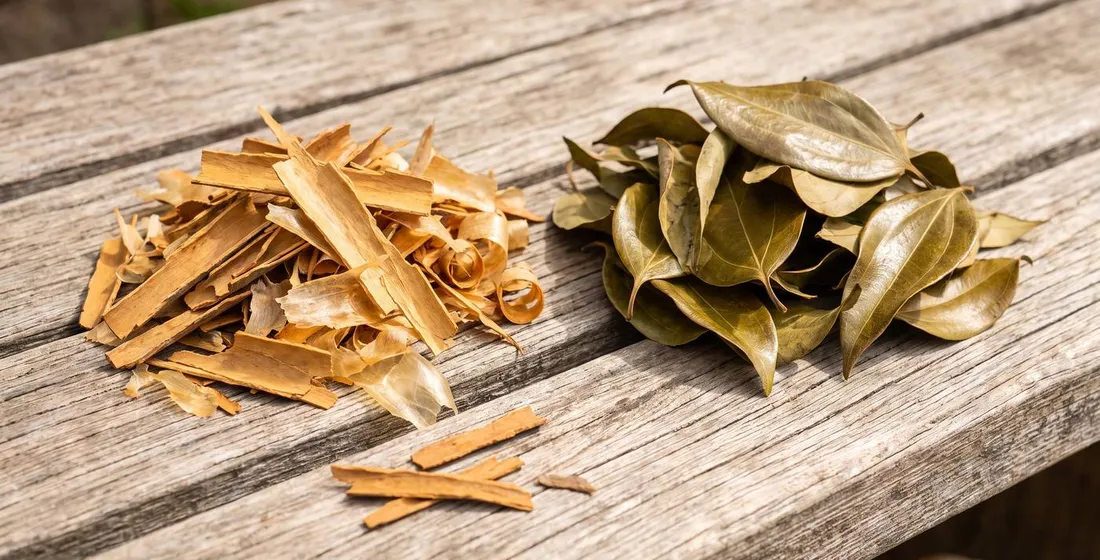
Buyer’s snapshot
- SLS 81:2021 recognises three by-product bark forms beside quills: quillings, featherings and chips. Chips are unpeelable bark with the outer bark left on (Sri Lanka Standards Institution).
- The volatile oil floor is 1.0 ml/100 g (dry basis) for quillings and featherings but only 0.5 for chips. Moisture is capped at 14.0 percent and total ash at 5.0 percent.
- Leaf is a different material. SLS 81 covers bark only, and leaf oil runs eugenol-dominant where bark oil runs cinnamaldehyde-dominant.
- Silk Foods Ceylon (SFC) supplies chips and leaf from Matale under FSSC 22000 V6, with a 100 kg first-order MOQ per SKU.
- Written for extraction, tea and milling buyers who default to quills in the RFQ.
Most cinnamon RFQs that reach a Sri Lankan exporter ask for quills, even when the buyer plans to distil, steep or mill the bark. That can mean paying for quill appearance that the process throws away. Sri Lanka’s own standard names three other bark forms, each with its own definition and its own volatile oil floor, and it treats the leaf as a separate material altogether. Quills are the showpiece. The by-products are the working stock.
This guide sets out what each form is, what SLS 81:2021 requires of it, and which RFQ lines keep the delivery on spec.
What are cinnamon quillings, featherings and chips?
Under SLS 81:2021, quillings are broken pieces and splits of peeled inner bark below 200 mm in length. Featherings are dried pieces of inner bark peeled or scraped from Ceylon cinnamon. Chips are the dried bark of unpeelable stems, branches and trimmings, outer bark included, obtained by chipping or scraping.
The line that matters is peeled versus unpeelable. Quillings and featherings are inner bark, the same material that goes into a quill. Chips are the bark that could not be peeled, so they carry outer bark and behave differently in the cup, the still and the mill. SLS 81:2021 also lets quillings carry up to 5 percent featherings by mass, so a quillings lot is not always pure. The earlier ISO 6539:1997 text allowed up to 3 percent of featherings and chips, which is worth knowing if a buyer’s legacy spec still cites it.
| Form | What it is | Peeled inner bark | Volatile oil floor (ml/100 g, dry basis) |
|---|---|---|---|
| Quillings | Broken pieces below 200 mm and splits of quills | Yes | 1.0 |
| Featherings | Inner bark peeled or scraped from the stem | Yes | 1.0 |
| Chips | Unpeelable stems, branches and trimmings, outer bark included | No | 0.5 |
Where do chips and featherings come from in quill production?
A quill is the scraped inner bark of mature stems, rolled, shade dried and joined by overlaps into a length of 1,050 mm, plus or minus 50 mm, with the hollow filled with small pieces of peeled inner bark (SLS 81:2021). Every quill produced leaves something behind. Broken lengths become quillings. Scrapings become featherings. Stems and branches too thin or irregular to peel become chips.
That production logic is why the by-products are a steady supply and not a niche. It is also why they sit lower on the price ladder than quills, though this guide quotes no figures because price moves with the crop. Buyers who want the harvest side of that picture can read the Ceylon cinnamon crop calendar.
From the standards file The Sri Lanka Standards Institution first published its cinnamon standard in 1973. In 1976 it split the document in two, and in 1978 the second part, covering quillings, featherings and chips, appeared as its own revision. Those forms have been specified separately for nearly half a century. The separate numbers below are the reason.
What does SLS 81:2021 require of chips, featherings and quillings?
SLS 81:2021 applies one chemical table to quills, cut quills, quillings, featherings and chips, with a second column for ground, crushed and special cuts. The moisture and ash limits are the same across the whole-bark forms. Volatile oil is the one number that differs, and it differs for chips only.
| Characteristic | Quills, quillings, featherings, chips | Ground, crushed, special cuts |
|---|---|---|
| Moisture, % by mass, max | 14.0 | 12.0 |
| Total ash, % by mass, max | 5.0 | 8.0 |
| Acid insoluble ash, % by mass, max | 1.0 | 1.0 |
| Volatile oil, ml/100 g dry basis, min | 1.0 (chips 0.5) | 0.5 |
| Sulphur as SO2, mg/kg, max | 150 | 150 |
The moisture gap carries a practical consequence. A lot of chips at 13.5 percent moisture passes the whole-bark limit and would fail the 12.0 percent limit for a milled product. A buyer who mills chips in house inherits the drying specification, so state the moisture target you need after milling, not only at receipt.
The standard also sets Escherichia coli and Salmonella limits (Salmonella absent in 25 g), but notes that these tests are not routine for every sample. They apply in a dispute, on a purchaser’s request, or where contamination is suspected. Hygiene and processing are tied to SLS 143 and SLS 1562, and growing to SLS 1523 Part 3.
Spec snapshot: Ceylon cinnamon chips Species: Cinnamomum verum Form: dried unpeelable bark, outer bark included Moisture: 14.0 percent maximum Total ash: 5.0 percent maximum Acid insoluble ash: 1.0 percent maximum Volatile oil: 0.5 ml/100 g minimum, dry basis Sulphur as SO2: 150 mg/kg maximum MOQ: 100 kg per SKU, trial quantities from 10 kg; lead time 2 to 3 weeks PO to dispatch
Which form suits extraction, tea cut or milling?
Match the form to what the process keeps. Extractors and distillers pay for volatile oil, not appearance. Tea blenders pay for flavour in the cup and a clean particle size. Millers pay for a powder that fits the ground-cinnamon definition. The table lays out the first-pass choice.
| Use | First-pass form | Reason |
|---|---|---|
| Distillation or solvent extraction | Chips or featherings | Oil yield is the buying criterion, so specify the volatile oil assay and not the grade |
| Tea cut and infusion blends | Quillings or featherings, cut to size | Peeled inner bark is the flavour the standard describes; cup-test chips before committing |
| Milling to powder | Quillings or featherings | SLS 81:2021 defines ground cinnamon as powder of peeled inner bark, so chips fall outside that definition |
| Brewing, mulled drinks, syrups | Chips or quillings | Small pieces infuse readily and the cut is not on show |
The milling row deserves a second look. On the standard’s own wording, a powder milled from chips is not “ground Ceylon cinnamon” in the SLS sense, because chips are unpeelable bark with outer bark attached. If the pack will say ground Ceylon cinnamon, specify quillings or featherings as the feedstock, or quills in the higher Hamburg grades. The grade ladder from Alba to H3 covers that route.
Tea is a format here, not the lead. The same bark can sit in a tisane blend or beside a Ceylon white tea, and the herbal tea bag cut specification covers particle size, dust and fill weight for the blend itself. For the white tea side, see the silver tips spec.
How does cinnamon leaf differ from cinnamon bark?
Cinnamon leaf and cinnamon bark come from the same species, Cinnamomum verum, but they are different spice and oil materials. A 2017 GC-MS study found eugenol at 81.51 percent in commercial leaf oil and E-cinnamaldehyde at about 67 percent in commercial bark oil, with each compound at no more than 1.4 percent in the other (Cantó Catalá and Blázquez Ferrer, Nereis).
For the buyer, that chemistry shows up as flavour. Bark is sweet and woody. Leaf is warm and clove-like, because eugenol is the clove compound. The same paper’s literature review reports that eugenol is highest in leaves from annual branches (93.69 percent) and falls as the leaf ages, a spread of roughly 4 percentage points against four-year-old branches. Leaf age moves the number, which is why a leaf lot needs its own COA line and not a borrowed bark spec.
SLS 81:2021 covers the processed dried bark of Ceylon cinnamon, so leaf has no grade in the standard. That leaves the RFQ to carry the spec: whole or broken leaf, moisture, foreign matter, and an oil yield if the buyer will distil. Leaf goes into spiced teas, herbal blends, broths and rice dishes, and it is distilled for its aromatic oil. Silk Route Ventures (SRV) lists it as cinnamon leaves.
Neither form replaces the other. Bark oil and leaf oil are not interchangeable in a flavour or a claim, and a supplier who quotes one against the other is quoting a different product.
What belongs in the RFQ for cinnamon chips and leaf?
Buyer’s checklist: cinnamon chips, featherings and leaf
- Species confirmed in writing as Cinnamomum verum, as set out in the RFQ guide for specifying Cinnamomum verum
- Form named as quillings, featherings or chips per SLS 81:2021, with a stated limit on any mixed-in featherings or chips
- Moisture, total ash, acid insoluble ash and volatile oil limits written out, tested by the SLS 186 methods
- Cut or particle size stated for the process (special cuts run 1 to 5 mm under the standard)
- Sulphur as SO2 at or below 150 mg/kg
- A COA available on request, with coumarin on the assay list for any food or capsule use; microbiology, heavy metals, pesticide residues and coumarin run through an external laboratory on request
- Pesticide residues checked against the destination market limits
- Organic status stated per SKU if the claim is needed
- A sample approved against the spec before any PO
Coumarin deserves its own line because chips include outer bark and buyers should see the assay rather than assume it. The species and coumarin background is in the Ceylon cinnamon versus Vietnamese cassia comparison.
Where this is not the fit SRV quotes Ceylon bark and leaf, not other origins. If the brief is a cinnamon-flavoured product that does not carry a Ceylon claim and price per kilo decides the order, Cinnamomum cassia chips from a competent processor elsewhere are the more honest answer than Ceylon chips at a squeezed price.
Frequently asked questions
What is the difference between cinnamon chips and cinnamon quillings?
Quillings are broken pieces and splits of peeled inner bark below 200 mm. Chips are dried unpeelable bark with the outer bark left on. SLS 81:2021 sets a volatile oil floor of 1.0 ml/100 g for quillings and 0.5 for chips, both on a dry basis (Sri Lanka Standards Institution, 2021).
What is the minimum volatile oil for Ceylon cinnamon chips?
SLS 81:2021 sets the minimum at 0.5 ml/100 g on a dry basis for chips, half the 1.0 ml/100 g floor that applies to quills, quillings and featherings. Moisture is capped at 14.0 percent and total ash at 5.0 percent for all whole-bark forms (Sri Lanka Standards Institution, 2021).
Is cinnamon leaf the same as cinnamon bark?
No. Both come from Cinnamomum verum, but leaf oil is eugenol-dominant (81.51 percent in a 2017 commercial sample) while bark oil is cinnamaldehyde-dominant (about 67 percent). SLS 81:2021 covers bark only, so leaf is specified in the RFQ and not graded by the standard (Cantó Catalá and Blázquez Ferrer, 2017).
Does Silk Route Ventures supply bulk cinnamon chips and cinnamon leaf?
Yes, as bulk raw material from the Silk Foods Ceylon facility in Matale. Commercial orders start at 100 kg per SKU, with trial quantities from 10 kg, and standard SKUs ship 2 to 3 weeks from PO to dispatch. Organic status is confirmed per SKU, so ask for the certificate for the exact SKU before listing it as organic.
How Silk Route Ventures can help
Silk Route Ventures supplies Ceylon cinnamon chips and cinnamon leaf as bulk Ingredient Supply, packed at the FSSC 22000 V6 certified Silk Foods Ceylon facility in Matale, with a COA available on request. First orders start at 100 kg per SKU, trial quantities start from 10 kg, and samples are free for evaluation (you cover the courier). Standard SKUs ship 2 to 3 weeks from PO to dispatch, priced FOB Colombo with CFR and CIF on request. The wider Ceylon cinnamon range runs from quills to powder, and the cinnamon chips listing carries the product detail. Contact us to send an inquiry or request a sample.
Sources
- Sri Lanka Standards Institution, “SLS 81:2021 Specification for Ceylon cinnamon,” (2021). Retrieved 2026-10-31 (text as reproduced at https://druera.com/blogs/ceylon-cinnamon-basics/the-sri-lanka-standards-institute-standard-for-ceylon-cinnamon-sls-81-2021). https://www.slsi.lk/
- International Organization for Standardization, “ISO 6539:1997 Cinnamon (Sri Lanka type, Seychelles type and Madagascar type), whole or ground, Specification,” (1997). Retrieved 2026-10-31. https://standards.iteh.ai/catalog/standards/iso/2baffaad-fa4c-4801-95f3-94556dde4941/iso-6539-1997
- Cantó Catalá, A. and Blázquez Ferrer, M.A., “Standardization of commercial cinnamon essential oils by gas chromatography-mass spectrometry analysis,” Nereis 9, 13-24 (March 2017). Retrieved 2026-10-31. https://revistas.ucv.es/nereis/index.php/Nereis/article/view/86
Further reading
- Silk Route Ventures, “Ceylon Cinnamon Grades: Alba to C5 Spec Sheet” → https://esilkroute.com.lk/blog/ceylon-cinnamon-grades-alba-to-c5-spec-sheet-for-bulk-buyers/
- Silk Route Ventures, “Specifying Cinnamomum verum on a sourcing RFQ” → https://esilkroute.com.lk/blog/specifying-cinnamomum-verum-on-a-sourcing-rfq-for-ceylon-cinnamon/
- Silk Route Ventures, “Ceylon Cinnamon vs Vietnamese Cassia” → https://esilkroute.com.lk/blog/ceylon-cinnamon-vs-vietnamese-cassia/
Written by the Silk Route Ventures Trade Team. Silk Route Ventures (E-Silk Route Ventures (Pvt) Ltd) is a Sri Lankan B2B supply-chain operator for the Food, Beverage, Wellness and Nutraceuticals sectors. The Silk Foods Ceylon manufacturing arm holds BRCGS and FSSC 22000 V6 certification. Questions or to request a sample: Contact us or email info@esilkroute.com.lk.