
Banana Blossom in Brine: A Plant-Based Seafood-Alternative Format for CPG Brands
Buyer’s snapshot
- Global retail sales of plant-based meat and seafood were an estimated $6.6 billion in 2025, growing in some regions and shrinking in others (GFI, 2026 State of the Industry report, citing Euromonitor).
- Banana blossom is a texture ingredient, not a protein source: 1.5 g protein and 35 kcal per 100 g, so any protein claim has to come from the coating or binder.
- Silk Foods Ceylon (SFC) packs banana blossom in brine under BRCGS and FSSC 22000 V6, with a 24-month retort shelf life and a 1,000-unit private-label MOQ per SKU.
- The comparison table and the RFQ checklist below are the sections to forward to procurement.
Plant-based seafood is the hardest shelf in the plant-based aisle to get right, and the format question comes before the flavor question. A brand needs something that flakes along layers when it is torn, takes a batter or a marinade, and survives a retort cycle without turning to paste. Young jackfruit gives pulled-meat strands. Banana blossom gives a different structure: tender, layered petal pieces that read closer to flaked white fish once they are seasoned and coated. This is the Silk Route Ventures (SRV) position on banana blossom in brine, what Silk Foods Ceylon (SFC) packs today, and what a brand should pin down before sending an RFQ.
What is banana blossom in brine, and what does the spec actually say?
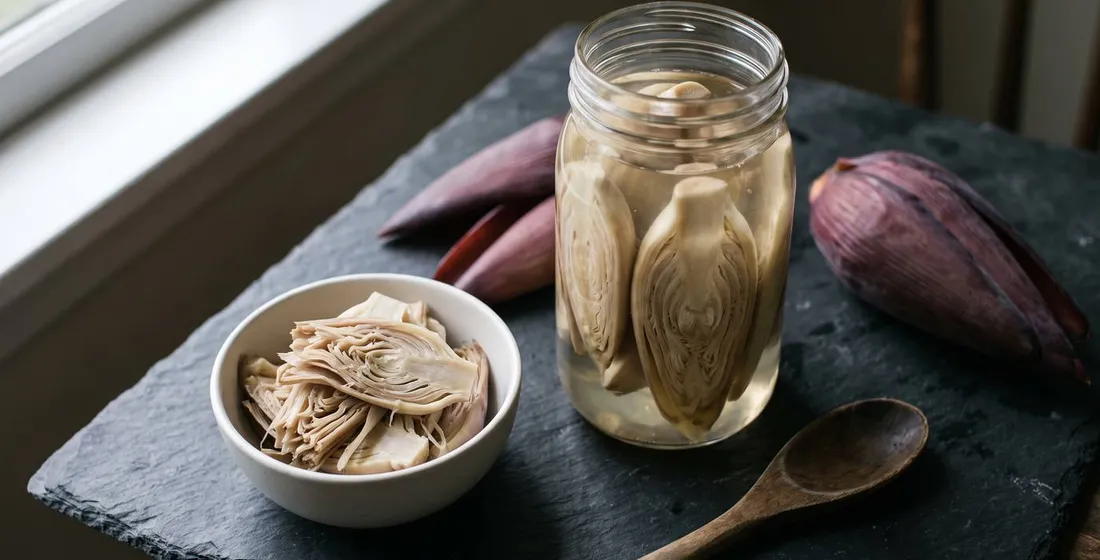
Banana blossom in brine is the male inflorescence of Musa x paradisiaca L., known in Sri Lanka as kesel mal, cleaned, cut, filled with brine, packed and retort-sterilised. SFC’s Banana Blossoms in Brine product page lists a single-ingredient declaration, 100% banana blossom in brine, with no preservatives or artificial additives unless declared on the label.
The inflorescence is traditionally eaten across South and Southeast Asia, yet it is often treated as an undervalued by-product of banana growing, according to a 2020 review in Trends in Food Science & Technology (Lau et al., 2020). For a buyer, that history matters for one reason: supply is a by-product stream from smallholder banana plots in Sri Lanka, so volume planning needs the same advance notice as any agricultural input.
Spec snapshot: banana blossom in brine, Silk Foods Ceylon
- Raw material: Musa x paradisiaca L., Sri Lankan origin
- Appearance: whole or halved blossoms in clear brine, pale cream, mild and tender
- Ingredient declaration: 100% banana blossom in brine
- Allergens: free from the 14 major EU allergens unless declared on the label
- Shelf life: 24 months from manufacture (retort-sterilised); refrigerate after opening and use within 3 days
- Process: raw material receiving, washing, cutting and slicing, sorting, brine filling, packing, labeling
The process has one critical control point on the audited flow: magnet separation for ferrous foreign matter, with a surface flux of at least 8,000 Gauss (0.8 Tesla) and a weekly QA review of the log. Drained weight and brine strength are spec fields set per SKU, not a single published number, which is the honest position: the figure depends on the pack format and the cut.
How does banana blossom differ from jackfruit in brine?
The two formats share a brine, a retort process and a plant-based shelf, and they share very little else. Jackfruit is chosen for fibrous, pulled-meat strands. Banana blossom is chosen when the finished SKU needs flaky, layered pieces. A brand that treats them as interchangeable ends up with the wrong texture in the jar.
| Factor | Banana blossom in brine | Young jackfruit in brine |
|---|---|---|
| Texture after cooking | Tender layered petals that flake | Fibrous strands that pull |
| Typical finished SKU | Fish-style fillets, fish-and-chips style battered pieces, tuna-style salads, seafood-style curries | Pulled-meat sandwiches, tacos, curries, fillings |
| Energy per 100 g | 35 kcal | See the jackfruit spec sheet |
| Protein per 100 g | 1.5 g | See the jackfruit spec sheet |
| Cuts at SFC | Whole and halved blossoms | Chunk, pulled, minced |
| Pack formats listed | Retort pouch, tin-plated can, glass jar, aseptic carton, bulk pails | Glass jar running; other formats confirmed with the Trade Team |
Source: Silk Foods Ceylon product dossiers, 2026.
The jackfruit side of this comparison is covered in the young jackfruit in brine capability one-pager and the RFQ primer for jackfruit in brine and patty fat. This page does not repeat that material, and the two formats can sit side by side in one range: a pulled-meat SKU and a fish-style SKU from the same audited site.
Which plant-based seafood SKUs does banana blossom suit?
The practical test is whether the finished product needs to flake. Banana blossom works where a fillet, a flake or a shred is the point, and where the brand controls the seasoning system that carries the seafood character.
Four applications come up most often in briefs. Battered fillet-style pieces, where the blossom is drained, pressed and coated. Flaked tuna-style salads and sandwich fillings, where the pieces are broken up and bound. Seafood-style curries and stews, where the blossom holds shape in a sauce. And ready-meal components, where blossom is one layer of a multi-part pack.
What banana blossom does not do is taste like fish. The raw material is mild by specification: mild odor, mild and tender taste. Any marine note comes from the brand’s seasoning, seaweed or oil system, and that formulation work is where the R&D time goes. SRV’s R&D and NPD team scopes it at 3 to 4 weeks maximum from signed brief to approved formulation, then production runs 2 to 3 weeks PO to dispatch, with sea freight of 3 to 4 weeks to the EU and Australia and 4 to 5 weeks to the US.
What does 1.5 g of protein mean for the label?
It means the blossom is carrying texture, not protein. Per 100 g, the dossier lists 35 kcal, 7 g carbohydrate (3 g sugars), 3 g dietary fibre, 1.5 g protein, 0.2 g fat and 400 mg sodium, estimated from USDA FoodData Central and FAO INFOODS reference compositions for canned banana blossom.
That profile suits a lean, low-fat SKU. It is a poor fit for a brief that wants a high-protein claim off the blossom alone, which matters because protein is where consumer demand is moving. GFI’s 2026 report names the continuing high-protein trend as one of its major 2025 themes (GFI, 2026). Brands that want both the flaky structure and a protein claim usually add the protein through a batter, a coating or a binder, and the claim is then calculated on the finished product, not the blossom.
Sodium needs the same honesty. The 400 mg per 100 g figure reflects the brine. A brand targeting a low-sodium positioning should say so in the first brief, because brine strength is a spec field that can be set per SKU.
A labeling check that belongs before the artwork
In 2025, according to GFI’s 2026 State of the Industry report, some governments placed labeling restrictions on plant-based meat products, making it harder for those products to compete (GFI, 2026). For a fish-style banana blossom SKU, that is a design-stage question, not a legal afterthought: which words the pack may use differs by destination market and can change a front-of-pack layout that is already printed.
The practical rule is to confirm the naming rules for each target market before the artwork is locked. A brand that waits until pack proofs will pay for reprints. Two numbers also have to be on the label in the EU regardless of the name: net weight and drained net weight for a solid food packed in brine (Regulation (EU) No 1169/2011, Annex IX). SFC agrees the drained-weight target with the buyer at spec stage and reports it against the batch COA.
Pack formats and minimums: what the dossier lists
The product guide lists four primary pack types: retort pouch, tin-plated can, glass jar and aseptic Tetra Recart. Bulk goes into A10 cans and 3 kg or 5 kg pails. Bulk sizes run from 1 kg to 25 kg, and private-label retail sizes run 50 g, 100 g, 250 g, 500 g and 1 kg, or to customer specification.
| Route | Sizes listed | MOQ | Typical use |
|---|---|---|---|
| Private-label retail pack | 50 g to 1 kg | 1,000 units per SKU | Retail shelf SKUs |
| Bulk pack | 1 kg to 25 kg; A10 cans, 3 kg and 5 kg pails | Per pallet | Foodservice and further processing |
Source: Silk Foods Ceylon product guide, FR-BBLOS, 2026.
One point on formats needs plain language. Daily line time for banana blossom is not a published number, because the retort capacity is shared across the in-brine range. Line slot, process and lead time for a given pack format are confirmed in writing at quote, before a price is given. The same applies to any format the brand has not yet run.
For a US launch, one more regulatory fact belongs in the brief. FDA defines low-acid foods as those with a finished equilibrium pH above 4.6 and water activity above 0.85, and treats acidified foods as low-acid foods brought to a finished equilibrium pH of 4.6 or below (21 CFR 114.3). Which route a banana blossom SKU follows depends on its finished pH, so the pH belongs on the spec and the COA, and the scheduled process is filed per product, container and size.
Certification snapshot: Silk Foods Ceylon, Matale
- BRCGS: covers the retorted and plant-based product lines
- FSSC 22000 V6: full processing scope, including retort and plant-based lines
- Also listed on the product page: HACCP, ISO 22000 and GMP
- US FDA-registered facility; Sri Lanka EDB-registered
For the certificate side in more depth, see what BRCGS signals to a retail listing buyer and the FSSC 22000 V6 scope explainer.
Buyer’s checklist: before sending a banana blossom RFQ
- Finished SKU type (fillet-style, flaked, curry component) and the cut it needs
- Pack format and size, with the shelf-life target
- Drained-weight target and tolerance, and the method used to measure it
- Brine strength and sodium target
- Destination markets, and the naming rules for each
- Finished pH expectation, and the US filing route if relevant
- Protein claim, if any, and where it will come from
- First-run volume against the 1,000-unit private-label MOQ
Where SRV walks away
Briefs that need a high-protein claim carried by the blossom alone, frozen-only formats, or a price before the pack format, drained weight and process are agreed. For those, the honest answer is a different base ingredient or a different supplier, and the Trade Team will say so at the first call.
Frequently asked questions
Does Silk Route Ventures offer private label for banana blossom in brine?
Yes. Silk Route Ventures supplies banana blossom in brine under private label from the BRCGS and FSSC 22000 V6 audited Silk Foods Ceylon facility in Matale. Retail sizes run 50 g to 1 kg with a first-order MOQ of 1,000 units per SKU. Bulk packs are quoted per pallet.
How long does banana blossom in brine last?
The product guide lists 24 months from the date of manufacture for the retort-sterilised pack. Once opened, the contents should be refrigerated and used within 3 days. Storage before opening is ambient, 15 to 25 degrees C, away from direct sunlight, heat and moisture.
Can banana blossom replace fish in a plant-based product?
It can replace the flaky texture, not the flavor. Banana blossom is mild by specification and carries 1.5 g protein per 100 g. Brands pair it with a seasoning system for the marine note and a coating or binder for protein. SRV’s R&D team scopes that formulation in 3 to 4 weeks maximum.
Does banana blossom in brine need a drained weight on the label?
In the EU, yes. Regulation (EU) No 1169/2011, Annex IX requires drained net weight alongside net weight for a solid food in brine. Silk Foods Ceylon agrees the target and tolerance at spec stage and reports it against the batch COA.
How Silk Route Ventures can help
Silk Route Ventures (SRV) contract-manufactures plant-based ingredients and finished SKUs for brands in the US, EU, UK and Australia at the Silk Foods Ceylon (SFC) facility in Matale, under BRCGS and FSSC 22000 V6. Banana blossom in brine is available in whole and halved cuts, in retort pouch, can, glass jar and bulk formats, with a 24-month shelf life and a private-label MOQ of 1,000 units per SKU. Drained weight, brine strength and finished pH are set at spec and reported per batch, and the SRV R&D and NPD team scopes seasoning and coating work in 3 to 4 weeks maximum. For brands consolidating several Sri Lankan ingredients into one order, the Sri Lankan spices and ingredients supplier page covers the wider range. Request a sample or send a brief, or email info@esilkroute.com.lk.
Further reading
- Five questions before you sign a plant-based co-manufacturing deal
- Jackfruit in brine: retort glass-jar formats for plant-meat SKUs
- Plant-based and functional food contract manufacturing in Sri Lanka
- Traceability depth and COA cadence: a compliance primer for buyers
Sources
- Good Food Institute, “2026 State of the Industry report: Plant-based meat, seafood, eggs, dairy, and ingredients” (2026). https://gfi.org/pb-report-2026 (retrieved 15 October 2026)
- Lau, B. F., Kong, K. W., Leong, K. H., et al., “Banana inflorescence: Its bio-prospects as an ingredient for functional foods”, Trends in Food Science & Technology, vol. 97, 2020. https://knova.um.edu.my/research_publications_2016_2020/7055 (retrieved 15 October 2026)
- European Union, Regulation (EU) No 1169/2011 on the provision of food information to consumers, Annex IX. https://eur-lex.europa.eu/LexUriServ/LexUriServ.do?uri=OJ:L:2011:304:0018:0063:en:PDF (retrieved 15 October 2026)
- US Code of Federal Regulations, 21 CFR Part 114, Acidified foods, section 114.3 definitions. https://www.ecfr.gov/current/title-21/chapter-I/subchapter-B/part-114 (retrieved 15 October 2026)
Written by the Silk Route Ventures Trade Team. Silk Route Ventures (E-Silk Route Ventures Ltd) is a Sri Lankan B2B supply-chain operator for the Food, Beverage, Wellness and Nutraceuticals sectors. The Silk Foods Ceylon manufacturing arm holds BRCGS and FSSC 22000 V6 certifications. Questions or to request a sample: Contact us or email info@esilkroute.com.lk.