
Coconut Sugar vs Cane Brown Sugar for Bakery and Beverage Formulators: Sweetness, Browning and Moisture
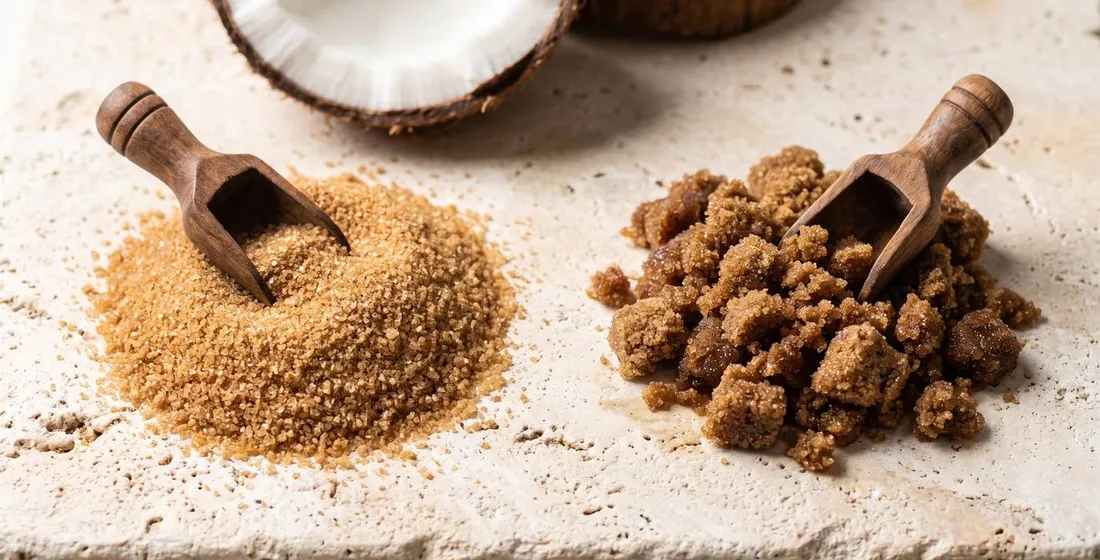
Buyer’s snapshot
- Cane brown sugar is sucrose coated with molasses, commonly about 3.5% for light and 6.5% for dark. Coconut sugar is a granular, unrefined palm-nectar sugar with no molasses coating, so the two do not behave alike even though both are brown and sweet.
- The moisture difference is the biggest practical gap. Molasses is hygroscopic and keeps brown sugar baked goods soft and chewy. Coconut sugar is drier, so a 1:1 swap tends to give a drier crumb unless liquid or fat is adjusted.
- Browning is a lot-by-lot question. Glucose and fructose brown faster than sucrose in model studies, and published coconut sugar analyses disagree widely on how much of each a lot holds. Put the numbers in the spec.
- SFC lists coconut sugar at 382 kcal per 100 g, 90 g sugars per 100 g, free-flowing light caramel-brown crystals and a 12 to 24 month shelf life. It is an added sugar on a US label, exactly like cane sugar.
- First-order MOQ for coconut products is 1 metric tonne, supplied from the BRCGS and FSSC 22000 V6 audited Silk Foods Ceylon facility in Matale.
A request to “swap the brown sugar for coconut sugar” touches five properties: sweetness, colour, moisture, browning speed and flow. This guide is for bakery, snack and beverage development teams that want the coconut sugar story on the pack and need the product to still bake, pour and keep. It sets out what differs, what to test first and what to write into the specification.
The glycaemic index argument for coconut sugar is covered in the coconut sugar GI claims and sourcing post, so this post stays with formulation behaviour.
What actually differs between coconut sugar and cane brown sugar?
Cane brown sugar is sucrose with molasses added back or left on the crystal, and the molasses sets the colour, flavour and moisture. Light brown sugar is commonly cited at about 3.5% molasses and dark at about 6.5%, figures that come from trade and consumer references rather than a single standard, so check the supplier’s own spec. Coconut sugar is made by boiling down the nectar of the coconut palm flower, so its colour and caramel notes come from the sap and the heat applied, not from a molasses coating.
| Property | Coconut sugar (SFC catalogue) | Cane brown sugar (typical) | Why it matters to a formulator |
|---|---|---|---|
| Form | Granular crystals, free-flowing | Fine, damp crystals that can clump | Metering, dosing and dust on the line |
| Colour | Light caramel-brown | Light to dark brown, set by molasses | Product colour and visual match |
| Aroma and taste | Mild caramel | Molasses, toffee, stronger in dark grades | Flavour balance and masking |
| Moisture behaviour | Drier, no molasses film | Hygroscopic, holds water in the crumb | Soft vs dry texture in bakery |
| Energy and sugars | 382 kcal and 90 g sugars per 100 g | Close to cane sugar | Nutrition panel changes little |
| Label treatment | Added sugar | Added sugar | No “healthier sugar” shortcut |
The last row is the one marketing teams most often skip. The US FDA requires coconut sugar to be declared under Added Sugars on the Nutrition Facts label (FDA, Added Sugars on the Nutrition Facts Label), the same as cane sugar, so the swap changes the story and the flavour, not the added sugar count.
Does coconut sugar taste as sweet as brown sugar?
Plan on testing it, because we could not find a published relative sweetness figure for coconut sugar that we would put in a specification. Both sugars are mainly sucrose, so the gap is small, and what a taster reports is often the flavour. Molasses adds a bitter, roasted note that raises perceived depth in brown sugar, and coconut sugar’s mild caramel reads lighter.
The honest test is a paired sensory trial at equal sugar solids. Dose both to the same Brix in the beverage base, or the same sugar weight in the dough, and have a trained or semi-trained panel rank sweetness and overall flavour separately. If the panel marks coconut sugar down on flavour but not on sweetness, the fix is a flavour fix, not more sugar.
Which one browns faster in the oven?
Coconut sugar can brown faster, but the evidence is lot-dependent, so treat it as a trial result and not a rule. Browning in baked goods comes from caramelisation and the Maillard reaction, and reducing sugars drive both. In model studies reported by Buera and co-workers, glucose and fructose developed colour faster than sucrose, which reacted least (Journal of Food Science). Cane brown sugar carries some reducing sugars and invert sugar from the molasses, so it is not a pure sucrose control either.
The published picture for coconut sugar is wide. One study of the neera sap used to make coconut sugar put glucose and fructose together at about 2.3% of total solids, with sucrose above 80% (PMC, 2020). A separate proximate analysis of finished coconut sugar reported roughly 49% sucrose, 15.6% glucose and 14.2% fructose (an Indian proximate-composition study). One figure is for sap solids and the other for finished sugar, so the gap probably reflects differences in sap quality and processing. A lot at the high end of reducing sugars will brown early and darken the crust, and one at the low end will behave close to sucrose.
From the Trade Team Do not sign off a coconut sugar from a single sample batch. A lot that bakes pale in the lab and dark in production can differ in reducing sugars and pH. Ask for the sugar profile on every COA and write a range into the spec.
How does each sugar behave on moisture and storage?
Brown sugar holds water. Molasses is hygroscopic, which is why brown sugar gives soft, chewy cookies and moist cakes, and also why it hardens into a block when that moisture leaves. Industrial brown sugar that sees varying humidity becomes hard and no longer free-flowing (US patent 5,747,089).
Coconut sugar has its own storage risk, and it depends on how the crystals were made. A 2020 storage study of coconut sugar powders found that a vacuum-dried, mostly amorphous product began to cake at a water activity of 0.65, while crystalline coconut sugar did not cake and only began to deliquesce at 0.75 (PMC, 2020). Amorphous sugar also has a low glass transition temperature, which is why sticky, melted lumps appear in hot warehouses and containers.
For a buyer this means the crystalline, granular form is the safer format for bulk handling and for dry-blend beverage mixes. Moisture and water activity belong in the specification next to colour, and storage conditions belong in the contract. SFC lists the shelf life at 12 to 24 months, which assumes dry, cool storage in sealed packaging.
How should a bakery team run the swap?
Run it as a small designed trial, not a one-off bake. A four-cell trial separates the sugar effect from the process effect.
- Cell A, control: current brown sugar recipe and bake.
- Cell B, straight swap: coconut sugar at the same weight, same bake. This shows how far the product moves.
- Cell C, liquid adjusted: coconut sugar with added water, egg or fat in steps of 1% of dough weight until crumb softness matches the control.
- Cell D, bake adjusted: coconut sugar with the oven temperature lowered or the time shortened until crust colour matches the control.
Measure crumb moisture, water activity, spread, crust colour (L* a* b*) and a sensory score at day 1 and at the end of the intended shelf life. The shelf-life reading matters because the moisture difference grows with time. A brown sugar cookie that stays soft for six weeks may need a humectant or a different fat to hold its texture on coconut sugar.
For beverages, dissolve both sugars to the target Brix and compare clarity, colour and any sediment after a 24 hour hold in the pack you intend to use. Unrefined sugars can carry fine insoluble matter, and it shows in clear packaging, so run the hold test before the label is drawn. Check colour again after your heat treatment step.
Buyer’s checklist: before you approve a coconut sugar for a brown sugar swap
- Sucrose, glucose and fructose by a named method on the COA, with a range written into the spec
- Moisture and water activity limits, with the storage condition the limits assume
- Colour range by a stated method, so lots match the approved sample
- Particle size distribution, because it drives dissolving and dusting
- Crystalline vs amorphous form confirmed, with the anticaking position stated
- Authenticity: sap-origin documentation, and isotope testing on premium or organic lots
- A paired sensory trial at equal sugar solids, not equal weight
- A shelf-life trial on the finished product, not only on the sugar
What does the swap cost?
Work the price gap through the recipe before the brand team commits. As an illustration only, a cookie dough with 20% sugar by weight carries a cost of the price gap times 0.20 for every kilogram of dough. If the coconut sugar costs USD 1.50 per kilogram more than the brown sugar, that adds USD 0.30 per kilogram of dough before yield and waste. Use your own quotes, and add any liquid, fat or humectant that Cell C needs.
The premium is easier to defend where the sweetener is a front-of-pack claim and harder in a mass product where the sugar is a few percent of the recipe.
Where the Silk Route Ventures model doesn’t fit A product that needs the cheapest possible brown sweetener at commodity cane volumes, or one that relies on the molasses flavour and moisture of dark brown sugar to define the product. Coconut sugar will cost more and taste different, and SRV will say so at the quote stage. A blend of coconut sugar with a molasses component is a better route for some recipes, and the R&D team can scope it.
Sourcing coconut sugar from Sri Lanka
Silk Route Ventures (SRV) supplies coconut sugar (SKU COCO-CSGR) from the Silk Foods Ceylon (SFC) facility in Matale, Central Province, made from the nectar of Sri Lankan coconut palms sourced through a direct-trade smallholder grower network. The catalogue lists granular, free-flowing crystals in a light caramel-brown colour with a mild caramel aroma. Specification, COA, SDS, nutrition facts, process flow and product guide are available on request.
Spec snapshot: Coconut sugar (COCO-CSGR), SFC catalogue Botanical: Cocos nucifera L. (nectar), Sri Lanka Energy: 382 kcal per 100 g Carbohydrate: 93 g per 100 g, of which sugars 90 g Fat: 0 g; protein 1 g; fibre 1 g; sodium 45 mg per 100 g Appearance: granular crystals, free-flowing, light caramel-brown Shelf life: 12 to 24 months Certification: BRCGS, FSSC 22000 V6, HACCP, ISO 22000, GMP
Brands weighing other sweeteners from the island can compare the coconut and kithul treacle specifications, and bakery teams can pair the sugar with the coconut flour spec guide or the desiccated coconut grade guide.
Frequently asked questions
Can coconut sugar replace brown sugar 1:1 in baking?
By weight, yes as a starting point, but expect changes. Coconut sugar lacks molasses, so baked goods tend to come out drier, and the crust can colour at a different rate. Run a four-cell trial and adjust liquid or bake time before you lock the recipe.
Is coconut sugar healthier than brown sugar?
Not in a way a label can claim. The US FDA treats coconut sugar as an added sugar (FDA, Added Sugars on the Nutrition Facts Label), and SFC lists it at 382 kcal and 90 g sugars per 100 g. The case for coconut sugar is flavour, provenance and minimal processing.
Why does coconut sugar clump or melt in storage?
Moisture and temperature. A 2020 storage study found amorphous coconut sugar powder began caking at a water activity of 0.65, while crystalline sugar held to 0.75 (PMC, 2020). Specify crystalline form, set a water activity limit and store sealed, cool and dry.
Does Silk Route Ventures supply private label coconut sugar?
Yes. SRV supplies coconut sugar in bulk and under the buyer’s own label from the Matale facility, with a first-order MOQ of 1 metric tonne for coconut products and 2 to 3 weeks from PO to dispatch. Samples with a COA ship by international courier in 3 to 5 business days.
How Silk Route Ventures can help
Silk Route Ventures (SRV) supplies coconut sugar in bulk and under the buyer’s own label, processed at the Silk Foods Ceylon facility in Matale under BRCGS and FSSC 22000 V6. The first-order MOQ for coconut products is 1 metric tonne, production takes 2 to 3 weeks from PO to dispatch, and sea freight adds 3 to 4 weeks to the EU and Australia or 4 to 5 weeks to the US. For a swap that needs a custom blend or a pre-mixed bakery sweetener, the SRV R&D and NPD team works to a maximum of 3 to 4 weeks from signed brief to approved formulation. Brands comparing the full coconut range can start with the Sri Lankan coconut products range, then contact us to send an inquiry or request a coconut sugar sample and COA.
Sources
- US Food and Drug Administration, Added Sugars on the Nutrition Facts Label. https://www.fda.gov/food/nutrition-facts-label/added-sugars-nutrition-facts-label (retrieved 14 October 2026)
- Physical Characteristics of Amorphous and Crystalline Coconut Sugar Powder with the Addition of Tricalcium Phosphate as an Anticaking Agent, PMC, 2020 (caking at water activity 0.65 and 0.75; neera sucrose above 80% and glucose plus fructose about 2.3% of total solids). https://pmc.ncbi.nlm.nih.gov/articles/PMC7509578/ (retrieved 14 October 2026)
- Proximate Composition, Phytochemical Analysis and In vitro Antioxidant Potentials of Aqueous Extract of Coconut Sugar (sucrose 49.41%, glucose 15.60%, fructose 14.15%). https://informaticsjournals.com/index.php/fijrfn/article/view/36838 (retrieved 14 October 2026, via search summary of the abstract)
- Buera MP and co-workers, color development of sugar and amino acid model systems, Journal of Food Science (glucose and fructose browning faster than sucrose). https://bdu3.siu.edu.ar/bdu/Record/todo:paper_00221147_v52_n4_p1063_BUERA (retrieved 14 October 2026, via search summary)
- US Patent 5,747,089, Method of making molasses product having low hygroscopicity and sufficient non-caking properties (brown sugar caking after humidity cycling). https://image-ppubs.uspto.gov/dirsearch-public/print/downloadPdf/5747089 (retrieved 14 October 2026, via search summary)
- Silk Foods Ceylon product catalogue, Coconut Sugar (COCO-CSGR): nutrition, sensory, shelf life and certification data.
Written by the Silk Route Ventures Trade Team. Silk Route Ventures (E-Silk Route Ventures Ltd) is a Sri Lankan B2B supply-chain operator for the Food, Beverage, Wellness, and Nutraceuticals sectors. The Silk Foods Ceylon manufacturing arm holds BRCGS and FSSC 22000 V6 certifications. Questions or to request a sample: Contact us or email info@esilkroute.com.lk.