
Private Label Coconut Fruit Bars for Snack Brands: Formulation, Shelf Life and MOQ
Buyer’s snapshot
- Fruit bars were the largest segment of the low-sugar fruit snacks market in 2025, at 37.3% of a USD 3.1 billion category, forecast to grow 8.1% a year to 2033 (Grand View Research, July 2026).
- Silk Foods Ceylon (SFC) makes a chewy coconut and mixed dried fruit bar under BRCGS and FSSC 22000 V6 in Matale, Central Province: 420 kcal, 22 g fat, 40 g sugars and 5 g fibre per 100 g, 24 month stated shelf life.
- That profile scores 7 to 14 under England’s 2004/05 nutrient profiling model, above the 4-point “less healthy” line in every reading. Plan for the UK promotion restrictions at the recipe stage.
- Three numbers carry an own-label bar brief: water activity at release and at end of life, the binder, and which claims the finished recipe can still make.
- The formulation and claims tables below are the two to settle before artwork. The bar economics live in the fruit powders and bars hub, linked below.
A brand that briefs “a coconut fruit bar, our label” has named a format, not a product. The recipe decides whether the bar survives 12 months in a kraft wrapper, which claims the pack can carry, and whether a UK multiple can put it at the till. This guide sets out how Silk Route Ventures (SRV) and its manufacturing arm, SFC, take that brief from a catalogue base recipe to an own-label run. The per-SKU MOQ logic and sample stage for the wider range are covered in the fruit powders and bars sourcing reference, so this post stays with the coconut bar itself.
What is a coconut fruit bar, and what does the Silk Foods Ceylon base recipe look like?
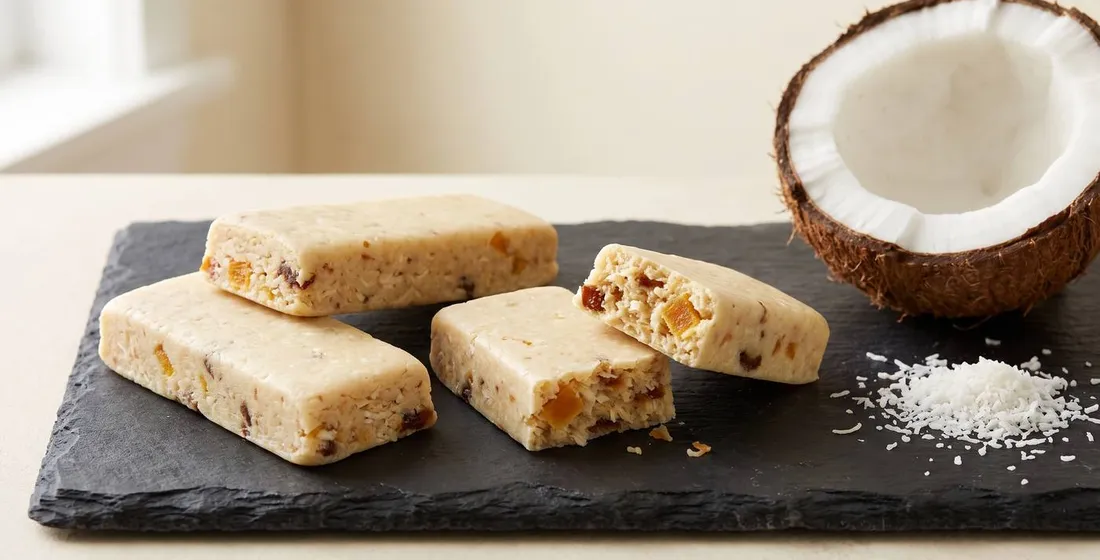
A coconut fruit bar is a pressed, chewy bar of coconut and dried fruit, bound by the fruit’s own sugars or a fruit paste rather than baked like a cereal bar. In food science terms it is an intermediate moisture food: soft, shelf stable at ambient temperature, with a water activity low enough to hold microbial growth down without refrigeration. The SFC catalogue bar is Sri Lankan coconut (Cocos nucifera L.) and mixed dried fruit, with no preservatives or artificial additives unless declared.
Spec snapshot: Coconut Fruit Bar (EB-CFB), SFC catalogue Composition: Sri Lankan coconut (Cocos nucifera L.) and mixed dried fruit Nutrition per 100 g: 420 kcal, 22 g fat (18 g saturated), 55 g carbohydrate (40 g sugars), 5 g fibre, 4 g protein, 30 mg sodium Sensory: chewy bar with visible inclusions, cream with fruit pieces, sweet fruity-coconut taste Dietary: vegan, vegetarian, plant-based Shelf life: 24 months as packed by SFC Certifications: BRCGS, FSSC 22000 V6, HACCP, ISO 22000, GMP
The saturated fat is coconut fat and tracks the coconut rate; the sugars are fruit sugars and track the dried fruit rate. Neither moves without the other, and both feed the claim and HFSS arithmetic below.
How should the formulation be specified for a private label run?
An own-label bar brief should fix six variables in writing: coconut format and rate, fruit mix, binder, inclusions, bar weight and shape, and the water activity target. SFC confirms each against the base recipe at quote stage. Any change to the fruit or binder restarts the stability work, so settle the brief before samples are cut.
| Variable | Options at the Matale line | What it changes |
|---|---|---|
| Coconut format | Fine or medium desiccated, chiplets | Texture, saturated fat, visible-inclusion claim |
| Fruit mix | Date, mango, pineapple, banana, papaya, mixed | Sugars, colour, sulfite status, cost |
| Binder | Fruit paste only, or a syrup | ”No added sugars” eligibility, chew, water activity |
| Inclusions | Seeds, nuts, cocoa nibs, none | Allergen declaration, HFSS category in England |
| Bar weight and shape | 25 g to 50 g, rectangular or square | Pack format, portion claims, case count |
| Water activity target | At release and at end of life | Shelf life, barrier film required |
Source: Silk Foods Ceylon product and process documentation, 2026.
Fine desiccated coconut disappears into the matrix and gives a smooth bar. Chiplets, the small dried pieces covered in the coconut chiplets specification guide, read as visible coconut on the broken edge. Either way, cutting coconut for fruit lowers saturated fat and raises sugars. There is no free move.
The fruit mix carries a sulfite question most briefs miss. Light-coloured dried mango, banana and papaya are sulfured by default to hold colour, and sulfites above 10 mg per kg must be declared on an EU label and above 10 ppm on a US label. Unsulfured fruit is available at a browning trade-off, as the dehydrated fruit spec primer explains. If the pack will say “no preservatives”, the brief has to say unsulfured.
What water activity and packaging keep a fruit bar stable for its stated shelf life?
Water activity, not moisture percentage, governs how long a fruit bar lasts. Published work describes fruit bars as intermediate moisture foods with a minimum water activity around 0.60 to hold enzymatic and microbial activity down at room temperature (Azmat et al., Proceedings of the Pakistan Academy of Sciences, 2017). Most spoilage moulds stop below aw 0.80, but xerophilic moulds grow down to roughly 0.60 to 0.65, so a fruit bar has to clear the lower threshold.
The same study shows what happens after release. Apple bars that started at aw 0.69 fell to 0.64 over 90 days, and colour, texture and overall acceptability dropped from 8.5 to between 5.7 and 6.7 on a nine-point scale. The bar did not become unsafe. It became a worse bar. Shelf life for this format is a sensory limit as much as a microbial one.
Buyer’s checklist: stability clauses for an own-label fruit bar
- Water activity target at release, written as a number (for example at or below 0.65), method named
- Water activity ceiling at end of declared life, measured in the brand’s own wrapper
- Wrapper specification: film structure, water vapour and oxygen transmission rates
- Accelerated shelf-life study on the final recipe in the final wrapper before the date code is printed
- Codex CXC 75-2015 named as the hygiene code for a low-moisture food, CXS 360-2020 for the dried fruit inputs
The 24 month figure on the SFC sheet is the life of the bar in SFC’s standard pack. A brand moving to a thinner recyclable film or a paper wrapper should take its number from the study, not the spec. SFC reports the release water activity on every batch COA; the end-of-life test in the brand’s own pack is paid for once, at launch.
Which label claims does a coconut fruit bar actually qualify for?
At the catalogue profile, a coconut fruit bar can carry “source of fibre” in the EU but not “high fibre”, can be labelled vegan, and may or may not qualify for “no added sugars” depending entirely on the binder. The same coconut that makes the bar chewy closes off the low-fat and low-saturated-fat claims for good.
| Claim | Rule | At the catalogue profile |
|---|---|---|
| Source of fibre (EU) | At least 3 g per 100 g, or 1.5 g per 100 kcal (Reg 1924/2006 Annex) | Qualifies at 5 g per 100 g |
| High fibre (EU) | At least 6 g per 100 g, or 3 g per 100 kcal | Does not qualify |
| No added sugars (EU) | No added mono- or disaccharides or other food used for its sweetening properties; label adds “contains naturally occurring sugars” | Depends on the binder; a syrup ends it |
| No sugar added (US) | 21 CFR 101.60(c)(2): no sugars or sugar-containing ingredient added; no jam, jelly or concentrated fruit juice; sugars not raised by processing; “not a low calorie food” statement | Depends on the binder and any juice concentrate |
| Low saturated fat (EU) | Saturated plus trans fat not above 1.5 g per 100 g | Does not qualify at 18 g |
| Tree nut statement | Coconut is not an EU Annex II allergen; FDA removed coconut from its tree nut list in January 2025 | Not required for coconut; required for any nut inclusion |
Sources: Regulation (EC) No 1924/2006 Annex; 21 CFR 101.60; Regulation (EU) No 1169/2011 Annex II; US FDA allergen guidance, January 2025.
The binder is where the claim is won or lost. Whether a date paste binder counts as “a food used for its sweetening properties” under the EU Annex is a question enforcement bodies have read differently, so the brand’s regulatory adviser should rule on it before artwork is approved. In the US the bar must also contain no concentrated fruit juice and must carry the statement that it is not a low calorie food. SRV states the binder on the specification so both questions can be asked with the recipe in hand.
Will a coconut fruit bar clear England’s HFSS promotion rules?
Not at the catalogue profile. England’s Food (Promotion and Placement) Regulations 2021 use the 2004/05 nutrient profiling model, and a food scoring 4 or more is “less healthy” and restricted where it falls in one of the 13 scheduled categories. The coconut fruit bar scores 7 to 14, and the restrictions have applied to location since 1 October 2022 and to volume price promotions since 1 October 2025 (Department of Health and Social Care implementation guidance).
| Per 100 g | Catalogue value | Points |
|---|---|---|
| Energy | 420 kcal (about 1,757 kJ) | 5 |
| Saturated fat | 18 g | 10 |
| Total sugars | 40 g | 4 |
| Sodium | 30 mg | 0 |
| Total A points | 19 | |
| Fruit, vegetables and nuts | Dried fruit and coconut count double; depends on recipe reading | 0 to 5 |
| Fibre (AOAC) | 5 g | 5 |
| Protein | 4 g; scorable only if fruit, veg and nuts score 5 | 0 to 2 |
| Score (A minus C) | 7 to 14 |
Scored against the Nutrient Profiling Technical Guidance, January 2011. Threshold for foods: 4 points or more.
Coconut fat alone contributes the maximum 10 saturated fat points, which is why no recipe within the format gets under the line. Whether the bar then sits in a scheduled category is a second question: Category 7 covers sweet biscuits and bars based on nuts, seeds or cereal, and the guidance does not address pure fruit bars. A coconut and fruit bar with no cereal, seed or nut inclusion may fall outside the schedule; a fruit and nut variant is inside it.
On 1 October 2025 the volume price rules switched on in England for businesses with 50 or more employees, closing multibuy and extra-free offers on in-scope products regardless of store size. For a snack brand whose UK launch rested on a three-for-two at a multiple, that date rewrote the promotion calendar for any bar scoring 4 or more. The brands that moved early had the score calculated at the recipe stage, not after the first buyer meeting.
Where the Silk Route Ventures model doesn’t fit A brand that needs a bar under 4 on the UK model while keeping a coconut-forward taste. SRV will say so at the brief rather than iterate samples toward a number the recipe cannot reach. A lower-coconut cereal or fruit-and-seed bar is the more honest product for that brief.
How an own-label coconut fruit bar run is sequenced
An own-label bar run follows one sequence: brief, R&D samples, stability and claims sign-off, artwork and compliance, then production. SRV’s R&D and NPD team works to a maximum of 3 to 4 weeks from signed brief to approved formulation, production takes 2 to 3 weeks from purchase order to dispatch, and sea freight adds 3 to 4 weeks to the EU and Australia or 4 to 5 weeks to the US. Samples ship by courier in 3 to 5 business days.
The MOQ for a finished bar run is set per SKU at the briefing stage, from bar weight, wrapper and case configuration. Before a slot is booked the plant needs the label panel, the barcode licence and the pallet specification, all of which belong to the brand owner, as the own-brand labels and export pallet guide sets out. Brands that want SRV to carry the concept and packaging design as well should read the Total OBM service explainer; buyers mapping the whole coconut range can start at the Ceylon coconut derivatives buyer’s guide.
From the Trade Team The bar briefs that go wrong are the ones where the claims were written before the recipe. The briefs that go right start with the one claim the brand will not give up, and let the rest follow the arithmetic.
Frequently asked questions
What is the shelf life of a private label coconut fruit bar?
The Silk Foods Ceylon catalogue bar carries 24 months in SFC’s standard pack. In the brand’s own wrapper the figure comes from an accelerated study, because published fruit bar work shows water activity drifting from 0.69 to 0.64 and sensory scores falling within 90 days of ordinary storage (Azmat et al., 2017).
Can a coconut fruit bar be labelled “no added sugars” in the EU?
Only if the recipe contains no added mono- or disaccharides and no other food used for its sweetening properties, and the label states “contains naturally occurring sugars” (Regulation 1924/2006 Annex). A syrup binder ends the claim; whether a fruit paste binder qualifies is a reading for the brand’s regulatory adviser.
Is a coconut fruit bar HFSS in the UK?
At the catalogue profile, yes. It scores 7 to 14 under the 2004/05 nutrient profiling model against a 4-point threshold, mainly because 18 g of saturated fat per 100 g scores the maximum 10 points. Whether restrictions apply then depends on whether the recipe falls in a scheduled category such as bars based on nuts, seeds or cereal.
Does Silk Route Ventures offer private label coconut fruit bars, and what is the MOQ?
Yes. Silk Route Ventures (SRV) supplies the coconut fruit bar in bulk and under the buyer’s own label from the BRCGS and FSSC 22000 V6 audited Matale facility. The MOQ is set per SKU at the briefing stage from bar weight, wrapper and case format. R&D runs 3 to 4 weeks maximum, then 2 to 3 weeks from PO to dispatch.
How Silk Route Ventures can help
Silk Route Ventures (SRV) supplies the coconut fruit bar in bulk and under the buyer’s own label, produced at the Silk Foods Ceylon facility in Matale, Central Province, under BRCGS and FSSC 22000 V6, with a batch COA and release water activity on every lot. For a new fruit mix or a binder that protects a claim, the SRV R&D and NPD team works to a maximum of 3 to 4 weeks from signed brief to approved formulation, then production runs 2 to 3 weeks from PO to dispatch and sea freight adds 3 to 4 weeks to the EU and Australia or 4 to 5 weeks to the US. Brands building a wider range can see the Sri Lankan coconut products SRV exports, then contact us to send a bar brief or request a sample and specification.
Sources
- Grand View Research, Low Sugar Fruit Snacks Market Size, Share and Trends Analysis Report, published July 2026. https://www.grandviewresearch.com/industry-analysis/low-sugar-fruit-snacks-market-report (retrieved 17 October 2026)
- Department of Health and Social Care, Restricting promotions of products high in fat, sugar or salt by location and by volume price: implementation guidance (England). https://www.gov.uk/government/publications/restricting-promotions-of-products-high-in-fat-sugar-or-salt-by-location-and-by-volume-price/restricting-promotions-of-products-high-in-fat-sugar-or-salt-by-location-and-by-volume-price-implementation-guidance (retrieved 17 October 2026)
- Department of Health, Nutrient Profiling Technical Guidance, January 2011 (the 2004/05 model). https://www.gov.uk/government/publications/the-nutrient-profiling-model (retrieved 17 October 2026)
- Regulation (EC) No 1924/2006 on nutrition and health claims made on foods, Annex. https://www.legislation.gov.uk/eur/2006/1924/annex (retrieved 17 October 2026)
- 21 CFR 101.60(c)(2), nutrient content claims for the sugar content of foods. https://www.law.cornell.edu/cfr/text/21/101.60 (retrieved 17 October 2026)
- Azmat, Z., Durrani, Y., Qazi, I. M., Ahmed, I. and Rasheed, S., Effect of Antioxidants on Storage Quality of Apple Sucrose Bars, Proceedings of the Pakistan Academy of Sciences B, 54(3), 165 to 175, 2017. https://www.paspk.org/wp-content/uploads/2017/09/Effect-of-Antioxidants.pdf (retrieved 17 October 2026)
- US Food and Drug Administration, Questions and Answers Regarding Food Allergens, Edition 5, January 2025 (coconut removed from the tree nut list). Coverage: https://www.newhope.com/regulatory/fda-removes-coconuts-from-tree-nut-list-in-new-allergen-labeling-final-guidance (retrieved 17 October 2026)
- Silk Foods Ceylon product catalogue, Coconut Fruit Bar (EB-CFB): composition, nutrition, sensory, shelf life and certification data.
Written by the Silk Route Ventures Trade Team. Silk Route Ventures (E-Silk Route Ventures Ltd) is a Sri Lankan B2B supply-chain operator for the Food, Beverage, Wellness, and Nutraceuticals sectors. The Silk Foods Ceylon manufacturing arm holds BRCGS and FSSC 22000 V6 certifications. Questions or to request a sample: Contact us or email info@esilkroute.com.lk.