
Total OBM at Silk Foods Ceylon
Total OBM at Silk Foods Ceylon: Building the Brand End to End
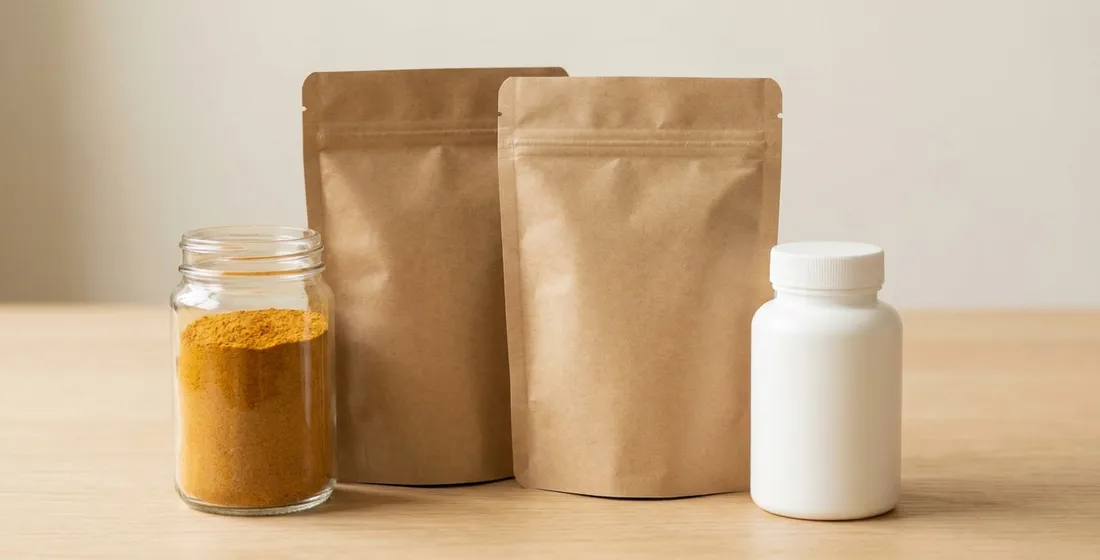
Hero image: plain, unbranded retail-ready packaging formats (clear glass jar, kraft stand-up pouches, capsule bottle) on a neutral wood surface, illustrating Total OBM finished output before a brand owner’s artwork is applied. Source: Higgsfield nano_banana_2, generated for Silk Route Ventures.
Buyer’s snapshot
- In 2025, US private label sales reached USD 330 billion and 24% of retail food and beverage dollar share, up 0.4 points year on year (Circana, reported by Food Business News). Own-brand is no longer the discount tier; it is the growth tier.
- Total OBM (Original Brand Manufacturing) is the turnkey option: Silk Route Ventures builds the product, the brand, and the retail-ready packaging end to end, against the buyer’s market brief rather than the buyer’s spec sheet.
- The Silk Foods Ceylon facility in Matale runs OBM under BRCGS and FSSC 22000 V6, with USDA Organic and EU Organic per SKU, so an OBM launch clears retail and customs gates on the same audit chain as the rest of SRV’s catalog.
- First-order MOQ stays low: 50 kg per SKU for bulk-format products, 180 bottles for capsules, 1,500 jars for glass-jar formats. Formulation and artwork work adds 2 to 4 weeks upfront.
- This post is for specialty brands and distributors launching a new own-label line. For buyers who already hold a finished formulation and just need it produced, private label or contract manufacturing is the cleaner fit.
Most Sri Lankan exporters quote against a spec sheet. The buyer arrives with a formulation, a particle-size target, a cert requirement, and a packaging format already decided, and the supplier produces to it. That model works when the buyer knows exactly what they want. It does not help the buyer who has a market opening, a shelf they want to win, and no product yet.
Total OBM (Original Brand Manufacturing) is the service for that second buyer. Silk Route Ventures (SRV) builds the product concept, develops the formulation, designs the retail packaging, and ships a finished, branded SKU the buyer can put on a shelf or a marketplace listing. The brand is the buyer’s. Almost everything else is built at the Silk Foods Ceylon (SFC) facility in Matale. This piece walks through what that service covers, when building the brand end to end is the right call, what it costs in MOQ and lead time, and how to brief SRV for an OBM project.
What is Total OBM, and how is it different from private label and contract manufacturing?
Total OBM is the most hands-off sourcing model a brand owner can choose: the manufacturer originates the product, the formulation, and the packaging design, and the buyer supplies the brand and the market intent. Private label sits one step down, where the buyer puts their label on a manufacturer’s existing product. Contract manufacturing sits further down still, where the buyer brings the formulation and the manufacturer produces it at scale. Total OBM is rare in the Sri Lankan export field because it asks the manufacturer to carry product development, not just production.
The distinction matters at the RFQ stage. A buyer who sends SRV a finished spec is asking for ingredient supply or contract manufacturing. A buyer who sends a market brief (“a clean-label turmeric latte blend for the Australian wellness retail channel, organic, glass jar, our brand”) is asking for OBM. The work, the timeline, and the pricing are different, so naming the service correctly on the first email saves a round of clarification.
| Service model | Who originates the formulation | Who designs packaging | Best-fit buyer |
| Ingredient Supply | Buyer (spec sheet) | N/A (bulk RM) | Brands and co-packers buying raw material |
| Contract Manufacturing | Buyer, or buyer with SRV R&D | Buyer | CPG scale-ups with a formulation ready |
| Private Labelling | SRV (existing product) | SRV, to buyer’s brand | Brands wanting a proven SKU under their label |
| Total OBM | SRV, to buyer’s market brief | SRV, to buyer’s brand | Brands and distributors launching a new own-label line |
Source: SRV service definitions, cross-referenced against standard OEM/ODM/OBM manufacturing terminology.
Buyers often move between these models as they grow. A distributor might start with ingredient supply, validate demand, then come back for an OBM line once the category is proven. Because all four models run on the same cert stack and the same audit chain at the Matale facility, that progression does not trigger a fresh supplier qualification each time. The Silk Route Ventures Ingredient Supply playbook and the private labelling guide cover the two adjacent models in detail.
What Total OBM at Silk Foods Ceylon actually covers
An OBM engagement at Silk Foods Ceylon covers five workstreams under one roof: product concept and formulation, production, retail-ready packaging design and supply, the certification and documentation pack, and freight to the buyer’s market. The buyer supplies the brand identity, the target market, the positioning, and the commercial decisions. SFC’s product team, the encapsulation and processing lines, and the SRV trade desk carry the rest. The output is a finished SKU, in the buyer’s packaging, with a COA and a full customs documentation pack, ready to land.
The product scope spans the same nine categories SRV supplies as bulk RM: Ceylon spices, Ayurvedic and functional herbs, coconut products, Ceylon tea, encapsulated herbals, plant-based formats, fruit powders, dehydrated fruits, and jackfruit-in-brine. So an OBM brief can be a single-origin cinnamon retail jar, an adaptogen capsule line, a coconut spread in a glass jar, or a functional tea-bag range. The cellular manufacturing layout at the Matale site means a new OBM SKU can run alongside existing lines without a separate audit cycle, which is the structural reason the facility can carry product development work for one buyer while running bulk RM for another.
The most common reason buyers ask SRV for OBM rather than private label is packaging. A buyer can find a competent co-packer for a known formulation in most sourcing markets. Finding one site that also designs and supplies retail-ready glass jars, kraft pouches, capsule bottles, or tea-bag cartons, audited under the same food-safety scope, is the harder search. OBM exists because that combined search is where buyers lose the most time.
Packaging is the workstream that separates OBM from the lighter models. SFC supplies brown and white kraft pouches from 50 g to 1 kg, glass jars from 50 ml to 1 litre, 60-count capsule bottles, round tin cans, and tea-bag formats including pyramid and string-and-tag. Under OBM, those formats are produced to the buyer’s artwork and brand specification rather than pulled from a generic stock range. Custom packaging beyond the standard formats is in scope and is quoted per project.
When does building the brand end to end make sense?
OBM makes sense when the buyer owns a market position but not a product, and when speed to a finished SKU matters more than control over every formulation parameter. New consumer packaged goods carry a high failure rate. Food Navigator-USA, reporting on Nielsen data, has put the share of new CPG products that fail within two years at roughly 85%, with poor market research and weak product-market fit among the leading causes. For a brand owner, OBM moves the formulation and packaging risk onto a manufacturer that runs the category every day, which is most of the value of the model.
The strongest-fit profiles are specialty brands and distributors. A specialty spice or wellness brand with a loyal audience and a clear gap in its own range can brief an OBM line and have a finished, certified SKU without building a formulation function in-house. A multi-category distributor can launch a private own-brand across several categories at once, using one supplier, one cert stack, and one freight consolidation rather than assembling a product team. early-stage wellness brands fit too, particularly for capsule and functional-powder launches, though they more often start with the R&D and NPD service when the formulation itself is the hard part.
Where Total OBM is not the right fit
Buyers who already hold a finished, validated formulation. If the spec is locked, paying for product development inside an OBM engagement is paying twice; contract manufacturing or private label is the honest answer. OBM is also not built for lowest-shelf-price retail. The model carries development and packaging cost that a value-tier SKU cannot absorb, and a brand competing below the Ceylon premium will find the math does not work.
The private label growth story is often read as a discount-channel story, but the data points the other way. With US private label at 24% dollar share and the global private label packaged food market valued at roughly USD 447.71 billion for 2026 at a 6.0% CAGR (Coherent Market Insights), the fastest-growing own-brand volume is in premium and specialty positioning, not in the value tier. That is the lane OBM serves: a brand owner who wants a differentiated own-label SKU, certified and provenance-anchored, without running a factory.
The certification and documentation backbone behind an OBM launch
Every OBM SKU ships under the same certification backbone as the rest of the Silk Foods Ceylon catalog: BRCGS and FSSC 22000 V6 across the processing scope, with USDA Organic and EU Organic held per SKU. For a brand owner launching a new line, that backbone is what makes the SKU listable. BRCGS is the standard most UK and EU retail multiples gate on before they shortlist a supplier. FSSC 22000 V6 is the GFSI-recognized food-safety scheme that clears the gate for US, EU, and Australian retail and for multinational ingredient buyers. A new OBM brand inherits both without running its own audit.
The documentation pack is the other half of the backbone. Every dispatched OBM order leaves Matale with a commercial invoice, packing list, bill of lading or air waybill, certificate of origin, phytosanitary certificate, batch COA, and the organic transaction certificate when the SKU carries USDA Organic or EU Organic. Halal and kosher certificates, allergen statements, fumigation declarations, and shelf-life letters issue on request per SKU. For an OBM buyer, this pack is what lets a brand-new label clear customs on first attempt and satisfy a retailer’s supplier-qualification file from day one.
Certification snapshot: Silk Foods Ceylon, Matale
BRCGS across the audited processing scope (spice and herb grinding, coconut and fruit powder processing, plant-based formats, retort lines, plant-milk lines)
FSSC 22000 V6 covering the full processing scope through to capsules and plant-based meat alternatives
USDA Organic and EU Organic, held per SKU
Sri Lanka EDB-registered exporter; US FDA-registered facility; registered with Sri Lanka’s Department of Ayurveda for the herbal capsule line
What the buyer does not get on the blog, and should ask for at RFQ stage, is the certification dossier: the certificate copies, the audit detail, the validity dates. Those live in the dossier sent in response to an inquiry, not in public content, because they date and need refreshing on every re-audit. The standard and the version are the public facts; the rest is RFQ-stage detail.
OBM economics: MOQ, lead time, and what a first launch costs in time
Total OBM keeps the same low first-order MOQ ladder as the rest of the SRV catalog, which is unusual for a turnkey model. Bulk-format products (spice and herb retail packs, fruit powders) start at 50 kg per SKU. Capsule lines start at 180 bottles per single shift, which is industry-low for the category. Glass-jar formats (spreads, sauces, retorted coconut jam) start at 1,500 jars, roughly half a day on the semi-liquid line. Plant-milk beverages in glass bottles start at 1,250 bottles. The low floor is deliberate: it lets a brand validate an OBM SKU on a pilot run before committing to a volume tier.
The cost an OBM buyer should plan for is time as much as unit price. A standard bulk RM order runs 2 to 3 weeks from purchase order to dispatch. An OBM project adds 2 to 4 weeks upfront for formulation development and packaging artwork before the production clock starts. Samples ship door-to-door by international courier (DHL, FedEx, UPS) in 3 to 5 business days, and air freight for formulation iterations runs 3 to 4 days port to port. Sea freight from Colombo is 4 to 5 weeks to the US, 3 to 4 weeks to the EU and UK, and 3 to 4 weeks to Australia. A realistic first OBM launch, brief to landed SKU, is a 10 to 14 week project.
One Australian wellness brand came to SRV with a market brief and no product: a single-origin spice blend for the specialty grocery channel, organic, glass jar, their own label. They had no formulation team and no packaging supplier. The OBM engagement scoped the blend, ran two sample iterations by air freight, supplied the jar artwork to their brand guidelines, and shipped a first 1,500-jar run inside 12 weeks of the brief. The brand never had to qualify a separate co-packer, a separate packaging vendor, or a separate organic certifier. That consolidation, more than the per-unit price, was the reason they chose OBM over assembling the pieces themselves.
Payment terms on an OBM project are the standard SRV framework. Orders under USD 10,000 are payable 100% in advance by bank transfer. Orders of USD 10,000 or above run 50% advance by bank transfer with the balance against scanned shipping documents. PayPal is accepted for sample payments only. The terms are consistent across the customer book and do not shift with tenure.
How to brief Silk Route Ventures for an OBM project
An OBM brief works best when it leads with market intent rather than product spec, because the product spec is what the engagement is meant to produce. The more the buyer can say about the shelf they want to win, the target consumer, the positioning, and the retail format, the faster the SFC product team can scope a formulation that fits. A precise market brief is worth more to an OBM project than a vague ingredient list.
Buyer’s checklist: briefing an OBM project\
- Target market and retail channel (US specialty grocery, EU health retail, AU marketplace, and so on)\
- Product category and rough format (capsule line, glass-jar spread, retail spice pack, functional tea range)\
- Positioning and price tier (premium, specialty, mass; the Ceylon-premium fit check happens here)\
- Certification requirements (USDA Organic, EU Organic, Halal, Kosher, per the destination market)\
- Brand identity assets (logo, brand guidelines, any existing packaging direction)\
- Target launch volume and any seasonal deadline\
- Whether the buyer wants a single SKU or a multi-SKU line launched together
With that brief, the SRV trade desk and the SFC product team can return a project scope, a sample plan, and an indicative timeline. The first deliverable is usually a sample iteration the buyer can taste, test, and react to, not a contract. For buyers still deciding between OBM and the lighter models, the Food and Beverage contract manufacturing buyer’s guide and the category pillars for Ceylon spices, herbal supplement capsules, and plant-based and functional food manufacturing lay out what each category can support.
Frequently asked questions
What is the difference between Total OBM and private label at Silk Route Ventures?
Under private label, the buyer puts their brand on an existing Silk Foods Ceylon product. Under Total OBM, SRV originates the product, the formulation, and the retail packaging design to the buyer’s market brief, then ships a finished branded SKU. OBM carries product development that private label does not, so it suits brands launching a genuinely new own-label line rather than relabelling a proven one.
Does Silk Route Ventures offer OBM for capsules and supplement products?
Yes. The Silk Foods Ceylon facility runs OBM for herbal capsule lines, with encapsulation capacity of 100,000 capsules per single shift and a first-order MOQ of 180 bottles, which is industry-low for the category. Capsule OBM covers formulation, the vegetable or gelatin shell choice, the 60-count bottle, and the artwork, all under FSSC 22000 V6, with USDA Organic and EU Organic available per SKU.
What is the MOQ and lead time for a Total OBM launch?
OBM keeps the standard SRV MOQ ladder: 50 kg per SKU for bulk-format products, 180 bottles for capsules, 1,500 jars for glass-jar formats. Lead time runs 2 to 4 weeks for formulation and packaging artwork, then 2 to 3 weeks from purchase order to dispatch, plus sea freight of 3 to 5 weeks. A realistic first launch, brief to landed SKU, is a 10 to 14 week project.
Which certifications cover a Total OBM product?
Every OBM SKU ships under BRCGS and FSSC 22000 V6 across the Silk Foods Ceylon processing scope, with USDA Organic and EU Organic held per SKU. The buyer inherits the cert stack and the full customs documentation pack (COA, certificate of origin, phytosanitary certificate, organic transaction certificate) without running a separate audit, which is what makes a new own-label SKU listable with retailers from launch.
Who should not use Total OBM?
Buyers who already hold a finished, validated formulation should use contract manufacturing or private label instead; paying for product development inside an OBM engagement duplicates work already done. OBM is also not built for lowest-shelf-price retail, because the development and packaging cost cannot be absorbed by a value-tier SKU competing below the Ceylon premium.
How Silk Route Ventures can help
Silk Route Ventures (SRV) runs Total OBM (Original Brand Manufacturing) for specialty brands and multi-category distributors launching a new own-label line in the US, EU and UK, and Australia. SRV originates the product, the formulation, and the retail packaging to the buyer’s market brief, then ships a finished branded SKU from the BRCGS and FSSC 22000 V6 audited Silk Foods Ceylon facility in Matale, with USDA Organic and EU Organic per SKU. First-order MOQ stays low (50 kg per SKU for bulk formats, 180 bottles for capsules, 1,500 jars for glass-jar formats), and a first launch from brief to landed SKU typically runs 10 to 14 weeks. For brands that already hold a finished formulation, SRV also runs private label and contract manufacturing from the same site. Contact us to send an OBM brief or request a sample plan.
Sources
1. Circana, “Private label sales reached $330 billion in 2025,” reported by Food Business News, (2026). Retrieved 2026-05-15. https://www.foodbusinessnews.net/articles/30087-private-label-sales-reached-330-billion-in-2025
2. Coherent Market Insights, “Private Label Packaged Food Market Forecast, 2026-2033,” (2026). Retrieved 2026-05-15. https://www.coherentmarketinsights.com/industry-reports/private-label-packaged-food-market
3. Sri Lanka Export Development Board, “Sri Lanka’s Export Performance Exceeded US$ 17.2 Billion in 2025,” (2026). Retrieved 2026-05-15. https://www.srilankabusiness.com/news/sri-lankas-export-performance-exceeded-us-17.2-billion-in-2025.html
4. Food Navigator-USA, “Why do 85% of new CPG products fail within two years?” reporting on Nielsen data, (2014, industry benchmark still widely cited). Retrieved 2026-05-15. https://www.foodnavigator-usa.com/Article/2014/07/31/Why-do-85-of-new-CPG-products-fail-within-two-years/
5. Innova Market Insights, “Top Ten Trends 2026: Shaping the Future of Food & Beverage,” (2026). Retrieved 2026-05-15. https://www.innovamarketinsights.com/press-releases/innovas-top-ten-trends-2026-shaping-the-future-of-food-beverage/
Further reading
- Technavio, “Private Label Food And Beverages Market Growth Analysis, 2025-2029” → https://www.technavio.com/report/private-label-food-and-beverages-market-industry-analysis
- Food Business News, “Private label market share hits all-time highs” → https://www.foodbusinessnews.net/articles/28678-private-label-market-share-hits-all-time-highs
- Sri Lanka Export Development Board, “Spices, Essential Oils and Oleoresins Sector Overview” → https://www.srilankabusiness.com/spices/
Written by the Silk Route Ventures Trade Team. Silk Route Ventures (E-Silk Route Ventures (Pvt) Ltd) is a Sri Lankan B2B supply-chain operator for the Food, Beverage, Wellness, and Nutraceuticals sectors. The Silk Foods Ceylon manufacturing arm is BRCGS and FSSC 22000 V6 certified. Questions or to request a sample: [Contact us](https://www.esilkroute.com.lk/contact) or email info@esilkroute.com.lk.