
Coconut Chiplets for Cereal, Granola and Bakery Toppings: Cut Size, Toast Level and Moisture Spec
Buyer’s snapshot
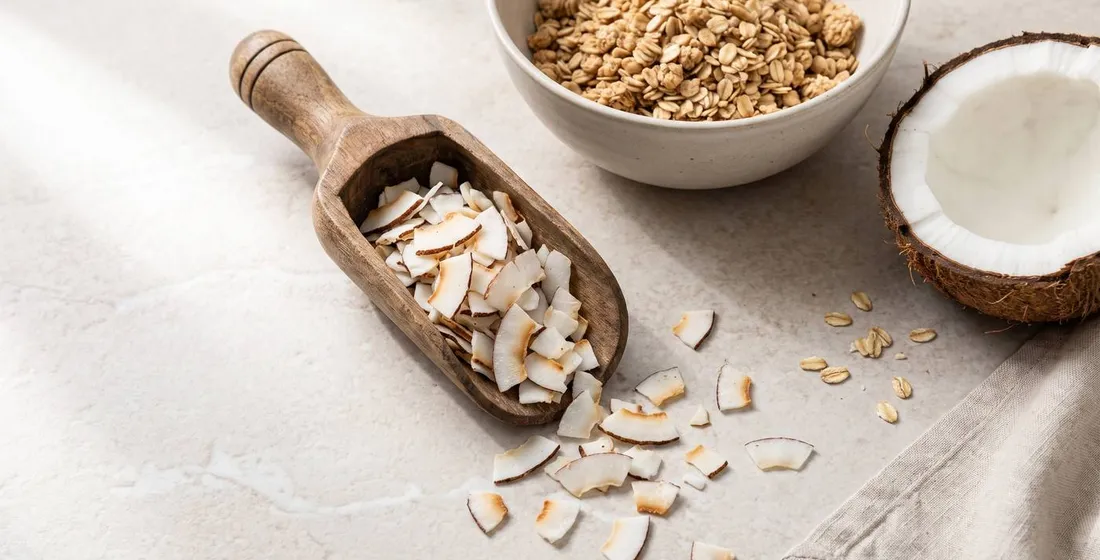
- Silk Foods Ceylon (SFC) supplies coconut chiplets, small dried pieces of mature Sri Lankan coconut, from a BRCGS and FSSC 22000 V6 audited facility in Matale, Central Province. The catalogue lists 660 kcal and 64 g fat per 100 g, a white piece with a brown edge, and a 12 to 24 month shelf life.
- Codex sets no size limits for chips and flakes. The only number a chiplet spec inherits is a 4% maximum moisture, so cut size has to be written into your own specification.
- Three numbers carry a chiplet spec: the dimension range, the colour band (white to toasted) and the moisture or water activity of the finished piece.
- Toast level is a buyer choice that SFC confirms at quote stage. It is not a catalogue variable, so ask for it in the RFQ and test it in your own bake.
- First-order MOQ for coconut products is 1 metric tonne. Samples reach buyers by courier in 3 to 5 business days.
A cereal or granola team that writes “coconut chiplets” into a brief has named a shape, not a specification. The same word can mean a thin shaving that melts into a cluster or a thick chip that stays crunchy in milk. This guide is for R&D and procurement teams at cereal, granola, bakery and snack brands, and covers the three things that decide whether a chiplet works: how big it is, how toasted it is, and how dry it is.
The choice between fine desiccated and larger pieces is covered in the desiccated coconut versus flaked guide, and flavoured snack chips in the coconut chips flavor formats spec. This post stays with the small, dry inclusion piece.
What is a coconut chiplet, and where does the spec come from?
A coconut chiplet is a small dried piece of coconut kernel, larger than a desiccated grain and smaller than a retail snack chip. It is sold for cereals, granola, bakery and toppings. No standard defines the size, so the buyer’s specification is the only definition the supplier will have.
The Codex standard for desiccated coconut (CODEX STAN 177-1991) defines extra-fine, fine and medium cuts by sieve. Everything else falls into an “other sized” group with no size limit, and chips and flakes sit there. What does carry across is a moisture ceiling of 4% m/m. A chiplet at 4% moisture complies with the standard and may still go soft in a cereal box within weeks, which is why the spec has to go further than the standard does.
SFC’s catalogue describes the chiplet as a dried, uniform piece, white with a brown edge, with a characteristic sweet coconut taste, made from selected, fully mature coconuts, with no preservatives, colours or flavours. The grower base is a direct-trade smallholder network. Dimensions are not published in the catalogue, so they are agreed per SKU.
From the Trade Team If the RFQ says “chiplets” and nothing else, the first shipment defines the size. Write the dimension range before the sample, not after the complaint.
How should you specify cut size?
Specify cut size as a length range and a thickness range in millimetres, with a limit on fines and on over-size pieces, measured by sieve or by hand count on a named sample weight. A single word such as “small” or “medium” will be read differently by every supplier and every line.
Size works on the line in three ways. It sets whether the piece flows through a dosing hopper without bridging, whether it stays visible in the pack window, and how it behaves in the oven. Thin pieces brown first and burn at the edge. Thick pieces stay chewy at the core.
| Application | What the chiplet needs to do | What to write in the cut size line |
|---|---|---|
| Granola and clusters | Hold shape through baking and show in the pack | A mid-range length, a thickness floor, and a low cap on fines |
| Breakfast cereal topping or mix | Dose evenly, stay crisp in milk | A tight length band, so pieces do not segregate from the cereal |
| Bakery topping (muffins, cookies) | Toast on the surface, adhere to dough or glaze | Thin to mid thickness, low over-size share |
| Bar inclusions | Bind with syrup, give a visible bite | A shorter length, so pieces do not shed at the bar edge |
| Confectionery coating | Cling to a coating without poking through | A narrow range, very low over-size share |
Fines matter more than most buyers expect. They fall to the bottom of the bag, burn first in an oven, and leave a dust layer in the pack. A limit on the share passing a named sieve is a cheap line to add.
The numbers in the right-hand column are agreed with SFC during sampling. They are not assumed from the catalogue, because the catalogue lists the product, not the sieve.
How do you choose a toast level?
Toast level is a colour band agreed between buyer and supplier, defined by a reference sample and a colour measurement, not by words like “golden”. Toasting browns the piece through the Maillard reaction and drives off water, so colour and moisture move together, and a darker band usually means a drier piece.
Coconut kernel carries little free sugar of its own, so colour in a toasted piece depends mostly on time, temperature and any sugar or syrup applied. That gives three practical routes.
| Route | What it gives | What to confirm |
|---|---|---|
| Natural white chiplet, toasted in your own bake | Full control of colour at your own line | Moisture and fat on the COA, so your oven profile is repeatable |
| Pre-toasted to a colour band | Consistent look, shorter bake for the buyer | The reference sample, the colour method and the allowed range |
| Sugar or flavour applied before toasting | Deeper colour and a sweeter bite | Added ingredients on the label, and the sugar line on the nutrition panel |
SFC’s catalogue lists a plain, additive-free chiplet. Toasting, sugar or flavour application and any other variant are handled as a custom SKU through SRV’s R&D and NPD team, which works to a maximum of 3 to 4 weeks from signed brief to approved formulation. Confirm which route you need at the quote stage, because each one changes the label.
Whichever route you choose, treat colour as a range on a reference card with a measured value. A brown edge on a white piece is normal for a natural chiplet, so the spec should say what share of edge browning is acceptable.
How dry does a chiplet need to be?
Dry enough that it does not pull water out of, or push it into, the product around it. The number that decides this is water activity, not moisture percentage. Water moves from the component with the higher water activity to the one with the lower, so a chiplet that is drier than the cereal around it stays crisp, and one that is wetter softens the cereal.
Water activity is the better limit because it predicts the direction of migration, where total moisture does not. Aqualab, a water-activity instrument maker, makes the same point in its guidance on predicting moisture migration: water activity, not water content, decides how water will move between components. Dry cereals are typically held at a low water activity, and they lose crispness as it rises.
Three things follow for a chiplet specification:
- State a moisture ceiling and a water activity ceiling, with the method for each, on every COA. The Codex 4% moisture figure is the outer limit, and a cereal brand will usually want a tighter one.
- Match the chiplet to the product around it. Measure the water activity of your cereal or granola base, then set the chiplet’s limit at or below it.
- Test after storage, not only at dispatch. Components reach equilibrium over days, so a result taken the week the chiplets are made does not describe what the customer eats.
Fat is the second constraint. At 64 g fat per 100 g, a chiplet is fat-rich, and a fat-rich piece can go off through oxidation before it goes soft. Packaging that keeps out both moisture and oxygen, and a shelf-life claim tied to the stated 12 to 24 months under cool, dry storage, are part of the specification, not an afterthought. The fat and moisture behaviour of coconut more broadly is in the desiccated coconut fat loss and moisture spec.
Where the Silk Route Ventures model doesn’t fit A brand that needs a branded, flavour-coated retail coconut snack in a finished pouch at a commodity price, or a very fine uniform grain for a bar binder. For the first, the flavoured coconut chips private-label route is the closer fit. For the second, a desiccated grade is the right ingredient, and SRV will say so on the first call.
What goes on the chiplet specification sheet?
Buyer’s checklist: before approving coconut chiplets
- Length and thickness range in millimetres, with a cap on fines and on over-size pieces
- Colour band defined by a reference sample and a measured value, with the allowed share of brown edge
- Moisture ceiling and water activity ceiling, each with the method, on every COA
- Fat and free fatty acid limits, with a peroxide value limit for fat-rich pieces
- Foreign matter, metal detection and sieve checks named in the contract
- Microbiological panel in the contract, not only the catalogue
- Allergen statement: coconut declared, with the labelling position for each target market confirmed in writing
- Barrier pack, storage instruction and shelf life stated together
- A trial lot run through the buyer’s own line, and stored at least a week before sign-off
The allergen line needs a note. Labelling rules for coconut differ by market and the guidance has changed over time, so confirm the position for each destination before the artwork is final.
Frequently asked questions
What is the MOQ for coconut chiplets?
At SFC the first-order MOQ for coconut products is 1 metric tonne, supplied from the Matale facility. Production runs 2 to 3 weeks from PO to dispatch, and samples reach buyers by courier in 3 to 5 business days. Sea freight adds 3 to 4 weeks to the EU or Australia, or 4 to 5 weeks to the US.
What moisture should coconut chiplets have for cereal?
The Codex standard for desiccated coconut sets a 4% m/m maximum moisture, and that is the outer limit. A cereal buyer should set a tighter moisture figure and a water activity ceiling matched to the cereal base, and ask for both on every COA (CODEX STAN 177-1991).
Can Silk Foods Ceylon supply toasted or flavoured chiplets?
Yes, as a custom SKU. The catalogue chiplet is plain and additive-free. A toasted, sugared or flavoured grade goes through SRV R&D and NPD, which works to a maximum of 3 to 4 weeks from signed brief to approved formulation. Colour band and label impact are confirmed at quote stage.
Are coconut chiplets the same as desiccated coconut?
No. Desiccated coconut is a fine, sieve-defined cut. Chiplets are larger pieces with no Codex size definition, so the buyer writes the dimensions. Both list the same 660 kcal and 64 g fat per 100 g in SFC’s catalogue, and the format choice is covered in the desiccated versus flaked guide.
How Silk Route Ventures can help
Silk Route Ventures (SRV) supplies coconut chiplets in bulk and under the buyer’s own label, processed at the Silk Foods Ceylon facility in Matale, Central Province, under BRCGS and FSSC 22000 V6. The first-order MOQ for coconut products is 1 metric tonne, production takes 2 to 3 weeks from PO to dispatch, and sea freight adds 3 to 4 weeks to the EU and Australia or 4 to 5 weeks to the US. For a toasted or flavoured grade, the SRV R&D and NPD team works to a maximum of 3 to 4 weeks from signed brief to approved formulation. Buyers comparing the full coconut range can start with the Sri Lankan coconut products range, then contact us to send an inquiry or request a chiplet sample.
Sources
- Codex Alimentarius, Standard for Desiccated Coconut, CODEX STAN 177-1991. https://www.fao.org/fao-who-codexalimentarius/ (retrieved 12 October 2026; size and moisture figures as stated in the earlier SRV desiccated coconut guide)
- Aqualab, “How to predict moisture migration with water activity”. https://aqualab.com/learn/how-predict-moisture-migration-water-activity (retrieved 12 October 2026, via search summary)
- Silk Foods Ceylon product catalogue, Coconut Chiplets (COCO-CPLT): nutrition, sensory, shelf life and dietary data.
Written by the Silk Route Ventures Trade Team. Silk Route Ventures (E-Silk Route Ventures Ltd) is a Sri Lankan B2B supply-chain operator for the Food, Beverage, Wellness, and Nutraceuticals sectors. The Silk Foods Ceylon manufacturing arm holds BRCGS and FSSC 22000 V6 certifications. Questions or to request a sample: Contact us or email info@esilkroute.com.lk.