
Private-Label Chai Spice Mix: Formats, Blend Matching and MOQ for Cafe Brands
Buyer’s snapshot
- Published chai recipes disagree on ratios. One lists 40 g of green cardamom pods against 20 g of cinnamon, another leads with 3 tablespoons of cinnamon against 2 of cardamom. A brand needs its own written ratio, not a recipe borrowed from the internet.
- Cassia cinnamon measured 1,880 to 3,260 mg/kg coumarin in Austrian testing, against a highest Ceylon value of 185 mg/kg (AGES). The cinnamon species is the biggest single label-story decision in a chai blend.
- Format splits the range in two: a coarse tea-bag cut for infusion, and a fine powder for latte and milk-based drinks. They are not interchangeable.
- Silk Route Ventures supplies private-label blends from a BRCGS and FSSC 22000 V6 audited site in Matale: 50 kg per SKU first order, blend matching within 3 to 4 weeks at most.
- This post is for cafe and retail brands building a winter-drinks range. It is not for buyers pricing against the cheapest cassia blend on the shelf.
A cafe group planning a winter-drinks range usually starts the chai brief with a flavour target and a pack format, and leaves the two decisions that carry the cost and the label risk until later: which cinnamon goes in, and what particle size the blend is milled to. Silk Route Ventures (SRV) quotes chai programmes alongside its other private-label spice work, and the same two gaps show up in most briefs.
This piece covers the spec side of a chai spice mix: the five core components, the cinnamon species question, the two formats, and what a first order looks like. It does not repeat the range-level contract questions (recipe ownership, allergen data, label declarations), which are set out in private-label spice blend range: formulation, labels and MOQ. Treat that post as the contract companion to this one.
What goes into a chai spice mix?
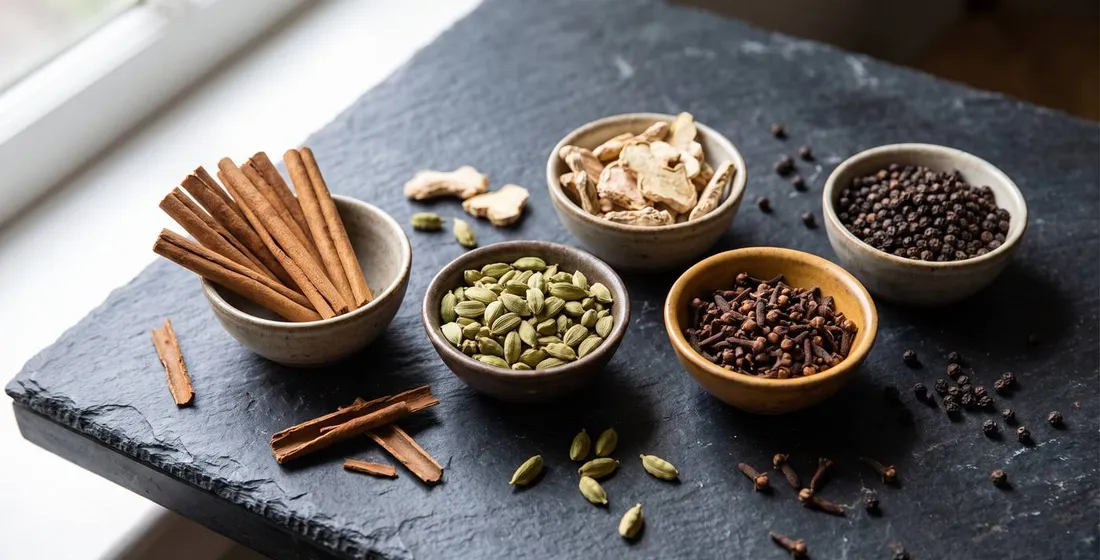
A chai spice mix is a blend of five core spices: cinnamon, green cardamom, dried ginger, clove and black pepper, with nutmeg, fennel or allspice added by some recipes. The ratios are not standardised. Published recipes put different spices in front, and a brand that wants a repeatable cup has to fix its own.
Two recipes show the spread. One, by weight, uses 40 g of green cardamom pods, 20 g each of cinnamon quills, black peppercorns, whole cloves and ground ginger, and 10 g of fennel seed (The Flavor Bender, retrieved 3 October 2026). Another, by volume, runs 3 tablespoons of ground cinnamon, 2 of cardamom, 2 of ginger, and only 1.5 teaspoons of pepper, three-quarters of a teaspoon of nutmeg and three-quarters of a teaspoon of clove (Dances with Knives, retrieved 3 October 2026). In the second, clove is under a tenth of the cinnamon by volume. In the first, it matches the cinnamon by weight.
Those two are not wrong. They are different drinks, and they are measured differently: whole cardamom pods include the husk, ground cardamom does not. That is why a brand needs a written spec rather than a reference recipe. Silk Route Ventures does not publish a house ratio in this post, because the ratio is the brand’s product and is set in sampling against the brand’s own cup.
Which cinnamon belongs in a chai blend?
Specify the species. Cinnamon is the largest component of most chai blends by volume, and it is the one with a regulatory and label dimension. Cinnamomum verum (Ceylon cinnamon) and the cassia species differ sharply in coumarin, a compound the EU regulates in finished foods.
Austria’s food-safety agency measured 1,880 to 3,260 mg/kg of coumarin in cassia cinnamon, while the highest value it found in Ceylon cinnamon was 185 mg/kg (AGES, Coumarin, retrieved 3 October 2026). The tolerable daily intake EFSA set in 2004 is 0.1 mg per kg of body weight, a figure the BfR confirmed (BfR FAQ on coumarin, retrieved 3 October 2026). For a drink that a customer has every day through winter, that is a real consideration rather than a footnote.
The EU limits themselves sit on finished foods, not on chai mix as such. Annex III of Regulation (EC) No 1334/2008 sets 50 mg/kg for traditional or seasonal bakery ware that references cinnamon on the label, 15 mg/kg for fine bakery ware, 20 mg/kg for breakfast cereals and 5 mg/kg for desserts (Regulation 1334/2008, Annex III, retrieved 3 October 2026). A cafe that also bakes with its chai blend carries the species choice straight into those categories.
The label story follows. “Ceylon cinnamon” has been a Protected Geographical Indication in the EU since 2 February 2022 (Implementing Regulation (EU) 2022/176), so the phrase is only available to a blend that actually uses Cinnamomum verum. The full species comparison is in Ceylon cinnamon versus Vietnamese cassia, and the grade and format menu is in the Ceylon cinnamon grades spec sheet.
Cost is the trade. Ceylon cinnamon is the premium species, and a brand competing on lowest shelf price is better served by a cassia blend that says so honestly than by a stretched Ceylon claim. A brand that wants the origin story on pack should build the blend on Ceylon cinnamon from a single-origin supplier, where the species is verified per shipment.
Tea-bag cut or powder: which format does the drink need?
Match the format to the preparation, because the two behave differently in the cup. A tea-bag or pyramid cut is a coarse, controlled particle designed for infusion in hot water or milk and then removal. A fine powder dissolves or suspends, and suits a latte base, a sachet stirred into steamed milk, or a concentrate.
| Format | Particle | Typical use | Watch for |
|---|---|---|---|
| Tea-bag cut | Coarse, dust kept low | Infusion bags, café bulk tins for steeping | Fill weight per bag, pepper and clove dominating the first sip |
| Pyramid cut | Larger visible pieces | Premium sachets where pieces show | Pack must be transparent, particle variation is visible |
| Fine powder | Milled | Latte base, instant sachets, bakery and dessert use | Faster aroma loss, needs barrier packaging, sedimentation in milk |
The pyramid and tea-bag formats are covered in more depth in Ceylon tea bag formats.
Which components are hardest to match?
Clove and cardamom drive most of the matching effort, because they carry the aroma and vary the most between lots. Clove bud holds 15 to 20 percent volatile oil, 75 to 85 percent of which is eugenol (BioMed Research, clove composition, 2018), so a small change in clove percentage moves the cup noticeably. Whole bud keeps that oil better than powder, which is why the format discussion in Ceylon cloves: whole, powder, tea cut or pyramid cut applies directly to a chai blend.
Cardamom is graded, and the grade changes the cost line. The grade structure is in cardamom grading for B2B buyers. Ginger moves less on aroma and more on heat, and the dried-ginger format options are in Ceylon ginger powder: spec and origin guide.
The blend-matching rule is simple. Fix the supply of each component to a written spec before the sample, then adjust the percentages against the brand’s reference cup. Changing a component after approval, even to a different lot of the same spice, can move the flavour.
What does a first chai order look like?
Plan the first order around one blend, one format and one pack size, then widen. A spice, herb or blend SKU has a first-order MOQ of 50 kg per SKU. A cafe launching a loose-leaf chai and a latte powder is running two SKUs, so 100 kg of blend in total, not 50 kg split across both. A sachet range multiplies it again.
The timeline for a new blend runs in three stages, and each has a stated limit:
- Blend matching: 3 to 4 weeks at most, from a signed brief to an approved formulation, against the brand’s reference cup.
- Production: 2 to 3 weeks from purchase order to dispatch.
- Sea freight: 3 to 4 weeks to the EU or Australia, 4 to 5 weeks to the US.
Samples travel separately by international courier, door to door in 3 to 5 business days. Orders under $10,000 are paid 100% in advance by bank transfer, and orders of $10,000 or above run 50% advance with the balance against scanned shipping documents.
Every shipment carries a batch Certificate of Analysis, and the standard documentation pack includes the commercial invoice, packing list, bill of lading or air waybill, certificate of origin and phytosanitary certificate. Allergen and cross-contact statements are available per SKU on request.
Frequently asked questions
What spices go into a private-label chai mix?
A private-label chai mix is built from cinnamon, green cardamom, dried ginger, clove and black pepper, with nutmeg or fennel in some recipes. Published recipes vary widely in ratio, for example 40 g of cardamom pods against 20 g of cinnamon in one and the reverse emphasis in another (The Flavor Bender; Dances with Knives, retrieved 3 October 2026). The brand fixes the ratio in sampling.
Should a chai blend use Ceylon cinnamon or cassia?
Ceylon cinnamon (Cinnamomum verum) carries far less coumarin than cassia. Austrian testing found 1,880 to 3,260 mg/kg in cassia against a highest Ceylon value of 185 mg/kg (AGES, retrieved 3 October 2026). Ceylon also qualifies for the EU Protected Geographical Indication label phrase. Cassia is the lower-cost option for brands that make no origin claim.
What is the difference between a tea-bag cut and a powder chai blend?
A tea-bag cut is a coarse particle for infusion and removal, while a fine powder is meant to dissolve or suspend in milk. Powder loses aroma faster and needs barrier packaging. The format follows the preparation method, so a latte base and an infusion bag are specified as two separate SKUs rather than one blend in two grinds.
Does Silk Route Ventures offer private label chai spice mix?
Yes. Silk Route Ventures runs private-label spice blends from the BRCGS and FSSC 22000 V6 audited Silk Foods Ceylon facility in Matale, with a first-order MOQ of 50 kg per SKU and blend matching within 3 to 4 weeks at most. The chai mix product page lists the available formats.
How Silk Route Ventures can help
Silk Route Ventures supplies private-label chai spice blends to cafe groups and specialty spice brands across the US, EU, and Australia. Blends are developed and packed at the BRCGS and FSSC 22000 V6 audited Silk Foods Ceylon (SFC) facility in Matale, in tea-bag cut, pyramid cut or fine powder, with a batch COA on every shipment. First-order MOQ is 50 kg per SKU, blend matching takes 3 to 4 weeks at most, and samples ship door to door by international courier in 3 to 5 business days. For brands that already own a recipe, the same site produces it against the brand’s spec. Contact us to send an inquiry or request a sample pack. The wider range is listed under Ceylon spices.
Sources
- Regulation (EC) No 1334/2008, Annex III (maximum levels of certain substances in flavourings and food ingredients), legislation.gov.uk. https://www.legislation.gov.uk/eur/2008/1334/annex/III. Retrieved 3 October 2026.
- AGES (Austrian Agency for Health and Food Safety), Coumarin. https://www.ages.at/en/human/nutrition-food/residues-contaminants-from-a-to-z/coumarin. Retrieved 3 October 2026.
- BfR (German Federal Institute for Risk Assessment), FAQ on coumarin in cinnamon and other foods. https://www.bfr.bund.de/en/service/frequently-asked-questions/topic/faq-on-coumarin-in-cinnamon-and-other-foods/. Retrieved 3 October 2026.
- European Commission, Implementing Regulation (EU) 2022/176 (Ceylon cinnamon PGI). https://eur-lex.europa.eu/eli/reg_impl/2022/176/oj. Retrieved 3 October 2026.
- The Flavor Bender, Authentic Masala Chai Recipe. https://www.theflavorbender.com/authentic-masala-chai-recipe/. Retrieved 3 October 2026.
- Dances with Knives, Masala Chai Spice Blend Recipe. https://www.danceswithknives.com/masala-chai-spice-blend/. Retrieved 3 October 2026.
Written by the Silk Route Ventures Trade Team.