
Mango Puree vs Mango Powder: Which Format Fits Beverage, Dairy-Free and Bakery Lines
Buyer’s snapshot
- Single-strength mango puree runs at about 14 to 16 Brix, so roughly 85% of every drum is water. Spray-dried mango powder carries the fruit’s soluble solids at under 5% moisture, almost always on a maltodextrin carrier that has to be declared.
- In the EU and UK, a reconstituted mango purée must reach 13.5 Brix and a mango nectar must contain at least 25% fruit (Directive 2001/112/EC, Annexes V and IV). Those two numbers decide how much of either format a compliant drink needs.
- In 2025 the mango puree market was worth about USD 1.25 billion, with industrial users taking 66% of demand (Mordor Intelligence, 2026). Puree is the default on wet lines; powder wins where the process is dry.
- Silk Route Ventures (SRV) supplies both: bulk mango puree against the buyer’s spec through the trade desk, and spray-dried mango powder from the BRCGS and FSSC 22000 V6 certified Silk Foods Ceylon facility in Matale, from 100 kg per SKU.
- The comparison table and the solids math below are the parts to send to R&D.
The same mango reaches a formulator in two forms that ship, store, label and cost out completely differently. A buyer who writes “mango” into briefs for a nectar, a plant-based yoghurt and a bakery filling is often quoted a drum of puree for one and a sack of powder for another, with no account of why. The format follows the process, not the fruit. This piece puts the two side by side on solids, dosing, flavour, storage and cost in use, so the right format lands on the right line.
What is the difference between mango puree and mango powder?
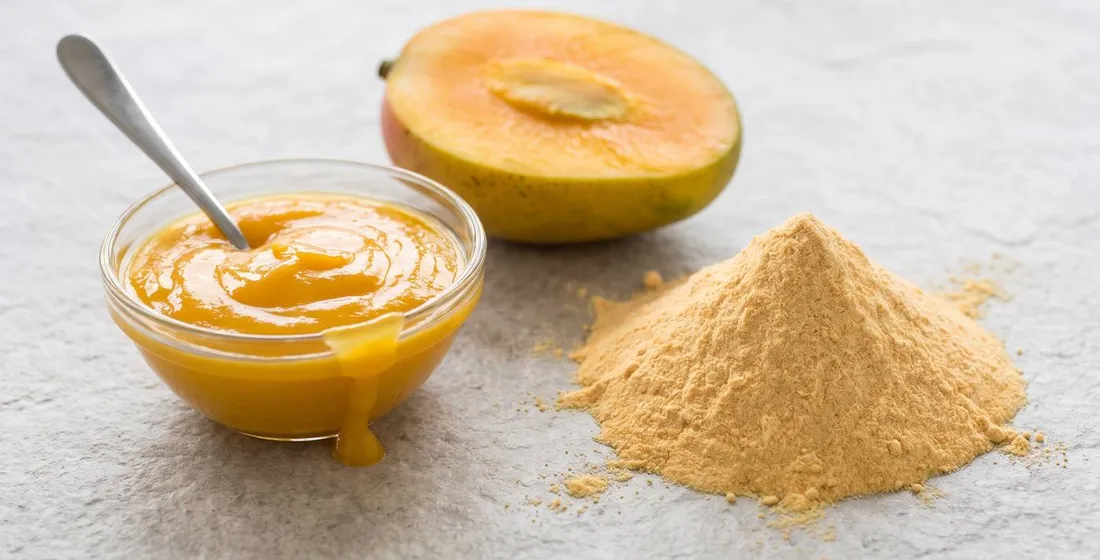
Mango puree is the sieved, heat-treated flesh of ripe mango, sold single-strength at about 14 to 16 Brix or as a concentrate, and EU rules set 13.5 Brix as the floor for a reconstituted mango purée (Directive 2001/112/EC, Annex V). Mango powder is that puree dried to a free-flowing solid, usually by spray drying with a maltodextrin carrier. One is a wet ingredient with water to move; the other is a dry ingredient with a carrier to declare.
The puree is the format closest to the fruit. The SRV product page describes it as pressed from ripe mango, pouring into juices, nectars, smoothies and lassi and forming the base for sorbets, mousses, fillings and sauces, with beverage and dairy processors taking it in aseptic bulk packs. A representative processor data sheet for single-strength aseptic puree, published through the Tridge trade platform, reads 14 to 16 Brix, pH 3.5 to 4.5, acidity 0.4 to 1.0% as citric acid, Bostwick flow of 8 to 12 cm in 30 seconds, and a 220 kg aseptic bag in a steel drum with an 18-month ambient shelf life (2014). Ask for the same lines on any quote.
The powder is a process product. In 2012, a Washington State University team spray-dried Carabao mango puree at 14 to 15 Brix and could only do it with maltodextrin (DE 10) at 0.25 kg per kg of mango solids; the finished powder sat at a water activity of about 0.17 and dissolved at 95%, the highest solubility of the four drying methods tested (Caparino et al., Journal of Food Engineering, 2012). Spray-dried mango powder is therefore mango plus carrier. The spray-dried versus freeze-dried choice is covered in the mango powder sourcing spec.
Mango puree vs mango powder: the comparison table
| Attribute | Mango puree (single-strength) | Spray-dried mango powder |
|---|---|---|
| Soluble solids | 14 to 16 Brix (EU floor 13.5 reconstituted) | Over 95% dry matter; moisture under 5% |
| Water shipped per kg | About 0.85 kg | About 0.03 to 0.05 kg |
| Carrier and label line | None; declares as mango puree | Maltodextrin typical; mango and carrier both declared |
| Flavour and colour | Closest to fresh fruit | Some heat loss; paler, carrier-diluted |
| Pack | Aseptic bulk packs (industry norm 200 to 220 kg bag-in-drum) | 25 kg multiwall sacks with a PE liner |
| Unopened storage | Ambient; 12 to 24 months typical for aseptic packs | Ambient, cool and dry; hygroscopic |
| After opening | Chill or freeze; use within days | Reseal the liner; keep water activity below 0.2 |
| Best fit | Nectars, juices, smoothies, lassi, sorbets, fillings, sauces | Dry premixes, bars, bakery mixes, seasonings, yoghurt-drink bases |
Sources: SRV product pages; Directive 2001/112/EC Annex V; Caparino et al. 2012; processor data sheet via Tridge, 2014.
How much powder replaces a kilo of puree? The solids math
On a mango-solids basis, 1 kg of spray-dried powder carrying 25% maltodextrin at 4% moisture holds about 0.72 kg of mango solids, the mango content of roughly 4.8 kg of 15 Brix puree. These are working figures from the SRV trade desk, built on the carrier load in the 2012 Washington State study, and they are confirmed against the COA of the actual lot before dosing is fixed.
The arithmetic runs like this. A 15 Brix puree is 0.15 kg of soluble solids per kilo. A powder at 96% dry matter with a quarter of that as carrier is 0.72 kg of mango solids per kilo. Divide one by the other and a kilo of powder stands in for 4.8 kg of puree on solids alone. Freight follows: a 20-foot container of 80 drums at 220 kg carries 17.6 tonnes of puree, and the same mango solids travel as about 3.7 tonnes of powder.
The arithmetic is less forgiving than the quote sheet makes it look. Powder costs more per kilo and less per kilo of mango solids delivered, but the swap also costs colour, some top-note flavour and a second word on the ingredient list. Compare quotes on price per kilo of mango solids landed, on the same basis: SRV quotes FOB Colombo, and a distributor’s DDP price already carries freight and margin.
Which format fits a beverage line?
For juices, nectars and smoothies, puree is the default. EU and UK nectar rules require at least 25% fruit for mango, which sits in the low-acid, pulpy fruit group (Directive 2001/112/EC, Annex IV), and a nectar built from powder would need the carrier declared and the Brix reconstituted to the 13.5 floor. For US beverage makers, puree and its concentrates fall inside FDA Juice HACCP, which defines juice to include purees and requires a 5-log pathogen reduction (21 CFR 120.1 and 120.24).
That rule shapes the RFQ: a US bottler needs the supplier’s thermal process record, because 21 CFR 120.24 exempts a single shelf-stabilising heat step only when it is written into the hazard analysis. Ask for it with the COA, not after the first container lands.
Powder earns its place where water is added at the point of use: instant drink sticks, powdered smoothie premixes, yoghurt-drink bases and vending blends. The 95% solubility of spray-dried mango powder is what makes it disperse in cold water (Caparino et al., 2012), and the carrier that pales its colour is the same carrier that lets it run through a sachet filler without bridging.
Which format fits dairy-free lines?
In plant-based yoghurts, frozen desserts and plant-milk drinks, puree supplies fruit identity and body as a fruit preparation or sorbet base, while powder goes into dry-blended bases and flavoured plant-milk powders where added water would unbalance the formulation. Industrial applications took 66.29% of mango puree demand in 2025, with dairy and frozen desserts counted inside that share alongside beverages (Mordor Intelligence, Mango Puree Market, 2026).
A fruit-on-the-bottom coconut yoghurt needs puree cooked into a preparation with sugar and pectin, because the fruit layer sells the SKU and no carrier belongs in it. A mango oat-milk powder is the opposite case: Silk Foods Ceylon spray-dries plant-milk powders at 50 kg per day, and a fruit powder dry-blends into one without changing its moisture, while a puree would.
The pattern the SRV trade desk sees most often in dairy-free briefs is a brand choosing powder across the whole range to avoid chilled storage, then finding the sorbet short on mango flavour in panel. The fix is a split spec: puree for the sorbet and the fruit layer, powder for the dusting and the dry base. The cold-chain saving on two wet SKUs rarely covers a weak panel score at the listing meeting.
Which format fits bakery and snack lines?
Bakery splits by water. Fillings, glazes, curds and swirls take puree, often cooked down or set with pectin, while dry mixes, crumb coatings, bar binders and seasonings take powder, because the water activity of the finished product has to stay low. A puree at 14 to 16 Brix is most of the way to a bake-stable filling once sugar and starch are added; a powder at under 5% moisture carries flavour and colour into a cake mix without adding water.
Where a snack needs visible fruit pieces, neither format is the answer; see the dried mango formats guide for tidbits, tea-bag cut and strips.
Spec snapshot: mango puree and mango powder, SRV
- Puree: single-strength; Brix, pH, acidity, Bostwick flow and heat treatment on the COA; aseptic bulk pack per the product page, confirmed on the quote
- Powder: spray-dried from mango pulp; moisture, water activity, mesh, carrier percentage and microbiology on the COA
- Certification: powder from the BRCGS and FSSC 22000 V6 certified Silk Foods Ceylon facility in Matale; puree supplied against the buyer’s spec, COA on request
- MOQ: 100 kg per SKU, trial quantities from 10 kg; samples free for evaluation (you cover the courier)
- Lead time: 2 to 3 weeks PO to dispatch for standard SKUs; 4 to 6 weeks for private label and custom specifications; FOB Colombo
Storage, shelf life and what to write on the RFQ
Aseptic mango puree keeps 12 to 24 months unopened at ambient temperature and must be chilled or frozen once the bag is cut. Spray-dried mango powder has a glass transition onset of about 19 to 26 °C at a water activity near 0.17 (Caparino et al., 2012), which is at or below a normal warehouse temperature, so a powder left in an open liner in a humid store cakes within days.
Puree’s storage rule is about the seal. An intact aseptic bag in a drum at or below 25 °C, out of direct sun, holds its spec for the stated shelf life; a cut bag is a fresh product. Powder’s rule is about moisture. Maltodextrin raises the glass transition temperature and lowers hygroscopicity, which is why spray-dried mango absorbed less water than drum-dried in the same study (16.5% against 20.1% at 75% humidity), but it is still a sugar-rich powder. The moisture, mesh and carrier lines for the brief are in the fruit powder RFQ primer.
Origin belongs on the RFQ too. In 2025 Sri Lanka grew about 193,000 tonnes of mango on 31,000 hectares, led by the TomEJC variety, with 85% of fresh exports going to West Asia and processors looking to expand capacity for the grades the fresh trade cannot use (Sunday Times via FreshPlaza, May 2025). Name the variety and crop season on the brief, because a processing-grade crop and a TomEJC crop give different colour and acid. SRV ships mango puree and powder alongside the wider range of Ceylon spices and ingredients from Colombo, so a multi-SKU order shares one set of shipping documents.
Buyer’s checklist: specifying mango puree or mango powder
- State the format per SKU: single-strength puree, concentrate, or spray-dried powder.
- For puree, set Brix, acidity, Bostwick and heat treatment, and ask for the thermal process record.
- For powder, set moisture, water activity and maltodextrin ceilings, all reported on the COA.
- Name the variety and crop season, or set a colour and Brix target.
- Compare quotes on price per kilo of mango solids landed, on the same pricing basis.
Frequently asked questions
Can mango powder replace mango puree in a nectar or juice?
Rarely on a like-for-like basis. EU and UK rules require a mango nectar to carry at least 25% fruit and a reconstituted mango purée to reach 13.5 Brix (Directive 2001/112/EC, Annexes IV and V). A powder-based drink must reconstitute to that Brix and declare the maltodextrin carrier, so nectar and juice lines stay on puree and use powder in instant premixes.
How much mango powder equals 1 kg of mango puree?
On mango solids, about 0.21 kg of spray-dried powder replaces 1 kg of 15 Brix puree, using a powder with 25% maltodextrin at 4% moisture (0.72 kg mango solids per kg). The ratio shifts with the carrier load, which is why the SRV COA states the maltodextrin percentage and dosing is confirmed on the actual lot.
How should mango puree and mango powder be stored?
Aseptic puree is stored unopened at or below 25 °C, out of direct sun, for the 12 to 24 months on the data sheet, then chilled or frozen once cut. Spray-dried mango powder has a glass transition onset of about 19 to 26 °C at water activity 0.17 (Caparino et al., 2012), so it stays in a sealed liner in a cool, dry store.
Does Silk Route Ventures supply both mango puree and mango powder in bulk?
Yes. Silk Route Ventures supplies bulk mango puree against the buyer’s spec through its trade desk, and spray-dries mango powder at the BRCGS and FSSC 22000 V6 certified Silk Foods Ceylon facility in Matale at 50 kg per day. MOQ is 100 kg per SKU with trial quantities from 10 kg, samples are free for evaluation (you cover the courier), and standard SKUs ship 2 to 3 weeks from PO.
How Silk Route Ventures can help
Silk Route Ventures supplies mango puree and mango powder, with the wider fruit, spice, herb and coconut range, to beverage, dairy-free and bakery manufacturers across the US, EU and Australia. Spray-dried mango powder is produced at the BRCGS and FSSC 22000 V6 certified Silk Foods Ceylon facility in Matale at 50 kg per day, with the maltodextrin percentage on the COA; bulk mango puree is supplied against the buyer’s Brix, acidity and heat-treatment spec, COA on request. MOQ is 100 kg per SKU with trial quantities from 10 kg, samples are free for evaluation (you cover the courier), and standard SKUs dispatch 2 to 3 weeks from PO, FOB Colombo. Contact us to send an inquiry or request samples of either format.
Sources
- Council Directive 2001/112/EC, as amended, Annex IV and Annex V, as assimilated in UK law. https://www.legislation.gov.uk/eudr/2001/112/annex/IV and https://www.legislation.gov.uk/eudr/2001/112/annex/V (retrieved 24 October 2026)
- Caparino, O.A. et al., “Effect of drying methods on the physical properties and microstructures of mango (Philippine ‘Carabao’ var.) powder,” Journal of Food Engineering 111 (2012) 135-148. https://wpcdn.web.wsu.edu/wp-labs/uploads/sites/1254/2016/04/tang213.pdf (retrieved 24 October 2026)
- Mordor Intelligence, Mango Puree Market Size and Share Analysis (2026-2031), updated 11 May 2026. https://www.mordorintelligence.com/industry-reports/mango-puree-market (retrieved 24 October 2026)
- US FDA, 21 CFR 120.1 and 120.24. https://www.law.cornell.edu/cfr/text/21/120.1 and https://www.law.cornell.edu/cfr/text/21/120.24 (retrieved 24 October 2026)
- Aseptic mango puree single-strength technical data sheet (processor document hosted by Tridge), December 2014. https://cdn.tridge.com/attachment-file/f0/4a/a7/f04aa7fcd318d62dc38f5eb95883adf3686bf3e9/MANGO-PUREE.pdf (retrieved 24 October 2026)
- Sunday Times (Sri Lanka) via FreshPlaza, “Sri Lanka boosts TomEJC mango exports to West Asia,” 20 May 2025. https://www.freshplaza.com/europe/article/9733118/sri-lanka-boosts-tomejc-mango-exports-to-west-asia (retrieved 24 October 2026)
- Silk Route Ventures, Mango Puree and Mango Powder product pages. https://esilkroute.com.lk/products/fruits/mango-puree/ and https://esilkroute.com.lk/products/fruits/mango-powder/ (retrieved 24 October 2026)
Written by the Silk Route Ventures Trade Team. Silk Route Ventures (E-Silk Route Ventures (Pvt) Ltd) is a Sri Lankan B2B supply-chain operator for the Food, Beverage, Wellness, and Nutraceuticals sectors. The Silk Foods Ceylon manufacturing arm holds BRCGS and FSSC 22000 V6 certifications. Questions or to request a sample: Contact us or email info@esilkroute.com.lk.