
Licorice root and powder: glycyrrhizin spec and intake limits for tea and supplement brands
Buyer’s snapshot
- Licorice root (Glycyrrhiza glabra) is bought on one number: glycyrrhizic acid, the compound behind both its sweetness and its regulatory limits. The European Pharmacopoeia sets a minimum of 4.0% on the dried drug, while the US Pharmacopeia monograph sets 2.5% (EMA assessment reports; USP).
- In the EU, Regulation (EU) No 1169/2011 Annex III requires “contains liquorice” on confectionery and beverages from 100 mg/kg or 10 mg/l of glycyrrhizic acid, and a hypertension warning from 4 g/kg in confectionery or 50 mg/l in beverages.
- The EU Scientific Committee on Food put a protective upper limit for regular intake at 100 mg of glycyrrhizic acid per day in 2003. That figure, not the pharmacopoeia minimum, decides how much root a serving can carry.
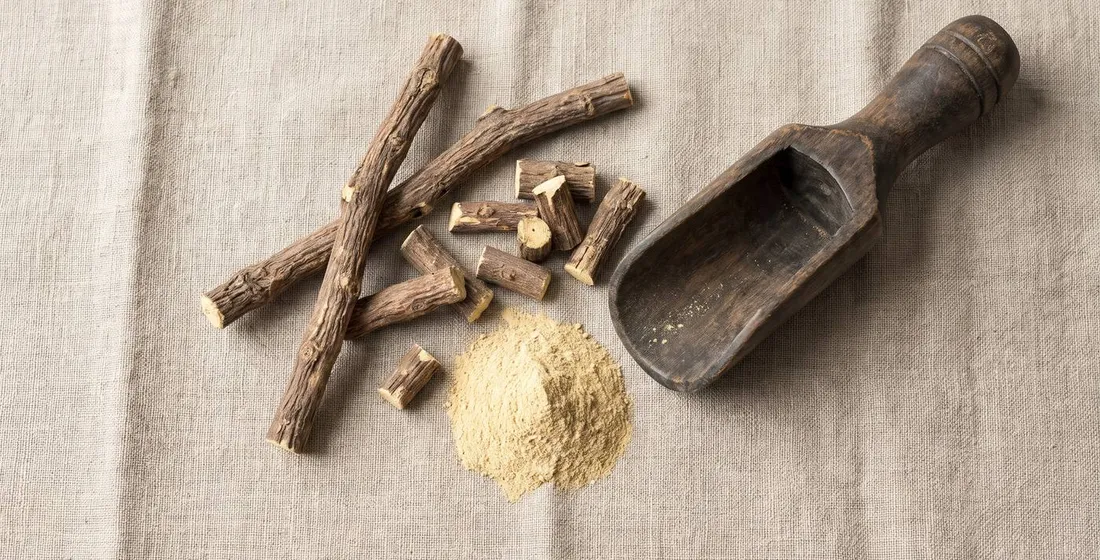
- Silk Route Ventures (SRV) supplies licorice root as cut pieces and as fine powder, from 25 kg per SKU for dried herbs, with a COA on request.
- This post is for tea, infusion and supplement brands setting a spec and a label. It is not for buyers who want a claim-led “adrenal” or “detox” product: that is a different regulatory file.
Most herbs are specified on botanical identity, moisture and microbiology. Licorice adds a fourth line that changes the commercial answer: how much glycyrrhizic acid ends up in a cup, a capsule or a chew. Buyers who skip it find out at label review, when a recipe that tasted right turns out to need a warning statement. This piece sets out what to specify on the root, how the EU label thresholds work, and how to turn an intake limit into a dosage in grams. For the wider herb range, see the Sri Lankan herbs supplier page.
What does a licorice root spec actually need to say?
A usable spec names the species and part, the glycyrrhizic acid assay and its method, the physical form, and the usual herb hygiene lines. The species matters because pharmacopoeias accept more than one licorice. The EMA herbal assessment describes the drug as the dried root and stolons of Glycyrrhiza glabra L., and/or G. inflata Bat., and/or G. uralensis Fisch. (EMA, assessment report on Glycyrrhiza radix). A brand that wants G. glabra only must say so in writing.
The assay is the number that moves price. The Ph. Eur. figure cited in the EMA report is not less than 4.0% of 18-beta-glycyrrhizic acid on the dried drug, and the USP monograph uses 2.5% on a dried basis (EMA, 2010; USP). Different floors, different pharmacopoeias, so state which monograph and which edition your spec follows. Then state the method: HPLC with UV detection at 254 nm is the common approach in the USP monograph.
| Spec line | What to write | Why it matters |
|---|---|---|
| Botanical identity | Glycyrrhiza glabra L., root, species confirmed in writing | Other licorice species are pharmacopoeial too, with different profiles |
| Glycyrrhizic acid | Minimum % on dried basis, named monograph and method | Sets sweetness, price and the daily dose ceiling |
| Form | Cut root (tea bag or decoction) or fine powder (blends, capsules) | Drives extraction in the cup and dispersion in the blend |
| Moisture | Maximum % stated on the quote | Affects shelf life and the dried-basis calculation |
| Microbiology and contaminants | Panel and limits set for the destination market | Root is a below-ground crop, so soil-borne load is a real risk |
| Documents | COA on request, certificate of origin, phytosanitary where the destination requires it | Needed for customs and for your own file |
Spec snapshot: SRV licorice root and powder Species: Glycyrrhiza glabra (confirmed per lot on request) Forms: cut root pieces and fine powder Assay: glycyrrhizic acid minimum agreed on the quote, by the method you name MOQ: 25 kg per SKU for dried herbs; trial quantities from 10 kg Lead time: 2 to 3 weeks from PO to dispatch for standard SKUs Samples: free for evaluation, buyer pays the courier
Why did the EU start labelling licorice at all?
In April 2003 the EU Scientific Committee on Food (SCF) reviewed glycyrrhizinic acid and concluded that an upper limit of 100 mg per day for regular intake gave sufficient protection for most people. It also noted that some groups, such as people with disturbed water and electrolyte balance, might not be covered by that limit (SCF opinion, 2003, as recited in Directive 2004/77/EC). The reason is physiological. JECFA’s 2005 evaluation identified the critical effect as pseudohyperaldosteronism, which, if sustained, can lead to raised blood pressure, and it did not set an acceptable daily intake because sensitive groups could not be characterised (WHO/JECFA, 2005).
Within a year the EU had written the finding into law. Directive 2004/77/EC added licorice labelling for confectionery and drinks, and the same thresholds now sit in Annex III of the food information regulation. The sequence is the useful part for a buyer: a daily-intake figure came first, and the label triggers were set to catch products where a normal serving could approach it.
That has a practical consequence for a recipe. The label thresholds are low, the daily limit is low, and a herb that tastes sweet at 1 g per cup is already close to both.
How do the EU label thresholds work for a tea or a chew?
Annex III, point 3, has three entries. Entry 3.1 requires the words “contains liquorice” after the ingredients list, unless “liquorice” already appears in the ingredients or the name, for confectionery or beverages at 100 mg/kg or 10 mg/l of glycyrrhizic acid or above. Entry 3.2 requires “contains liquorice - people suffering from hypertension should avoid excessive consumption” for confectionery at 4 g/kg or above. Entry 3.3 requires the same hypertension wording for beverages at 50 mg/l or above, or 300 mg/l or above where the beverage is over 1.2% alcohol by volume (Regulation (EU) No 1169/2011, Annex III, as adopted).
| Product type | ”Contains liquorice” | Hypertension warning added |
|---|---|---|
| Confectionery | 100 mg/kg and above | 4 g/kg and above |
| Beverage (up to 1.2% alcohol) | 10 mg/l and above | 50 mg/l and above |
| Beverage (over 1.2% alcohol) | 10 mg/l and above | 300 mg/l and above |
Here is an illustrative calculation, not a formulation. Take 1 g of licorice root powder at 4.0% glycyrrhizic acid in a 250 ml cup. If extraction were complete, that is 40 mg per 250 ml, or 160 mg/l. Real extraction in a tea bag is lower, but even at a quarter of that, 40 mg/l, the cup sits well over the 10 mg/l label trigger and close to the 50 mg/l hypertension trigger. A two-cup day at full extraction would be 80 mg against the 100 mg/day limit.
Two cautions. First, this is the adopted text of the regulation. Check the current consolidated version on EUR-Lex for your target market, and note that Great Britain and other markets may differ. Second, how Annex III applies to a dry tea bag, which becomes a beverage only when brewed, is a point to settle with your regulatory adviser. Footnote (a) of the annex applies the alcohol test “as reconstituted according to the instructions of the manufacturers”, which is why many brands assess the brewed cup.
How much licorice can a serving carry?
Work backwards from the daily limit, not forwards from the flavour. Divide 100 mg by the glycyrrhizic acid per gram of your powder to get the ceiling for total daily licorice root from every source. At 4.0%, each gram carries up to 40 mg, so 2.5 g of root powder reaches 100 mg if fully extracted. A product with a recommended two servings a day then has a design ceiling of roughly 1.25 g of root per serving, before allowing for licorice already in other products the consumer uses.
In an infusion blend, licorice is usually a sweetener-and-mouthfeel line at a few percent of the fill weight, not a main botanical. A 2 g tea bag with 10% licorice root carries 0.2 g of root, about 8 mg of glycyrrhizic acid at 4.0% if fully extracted. That leaves room for several cups a day, and it still crosses the 10 mg/l label line once brewed in 250 ml (about 32 mg/l). For supplement capsules the arithmetic is the same, but the dose is fixed, so the capsule fill and serving count must be inside the intake figure on the pack.
One more variable is the assay itself. A lot at 6% glycyrrhizic acid delivers 50% more than a lot at 4% at the same fill weight. The spec floor is a minimum, so ask for the assay of each lot and recalculate the serving whenever the lot changes.
What should buyers ask a licorice supplier for?
A first enquiry for a herbal infusion often lists botanical name, cut size and target price, and leaves the assay out. That is fixable in one line, but it changes the quote, because assay drives both cost and dose. A short brief closes the gap.
Buyer’s checklist: licorice root RFQ
- Species and plant part in writing (Glycyrrhiza glabra L., root)
- Glycyrrhizic acid minimum, on a dried basis, with the monograph and method named
- Form and particle size: cut root, tea cut or fine powder
- Moisture maximum and the microbiology and contaminant panel for your destination
- COA with the lot assay, on request, and a certificate of origin
- Phytosanitary certificate where the destination requires it
- Your target serving, daily servings and intended label statement, so the dose can be checked against 100 mg/day
- Free evaluation sample against your spec before any PO
Origin for each lot is confirmed on request, so say in the RFQ if your market or claim needs it. Silk Foods Ceylon (SFC) processes dried herbs at its Matale facility under BRCGS and FSSC 22000 Version 6, and testing through an external laboratory can be arranged on request. Read the herbal tea bag cut specification guide for particle size and fill-weight rules, and the tisane brand buyer’s guide for how cuts behave across a blend.
Where SRV walks away Products built on health-outcome claims for licorice, such as adrenal, hormonal or blood-pressure positioning. Those need a claims dossier that a raw-material supplier cannot write for you. SRV supplies the ingredient to a spec; the claim file is the brand’s.
FAQ
What glycyrrhizic acid level should a licorice root spec require?
State a minimum on a dried basis and name the monograph. The European Pharmacopoeia figure cited by the EMA is 4.0%, and the USP monograph uses 2.5% (EMA assessment report; USP). Ask for the lot assay on the COA, since a higher assay raises the dose per gram and can change your label.
Does licorice tea need a warning label in the EU?
Beverages containing glycyrrhizic acid from the licorice plant carry “contains liquorice” from 10 mg/l, and a hypertension warning from 50 mg/l (Regulation (EU) No 1169/2011, Annex III, point 3). How this applies to a dry tea bag is best confirmed with your regulatory adviser against the current EUR-Lex text.
What is the daily intake limit for glycyrrhizic acid?
The EU Scientific Committee on Food set 100 mg per day as an upper limit for regular intake in 2003, and noted that some groups may need more protection. JECFA, in 2005, did not set an acceptable daily intake (SCF 2003; WHO/JECFA 2005). Brands usually design servings to stay below 100 mg per day across all intended servings.
Does Silk Route Ventures supply licorice root and powder for private label?
Yes. SRV supplies cut licorice root and fine powder from 25 kg per SKU for dried herbs, with trial quantities from 10 kg, and private label tea or capsule fill is quoted at 4 to 6 weeks. Retail-pack and capsule unit minimums are confirmed on the quote, and a COA is available on request.
How Silk Route Ventures can help
Silk Route Ventures (SRV) supplies licorice root and powder to tea packers, supplement brands and private-label programmes, alongside the wider Sri Lankan herbs range. Dried herbs are processed at the Silk Foods Ceylon (SFC) facility in Matale under BRCGS and FSSC 22000 V6, with USDA Organic and EU Organic on selected SKUs, confirmed per SKU. Commercial orders start from 25 kg per SKU for dried herbs, trial quantities from 10 kg, samples are free for evaluation (you cover the courier), and standard SKUs run 2 to 3 weeks from PO to dispatch. Contact us to send an inquiry with your target glycyrrhizic acid assay and serving plan, and the team will quote against them.
Sources
- European Medicines Agency, “Assessment report on Glycyrrhiza glabra L. and/or Glycyrrhiza inflata Bat. and/or Glycyrrhiza uralensis Fisch., radix,” citing Ph. Eur. (2010 and later). Retrieved 2026-11-08. https://www.ema.europa.eu/en/documents/herbal-report/draft-assessment-report-glycyrrhiza-glabra-l-andor-glycyrrhiza-inflata-bat-andor-glycyrrhiza-uralensis-fisch-radix-first-version_en.pdf
- European Union, “Regulation (EU) No 1169/2011 on the provision of food information to consumers, Annex III” (2011, as adopted). Retrieved 2026-11-08. https://www.legislation.gov.uk/eur/2011/1169/annex/III/adopted
- European Union, “Directive 2004/77/EC amending Directive 2002/67/EC as regards labelling of foodstuffs containing glycyrrhizinic acid” (2004). Retrieved 2026-11-08. https://eur-lex.europa.eu/eli/dir/2004/77/oj/eng
- WHO/FAO JECFA, “Glycyrrhizinic acid,” evaluation database (2005). Retrieved 2026-11-08. https://apps.who.int/food-additives-contaminants-jecfa-database/Home/Chemical/4366
- US Pharmacopeia, “Licorice” monograph, USP 32-NF 27. Retrieved 2026-11-08. https://www.drugfuture.com/Pharmacopoeia/USP32/pub/data/v32270/usp32nf27s0_m45050.html
Further reading
- Silk Route Ventures, “Sourcing Functional Herbs and Ayurvedic Botanicals from Sri Lanka” → https://esilkroute.com.lk/blog/sourcing-functional-herbs-and-ayurvedic-botanicals-from-sri-lanka/
- Silk Route Ventures, “Herbal Supplement Capsules from Sri Lanka” → https://esilkroute.com.lk/blog/herbal-supplement-capsules-from-sri-lanka/
Written by the Silk Route Ventures Trade Team. Silk Route Ventures (E-Silk Route Ventures (Pvt) Ltd) is a Sri Lankan B2B supply-chain operator for the Food, Beverage, Wellness and Nutraceuticals sectors. The Silk Foods Ceylon manufacturing arm holds BRCGS and FSSC 22000 V6 certification. Questions or to request a sample: Contact us or email info@esilkroute.com.lk.