
Creamed Coconut Blocks for Food Manufacturers and Private Label: Fat Content, Block Format, and MOQ
Buyer’s snapshot
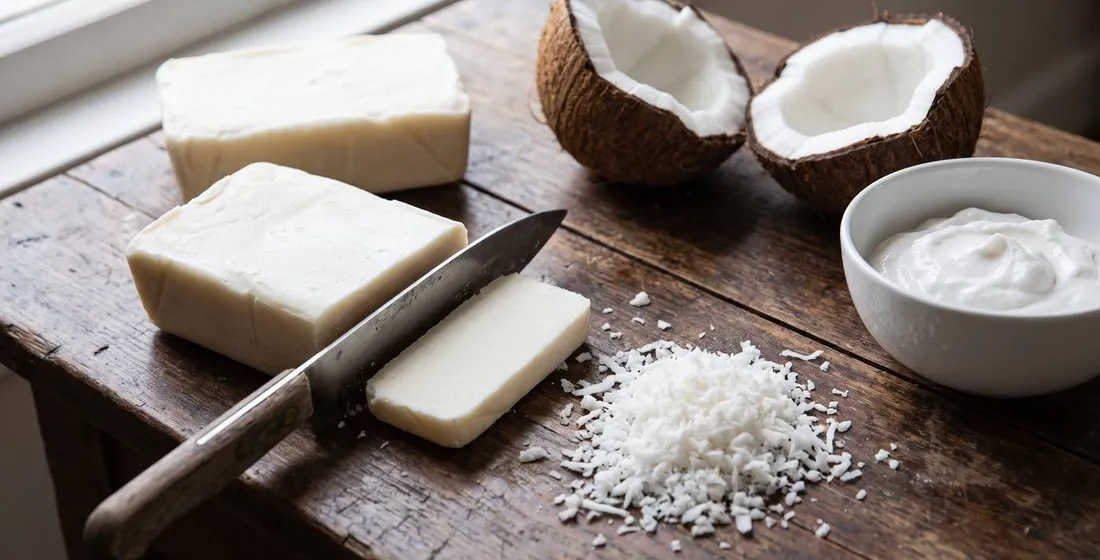
- Creamed coconut is the whole mature kernel, dried and ground to a paste that sets into a solid block. It is not coconut oil and it is not coconut cream: the fibre and protein stay in.
- The Silk Foods Ceylon (SFC) creamed coconut specification lists 69 g fat, 7 g fibre and 7 g protein per 100 g, against 34 g fat for its retort-packed coconut cream. One block does the work of roughly two to three times its weight in cream.
- Codex has no standard for creamed coconut, so the specification has to borrow limits from the desiccated coconut standard (CXS 177-1991) and state everything else in the contract.
- Warm storage separates the fat from the solids. This is physics, not a defect, and the block format, wrap and storage line should plan for it.
- Bulk MOQ is 1 MT per SKU from the BRCGS and FSSC 22000 V6 audited facility in Matale, with 2 to 3 weeks from PO to dispatch.
A creamed coconut block looks like the simplest product on a coconut price list: one ingredient, shipped dry, stable for a year or more at room temperature. The questions that decide whether it works in a recipe or on a shelf are less obvious: how much fat is actually in it, what it turns into when you add water, how the block behaves in a warm warehouse, and what goes on a private-label pack. This piece is for food manufacturers and private-label brand owners who are weighing creamed coconut against coconut cream, coconut milk powder or coconut oil, and want to know what they are buying before the first sample request.
It sits alongside the Ceylon virgin coconut oil buyer’s guide, which covers the oil side of the same Matale supply base, and the white coconut oil grade comparison, which covers the middle oil grade.
What is creamed coconut, and how is it different from coconut cream?
Creamed coconut is dehydrated mature coconut kernel ground into a smooth paste that sets into a hard, off-white block, with the oil, fibre and protein of the kernel all retained. Coconut cream is a water-based emulsion pressed from the kernel with most of the fibre filtered out. One is a solid ingredient, the other is a liquid.
The difference shows up clearly on the two SFC catalogue specifications, which come from the same facility and the same mature Sri Lankan coconuts.
| Per 100 g | Creamed coconut (block) | Coconut cream (retort-packed) | Coconut milk powder |
|---|---|---|---|
| Fat | 69 g | 34 g | 65 g |
| Saturated fat | 60 g | 30 g | 60 g |
| Fibre | 7 g | 2 g | 3 g |
| Protein | 7 g | 3.6 g | 7 g |
| Energy | 670 kcal | 330 kcal | 660 kcal |
| Format | Smooth solid block, off-white | Thick white emulsion | Free-flowing powder |
| Shelf life | 12 to 24 months | 24 months, refrigerate after opening | 12 to 24 months |
Creamed coconut and coconut milk powder carry similar fat, but the powder is a spray-dried emulsion that disperses in cold water, while the block needs heat and shear and keeps its fibre. That fibre gives a thicker body than pressed cream: an advantage in a curry base or baked filling, usually the wrong choice for a smooth beverage.
Is there a standard for creamed coconut fat content?
No Codex standard defines creamed coconut. The Codex standard for aqueous coconut products (CXS 240-2003) covers coconut milk and cream, and the desiccated coconut standard (CXS 177-1991) covers the dried kernel. Creamed coconut falls between them, so its fat, moisture and acidity limits must be written into the buyer’s specification.
The two standards still give useful reference points. CXS 177-1991 sets a minimum oil content of 60% m/m for full-fat desiccated coconut, a maximum moisture of 4% m/m and a maximum total acidity of 0.3% of the extracted oil, measured as lauric acid. Creamed coconut starts from the same dried kernel, so those three numbers are a sensible floor to borrow. CXS 240-2003 sets a minimum fat of 20% m/m for coconut cream and 29% m/m for coconut cream concentrate, which shows how far above the liquid formats a 69% block sits.
Write the fat as a range with a test method (for example 65 to 72% by Soxhlet or an agreed equivalent), not a single catalogue figure. Fat moves with nut maturity and season, and a range stops a 67% batch becoming a dispute.
How much water turns a block into milk or cream?
Dilution is simple mass balance: divide the block’s fat percentage by the target fat percentage to get the total finished weight per unit of block. At 69% fat, 100 g of creamed coconut makes about 406 g of 17% fat coconut milk or about 288 g of 24% fat coconut cream.
| Target product | Target fat | Block : water ratio (by weight) | Finished yield from 1 kg of block |
|---|---|---|---|
| Coconut cream, Codex minimum | 20% | 1 : 2.45 | 3.45 kg |
| Rich coconut cream | 24% | 1 : 1.88 | 2.88 kg |
| Full-fat coconut milk | 17% | 1 : 3.06 | 4.06 kg |
| Coconut milk, Codex minimum | 10% | 1 : 5.9 | 6.9 kg |
These figures are illustrative arithmetic on a 69% block. Your own batch COA fat figure goes in place of 69. The same logic, applied to liquid milk formats, is worked through in the coconut milk fat formats and reconstitution maths piece.
One caution for anyone reconstituting at scale: the result is not identical to pressed coconut milk. The fibre stays in, so the dispersion is slightly thicker and can settle. Most kitchens and sauce lines use hot water (well above the 24 to 25°C melting range of coconut fat) and high-shear mixing, and some filter the dispersion. If the finished product must meet a coconut milk or cream specification, run the trial with the fibre in and test the result, not the block.
Why the block separates, and what the format should do about it
Creamed coconut separates because coconut fat melts at roughly 24 to 25°C. Above that temperature the oil softens and migrates to the top of the block, leaving a firmer, darker layer of solids below. Stirred back in or melted through, it is the same product.
Consider a UK wholesale buyer who opens the first carton of an August container and finds a band of clear fat on every block. Nothing is wrong with the product, but nobody wrote a storage line into the specification, so goods-in treats it as a defect. This is a hypothetical, but it is the most common avoidable complaint on the product.
Four format decisions reduce the problem. A food-grade inner wrap under the carton stops fat migrating into the board, where it stains and weakens the outer pack. Block weight should suit the use: retail blocks are cut and used over a few meals, while foodservice and manufacturing blocks are melted whole, so larger weights cut handling. Weight, dimensions and case count are agreed at specification stage.
A storage line on both the specification and the pack, such as “Store below 24°C. Natural separation may occur, warm and stir before use”, answers the complaint before it arrives. And for warm-season sea freight (3 to 4 weeks to the EU or AU, 4 to 5 weeks to the US), the contract should say whether visible separation on arrival is accepted as normal.
What a private-label creamed coconut specification should include
A usable creamed coconut specification needs fat as a range with method, moisture, acidity of the extracted oil, microbiology, sensory and grit limits, the block and pack format, and the label claims. Each line closes a gap the product name leaves open.
Buyer’s checklist: creamed coconut block specification
- Fat range with test method, per batch (for example 65 to 72%)
- Moisture maximum (CXS 177-1991 uses 4% m/m for the dried kernel)
- Free fatty acid of the extracted oil, as lauric acid (CXS 177-1991 uses 0.3% maximum)
- Microbiology: total plate count, yeast and mould, coliforms, Salmonella absent in 25 g
- Sensory: characteristic coconut aroma and taste, no rancid or soapy notes, off-white colour
- Fineness: smooth paste, no perceptible grit, against an approved sample
- Format: block weight, wrap material, carton and case count
- Storage and usage lines, plus shelf life (12 to 24 months) and allergen declaration for the destination market
- Certifications on the SKU: BRCGS, FSSC 22000 V6, plus USDA Organic or EU Organic if the claim needs it
For an EU pack, the nutrition declaration required by Regulation (EU) 1169/2011 should be built from the supplier’s batch data rather than a generic table, because fat and energy dominate the label and move with the fat range. Claims such as “vegan”, “dairy-free” or “no additives” follow the ingredient list, which for creamed coconut is one word.
The same approach to spec-first private label, applied to a glass-jar coconut cream, is set out in the coconut cream 22% versus 24% fat economics piece.
MOQ and lead time: what a first order looks like
The bulk MOQ for creamed coconut from SFC is 1 metric tonne per SKU, with 2 to 3 weeks from PO to dispatch, and volume pricing breaks above that. The MOQ is per SKU, so a brand launching a retail block and a foodservice block commits to 1 MT of each.
A first order usually runs in three steps. Samples of the standard block ship by international courier in 3 to 5 business days. If the brand needs a different fat target, a finer grind or a blended format, the SRV R&D and NPD team works to a maximum of 3 to 4 weeks from signed brief to approved formulation. Production then follows the standard 2 to 3 week window, under the same BRCGS and FSSC 22000 V6 scope that covers the facility’s coconut oils, desiccated coconut and cream, so the document pack for a second coconut SKU is an addition, not a new supplier approval. The guide to qualifying a coconut and plant-based contract manufacturer lists the audit questions worth asking first.
Where the Silk Route Ventures model doesn’t fit
Buyers who want the cheapest coconut fat by the tonne with no specification beyond “creamed coconut.” Multi-origin blended programmes where provenance does not matter to the label. Cold-water-dispersible beverage applications, where a spray-dried coconut milk powder is the better format. For those briefs, SRV will say so on the first call.
Frequently asked questions
What is the fat content of creamed coconut?
The SFC creamed coconut specification lists 69 g fat per 100 g, of which 60 g is saturated. That is roughly double a 34% coconut cream. Because Codex has no creamed coconut standard, buyers should write fat as a range with a test method, typically in the mid-60s to low-70s percent, and check each batch COA.
Is creamed coconut the same as coconut butter?
The terms are often used for the same thing: ground whole coconut kernel that sets solid. Some retail brands use “coconut butter” for a spreadable jar and “creamed coconut” for a firm block. What matters to a buyer is the specification, meaning fat range, moisture, fineness and format, rather than the trade name on the label.
Can creamed coconut replace coconut cream in a recipe?
Yes, by dilution. At 69% fat, one part block to about 1.9 parts hot water by weight gives a cream at around 24% fat. The result keeps the kernel fibre, so it is slightly thicker than pressed cream. For sauces, curries and bakery it works well. For smooth beverages, test first or use coconut milk powder.
Does Silk Foods Ceylon make private-label creamed coconut blocks?
Yes. SFC supplies creamed coconut from mature Sri Lankan coconuts at its Matale facility under BRCGS and FSSC 22000 V6, in bulk from 1 MT per SKU with 2 to 3 weeks PO to dispatch. Block weight, wrap and carton are set in the specification, and custom formats are developed within 3 to 4 weeks.
How Silk Route Ventures can help
Silk Route Ventures (SRV) supplies creamed coconut from the Silk Foods Ceylon facility in Matale, Central Province, alongside coconut cream, coconut milk powder, desiccated coconut and the full coconut oil range, all under one BRCGS and FSSC 22000 V6 audit. Bulk MOQ is 1 MT per SKU, with 2 to 3 weeks from PO to dispatch and courier samples in 3 to 5 business days. For brand owners building a private-label block, the SRV R&D and NPD team can set the fat range, format and label lines with you within a 3 to 4 week window. Contact us to send an inquiry or request a creamed coconut sample. Bulk buyers can review the wider range of coconut products from Sri Lanka.
Sources
- Codex Alimentarius, Standard for Desiccated Coconut (CXS 177-1991, revised 2011), oil content, moisture and total acidity limits. https://www.fao.org/input/download/standards/261/CXS_177e.pdf (retrieved 30 September 2026)
- Codex Alimentarius, Standard for Aqueous Coconut Products: Coconut Milk and Coconut Cream (CXS 240-2003), composition table. https://www.fao.org/input/download/standards/10401/CXS_240e.pdf (retrieved 30 September 2026)
- Codex Alimentarius, Standard for Named Vegetable Oils (CXS 210-1999), coconut oil composition. https://www.fao.org/input/download/standards/336/CXS_210e_2015.pdf (retrieved 29 September 2026)
- Regulation (EU) No 1169/2011 on the provision of food information to consumers. https://eur-lex.europa.eu/eli/reg/2011/1169/oj (retrieved 29 September 2026)
Further reading
- Tetra Pak, Coconut Handbook, chapter on coconut food production. https://coconuthandbook.tetrapak.com/chapter/coconut-food-production
- Sri Lanka Export Development Board, Coconut industry export potential. https://www.srilankabusiness.com/coconut/exporter-information/export-potential.html
Written by the Silk Route Ventures Trade Team. Silk Route Ventures (E-Silk Route Ventures Ltd) is a Sri Lankan B2B supply-chain operator for the Food, Beverage, Wellness, and Nutraceuticals sectors. The Silk Foods Ceylon manufacturing arm holds BRCGS and FSSC 22000 V6 certifications. Questions or to request a sample: Contact us or email info@esilkroute.com.lk.