
White Coconut Oil vs Virgin and RBD Coconut Oil: Where the Middle Grade Fits a Food Manufacturer's Spec
Buyer’s snapshot
- “White coconut oil” is a trade term, not a Codex grade. Codex Standard CXS 210-1999 draws its line between refined oil (acid value 0.6 mg KOH/g maximum) and cold-pressed or virgin oil (4.0 mg KOH/g maximum), so a purchase order that says only “white” leaves the real specification undefined.
- Fatty acid profile does not separate the three grades. Lauric acid (C12) sits at 45.1 to 53.2% of total fatty acids in coconut oil under Codex, whichever route the oil took.
- What separates them is the processing route, and therefore flavour, contaminant exposure and label claim. White oil is the grade that keeps a mild coconut note without a “virgin” claim.
- Silk Foods Ceylon (SFC) supplies virgin, extra virgin, white and RBD coconut oil from one BRCGS and FSSC 22000 V6 audited facility in Matale, with a 1 MT per grade bulk MOQ.
- The five-line spec block and the grade comparison table below are the parts to send to your formulation lead.
Most coconut oil RFQs name two grades and quietly skip a third. Virgin gets a full specification, RBD gets a Codex reference, and “white coconut oil” gets two words. Then two suppliers quote the same line item far apart, because one read “white” as a fully refined oil and the other read it as a lightly processed one. The buyer never said which oil they meant. This piece is for food manufacturers and private-label brand owners who have a coconut fat in a bakery, confectionery or plant-based recipe and want to know where white coconut oil belongs on the grade ladder, and what to write so a quote means one thing.
The head-to-head between virgin and RBD is already covered in the virgin versus RBD decision guide, so this piece treats that as the hub and does not restate it. It picks up the grade in between.
What is white coconut oil, and is it a defined grade?
White coconut oil is a commercial description for coconut oil that is clear when liquid, white when solid, and milder in aroma than virgin oil, without a formal grade definition in Codex. Codex CXS 210-1999 recognises refined oils and cold-pressed or virgin oils, so “white” must be defined by the parties in the specification.
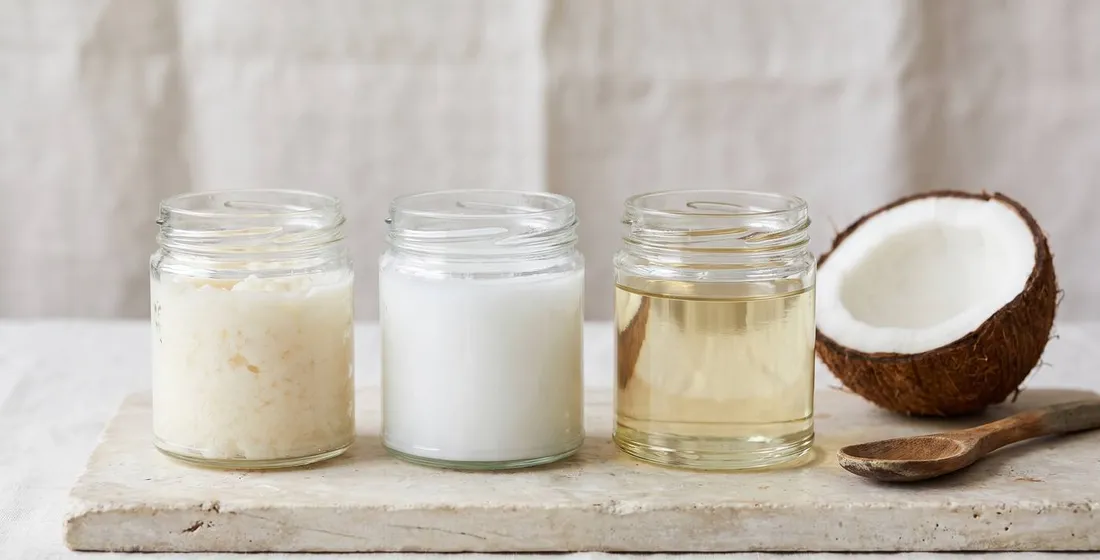
That gap is the single most useful thing to know about the grade. Virgin coconut oil has a body of published limits behind it: the Codex acid value ceiling of 4.0 mg KOH/g for virgin oils and the tighter Asian and Pacific Coconut Community (APCC) limits for virgin oil. RBD has the Codex refined ceiling of 0.6 mg KOH/g and a well-understood process. White sits between them in sensory terms and has no standard of its own. The SFC catalogue describes its white coconut oil as clear when liquid, white when solid below 24°C, with a mild coconut aroma and a neutral taste. Note the contrast in the same catalogue: virgin is listed with a mild, characteristic coconut aroma and taste, and RBD with a neutral aroma and taste. White lands on the mild-to-neutral side.
The practical reading is straightforward. White coconut oil is what a buyer wants when the recipe should taste faintly of coconut, or at least not taste of nothing, but the pack makes no “virgin” or “unrefined” claim and the cost model does not justify one.
Spec snapshot: coconut oil grades from Silk Foods Ceylon, Matale
Virgin and extra virgin: fresh-kernel oil, mild characteristic coconut aroma, per-batch COA
White: clear liquid, white solid below 24°C, mild coconut aroma, neutral taste
RBD: refined, bleached and deodorised, neutral aroma and taste
Packing: bulk drums; retail glass for virgin and flavoured grades
MOQ: 1 MT per grade for bulk; lead time 2 to 3 weeks PO to dispatch
Audit: one BRCGS and FSSC 22000 V6 scope covers every grade
How do the three grades compare on a spec sheet?
The three grades share the same fat and differ in route, sensory profile, heat behaviour and claim eligibility. Fatty acid composition, melting behaviour (solid below about 24°C, liquid above 25°C) and nutrition are effectively the same across virgin, white and RBD, so the choice comes down to four commercial variables rather than functionality.
| Variable | Virgin | White | RBD |
|---|---|---|---|
| Aroma and taste | Mild, characteristic coconut | Mild coconut aroma, neutral taste | Neutral |
| Codex category | Cold-pressed or virgin, acid value 4.0 mg KOH/g max | No named category, defined by contract | Refined, acid value 0.6 mg KOH/g max |
| ”Virgin” or “unrefined” claim | Eligible | Not eligible | Not eligible |
| Process contaminant exposure (3-MCPD and glycidyl esters) | Trace, not deodorised | Depends on route, must be asked | Highest, formed during high-temperature deodorisation |
| High-heat frying | Poor (smokes at about 170 to 177°C) | Confirm by supplier data or fry trial | Best (about 204 to 232°C) |
| Typical use | Spreads, desserts, retail jars | Bakery, confectionery fillings, sauces, light frying | Neutral bakery fat, coatings, frying |
Two cells say “must be asked” or “confirm” on purpose: with no defined route, white’s contaminant profile and smoke point belong to the specific oil on the specific COA, not to the grade name.
Why the processing route matters more than the colour
Colour cannot distinguish the grades: the SFC catalogue lists virgin and RBD, like white, as clear when liquid and white when solid, so a buyer inspecting a sample will not catch a mismatch by eye.
Consider a buyer who approves a white coconut oil sample for a filled biscuit, then finds the production lot smells noticeably stronger. The colour matched. The route had shifted. This is a hypothetical, but it is the failure the specification exists to prevent, and it happens whenever the approved sample and the contract describe the oil by appearance alone.
The route also carries regulatory weight in 2026. Regulation (EU) 2026/1825, adopted on 29 July 2026, tightens EU maximum levels for 3-MCPD, its fatty acid esters and glycidyl fatty acid esters, including limits for composite foods and for foods aimed at infants and young children applicable from 1 January 2027. These contaminants form when oil is deodorised at high temperature. A white oil that skipped deodorisation and a white oil that went through it will look identical and behave differently under that regulation. For an EU-bound SKU, the first question to put to any white-oil quote is whether the oil is deodorised, and the second is for the per-batch 3-MCPD and glycidyl ester result.
Which applications suit the middle grade?
White coconut oil suits applications where a faint coconut note is acceptable or welcome but “virgin” is not on the pack. That covers biscuit and cake fat phases, confectionery fillings, sauces, granola binders and light pan use, where virgin oil would over-flavour the result and RBD would flatten it.
A filling or spread where the coconut note should be present but quiet is the clearest case: virgin can dominate a chocolate or nut filling, RBD removes the note entirely, and a single white oil avoids the dual declaration a VCO and RBD blend needs under Regulation (EU) 1169/2011. A bakery SKU with a generic “coconut oil” line gains little from a virgin premium, and a per-unit cost check, as set out in the hub piece, usually settles it. In savoury plant-based products coconut aroma is usually a defect, and the plant-based patty fat comparison covers why RBD tends to win there.
Five lines that make “white coconut oil” a real specification
A usable white coconut oil specification needs five lines: the processing route, the numeric quality limits, the sensory reference, the contaminant results, and the approved sample. Each closes a gap that the grade name leaves open, and together they make two suppliers’ quotes comparable.
Buyer’s checklist: writing a white coconut oil RFQ
- Route stated in writing: refined and bleached only, or refined, bleached and deodorised, so the quote is for the oil you mean
- Numeric limits with test method, per batch: free fatty acid (as lauric acid), moisture, peroxide value
- Sensory reference: an approved production-batch sample and a description of acceptable aroma, not just “mild”
- Colour limit (Lovibond) so the “white” is measurable
- For EU-bound SKUs: 3-MCPD and glycidyl ester results per batch against Regulation (EU) 2023/915 as amended by 2026/1825
- Certifications on the SKU: BRCGS, FSSC 22000 V6, plus USDA Organic or EU Organic if the claim needs it
- Target application and maximum process temperature, so the supplier can flag a mismatch early
The virgin-oil equivalents of these lines, including the APCC limits, are laid out in the coconut oil grades and RFQ specification primer, and the labelling and organic split for EU importers is in the private-label coconut oil spec sheet. Reuse the same skeleton and change the route line.
Why buying all three grades from one facility keeps the decision open
Sourcing virgin, white and RBD from one audited facility means a brand can move a SKU between grades without re-qualifying a supplier. When all three ship under the same BRCGS and FSSC 22000 V6 scope from the Matale facility, a shift from RBD to white to test a milder flavour is a specification change and a new approved sample, not a new audit and a new document pack.
SFC also runs the semi-liquid line (3,000 jars of 300 g a day) at the same site, so a coconut spread brand can put the oil and the finished jar under one audit, as the glass jar contract manufacturing guide describes. It is the lean-route argument in practical form, and the guide to qualifying a coconut and plant-based contract manufacturer lists the audit questions worth asking before consolidating.
Where the Silk Route Ventures model doesn’t fit
Full-tanker crude or RBD programmes bought on the day’s tonnage quote. Multi-origin blended oil where provenance does not matter to the label. Buyers choosing purely on lowest price per tonne with no specification beyond “coconut oil.” For those briefs, a large refinery or a commodity desk is the more honest answer, and SRV will say so on the first call.
Frequently asked questions
What is the difference between white coconut oil and RBD coconut oil?
RBD is refined, bleached and deodorised to a neutral aroma and taste, and has a defined Codex refined category (acid value 0.6 mg KOH/g maximum). White coconut oil has no formal grade, so the difference is set by the supplier’s route. The SFC catalogue lists white with a mild coconut aroma and RBD as neutral. Confirm the route on the specification.
Can white coconut oil carry a “virgin” or “unrefined” claim?
No. Those are process claims reserved for oil produced by a virgin route, which is a separate category with its own limits under Codex (acid value 4.0 mg KOH/g maximum) and APCC standards. A white coconut oil is declared simply as coconut oil on the ingredient list, which is accurate for all three grades.
Does Silk Foods Ceylon supply white coconut oil for private label?
Yes. Silk Foods Ceylon supplies white, virgin, extra virgin and RBD coconut oil from its Matale facility under BRCGS and FSSC 22000 V6, with USDA Organic and EU Organic on selected SKUs, confirmed per SKU. Bulk MOQ is 1 MT per grade, lead time is 2 to 3 weeks from PO, and matched grade samples ship by courier in 3 to 5 business days.
How long does it take to develop a custom coconut fat blend?
The SRV R&D and NPD team works to a maximum of 3 to 4 weeks from signed brief to approved formulation. For a coconut fat decision, that means matched white, virgin and RBD samples run against your recipe, so the panel test and the cost model use the same oil you would buy at volume.
How Silk Route Ventures can help
Silk Route Ventures (SRV) supplies white coconut oil alongside virgin, extra virgin and RBD grades from the Silk Foods Ceylon facility in Matale, under one BRCGS and FSSC 22000 V6 audit, with USDA Organic and EU Organic on the relevant SKUs. Bulk MOQ is 1 MT per grade, with 2 to 3 weeks from PO to dispatch. For food manufacturers unsure which grade their recipe needs, the SRV R&D and NPD team can run matched samples within a 3 to 4 week window and write the five-line specification with you. Contact us to send an inquiry or request a coconut oil sample set. Bulk buyers can review the full range on our Sri Lanka coconut products page.
Sources
- Codex Alimentarius, Standard for Named Vegetable Oils (CXS 210-1999), acid value limits for refined and cold-pressed or virgin oils, and Table 1 fatty acid composition for coconut oil. https://www.fao.org/input/download/standards/336/CXS_210e_2015.pdf (retrieved 29 September 2026)
- Commission Regulation (EU) 2026/1825 amending Regulation (EU) 2023/915 as regards maximum levels of 3-MCPD, 3-MCPD fatty acid esters and glycidyl fatty acid esters in certain foods. https://eur-lex.europa.eu/eli/reg/2026/1825/oj/eng (retrieved 24 September 2026)
- Commission Regulation (EU) 2023/915 on maximum levels for certain contaminants in food. https://eur-lex.europa.eu/eli/reg/2023/915/oj (retrieved 24 September 2026)
- Regulation (EU) No 1169/2011 on the provision of food information to consumers. https://eur-lex.europa.eu/eli/reg/2011/1169/oj (retrieved 29 September 2026)
- Asian and Pacific Coconut Community, APCC Standards for Virgin Coconut Oil. https://www.academia.edu/27611401/APCC_STANDARDS_FOR_VIRGIN_COCONUT_OIL (retrieved 24 September 2026)
Further reading
- Marina, A. M., Che Man, Y. B., Nazimah, S. A. H., and Amin, I., “Chemical Properties of Virgin Coconut Oil”, Journal of the American Oil Chemists’ Society 86, 301-307, 2009. https://link.springer.com/article/10.1007/s11746-009-1351-1
- Sri Lanka Export Development Board, Coconut industry export potential. https://www.srilankabusiness.com/coconut/exporter-information/export-potential.html
Written by the Silk Route Ventures Trade Team. Silk Route Ventures (E-Silk Route Ventures Ltd) is a Sri Lankan B2B supply-chain operator for the Food, Beverage, Wellness, and Nutraceuticals sectors. The Silk Foods Ceylon manufacturing arm holds BRCGS and FSSC 22000 V6 certifications. Questions or to request a sample: Contact us or email info@esilkroute.com.lk.