
Private Label Coconut Sugar in Retail Pouches: Granulation, Caking Control and MOQ
Buyer’s snapshot
- The first-order MOQ for coconut sugar is 100 kg per SKU. In retail pouches that is 400 pouches of 250 g, 200 of 500 g or 100 of 1 kg. Sugar fills fast, so the pack, not the powder, sets the delivery date.
- Caking is the retail risk. A 2020 storage study found that amorphous coconut sugar powder began to cake at a water activity of 0.65, while crystalline coconut sugar did not cake and began to deliquesce at 0.75. Specify crystalline, granular form and put moisture and water activity on the specification.
- The pouch film is a moisture decision. A paper-faced pouch with no barrier layer is not suitable for an unrefined sugar that picks up water from the air.
- Coconut sugar is an added sugar on a US label, exactly like cane sugar. The retail story is provenance, flavour and minimal processing, not a health claim.
- PO to dispatch is 4 to 6 weeks for private label (2 to 3 weeks for standard SKUs). Sea freight adds 3 to 4 weeks to the EU and Australia and 4 to 5 weeks to the US.
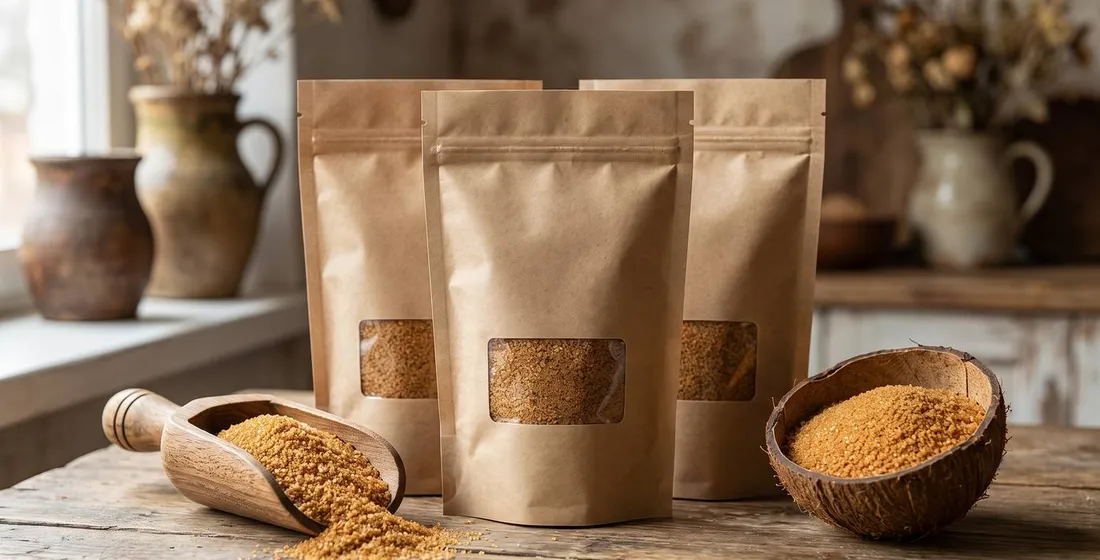
A brand that wants its own coconut sugar on the shelf usually arrives with a pouch in mind: a 250 g stand-up pouch with a window, a 500 g kraft look, a 1 kg family pack. The sugar inside is a short conversation. Granule size, how the pack protects it from humidity, and how many units the first order makes are the longer one. This guide takes those three in order for a private label launch from Sri Lanka.
The formulation side of coconut sugar is covered in the coconut sugar vs brown sugar post, and the glycaemic index argument in the coconut sugar GI claims and sourcing post. This one starts once the brand has decided to sell it in a bag.
What does private label coconut sugar actually mean here?
It means Silk Route Ventures (SRV) supplies the catalogue coconut sugar, packed in the buyer’s format and under the buyer’s label. The sugar is not reformulated: it is the same product listed in the Silk Foods Ceylon (SFC) catalogue as COCO-CSGR.
The catalogue describes coconut sugar made from the nectar of Sri Lankan coconut palms by approved Sri Lankan coconut processors, then packed under SFC’s certification. SFC handles it on its repacking line at the BRCGS and FSSC 22000 V6 certified Matale facility, with bulk and retail formats.
| Service | What the brand supplies | What SRV supplies |
|---|---|---|
| Bulk ingredient | Spec and quantity | Coconut sugar in lined bulk packs |
| Private label | Brand, artwork, pack format | Coconut sugar packed and labelled to the brand |
| Total OBM | A market brief only | Product choice, packaging design and supply, then packing (see Total OBM at Silk Foods Ceylon) |
Private label is the right fit when the brand already knows it wants plain coconut sugar. If the brief is a blend, a flavoured sugar or a sachet range, it becomes a development job, covered below.
Which granulation should a retail pouch use?
Granular, free-flowing crystals. The catalogue lists coconut sugar as granular crystals, free-flowing, light caramel-brown, with a mild caramel aroma. That form is the one to keep for retail, for two reasons.
First, it is the form that resists caking. The 2020 study compared a vacuum-dried powder, which was about 76% amorphous, with a conventionally made sugar that was more than 90% crystalline by the same measure of structure. The amorphous powder caked at a water activity of 0.65. The conventional sugar did not cake at all in the test and only began to deliquesce at 0.75.
Second, granule size decides how the sugar behaves for the shopper. Fine powder dusts when the pouch is torn open, and coarse crystals are slow to dissolve in a cup of tea. Put a particle size range in the specification so every lot looks and pours the same.
From the Trade Team Approve the sample, then write the sample’s particle size distribution and colour range into the contract. A retail shopper compares this month’s bag with last month’s, and a lot that is two shades darker reads as a different product.
How do you control caking in a retail pouch?
Control caking with three things in this order: the form of the sugar, the moisture it leaves the line with, and the barrier of the pack. An anticaking agent is the last resort, not the first.
- Form. Crystalline and granular, as above.
- Moisture at pack-out. Moisture and water activity limits belong on the COA with the method named, because the pack can only keep out new water; it cannot remove what is already inside.
- Barrier. A pack that is open to humidity will move any sugar toward the 0.75 line over time. Packaging vendors group coconut sugar with brown sugar and jaggery for this reason and point to multi-layer, high-barrier films.
| Pouch structure (typical) | Moisture barrier | Where it fits |
|---|---|---|
| Kraft paper / metallised PET / PE | High | Natural kraft look with a barrier layer inside; the usual choice for premium sugar |
| Metallised PET / PE | High | Where a paper look is not needed |
| PET / aluminium foil / PE | Highest | Long shelf life and long export routes |
| Plain kraft paper / PE, no barrier layer | Low | Not recommended for unrefined sugar on a retail shelf |
Typical structures only. One packaging supplier lists a 500 g organic coconut sugar pouch built from MOPP, kraft paper, VMPET and PE, which is a vendor description and not a test result. Film structure, fill weight and seal are confirmed per SKU at quote stage.
On anticaking agents, the same study tested tricalcium phosphate at 0.5% and 1% and found it stopped caking in the amorphous powder. It also means an added ingredient, which has to appear in the ingredient list and which cuts across a clean label “single ingredient” pack. The catalogue entry for COCO-CSGR lists no additives. For a premium retail brand the cleaner route is crystalline sugar plus a good film, and an anticaking agent should be a conscious decision with the label consequence written down.
Storage after packing matters as much as the film. Keep pallets cool and dry, off the floor and away from the container wall during sea freight, and ask the shipping plan to name the storage condition the shelf life assumes. The catalogue states 12 to 24 months, which holds for dry, cool storage in sealed packaging.
How many pouches does the minimum order make?
Divide the net weight into the order. SRV’s first-order MOQ for coconut products is 100 kg per SKU.
| Retail pack (net) | Pouches from 100 kg | Pouches from 500 kg |
|---|---|---|
| 100 g | 1,000 | 5,000 |
| 250 g | 400 | 2,000 |
| 500 g | 200 | 1,000 |
| 1 kg | 100 | 500 |
Arithmetic only: net weight divided by pack size. Real counts are slightly lower once fill allowance and line losses are agreed.
For a brand testing a retail shelf, 400 pouches of 250 g is a small, honest launch: enough for a regional online launch or a few dozen stores, at a stock cost that a failed SKU does not make painful. The same MOQ in a 1 kg family pack is 100 bags and a thin first run. If the brand wants two pack sizes from the same sugar, each pack counts as its own SKU for planning, so confirm at quote stage how the 100 kg is shared.
Where the Silk Route Ventures model doesn’t fit A programme that needs full containers of plain coconut sugar at commodity pricing, or the cheapest possible sweetener at cane sugar volumes. SRV supplies a certified, single-origin, own-brand product at specified volumes, and will say so on the first call if the brief is a trading-desk one.
What goes on a private label coconut sugar label?
The label needs the product name, ingredient list, net quantity, a best-before and storage line, the nutrition panel for the destination market, and the origin statement.
- Added sugars. The US FDA requires coconut sugar to be declared under Added Sugars on the Nutrition Facts label, as it does for cane sugar. A “healthier sugar” claim has no support in the label rules.
- Glycaemic claims. A GI figure belongs to a finished food tested in people, not to a raw material. Leave a “low GI” line off the pack unless the finished product has been tested for it.
- Nutrition data. The catalogue lists 382 kcal, 93 g carbohydrate of which 90 g sugars, no fat, 1 g fibre, 1 g protein and 45 mg sodium per 100 g. Confirm the panel against the lot COA for the destination.
- Organic. Organic status is available on selected SKUs and is confirmed per SKU. Do not print an organic claim until the certificate for that lot covers it.
- Allergens. In the EU, coconut is not among the 14 allergens in Annex II of Regulation (EU) No 1169/2011. The US FDA’s January 2025 allergen guidance removed coconut from its tree-nut list. The brand’s regulatory adviser makes the final call, and SFC supplies an allergen declaration per SKU.
The barcode, importer details and pallet labelling that sit around the pack are covered in the guide to own-brand labels, barcodes and the certified export pallet.
How long does a first private label order take?
For private label, PO to dispatch is 4 to 6 weeks. Standard SKUs in standard packs take 2 to 3 weeks. Sea freight adds 3 to 4 weeks to the EU and Australia and 4 to 5 weeks to the US.
| Stage | Duration | Can it run in parallel? |
|---|---|---|
| Samples | Free for evaluation (you cover the courier) | Starts the clock; runs alongside artwork |
| Blend, flavour or pre-mix development | 3 to 4 weeks maximum, signed brief to approved formulation | Only if the brief is not plain coconut sugar |
| Printed pouch film | Per the converter | Yes: order against approved artwork during sampling |
| Packing and labelling | 4 to 6 weeks from PO to dispatch for private label | Booked at PO |
| Sea freight | 3 to 4 weeks EU and Australia, 4 to 5 weeks US | No |
As on every private label run, printed film is the item that most often slips, so order it during sampling and not after sign-off. The sample to first PO timeline shows where a buyer’s own steps add the most time.
Buyer’s checklist: before approving a private label coconut sugar SKU
- Granular, crystalline form confirmed, with a particle size range on the specification
- Moisture and water activity limits on the COA, with the method named
- Colour range by a stated method, so lots match the approved sample
- Pouch film structure, fill weight and seal in writing, with the shelf life for that structure
- A position on anticaking agents, and the label consequence if one is used
- Authenticity: sap-origin documentation, and isotope testing on premium or organic lots
- Storage and shipping condition named in the contract
- Nutrition panel, allergen declaration and any organic scope confirmed for the SKU
- Artwork approved and film ordered during sampling
Frequently asked questions
What is the MOQ for private label coconut sugar?
The first-order MOQ is 100 kg per SKU, which is 400 pouches of 250 g or 200 pouches of 500 g. If the brand wants several pack sizes, confirm at quote stage how the 100 kg is shared across them.
Why does coconut sugar cake in a pouch?
Moisture. A 2020 storage study found amorphous coconut sugar powder began to cake at a water activity of 0.65, while crystalline sugar held to 0.75. Specify crystalline, granular sugar, set a moisture and water activity limit, and choose a pouch film with a barrier layer.
Can coconut sugar carry a low GI claim on a private label pack?
Not on the strength of a raw material spec. Glycaemic index is measured on a finished food in people, and regulators treat coconut sugar as an added sugar. The US FDA requires it under Added Sugars on the Nutrition Facts label.
Does Silk Route Ventures supply organic private label coconut sugar?
Organic status is available on selected SKUs and is confirmed per SKU. Organic orders take 4 to 6 weeks from PO to dispatch, and the organic import certificate the destination requires travels with the shipment.
How Silk Route Ventures can help
Silk Route Ventures (SRV) supplies coconut sugar in bulk and under the buyer’s own label, packed at the BRCGS and FSSC 22000 V6 certified Silk Foods Ceylon facility in Matale, from approved Sri Lankan coconut processors. The first-order MOQ is 100 kg per SKU, production takes 2 to 3 weeks from PO to dispatch for standard SKUs (4 to 6 weeks for private label, custom specifications and organic orders), and samples are free for evaluation (you cover the courier). For a blend, a flavoured sugar or a pre-mixed sweetener, the SRV R&D and NPD team works to a maximum of 3 to 4 weeks from signed brief to approved formulation. See the Sri Lanka coconut supplier page for the full range, or contact us with your pack format and volume.
Sources
- Physical Characteristics of Amorphous and Crystalline Coconut Sugar Powder with the Addition of Tricalcium Phosphate as an Anticaking Agent, PMC, 2020 (caking at water activity 0.65 for amorphous powder; deliquescence from 0.75 for crystalline sugar; tricalcium phosphate at 0.5% and 1%). https://pmc.ncbi.nlm.nih.gov/articles/PMC7509578/ (retrieved 28 October 2026)
- US Food and Drug Administration, Added Sugars on the Nutrition Facts Label. https://www.fda.gov/food/nutrition-facts-label/added-sugars-nutrition-facts-label (retrieved 14 October 2026)
- Jinlu Packing, Sugar Packaging Guide (coconut sugar grouped with brown sugar and jaggery as humidity-sensitive; multi-layer barrier films). https://www.jinlupacking.com/blogs/sugar-packaging-guide/ (retrieved 28 October 2026, via search summary)
- Gozen Packaging, kraft paper stand-up pouch for 500 g organic coconut sugar (MOPP, kraft paper, VMPET, PE; vendor description). https://www.gozenpackaging.com/?p=6683 (retrieved 28 October 2026, via search summary)
- Regulation (EU) No 1169/2011 on the provision of food information to consumers, Annex II. https://eur-lex.europa.eu/eli/reg/2011/1169/oj (retrieved 10 October 2026)
- US Food and Drug Administration, Questions and Answers Regarding Food Allergens, Edition 5 (January 2025). https://www.fda.gov/food/food-allergies/food-allergen-labeling-and-consumer-protection-act-2004-falcpa (retrieved 10 October 2026)
- Silk Foods Ceylon product catalogue, Coconut Sugar (COCO-CSGR): nutrition, sensory, shelf life and certification data.
Written by the Silk Route Ventures Trade Team. Silk Route Ventures (E-Silk Route Ventures (Pvt) Ltd) is a Sri Lankan B2B supply-chain operator for the Food, Beverage, Wellness, and Nutraceuticals sectors. The Silk Foods Ceylon manufacturing arm holds BRCGS and FSSC 22000 V6 certifications. Questions or to request a sample: Contact us or email info@esilkroute.com.lk.