
Briefing a New Coconut SKU for R&D and NPD in 3 to 4 Weeks
Buyer’s snapshot
- A coconut NPD project runs on a 3 to 4 week R&D window at most, from signed brief to approved formulation, and most slippage traces back to the brief, not the bench.
- Coconut is one raw material with at least five commercial formats (milk, cream, milk powder, oil, desiccated or flour), and each one changes the line, the pack and the label. The brief has to pick one before R&D starts.
- Since January 2025 the US FDA no longer counts coconut as a tree nut for allergen labelling (FARE, 2025). That is a labelling fact, not a clinical one, and it belongs in the brief.
- Silk Route Ventures (SRV) develops coconut SKUs with the BRCGS and FSSC 22000 V6 certified Silk Foods Ceylon facility in Matale and approved Sri Lankan coconut processors, with trial quantities from 10 kg.
- This post is for brand owners and CPG scale-ups with a launch plan. It is not for projects without a target market or a pack decision.
Most coconut NPD projects lose their first week on a question the brief should have answered: which coconut format is this, and in what pack? Everything downstream, from the fat percentage to the shelf-life study to the label, follows from that answer. This piece sets out what a coconut brief needs to contain so that Silk Route Ventures (SRV) and its manufacturing arm Silk Foods Ceylon (SFC) can hold R&D to three to four weeks at most, from signed brief to approved formulation. For the stage-by-stage view of a generic project, read R&D and NPD at Silk Foods Ceylon. This post covers what is specific to coconut.
Why does a coconut brief start with the format, not the flavour?
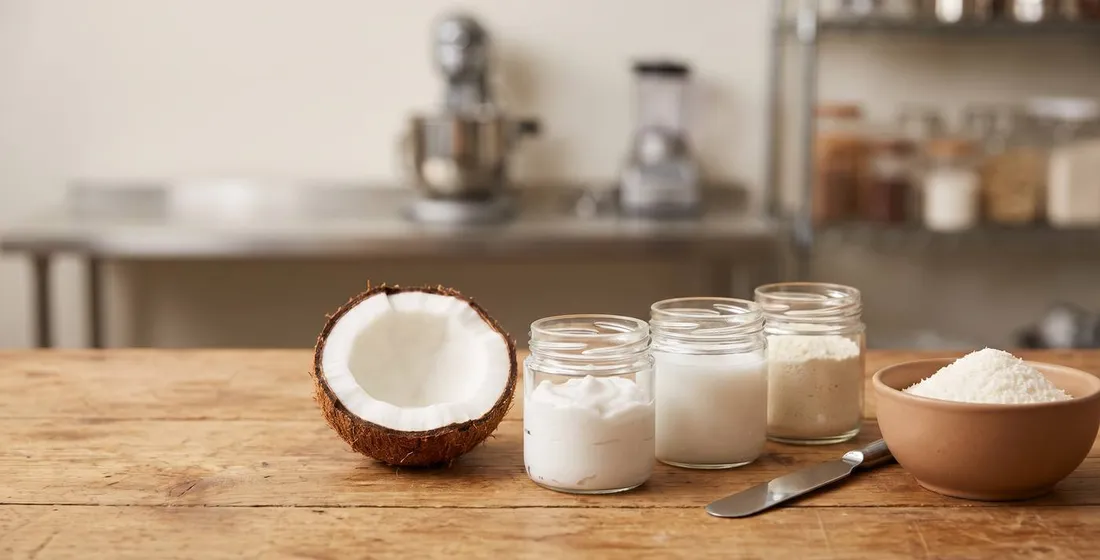
Coconut is not one ingredient with one route to market. Milk and cream are retort-sterilised liquids, packed in cans, pouches or glass. Milk powder is spray-dried. Oil comes off a separate oil line. Desiccated coconut and flour are repacked and graded. A new SKU therefore starts by choosing which of those routes it travels, because each uses different equipment, has a different shelf-life logic and carries different label rules.
The SFC product range already spans the formats a brand is most likely to want: coconut milk in 7%, 11%, 17% and 18% fat, coconut cream in 22% and 24% fat, high-fat and low-fat milk powder, and desiccated coconut in fine and medium cut. A brief that names one of those as the base compresses R&D to adjustment work: fat level, additions, pack. A brief that says “something coconut-based and creamy” sends the first week into choosing a format. The coconut cream vs milk formulator guide covers the differences between them in detail.
Coconut products are made at the Matale facility and by approved Sri Lankan coconut processors, and SRV names the processing site on the quote. Which site makes the base is itself a brief-stage decision, so ask for it early.
What goes into the coconut NPD brief?
A brief is a document the manufacturer can quote against. For coconut, seven lines do most of the work.
Buyer’s checklist: the coconut NPD brief
- Base format (milk, cream, milk powder, oil, desiccated, flour) and the target fat percentage or grade.
- Finished format and pack: can, retort pouch, glass jar or bulk sack, with fill weight.
- Target market and the retailer or channel, so the label and document pack can be scoped at the start.
- Claim platform: what the pack may say, and what it must not say.
- Organic intent: whether the SKU needs USDA Organic or EU Organic, which is confirmed per SKU and never assumed.
- Shelf-life target and storage condition (ambient, chilled, frozen).
- Launch volume, the second-order volume and the unit cost the brand has to defend.
Lines 3 and 4 are where most briefs go wrong, and the next sections explain why.
| Brief line | If it is clear at signing | If it is left open |
|---|---|---|
| Base format and fat % | R&D adjusts a known product | First week spent choosing a format |
| Pack and fill weight | Line and pack scoped in parallel | Pack sourcing starts after the formulation, adding weeks |
| Target market | Documents and label scoped at the start | Rework after the formulation is locked |
| Organic intent | Eligibility checked at spec stage | Late discovery that the SKU is not on a certificate |
| Shelf-life target | Stability work runs alongside the pilot | Study starts after approval, so the launch date moves |
How does the 3 to 4 week R&D window actually run?
The window runs from the signed brief to the approved formulation. It covers brief intake and spec scoping, a bench batch, one or two sample rounds, and a pilot on production equipment where the format needs it. Production scoping runs in parallel from the third week so that the first purchase order does not wait on paperwork.
The window applies to formats SFC already produces. A genuinely new process or a novel ingredient can take longer, and a brief that depends on one should say so at intake rather than promise the same four weeks. After approval, production takes 2 to 3 weeks from PO to dispatch for standard SKUs and 4 to 6 weeks for private label, custom specifications and organic orders. Sea freight then adds 3 to 4 weeks to the EU and Australia, or 4 to 5 weeks to the US. The NPD as a service post lays out the stage gates in full.
The SRV R&D desk sees the same pattern in project after project: the single most common reason a coconut project slips past four weeks is a brief that left the target market or the claim platform ambiguous. A brand that has not decided where the first listing will be cannot get a label reviewed, and a formulation locked before the label is reviewed is a formulation that may be reopened. Four weeks is realistic when those answers exist on day one, and optimistic when they do not.
Spec snapshot: coconut NPD at Silk Foods Ceylon R&D window: 3 to 4 weeks at most, signed brief to approved formulation Trial quantities: from 10 kg; commercial orders from 100 kg per SKU Samples: free for evaluation, buyer pays the courier Production: 2 to 3 weeks PO to dispatch (standard), 4 to 6 weeks (private label, custom spec, organic) Certification: BRCGS and FSSC 22000 V6 at the Matale facility; USDA Organic and EU Organic on selected SKUs, confirmed per SKU Pricing basis: FOB Colombo, CFR and CIF on request
What should the brief say about labels and allergens?
Coconut labelling rules differ by market, and they changed recently. In January 2025 the US FDA’s revised allergen guidance dropped coconut from the list of tree nuts that trigger a “Contains: tree nuts” statement, although coconut must still appear by name in the ingredient list (FARE, 2025). FARE notes that the change concerns legal labelling requirements under US law and says nothing about whether coconut can cause reactions. A brand selling in several markets should not assume the same treatment everywhere.
For the brief, that means one line stating the destination markets and one line asking SFC to confirm the allergen position for each. The coconut allergen labelling post walks through the market-by-market detail. Doing this at week one costs a few minutes. Doing it after the pack artwork is approved costs a reprint.
Two further lines belong here. First, state what the pack will claim (for example a fat percentage, a dairy-free statement or an origin statement) so the spec can support it with a measured parameter. Second, agree the COA parameters at brief stage. A COA is available on request, and the parameters that go on it should be written into the order, not discovered afterwards. The COA and batch traceability post explains how batch codes tie each lot back to raw material intake.
Which coconut SKUs suit a quick R&D cycle, and which do not?
Briefs built on an existing format move fastest. A coconut milk powder private label with a changed fat level or pack, or a dairy-free dessert base built on coconut cream, starts from a known process. The milk powder private label post and the dairy-free frozen dessert post show what those projects look like once the format is fixed.
Briefs that stretch the window are the ones that combine a new format with a new claim: for example, a low-fat coconut product that also wants a clean-label statement, in a pack the factory has not filled before. None of that is impossible. It means the first call should agree which element is fixed and which is open, and the 3 to 4 week commitment applies to the fixed version.
Where SRV’s R&D offer does not fit Projects with no target market or launch plan. Brands that want a zero-development product with their label on it (that is private label, not R&D). Briefs that need a protected-origin or health claim SRV cannot support with a measured parameter. Brands buying purely on the lowest price per unit.
Frequently asked questions
How long does R&D take for a new coconut product?
For a coconut format Silk Foods Ceylon already produces, R&D takes 3 to 4 weeks at most from signed brief to approved formulation. Production then takes 2 to 3 weeks from PO to dispatch for standard SKUs and 4 to 6 weeks for private label, custom specification and organic orders. A novel process or ingredient can take longer, and the quote says so.
What do I need to bring to the first coconut NPD call?
Bring the base format and target fat percentage, the finished pack and fill weight, the destination markets, the claim platform, organic intent, the shelf-life target and the launch and second-order volumes. With those seven lines, the SRV R&D desk can scope the spec, the sample plan and a quote in one conversation.
Can SRV develop a custom coconut formulation for a new brand?
Yes, for formats within the Matale facility and approved Sri Lankan processor scope. SRV develops coconut SKUs for brand owners launching a new product, with trial quantities from 10 kg and commercial orders from 100 kg per SKU. Private label unit minimums are confirmed on the quote. Samples are free for evaluation and the buyer pays the courier.
Will a coconut SKU developed by SRV be organic?
Only if the specific SKU is on a current certificate. USDA Organic and EU Organic apply to selected SKUs and are confirmed per SKU, so state organic intent in the brief and SRV will confirm eligibility at the spec stage. The import certificate the destination requires is planned alongside the first order.
How Silk Route Ventures can help
Silk Route Ventures (SRV) develops new coconut SKUs, from milk, cream and milk powder to desiccated coconut and flour, with the BRCGS and FSSC 22000 V6 certified Silk Foods Ceylon facility in Matale and approved Sri Lankan coconut processors. R&D runs 3 to 4 weeks at most from signed brief to approved formulation, trial quantities start from 10 kg, and commercial orders start from 100 kg per SKU, with USDA Organic and EU Organic on selected SKUs, confirmed per SKU. Production follows in 2 to 3 weeks from PO for standard SKUs, or 4 to 6 weeks for private label, custom specification and organic orders, with pricing FOB Colombo and CFR or CIF on request. See the Sri Lanka coconut supplier page for the range, then contact us with your base format, pack and destination market to start a scoping call.
Sources
- FARE (Food Allergy Research & Education), “Update: FDA guidance on food allergen labeling” (January 2025). https://www.foodallergy.org/fare-blog/update-fda-guidance-food-allergen-labeling (retrieved 31 October 2026)
- Allergic Living, “FDA on Top Allergen Labels: Coconut Off List, Milk Sources Expand”, 17 January 2025. https://www.allergicliving.com/2025/01/17/fda-on-top-allergen-labels-coconut-off-list-milk-sources-expand/ (retrieved 31 October 2026)
Written by the Silk Route Ventures Trade Team. Silk Route Ventures (E-Silk Route Ventures (Pvt) Ltd) is a Sri Lankan B2B supply-chain operator for the Food, Beverage, Wellness, and Nutraceuticals sectors. The Silk Foods Ceylon manufacturing arm holds BRCGS and FSSC 22000 V6 certifications. Questions or to request a sample: Contact us or email info@esilkroute.com.lk.