
Private Label Coconut Milk Powder: Sachets, Pouches, Barrier Film and MOQ
Buyer’s snapshot
- Silk Foods Ceylon (SFC) spray-dries coconut milk powder in Matale, Central Province, at 50 kg per day, from a BRCGS and FSSC 22000 V6 audited facility. The MOQ is 50 kg per SKU, which is one drying day.
- 50 kg fills 2,000 sachets of 25 g, 1,000 sachets of 50 g, or 200 pouches of 250 g. For a retail launch, drying days, not the MOQ, are what set the delivery date.
- A high-fat powder carries about 65% fat. The pouch or sachet film has to keep out moisture and oxygen for a stated shelf life of 12 to 24 months, so the film belongs in the specification.
- “Dairy-free” on the front of the pack depends on the carrier. Many coconut milk powders on the market use sodium caseinate, a milk protein.
- PO to dispatch is 2 to 3 weeks. Sea freight adds 3 to 4 weeks to the EU and Australia, 4 to 5 weeks to the US.
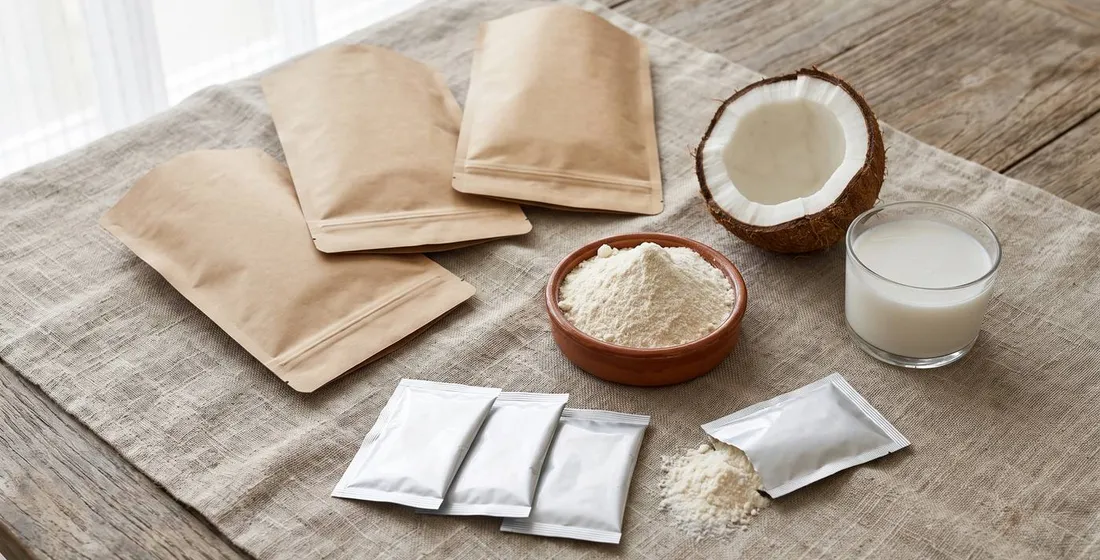
A private label coconut milk powder brief usually arrives as a pack idea: a 25 g curry sachet for an ethnic grocery shelf, a 250 g resealable pouch for a vegan baking range, a stick pack for a coffee creamer. The powder inside is the part buyers ask the most about, but on a first order the pack, the label and the drying schedule decide whether the launch date holds. This guide takes them in that order.
Grade and fat choices come first, and they are covered in the coconut milk powder fat percentage guide. For frozen desserts and other formulation work, see the guide to coconut cream and milk powder in dairy-free frozen desserts. This one starts once the grade is picked.
Which retail formats suit private label coconut milk powder?
Coconut milk powder sells in three retail shapes: single-use sachets of 25 to 50 g, resealable stand-up pouches of 150 g to 1 kg, and stick packs for drinks. Each format suits a different shelf and needs a different barrier film. Bulk supply for manufacturers ships in lined bags.
| Format | Typical channel | Use occasion | What to weigh |
|---|---|---|---|
| Sachet, 25 to 50 g | Asian and ethnic grocery, convenience | One curry or one batch of sauce | Highest film cost per gram; no reseal, so the barrier only has to last until opening |
| Stand-up pouch, 150 g to 1 kg | Supermarket, health store, online | Repeated use: baking, smoothies, cooking | Reseal quality and headspace matter, because the pack is opened many times |
| Stick pack, 10 to 20 g | Coffee and drinks aisle, foodservice | One cup of creamer or latte | Needs fine, free-flowing powder and a tight seal; usually a blended product, not plain powder |
| Lined bulk bag | Food manufacturers, repackers | Ingredient for further processing | Not a retail format; sold as ingredient supply |
SFC packs coconut milk powder in plastic pouches and bulk. Sachet and stick formats, film structure, fill weight and print method are confirmed per project at quote stage, against the filling line available for the run.
How many retail units does 50 kg make, and how many drying days does a launch need?
At SFC’s spray-drying capacity of 50 kg per day, the arithmetic is simple. One drying day makes 2,000 sachets of 25 g. A 10,000-sachet launch needs 250 kg, about five drying days, before filling starts.
| Retail pack (net) | Units from 50 kg (one drying day) | Units from 250 kg (five drying days) |
|---|---|---|
| 25 g sachet | 2,000 | 10,000 |
| 50 g sachet | 1,000 | 5,000 |
| 150 g pouch | 333 | 1,666 |
| 250 g pouch | 200 | 1,000 |
| 1 kg pouch | 50 | 250 |
Arithmetic only: net weight divided into the batch. Real counts are slightly lower once fill allowance and line losses are agreed.
Here the private label problem is the opposite of a bulk coconut line. On desiccated coconut, where the MOQ is a tonne, small brands struggle to use the minimum. On spray-dried powder the 50 kg minimum is easy to reach. The constraint is how many drying days the launch takes, and those days are shared with every other spray-dried SKU on the line, including oat, soy and rice milk powders. The wider line is described in the guide to spray-dried plant milk powder for global distribution.
Take a hypothetical UK brand planning 20,000 sachets of 25 g across two flavours. That is 500 kg of powder, ten drying days on a single line. Booked in the first week of the conversation, those ten days fit inside the 2 to 3 week PO-to-dispatch window for a standard grade. Booked after artwork is signed off, they may not.
Where the Silk Route Ventures model doesn’t fit Programmes that need tens of tonnes of plain coconut milk powder a month on a fixed annual price. A 50 kg per day line is built for specified, certified, own-brand runs, not for commodity tonnage. For that brief, a high-volume dryer is the better fit, and SRV will say so on the first call.
What barrier film does a high-fat coconut milk powder need?
A powder with about 65% fat needs a film with low oxygen and low moisture transmission, usually a laminate with an aluminium foil or metallised layer, heat-sealed tight and stored cool. Moisture is the bigger day-to-day risk: it causes caking and, in coconut fat, can start soapy off-flavours.
Coconut fat behaves differently from dairy fat in a pack. SFC’s catalogue gives 60 g of saturated fat in 65 g of total fat per 100 g, so most of the fat is saturated and slow to oxidise. The coconut-specific risk is moisture. Coconut fat is rich in lauric acid, and when moisture and residual enzyme activity break it down, the free fatty acids give a soapy taste. So the water vapour barrier, the seal and the storage instruction count as much as the oxygen barrier.
Dairy powder research gives a guide to film choice. Studies of milk powder packs report that aluminium-laminated films have the lowest oxygen permeability of the structures tested, by several orders of magnitude against plain PE and PP. A pack study on high-fat milk powder found that a metallised BOPP structure performed worse than metallised PET, because its higher oxygen transmission left more oxygen in the headspace (International Institute of Refrigeration, Fridoc database). Nitrogen flushing is the other lever; a Journal of Dairy Science study (Lloyd and colleagues, 2009) tested nitrogen-flushed against air-packed whole milk powder over a year of storage.
| Film structure (typical) | Oxygen and moisture barrier | Where it fits |
|---|---|---|
| PET / aluminium foil / PE | Highest | Sachets and pouches for long shelf life and export |
| Metallised PET / PE | High | Pouches where foil is not wanted, shorter shelf life |
| Metallised BOPP / PE | Moderate | Short shelf life, low-humidity markets |
| Kraft paper / PE, no barrier layer | Low | Not recommended for high-fat powder |
Typical structures only. The film structure, shelf life and storage conditions are confirmed per SKU at quote stage.
The practical rule: ask for the film structure in writing, with the shelf life that the specification states for that structure. SFC’s catalogue gives 12 to 24 months for coconut milk powder; where in that range a SKU sits depends on the pack.
What has to be on a private label coconut milk powder label?
The label needs a clear product name, the full ingredient list including the carrier, net quantity, a storage and best-before line, and the allergen information required in the destination market. The carrier is where most coconut milk powder labels go wrong.
Many coconut milk powders use maltodextrin as a carrier and sodium caseinate as an emulsifier. Sodium caseinate is a milk protein. A coconut milk powder that contains it cannot carry a dairy-free or vegan claim, and in most markets it must declare milk as an allergen. In May 2015, a US importer recalled a coconut milk powder mix in several states because it contained sodium caseinate without a “Contains milk” statement, and the Canadian Food Inspection Agency issued a parallel recall the same month.
SFC’s coconut milk powder is catalogued as vegan, dairy-free and free of preservatives, colours and flavours. For any supplier, check four points on the specification before artwork:
- Carrier. Name it (maltodextrin, gum acacia, or coconut solids only) and its source, so the ingredient list is complete.
- Milk protein. Confirm in writing that no caseinate or other milk derivative is used, before a dairy-free or vegan claim goes on the pack.
- Coconut as an allergen. In the EU, coconut is not among the 14 allergens in Annex II of Regulation (EU) No 1169/2011. In the US, the FDA’s January 2025 allergen guidance removed coconut from its list of tree nuts. The brand’s regulatory adviser makes the final call; SFC supplies an allergen declaration per SKU.
- Reconstitution claims. If the pack says “makes 1 litre”, the claim needs to match the grade’s tested ratio.
The barcode, importer details and pallet labelling that sit around the pack are covered in the guide to own-brand labels, barcodes and the certified export pallet.
How long does a first private label order take?
For a standard grade in a standard pack, PO to dispatch is 2 to 3 weeks, including the drying days. Sea freight adds 3 to 4 weeks to the EU and Australia and 4 to 5 weeks to the US. A custom grade or flavoured blend adds up to 3 to 4 weeks of R&D at the front.
| Stage | Duration | Can it run in parallel? |
|---|---|---|
| Sample to courier arrival | 3 to 5 business days transit | Starts the clock; runs alongside artwork |
| Custom grade, carrier or blend development | 3 to 4 weeks maximum, signed brief to approved formulation | Only for non-standard SKUs |
| Printed sachet or pouch film | Per the converter | Yes: order against approved artwork during sampling |
| Drying, filling and packing | 2 to 3 weeks from PO to dispatch | Drying days booked at PO |
| Sea freight | 3 to 4 weeks EU and Australia, 4 to 5 weeks US | No |
As on every private label run, printed film is the item that most often slips. The private label desiccated coconut guide shows the same critical path on a tonne-scale coconut line.
Buyer’s checklist: before approving a private label coconut milk powder SKU
- Grade and fat band in the specification, with the test method
- Carrier named, and milk-protein status confirmed in writing
- Moisture ceiling and microbiological panel in the contract, not only the catalogue
- Film structure, fill weight and seal spec in writing, with the shelf life for that structure
- Powder volume converted into drying days and booked with the PO
- Allergen declaration and any organic scope confirmed for the SKU
- Reconstitution ratio tested before it goes on the pack
- Artwork approved and film ordered during sampling
- Batch COA and shipping documents agreed before the first PO
Frequently asked questions
What is the MOQ for private label coconut milk powder?
At SFC the MOQ for spray-dried coconut milk powder is 50 kg per SKU, which is one day on the 50 kg per day spray-drying line. That is about 2,000 sachets of 25 g. Larger launches are booked as several drying days, so share the total powder volume when you send the PO.
Can Silk Foods Ceylon pack coconut milk powder under my brand?
Yes. SFC supplies coconut milk powder in bulk and in pouches under the buyer’s own label, from its BRCGS and FSSC 22000 V6 audited facility in Matale. Sachet and stick formats, film structure and fill weight are confirmed per project at quote stage. Production runs 2 to 3 weeks from PO to dispatch.
Is coconut milk powder dairy-free?
Not always. Many coconut milk powders contain sodium caseinate, a milk protein, and in 2015 a coconut milk powder mix was recalled in the US and Canada for undeclared milk. SFC’s coconut milk powder is catalogued as vegan and dairy-free. Always confirm the carrier on the specification before claiming dairy-free on a label.
What packaging gives coconut milk powder the longest shelf life?
A foil laminate such as PET / aluminium / PE gives the best barrier to oxygen and moisture, with a tight heat seal and cool, dry storage. Milk powder studies show foil laminates have far lower oxygen permeability than plain plastic films. SFC states 12 to 24 months for coconut milk powder, depending on the pack.
How Silk Route Ventures can help
Silk Route Ventures (SRV) supplies coconut milk powder in bulk and under the buyer’s own label, spray-dried at the Silk Foods Ceylon facility in Matale, Central Province, under BRCGS and FSSC 22000 V6. The line runs 50 kg per day with a 50 kg MOQ per SKU, production takes 2 to 3 weeks from PO to dispatch, and samples arrive by courier in 3 to 5 business days. For a custom grade, carrier or flavoured blend, the SRV R&D and NPD team works to a maximum of 3 to 4 weeks from signed brief to approved formulation. Buyers comparing the full coconut range can start with the Sri Lankan coconut products range, then contact us to send an inquiry or request a coconut milk powder sample.
Sources
- Bedessee Imports Inc., “Bedessee Imports Inc. Voluntarily Recalls Brown Betty Coconut Milk Powder Due to Presence of Undeclared Milk”, press release, 26 May 2015, as reposted by Food Poisoning Bulletin. https://foodpoisoningbulletin.com/2015/brown-betty-coconut-milk-powder-recalled-for-undeclared-milk/ (retrieved 10 October 2026)
- Lloyd, M. A. and colleagues (2009), effect of nitrogen flushing and storage temperature on the flavour and shelf life of whole milk powder, Journal of Dairy Science, summarised by Milk SA. https://milksa.co.za/research/research-column/effect-nitrogen-flushing-and-storage-temperature-flavour-and-shelf-life (retrieved 10 October 2026)
- International Institute of Refrigeration, Fridoc, “Influence of the barrier properties of flexible packaging on whole milk powder”. https://iifiir.org/en/fridoc/influence-of-the-barrier-properties-of-flexible-packaging-on-whole-131193 (retrieved 10 October 2026)
- Labthink, “The Application of Permeability Test in Dairy Package” (oxygen permeability of milk powder packaging films). https://es.labthink.com/UploadFile/2013/1/21/Document/The-Application-of-Permeability-Test-in-Dairy-Package.pdf (retrieved 10 October 2026)
- Regulation (EU) No 1169/2011 on the provision of food information to consumers, Annex II. https://eur-lex.europa.eu/eli/reg/2011/1169/oj (retrieved 10 October 2026)
- US Food and Drug Administration, Questions and Answers Regarding Food Allergens, Edition 5 (January 2025). https://www.fda.gov/food/food-allergies/food-allergen-labeling-and-consumer-protection-act-2004-falcpa (retrieved 10 October 2026)
Written by the Silk Route Ventures Trade Team. Silk Route Ventures (E-Silk Route Ventures Ltd) is a Sri Lankan B2B supply-chain operator for the Food, Beverage, Wellness, and Nutraceuticals sectors. The Silk Foods Ceylon manufacturing arm holds BRCGS and FSSC 22000 V6 certifications. Questions or to request a sample: Contact us or email info@esilkroute.com.lk.