
The EU Packaging Regulation (PPWR) and Private-Label Packs Shipped from Sri Lanka
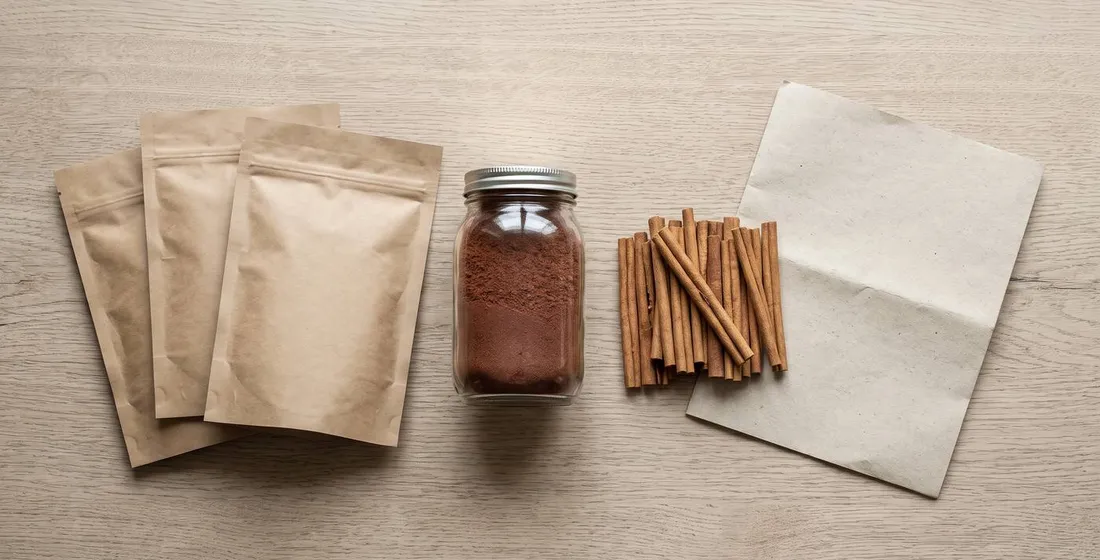
Compliance snapshot
- Regulation (EU) 2025/40, the Packaging and Packaging Waste Regulation (PPWR), entered into force on 11 February 2025 and has applied generally since 12 August 2026 (European Commission, 2026). The first hard rule for food packs is the PFAS limit on food-contact packaging, in force from that date.
- The heavier duties come later: design-for-recycling criteria, plastic recycled content and packaging minimisation from 1 January 2030, and harmonised labelling from the later of 12 August 2028 or 24 months after the implementing acts.
- The obligation usually sits with the brand owner or importer, not with the ingredient supplier. A company that has packaging made under its own name or trademark falls inside the regulation’s definition of manufacturer.
- Silk Route Ventures (SRV) packs private-label spice and herb SKUs from the Silk Foods Ceylon (SFC) facility in Matale, with 4 to 6 weeks from PO to dispatch for private label and unit minimums confirmed on the quote.
- This post is for EU and UK brand owners and importers specifying a first retail pack. It is a buying guide, not legal advice.
On 12 August 2026 the European Commission announced that the packaging regulation had started to apply across the Union. For a brand ordering a private-label pack from Sri Lanka, the date changed one thing at once and several things over the next four years. This piece sets out what changed, who carries the duty when the pack is private label, and which pack formats SRV can supply need a decision from the buyer before artwork is approved. Check the dates against the text on EUR-Lex before you rely on them.
What did Regulation (EU) 2025/40 change, and when?
PPWR replaced a directive with a regulation, so the same rules apply directly in every member state. It applied generally from 12 August 2026, and different articles switch on at different dates. For a retail pack the dates below matter most, drawn from the Commission’s announcement and a 2026 legal summary by Latham & Watkins.
| Measure | Date | What it means for a retail pack |
|---|---|---|
| PFAS limits in food-contact packaging (Art. 5) | 12 August 2026 | Food-contact layers placed on the EU market must stay under the limits |
| Harmonised labelling (Arts. 12 to 14) | Later of 12 August 2028 or 24 months after the implementing acts | Material-composition marking for sorting, so artwork space is needed |
| Design for recycling (Art. 6) | 1 January 2030, or later if the delegated acts slip | Pack structure must meet criteria still being written |
| Recycled content in plastic packaging (Art. 7) | 1 January 2030, or three years after the implementing acts | Applies to plastic parts such as closures and bottles |
| Packaging minimisation (Art. 10) | 1 January 2030 | Weight and volume kept to what the function needs |
| Empty-space ratio (Art. 24) | 1 January 2030 | Maximum 50% for grouped, transport and e-commerce packaging |
| Recyclable at scale | 1 January 2035 | A tighter test on the same pack |
Two cautions. The recyclability criteria and the labelling rules depend on secondary legislation that the Commission was still preparing in late 2026, so some dates may move. And the table is a reading aid. The regulation text and the Commission’s guidance document are the authority.
Who carries the obligation on a private-label pack?
In most private-label set-ups it is the brand owner, the importer, or both. The regulation defines a manufacturer as a company that designs or makes packaging, or has packaging made, under its own name or trademark. An importer is a company that places packaging, or packaged products, from outside the EU on the EU market. A non-EU company placing packs on the market may need an EU authorised representative.
A brand owner commissioning a private-label pack has the packaging made under its own name, which points at the manufacturer definition. SRV ships filled packs on a FOB Colombo basis, with CFR and CIF on request, and does not quote DDP. The EU buyer is therefore the importer of record for the filled pack, and the documents that follow from that role stay with the buyer.
How those roles map onto your own structure is a question for your regulatory adviser, not for a supplier’s blog post. What a supplier can do is state the pack material in writing, and that is the first thing to ask for.
Where SRV does not fit A buyer who wants the supplier to act as importer of record for the EU, hold the packaging registrations and carry the producer fees will not find that arrangement at SRV. SRV supplies the filled pack, the pack specification and the documents of a normal export order. The compliance role in the EU belongs to the brand or to an importer it appoints.
Which SRV pack formats need a decision from the buyer?
Every format needs the same three questions: what is it made of, what does it touch the food with, and what will it need to say. The answers differ by format. The table lists the formats SRV works with and the decision each one raises. It describes decisions, not compliance outcomes, because compliance depends on the exact material and the date of placing on the market.
| Format | What PPWR touches | Decision before artwork is approved |
|---|---|---|
| Kraft pouches, 50 g to 1 kg | Laminate or liner structure, PFAS in the food-contact layer, future recyclability criteria | Fibre-based or plastic-based structure, and a written material declaration |
| Kraft window pouches | The window film is a second material | Whether the window is worth a harder recycling case |
| Glass jars, 50 ml to 1 L | Metal lid and any lid liner, label adhesive | Lid material and what the label says about disposal |
| Round tin cans, 400 ml | Internal coating on the can | Written confirmation of the coating from the can maker |
| Capsule bottles, 60-count | Plastic body and closure, recycled content from 2030 | Resin type and closure, with the 2030 date in the launch plan |
| Tea bags | Article 9 compostability from 12 February 2028 | Bag material, see the tea bag formats guide |
| Cartons and 25 kg sacks | Grouped and transport packaging, empty space from 2030 | Carton size against fill, outer count per pallet |
Glass has the simplest story because it is a single material with a long-established recycling stream, but the lid decides whether the whole pack is easy to sort. Kraft looks like paper and often is not entirely paper, since many kraft pouches carry a plastic inner layer for barrier. That is not a fault. It is the reason the structure should be declared before anyone claims a pack is recyclable.
Buyer’s checklist: before approving a private-label pack
- Ask for the pack material composition, layer by layer, in writing
- Ask the pack maker for a PFAS declaration covering the food-contact layer
- Confirm which party buys each pack component, SRV or the brand
- Leave space on the artwork for a material-composition mark that is not yet specified
- Put the 1 January 2030 recyclability and recycled-content dates in the launch plan
- Ask your adviser who the manufacturer, importer and authorised representative are
What does the PFAS limit mean for a spice or jar pack?
It means the food-contact layer of a pack placed on the EU market from 12 August 2026 has to stay under the limits in Article 5. For a dry spice in a kraft pouch the question is whether a grease-resistant or barrier coating contains PFAS. For a jar it is mainly the lid liner. Secondary summaries of the Commission’s guidance note that there is no single harmonised test method for every material, so a written declaration from the pack maker is the practical document.
The earlier a pack is declared, the less the date matters. A material declaration collected before artwork is approved costs a phone call. The same question found after the pouches are printed costs a reprint.
How should the timeline be planned?
Build it backwards from the regulatory date that bites hardest on your pack, then add the supplier’s own lead time. Private-label orders at SRV take 4 to 6 weeks from PO to dispatch, against 2 to 3 weeks for standard SKUs, and sea freight to the EU adds 3 to 4 weeks. Artwork and pack approval sit upstream of all of that, so a pack that needs a new material or a new declaration pushes the launch date before the order is even placed.
The practical sequence is short. Choose the format. Get the material declaration. Approve artwork with space for the future label. Then place the PO. The private-label spice blend range guide covers the formulation and label work that runs in parallel, and the own-brand labels and certified export pallet piece covers what goes on the outer carton.
Does PPWR apply to packs sold in the UK?
No, and that is a common mix-up. The regulation is EU law and does not apply in Great Britain. GB runs its own packaging extended producer responsibility scheme, administered through GOV.UK, where brand owners and importers report packaging data and pay fees (GOV.UK, 2026). A brand selling in both markets works to two regimes with different dates, definitions and paperwork. The GB organic and labelling guide covers the labelling side for UK buyers, and the 2026 export compliance checklist covers the wider document set for EU and US shipments.
Frequently asked questions
When did the EU packaging regulation (PPWR) start to apply?
Regulation (EU) 2025/40 entered into force on 11 February 2025 and has applied generally since 12 August 2026. The PFAS limit for food-contact packaging applies from the same date. Recyclability criteria, plastic recycled content and packaging minimisation follow from 1 January 2030, so a pack ordered now has to be planned across both dates.
Who is responsible for PPWR compliance on a private-label spice pack?
Usually the brand owner, the importer, or both. The regulation treats a company that has packaging made under its own name as a manufacturer, and a company that places packaged products from outside the EU on the market as an importer. SRV supplies filled packs FOB Colombo and does not quote DDP, so the EU buyer holds the importer role. Confirm the mapping with your adviser.
Does Silk Route Ventures offer private label for spices in kraft or glass packs?
Yes. SRV packs private-label spices and herbs from the Silk Foods Ceylon facility in Matale, which holds FSSC 22000 V6 for spice products, in kraft pouches from 50 g to 1 kg and in glass jars. Lead time runs 4 to 6 weeks from PO to dispatch, unit minimums are confirmed on the quote, and samples are free for evaluation with the buyer paying the courier.
Does PPWR apply to packs I sell in the UK?
No. PPWR is EU law and does not apply in Great Britain, which has its own packaging extended producer responsibility scheme run through GOV.UK. A brand selling in both markets reports and pays under both regimes, with different dates and definitions.
How Silk Route Ventures can help
Silk Route Ventures supplies private-label spices and herbs to brands and importers in the EU and UK, packed at the Silk Foods Ceylon facility in Matale, which holds BRCGS and FSSC 22000 V6, with FSSC 22000 V6 as the scope for spice products and USDA Organic and EU Organic on selected SKUs, confirmed per SKU. Private-label and custom-specification orders ship 4 to 6 weeks from PO to dispatch, retail-pack minimums are confirmed on the quote, and trial quantities start from 10 kg. For brands planning a first pack, the team can discuss pack format and material at the quote stage, before artwork is approved. Browse the Ceylon spices range, then contact us with your pack format and target market.
Sources
- European Commission, Directorate-General for Environment, “New EU rules on packaging enter into application” (11 August 2026). Retrieved 2026-11-23. https://environment.ec.europa.eu/news/new-eu-rules-packaging-enter-application-2026-08-11_en
- European Parliament and Council, “Regulation (EU) 2025/40 on packaging and packaging waste,” Official Journal of the European Union, 22 January 2025. Retrieved 2026-11-23. https://eur-lex.europa.eu/legal-content/EN/TXT/?uri=OJ:L_202500040
- Latham & Watkins, “European Packaging and Packaging Waste Regulation: Summary of Provisions and New Guidance” (24 April 2026). Retrieved 2026-11-23. https://www.lw.com/en/insights/european-packaging-and-packaging-waste-regulation-summary-of-provisions-and-new-guidance
- GOV.UK, “Extended producer responsibility for packaging: who is affected and what to do” (2026). Retrieved 2026-11-23. https://www.gov.uk/guidance/extended-producer-responsibility-for-packaging-who-is-affected-and-what-to-do
Further reading
- Silk Route Ventures, “Private-Label Organic Ceylon Cinnamon: Pack Formats, Organic Labelling and First-Run MOQ” → https://www.esilkroute.com.lk/blog/private-label-organic-ceylon-cinnamon-pack-formats-organic-labelling-and-first-run-moq/
- Silk Route Ventures, “Private-Label Simmer Sauces in Glass Jars: Retort Process, Fill and MOQ” → https://www.esilkroute.com.lk/blog/private-label-simmer-sauces-in-glass-jars-retort-process-fill-and-moq/
Written by the Silk Route Ventures Trade Team. Silk Route Ventures (E-Silk Route Ventures (Pvt) Ltd) is a Sri Lankan B2B supply-chain operator for the Food, Beverage, Wellness and Nutraceuticals sectors. The Silk Foods Ceylon manufacturing arm holds BRCGS and FSSC 22000 V6 certifications. Questions or to request a sample: Contact us or email info@esilkroute.com.lk.