
Rambutan and Mangosteen Powder for Premium Beverage Lines
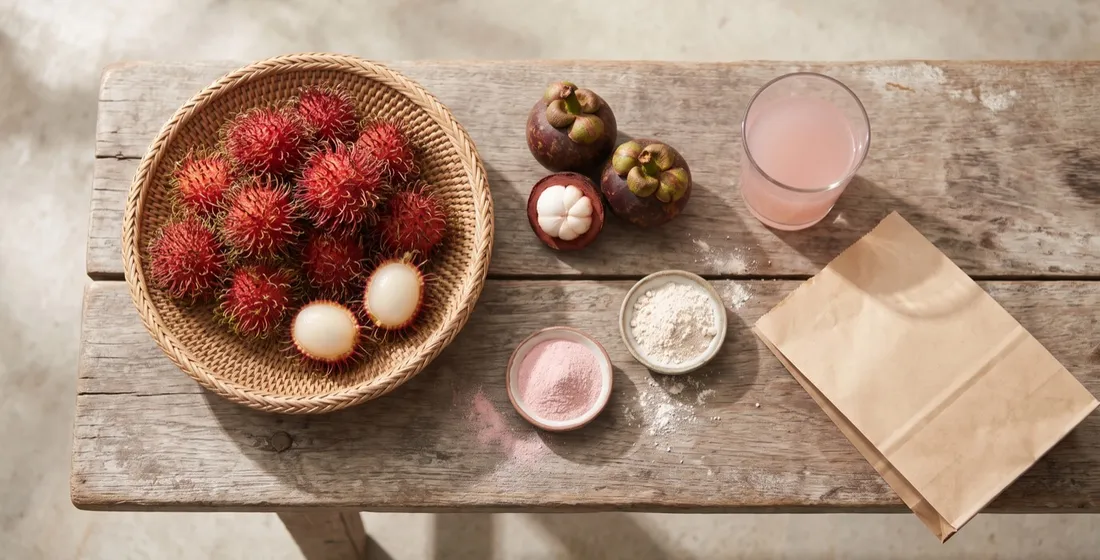
Buyer’s snapshot
- Mangosteen’s xanthones sit in the rind, not the fruit you eat. Analysis published in the Journal of Enzyme Inhibition and Medicinal Chemistry in 2020 measured alpha-mangostin at 403.9 mg/g in pericarp extract against 1.2 mg/g in the aril, with total xanthone content of the pericarp roughly 100 times that of the aril on raw dry material. Most mangosteen powder on the market is aril.
- Rambutan is not a stability problem in storage so much as a browning problem in processing. Work in Frontiers in Plant Science in 2022 identified polyphenol oxidase driven enzymatic browning as the primary constraint on rambutan shelf life.
- Drying method decides the colour you get. Freeze-dried mangosteen pericarp held 2.11 to 2.20 mg/g total anthocyanins in a 2023 Foods study, against 0.41 to 0.70 mg/g oven-dried and 0.14 to 0.15 mg/g sun-dried.
- A spray-dried tropical pulp powder at 15 percent carrier and 170 degrees Celsius inlet returned water activity of 0.255 and 62.5 percent anthocyanin retention in a 2024 Heliyon trial. The carrier is not a detail. It is a line on your ingredient legend.
- Silk Foods Ceylon spray-dries fruit powder in Matale at 50 kg per day under BRCGS and FSSC 22000 V6, with a 50 kg first-order MOQ per SKU.
Ask ten beverage formulators what rambutan powder tastes like and most will describe the fresh fruit. Ask what it does in a clear PET bottle at pH 3.4 after a 92 degree tunnel pasteuriser, and the room goes quiet. Rambutan and mangosteen are the two fruits buyers name when they want an Asian beverage line to sound premium rather than generic, and they are also the two where the gap between the fruit and the ingredient is widest. This piece is the formulation and sourcing spec for both, written for the people who have to make the liquid work.
What are you actually buying when you order rambutan or mangosteen powder?
Rambutan powder is made from the aril, the translucent white flesh around the seed. There is no commercially traded alternative part. Mangosteen powder is the ambiguous one. It can be milled from the snow-white aril, from the thick purple pericarp, or from a blend of both, and the three behave nothing alike.
The 2020 LC-QTOF-MS work cited above puts numbers on that difference. In extract form, alpha-mangostin ran 403.9 mg/g in pericarp against 1.2 mg/g in aril, and total xanthones 521.2 against 5.4 mg/g. On raw dry material the pericarp figure was 185.5 mg/g against 0.6 mg/g. The ranking across the plant ran pericarp, then calyx, bark, stalk, stem, leaves, and aril last. A brand positioning a mangosteen SKU on xanthone content, then specifying aril powder, has built a claim its own ingredient cannot carry. The claim and labelling side of that decision is covered separately in mangosteen powder and xanthone spec for premium retail. What matters here is that the part of the fruit is a spec line, and most RFQs leave it blank.
Pericarp is also where the colour is. The anthocyanin that drives mangosteen’s deep red is concentrated in the rind, which means a white aril powder will contribute flavour and body to a beverage but almost no colour, and a pericarp powder will contribute colour that then has to survive your pH and your process.
Why rambutan and mangosteen behave as opposites in a beverage base
| Spec line | Rambutan (aril) | Mangosteen aril | Mangosteen pericarp |
|---|---|---|---|
| Primary contribution | Sweet aromatic top note | Soft acid and body | Colour, bitterness, xanthones |
| Colour in solution | Near colourless to pale cream | Near colourless | Deep red, pH dependent |
| Main processing risk | Enzymatic browning before drying | Aroma loss in the dryer | Anthocyanin loss and astringency |
| Needs a blanch step | Yes | Usually | Yes for colour retention |
| Carrier typically required | Yes, high sugar load | Yes | Lower than aril |
| Works in a clear bottle | Yes | Yes | Only with pH and light control |
| Typical role in a formula | Lead flavour | Rounding and mouthfeel | Colour and claim substrate |
Read down that table and the pairing logic appears. Rambutan carries the aroma a premium Asian line is bought for and contributes almost nothing visually. Mangosteen pericarp contributes the visual signature and a substantiable compositional story, and contributes bitterness you have to formulate around. The two are complementary precisely because neither is sufficient. A rambutan-only RTD looks like water. A pericarp-only RTD looks superb and tastes medicinal.
The browning problem nobody puts in the RFQ
Rambutan’s binding constraint is polyphenol oxidase. The 2022 Frontiers in Plant Science study, which ran fruit at 25 degrees Celsius over eight days, named PPO driven enzymatic browning as the primary constraint affecting storage life, ahead of microbial load. That is a processing instruction, not a storage warning. If the aril browns before it reaches the dryer, no drying method recovers the colour, and a premium beverage built on a grey-beige powder has a problem the marketing budget cannot fix.
Blanching is the control, and the useful parameters come from the mangosteen side of the same problem. Work on mangosteen pericarp published in Food Technology and Biotechnology in 2024 measured residual PPO activity after 90 seconds of hot water blanching at 18.4 percent, against 61.0 percent for 90 seconds of steam. PPO half-life ran 59.0 seconds in hot water against 121.1 seconds in steam. Hot water kills the enzyme faster.
The same study found the opposite ranking for everything else worth keeping. Steam blanching for 90 seconds gave the best anthocyanin result at 3.03 mg/g, of which cyanidin-3-O-sophoroside was 2.94 mg/g, the best total phenolic content at 1057 mg GAE/g against 264 for the untreated control, and better redness with an a* value of 32.8 against 24.0 for hot water. Steam protects the pigment and the phenolics. Hot water protects against browning.
That is why the two fruits want different blanch decisions from the same plant. Rambutan aril has no pigment to lose and an enzyme to kill, so the hot water route fits. Mangosteen pericarp is bought for the pigment, so a steam blanch that gives up some enzyme inactivation to keep the colour is usually the better trade. A supplier running one blanch setting for every fruit that crosses the line is optimising for the plant, not for your formula.
Which makes the blanch the single most useful question to put to a supplier. Ask which medium and which dwell time they run, for which fruit, and why. A supplier who cannot answer is buying dried material from someone else and reselling it.
Drying method, and what it costs you
Three drying routes, three different ingredients
- Freeze-drying: highest pigment and volatile retention, no carrier required, single-ingredient declaration possible, highest cost per kg.
- Spray-drying: high throughput, low unit cost, free-flowing and fast to reconstitute, requires a carrier, thermal loss on the fragile fractions.
- Oven and sun drying: lowest cost, unacceptable pigment loss for a premium coloured beverage, and sun drying is not a controlled process.
The 2023 Foods study on mangosteen pericarp quantified the spread. Freeze-drying for 36 and 48 hours held total anthocyanins at 2.11 and 2.20 mg/g. Oven drying over the same windows returned 0.70 and 0.41 mg/g. Sun drying returned 0.14 and 0.15 mg/g. Antioxidant capacity tracked it, with freeze-dried at 36 hours measuring 785.9 micromoles Trolox equivalent per gram against 201.4 for sun-dried.
Spray-drying sits in between, and the 2024 Heliyon trial on tropical pulp gives usable benchmarks. At 170 degrees Celsius inlet with 15 percent wall material, the powder came out at 0.303 percent moisture, 0.255 water activity, 7.279 g/100 g hygroscopicity, 23.206 percent water solubility index, and 70.285 percent process yield. Compound retention was uneven in a way that matters: ascorbic acid 96.9 percent, flavonoids 82.1 percent, total phenolics 65.1 percent, anthocyanins 62.5 percent. The pigment is the first thing the dryer takes.
For rambutan, where there is no pigment to protect and the value is aroma and sweetness, spray-drying is usually the honest choice. For mangosteen pericarp in a product whose whole premise is the colour, freeze-drying earns its price. The same logic runs through the comparison of spray-dried and freeze-dried pineapple powder and the soursop beverage and ice cream spec.
How much of your fruit powder is maltodextrin?
This is the question that decides your label. Rambutan aril is high in sugar and organic acid, which gives the concentrate a low glass transition temperature. It sticks to the dryer wall. The industry answer is a carrier, usually maltodextrin, typically declared, and at the 15 percent wall material loading in the Heliyon work above, meaningful.
Three consequences follow, and all three belong on the RFQ. The carrier is an ingredient and appears in the legend, so a clean-label positioning has to survive it. The carrier dilutes everything you are paying for per kilo, so two quotes at different carrier loads are not comparable on price. And the carrier changes reconstitution behaviour, Brix contribution, and how the powder sits in a stick pack. Ask for the carrier identity and the percentage as a number, not as “minimal.”
Dosing into three formats
| Format | Typical issue | What to specify |
|---|---|---|
| Ready to drink, clear bottle | Colour drift at low pH, sediment, light exposure | Pericarp dose, pH range, particle size, light barrier |
| Stick pack or sachet | Caking, flowability, dissolution speed | Water activity, hygroscopicity, bulk density, mesh |
| Liquid concentrate | Carrier interaction, sugar load, microbial spec | Carrier percentage, Brix, water activity, total plate count |
Water activity is the number to hold a supplier to across all three. The 0.255 figure from the spray-drying trial is the kind of value a well-run process delivers, and a powder arriving materially wetter will cake in a sachet and clump on reconstitution regardless of how good the fruit was.
Where the demand actually is
The commercial case for an Asian fruit line is not that rambutan and mangosteen are large flavours. They are not. Reporting in Food Technology in 2026, drawing on Innova Market Insights data, put mango at the top of global food and beverage launches carrying tropical flavours across 2023 to 2025, followed by banana and coconut, with the US order running mango, pineapple, coconut. Tropical flavours accounted for 14 percent of new US sports nutrition launches. The movement is in the tail: camu camu launches grew 64 percent globally between 2023 and 2025.
Consumer appetite in the origin region is real and measurable. Mintel reported in 2026 that 54 percent of Filipino consumers look for new foods and flavours most of the time, that 41 percent of Thai consumers want drinks that challenge the senses through taste and aroma, and that 41 percent of Singaporeans aged 18 to 34 enjoy breaking the rules in what they eat and drink.
The wider category is funding the experiment. FoodNavigator reported in November 2025 that functional food and beverage stood at 364 billion US dollars heading for more than 793 billion by 2032 on Fortune Business Insights data, a compound growth rate above 10 percent, with 59 percent of global consumers prioritising gut health on Innova’s numbers. Rambutan and mangosteen are differentiation plays inside a growing category, not volume plays. Specify them accordingly, in the flavour and colour positions, at doses a premium SKU can carry.
Where Sri Lanka fits, and what it cannot do
Sri Lanka grows both fruits, in the wet zone and the Kandy and Matale districts, with rambutan in particular a well-established smallholder crop with a short, sharp season. That seasonality is the honest constraint. Sri Lanka is not Thailand or Indonesia on rambutan or mangosteen volume, and a buyer who needs several hundred tonnes a year of either powder should hear that from a supplier rather than discover it at the second purchase order.
What the origin does well is the other half of the problem. A processor sitting close to the fruit can blanch within hours of harvest, which is exactly what the PPO data says matters, and can run the material under one certification stack rather than buying dried intermediate from an unnamed party. For a premium beverage line built on modest tonnages and a defensible story, that is the right trade. For commodity volume it is not.
On the regulatory side, treat the part of the fruit as a regulatory variable, not only a technical one. Under Regulation (EU) 2015/2283, a food with negligible consumption in the Union before 15 May 1997 is a novel food, and the Commission’s status catalogue is an indicative, non-binding tool rather than a decision. Aril and pericarp are not automatically in the same position, and the sensible sequence is to settle status with your regulatory counsel for the specific material and market before a launch date is set. Contaminant limits sit under Regulation (EU) 2023/915, which set the maximum levels for lead, cadmium, mercury, arsenic and nickel and repealed the earlier Regulation 1881/2006. Dried powders concentrate what was in the fruit, so per-lot testing is the control, and how to read what comes back is covered in per-lot heavy metal and pesticide testing. Buyers shipping into the EU should also read the MRL and novel food note for botanical ingredient sourcing.
What to put in the RFQ
- Part of fruit, stated explicitly: rambutan aril, mangosteen aril, mangosteen pericarp, or a defined blend ratio
- Drying method and, for freeze-dried, the cycle length
- Blanch medium and dwell time, with the reason for the choice
- Carrier identity and percentage as a number, plus the resulting ingredient legend
- Moisture, water activity, hygroscopicity, bulk density, and mesh or particle size distribution
- Colour specification for pericarp material, with the pH at which it was measured
- Anthocyanin or total phenolic content where a colour or composition claim depends on it
- Per-lot certificate of analysis covering heavy metals, pesticide residues and microbiology
- Lot traceability to harvest window and processing site
- Sample quantity and lead time, then a pilot batch before the first commercial order
The same discipline applied to a liquid base rather than a powder is set out in the coconut water and fruit beverage base RFQ primer.
FAQ
Is mangosteen powder made from the rind or the fruit?
Both are sold, and they are different ingredients. Analysis in the Journal of Enzyme Inhibition and Medicinal Chemistry in 2020 measured total xanthones in the pericarp at roughly 100 times the aril level on raw dry material, with alpha-mangostin at 403.9 mg/g in pericarp extract against 1.2 mg/g in aril. Specify which part you want.
Why does rambutan powder go brown?
Polyphenol oxidase. A 2022 Frontiers in Plant Science study identified PPO driven enzymatic browning as the primary constraint on rambutan storage life. The control is a blanch step before drying, and the blanch medium matters. In 2024 work on mangosteen pericarp in Food Technology and Biotechnology, hot water blanching for 90 seconds left 18.4 percent residual PPO activity against 61.0 percent for steam.
Does spray-drying ruin mangosteen colour?
It costs a meaningful share of it. A 2024 Heliyon trial on spray-dried tropical pulp at 170 degrees Celsius inlet and 15 percent carrier recorded 62.5 percent anthocyanin retention, against 96.9 percent for ascorbic acid. Freeze-drying held 2.11 to 2.20 mg/g anthocyanins in mangosteen pericarp versus 0.41 to 0.70 mg/g oven-dried in a 2023 Foods study.
Can Silk Route Ventures supply a trial quantity before we commit to a container?
Yes. Samples ship door to door by international courier in 3 to 5 business days, and the first order MOQ is 50 kg per SKU, which is sized for a pilot run rather than a commercial launch. Spray-dried fruit powder is produced in-house in Matale at 50 kg per day.
How Silk Route Ventures can help
Silk Route Ventures (SRV) supplies tropical fruit powders, including rambutan and mangosteen, to beverage formulators, specialty brands and multi-category distributors across the US, EU and Australia. Bulk ingredient supply ships against the buyer’s written spec from the BRCGS and FSSC 22000 V6 audited Silk Foods Ceylon (SFC) facility in Matale, with spray-dried powder produced in-house at 50 kg per day and freeze-dried sourced to the buyer’s stated parameters. Part of fruit, blanch protocol, carrier percentage and water activity are all specifiable lines, not house defaults. First-order MOQ is 50 kg per SKU, and samples ship door to door by international courier in 3 to 5 business days.
For brands taking an Asian fruit line to market under their own label, the same powder is available inside a finished private-label SKU from the same site, and distributors can consolidate fruit powders with the wider spice, herb and coconut catalogue under one certification stack and one set of customs documents. Contact SRV to send an inquiry or request a sample pack.
Sources
-
Journal of Enzyme Inhibition and Medicinal Chemistry, “Comparative analysis of xanthones in different parts of Garcinia mangostana by LC-QTOF-MS,” 2020. https://pmc.ncbi.nlm.nih.gov/articles/PMC7717613/ (retrieved 16 September 2026)
-
Molecules (MDPI), “Optimisation of microwave-assisted extraction of alpha-mangostin from mangosteen pericarp,” 2018. https://pmc.ncbi.nlm.nih.gov/articles/PMC6222712/ (retrieved 16 September 2026)
-
Foods (MDPI), “Effect of drying methods on anthocyanins and antioxidant capacity of mangosteen pericarp,” 2023. https://pmc.ncbi.nlm.nih.gov/articles/PMC10297665/ (retrieved 16 September 2026)
-
Food Technology and Biotechnology, “Blanching treatment and polyphenol oxidase inactivation in mangosteen pericarp,” 2024. https://pmc.ncbi.nlm.nih.gov/articles/PMC11740744/ (retrieved 16 September 2026)
-
Heliyon (Elsevier), “Spray-drying of tropical fruit pulp: process parameters, powder properties and bioactive retention,” 2024. https://pmc.ncbi.nlm.nih.gov/articles/PMC11260920/ (retrieved 16 September 2026)
-
Frontiers in Plant Science 12:795671, “Postharvest quality and enzymatic browning in rambutan,” 2022. https://pmc.ncbi.nlm.nih.gov/articles/PMC8787335/ (retrieved 16 September 2026)
-
Institute of Food Technologists, Food Technology, “The New Tropical Fruit Palette,” 22 July 2026, citing Innova Market Insights. https://www.ift.org/food-technology-magazine/the-new-tropical-fruit-palette (retrieved 16 September 2026)
-
Mintel, “Flavour Trends 2026,” 2026. https://www.mintel.com/insights/events/flavour-trends-2026/ (retrieved 16 September 2026)
-
FoodNavigator, “Top 5 functional food and beverage ingredients trends for 2026,” 5 November 2025. https://www.foodnavigator.com/Article/2025/11/05/top-5-functional-food-and-beverage-ingredients-trends-for-2026/ (retrieved 16 September 2026)
-
Regulation (EU) 2015/2283 of the European Parliament and of the Council on novel foods. https://eur-lex.europa.eu/legal-content/EN/TXT/?uri=CELEX%3A32015R2283 (retrieved 16 September 2026)
-
Commission Regulation (EU) 2023/915 on maximum levels for certain contaminants in food, 25 April 2023. https://op.europa.eu/en/publication-detail/-/publication/791311ae-eae0-11ed-a05c-01aa75ed71a1 (retrieved 16 September 2026)
Written by the Silk Route Ventures Trade Team. Silk Route Ventures (E-Silk Route Ventures Ltd) is a Sri Lankan B2B supply-chain operator for the Food, Beverage, Wellness, and Nutraceuticals sectors. The Silk Foods Ceylon manufacturing arm holds BRCGS and FSSC 22000 V6 certifications, with USDA Organic and EU Organic on the relevant lines. Questions or to request a sample: Contact us or email info@esilkroute.com.lk.