
Mangosteen Powder for Premium Retail: Xanthone Spec and Antioxidant-Claim Framing
By the Silk Route Ventures Trade Team | 2 July 2026
Buyer’s snapshot
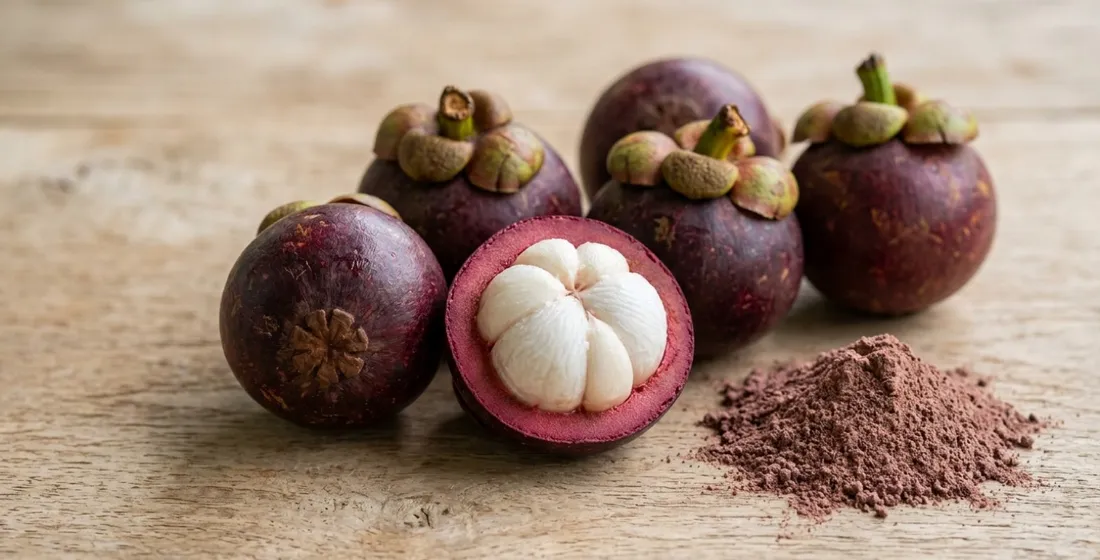
- Mangosteen (Garcinia mangostana) concentrates its xanthones in the pericarp, the thick purple rind, not the sweet white aril most people eat. Alpha-mangostin and gamma-mangostin are the most abundant (Wittenauer et al., Food Chemistry, 2012). The fruit part your powder is milled from sets its xanthone spec.
- In 2012 the US Department of Agriculture withdrew its ORAC antioxidant database, calling the values not relevant to human health and routinely misused in marketing. “High in antioxidants” no longer has a defensible spine.
- In the EU, Regulation (EC) 1924/2006 does not permit a general antioxidant claim unless it is authorised. In the US, 21 CFR 101.54 ties an antioxidant content claim to a nutrient with an established RDI, which xanthones do not have.
- Silk Route Ventures supplies bulk and private-label mangosteen powder from a Matale facility under BRCGS and FSSC 22000 V6, with a COA on request and a 100 kg MOQ per SKU.
- For brands building a documented premium SKU, this post is the spec. For a plan that hinges on the highest ORAC number, it is the reset.
Most mangosteen powder sold into premium retail is milled from the sweet white aril or the whole fruit. The compounds buyers think they are paying for, the xanthones, sit somewhere else entirely: in the deep purple rind that most eaters discard. That single fact decides the spec. So does the process, because a spray-dried powder on a maltodextrin carrier and a plain dried-and-milled rind powder are not the same ingredient. And the antioxidant story that built the mangosteen category has quietly lost its footing since the US Department of Agriculture withdrew its ORAC database in 2012. This piece is the spec-and-claim reset for brand owners and procurement teams sourcing mangosteen for a US, EU, or Australian SKU.
Where do the xanthones in mangosteen actually live?
Mangosteen (Garcinia mangostana) concentrates its xanthones in the pericarp, the thick purple rind, not the sweet white aril most people eat. Alpha-mangostin and gamma-mangostin are the most abundant of the 60-plus xanthones identified in the rind (Wittenauer et al., Food Chemistry, 2012; Gutierrez-Orozco et al., Journal of Agricultural and Food Chemistry, 2013). The fruit part a powder is milled from therefore sets its xanthone spec.
That distinction is the whole ballgame for a premium claim. An aril powder tastes better and carries the fruit’s sugars and acids, but it is xanthone-poor. A pericarp powder is xanthone-rich but tannic, astringent, and deep reddish-purple. A whole-fruit powder is a blend of the two, with a xanthone level that depends entirely on the rind-to-aril ratio the processor used. A brand that specifies “mangosteen powder” without naming the fruit part has not specified a xanthone level at all.
There is a second trap in the numbers. Peer-reviewed studies report alpha-mangostin in solvent-optimised rind extracts at anywhere from tens to over 100 mg per gram, but those are concentrated laboratory extracts, not the concentration a buyer gets in a dried-and-milled food powder. Extract concentrations are not powder concentrations. Anyone quoting a lab extract figure on a food-powder label is comparing two different things. Different fruit part, different process, different spec.
Mangosteen sits inside a wider category, and the same fruit-part and process questions run through it; Silk Route Ventures maps the range in its guide to fruit powders and bars from Sri Lanka.
Specifying mangosteen powder in a sourcing RFQ
A finished mangosteen powder’s fruit-solids content, and therefore its xanthone content, depends on the carrier load. Spray-dried fruit powders typically use maltodextrin to control stickiness and hygroscopicity, and every percentage point of added carrier proportionally dilutes the fruit solids (peer-reviewed spray-drying literature, 2020 to 2023). A spec that omits the carrier percentage is incomplete, because two powders labelled the same can differ by half in actual fruit content.
The pericarp powder route adds its own handling notes: the rind is tannin-rich, hygroscopic, and dark, so drying method, particle size, caking, and blend ratios all need to be pinned down before a first order, the same way they are for a mango powder sourcing spec. A sourcing brief should name each of the parameters below and require a batch COA against them, rather than accepting a generic “premium mangosteen powder” line.
Spec snapshot: mangosteen fruit powder
- Fruit part: pericarp (rind), aril, or whole fruit, stated explicitly
- Process: dried-and-milled or spray-dried; if spray-dried, carrier type and percentage declared (for example maltodextrin at a named load)
- Moisture: target range for a stable dried fruit powder
- Particle size / mesh: to the application (beverage dispersibility versus capsule fill)
- Color and organoleptic: pericarp powders run dark reddish-purple and astringent
- Microbial: Total Plate Count, yeast and mould, Salmonella (absent), E. coli / coliforms
- Heavy metals: to Codex CXS 193-1995 limits for dried fruit products
- Pesticide residues: to the destination market MRL (EU Pesticides Database or US FDA)
- COA on every batch, plus the full export documentation pack
Silk Foods Ceylon (SFC) processes fruit powders two ways from its Matale facility: spray-dried at 50 kg per day, and dried-and-milled on the spice line at 100 to 200 kg per hour. A COA is available on request, and the powder can be specified by fruit part, process, and carrier load so the xanthone and fruit-solids spec is defined before the first purchase order rather than discovered after it.
Why “high in antioxidants” will not carry a premium mangosteen SKU
In 2012 the US Department of Agriculture’s Agricultural Research Service withdrew its ORAC (Oxygen Radical Absorbance Capacity) database, stating the values had no relevance to human health and were routinely misused to market foods and supplements (USDA ARS, 2012). The single number that built the superfruit category is no longer an authority a brand can cite.
The category has been here before. In September 2006, the FDA sent a warning letter to XanGo LLC over mangosteen-juice marketing that promoted the drink against cancer, inflammation, and viral infection, among roughly twenty other health benefits (FDA warning letter, 2006). The juice sold. The claims did not survive regulatory contact. For a procurement team writing a mangosteen brief in 2026, that letter is not history; it is the compliance baseline.
The practical consequence for sourcing is simple. If the premium cannot rest on an antioxidant adjective or an ORAC score, it has to rest on the spec: a named fruit part, a verified xanthone profile, a clean COA, and traceable origin. That is a harder story to tell on a shelf than “antioxidant superfruit,” and it is the only one that holds up when a compliance team reads the label. It is the same claim discipline that governs a blood-sugar SKU built on Gymnema: the function has to be evidenced, not asserted.
How do you frame a compliant mangosteen claim in the US and EU?
Under Regulation (EC) No 1924/2006, a general antioxidant claim is not permitted in the EU unless it is specifically authorised, and health claims on botanical substances remain on hold pending Commission review, a position the Court of Justice reaffirmed in 2025 (Case C-386/23, Novel Nutriology). A brand cannot simply print “antioxidant” on an EU label and move on.
The US path is narrow but definable. Under 21 CFR 101.54, an antioxidant nutrient content claim such as “high in antioxidants” can only attach to a nutrient that has an established Reference Daily Intake and recognised antioxidant activity, for example vitamin C or vitamin E, and the claim has to name that nutrient. Xanthones have no RDI, so “high in antioxidants” is not a compliant nutrient content claim for a xanthone-driven powder. The defensible routes are to name a qualifying nutrient the powder genuinely delivers, or to make a carefully worded structure or function statement backed by evidence and carrying the standard supplement disclaimer, with no disease claim attached. The same framing question shapes enzyme claims on papaya powder, where the compound is real but the permitted wording is narrow.
The table below maps the realistic claim options by market.
| Approach | United States | European Union |
|---|---|---|
| Generic “antioxidant” / “high in antioxidants” | Only if tied to a nutrient with an established RDI (vitamin C, E) and that nutrient is named (21 CFR 101.54); not usable for xanthones alone | Not permitted unless specifically authorised (Reg (EC) 1924/2006) |
| ORAC value as a selling point | Not supported; USDA withdrew the ORAC database in 2012 | Not supported; not an authorised basis for a claim |
| Botanical / xanthone health claim | Structure/function statement allowed with evidence and the DSHEA disclaimer; no disease claims | Botanical health claims on hold pending Commission review (CJEU C-386/23, 2025) |
| Defensible premium angle | Named fruit part, verified xanthone content, clean COA, traceable origin | Same: spec and provenance, not adjectives |
Source: 21 CFR 101.54; USDA ARS (2012); Regulation (EC) 1924/2006; CJEU Case C-386/23 (2025).
Where Sri Lanka fits in the global mangosteen supply chain
Thailand dominates the mangosteen trade, exporting about 248,600 tonnes worth roughly US$502 million in 2023, up around 21 percent year on year, with China taking close to 94 percent of that volume (Thai government trade data, reported 2023). Sri Lanka grows mangosteen but is a minor supplier, and the standard trade databases do not report it separately.
There is a data caveat worth knowing before anyone quotes a production figure. FAOSTAT groups mangosteen with mangoes and guavas under a single item code, so a clean standalone “mangosteen production” number from FAOSTAT does not exist; it is a combined category. Sri Lanka’s Export Development Board lists mangosteen among the country’s tropical fruits, but Sri Lanka is not a volume player and carries no separately published mangosteen export figure.
So the honest positioning is that Silk Route Ventures does not compete on mangosteen tonnage. It competes on a certified, traceable, spec-controlled powder with a COA on request out of Matale, for brands that need documentation rather than the lowest landed price.
Where Silk Route Ventures does not fit
- Commodity juice-concentrate buyers chasing the lowest landed price will find Thailand and Indonesia the more honest answer on volume.
- Silk Route Ventures fits brands sourcing a documented, low-MOQ premium powder with a defined fruit-part and xanthone spec, not a bulk superfruit commodity.
Contamination and import-compliance checks for a dried fruit powder
Contaminant limits for dried fruit products are set internationally by the Codex General Standard for Contaminants and Toxins in Food and Feed (CXS 193-1995), and EU pesticide maximum residue levels apply identically to imported and EU-grown food, searchable per commodity in the EU Pesticides Database. A dried fruit powder clears customs on documentation, not reputation.
The US FDA can subject an imported ingredient to Detention Without Physical Examination under an Import Alert for issues such as Salmonella or illegal pesticide residues. There is no mangosteen-specific import alert, so the point is not a category-specific risk; it is that the general detention regime applies to any imported dried fruit powder. The COA and the documentation pack are what move the shipment. For brands adding a USDA Organic or EU Organic layer, the organic transaction certificate joins that pack; the buyer’s guide to organic certifications covers when that layer pays back.
Buyer’s checklist: verifying a mangosteen powder supplier
- Fruit part (pericarp, aril, or whole) confirmed in writing, not assumed
- Process and carrier percentage declared on the spec sheet
- Per-batch COA including microbial, heavy metals, and a pesticide panel to the destination market
- Heavy metals assessed against Codex CXS 193-1995 for dried fruit
- A named, defensible claim path for the destination market (not “high in antioxidants”)
- Full export documentation pack: commercial invoice, packing list, bill of lading, certificate of origin, phytosanitary certificate, COA, and organic transaction certificate for organic SKUs
- A sample dispatched against the spec before any purchase order
FAQ
Which part of the mangosteen has the most xanthones?
The pericarp, the thick purple rind, holds the highest xanthone concentration; alpha-mangostin and gamma-mangostin are the most abundant (Wittenauer et al., Food Chemistry, 2012). The sweet white aril most people eat is xanthone-poor. A mangosteen powder’s xanthone spec depends on which fruit part it is milled from.
Can I claim my mangosteen powder is “high in antioxidants”?
Not on that basis alone. In the US, an antioxidant content claim under 21 CFR 101.54 must attach to a nutrient with an established RDI, such as vitamin C, which xanthones lack. In the EU, generic antioxidant claims are not permitted under Regulation (EC) 1924/2006, and USDA withdrew its ORAC database in 2012.
Does Silk Route Ventures supply bulk and private-label mangosteen powder?
Yes. Silk Route Ventures supplies bulk ingredient and private-label mangosteen powder from the Matale facility under BRCGS and FSSC 22000 V6, with a 100 kg MOQ per SKU and a COA on request. Samples are free for evaluation (you cover the courier).
Is spray-dried or dried-and-milled mangosteen powder better?
It depends on the application. Spray-dried powder disperses well but usually needs a maltodextrin carrier that dilutes fruit solids and xanthones. Dried-and-milled powder keeps more fruit solids but is coarser and darker. Either way, specify the fruit part, the process, and the carrier percentage before ordering.
Does mangosteen powder need organic certification to sell in the US or EU?
Organic certification is not mandatory, but USDA Organic or EU Organic supports a premium positioning. With or without it, the gating documents are the same: a per-batch COA, heavy metals to Codex CXS 193-1995, and a pesticide residue panel matched to the destination market’s MRLs.
How Silk Route Ventures can help
Silk Route Ventures (SRV) supplies bulk and private-label mangosteen fruit powder to specialty food and wellness brands across the US, EU, and Australia, shipped against the buyer’s spec from the BRCGS and FSSC 22000 V6 audited Silk Foods Ceylon (SFC) facility in Matale. A COA is available on request, and the powder can be specified by fruit part, process, and carrier load so the xanthone and fruit-solids spec is defined before the first order. MOQ is 100 kg per SKU, and samples are free for evaluation (you cover the international courier, such as DHL, FedEx or UPS). For brands building a finished retail SKU or a custom blend, the SRV R&D and NPD team scopes the formulation in-house. Contact us to send an inquiry or request a sample. For bulk orders, see our Sri Lankan spices supplier.
Sources
- Wittenauer, J., et al., “Characterisation and quantification of xanthones from the aril and pericarp of mangosteens (Garcinia mangostana L.),” Food Chemistry (2012). Retrieved 2026-07-02. https://www.sciencedirect.com/science/article/abs/pii/S0308814612002828
- Gutierrez-Orozco, F., et al., “Alpha-Mangostin: Anti-Inflammatory Activity and Metabolism by Human Cells,” Journal of Agricultural and Food Chemistry (2013). Retrieved 2026-07-02. https://pmc.ncbi.nlm.nih.gov/articles/PMC3793015/
- USDA Agricultural Research Service, ORAC database withdrawal, reported by NutraIngredients-USA (2012). Retrieved 2026-07-02. https://www.nutraingredients.com/Article/2012/06/13/ORAC-has-ongoing-value-says-expert-as-USDA-removes-online-database/
- European Parliament and Council, “Regulation (EC) No 1924/2006 on nutrition and health claims made on foods,” EUR-Lex (2006). Retrieved 2026-07-02. https://eur-lex.europa.eu/eli/reg/2006/1924/oj/eng
- Court of Justice of the European Union, Case C-386/23 (Novel Nutriology), case note, European Journal of Risk Regulation (2025). Retrieved 2026-07-02. https://www.cambridge.org/core/journals/european-journal-of-risk-regulation/article/health-claims-on-botanical-substances-prohibited-pending-commission-evaluation-case-c38623-novel-nutriology-2025-eclieuc2025304/A905507541D9DB8FA629BA9FF103C903
- US FDA, “Nutrient Content Claims,” 21 CFR 101.54, eCFR (current). Retrieved 2026-07-02. https://www.ecfr.gov/current/title-21/chapter-I/subchapter-B/part-101/subpart-D/section-101.54
- US FDA, Warning Letter to XanGo LLC (2006), archived by Quackwatch. Retrieved 2026-07-02. https://quackwatch.org/cases/fdawarning/prod/fda-warning-letters-about-products-2006/xango/
- FAO/WHO Codex Alimentarius, “General Standard for Contaminants and Toxins in Food and Feed (CXS 193-1995).” Retrieved 2026-07-02. https://www.fao.org/fileadmin/user_upload/agns/pdf/CXS_193e.pdf
- The Nation (Thailand), “Thai mangosteen exports post record growth,” Thai government trade data (2023). Retrieved 2026-07-02. https://www.nationthailand.com/blogs/business/trade/40042139
Further reading
- European Commission, “EU Pesticides Database (MRLs)” https://food.ec.europa.eu/plants/pesticides/eu-pesticides-database_en
- FAO, “Major Tropical Fruits Market Review, Preliminary Results 2023” https://openknowledge.fao.org/server/api/core/bitstreams/c03844d3-3dc6-4465-abf3-8c49947e77d8/content
- Sri Lanka Export Development Board, “Tropical Fruits from Sri Lanka” https://www.srilankabusiness.com/fruits-and-vegetables/tropical-fruits-from-sri-lanka.html
Written by the Silk Route Ventures Trade Team. Silk Route Ventures (E-Silk Route Ventures (Pvt) Ltd) is a Sri Lankan B2B supply-chain operator for the Food, Beverage, Wellness, and Nutraceuticals sectors. The Silk Foods Ceylon manufacturing arm holds BRCGS and FSSC 22000 V6 certifications. Questions or to request a sample: Contact us or email info@esilkroute.com.lk.