
Soursop Powder for Beverage and Ice Cream: A Sourcing Spec
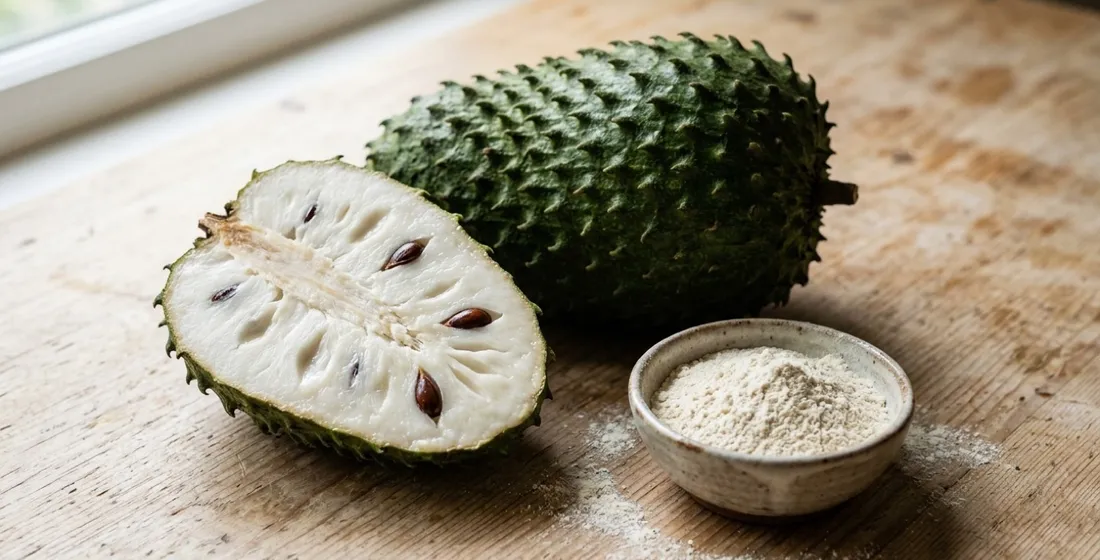
By the Silk Route Ventures Trade Team | 10 July 2026
Buyer’s snapshot
- Soursop (Annona muricata, called katu anoda in Sri Lanka, graviola or guanabana elsewhere) is a high-acid, aromatic tropical fruit. Ripe pulp sits around pH 3.4 to 3.9, and that single number decides how the powder behaves in a dairy ice cream base.
- The safety headline is annonacin, a neurotoxic acetogenin that concentrates in the seeds and leaves, not the de-seeded pulp. A 2005 study measured roughly 15 mg annonacin in an average fruit and 36 mg in a can of nectar, against about 0.14 mg in a cup of leaf tea (Champy et al., Movement Disorders, 2005).
- Do not carry a soursop cancer claim. In 2017 the US FDA issued warning letters over exactly that. De-seeded pulp powder, sold as a flavour and vitamin C ingredient, is the defensible position.
- Spray-dried and freeze-dried soursop powders are different ingredients: drying method drives vitamin C, aroma, cost, and whether a maltodextrin carrier appears on the label.
- Silk Route Ventures (SRV) supplies bulk and private-label soursop powder from a BRCGS and FSSC 22000 V6 audited facility in Matale, with a 100 kg first-order MOQ and samples free for evaluation (you cover the courier).
Most buyers who ask for soursop powder are really asking for one of two things: a tropical flavour system for a beverage or a frozen dessert, or a functional botanical with a health story attached. The two briefs pull in opposite directions. One is a flavour-chemistry and food-safety problem with a clean answer. The other runs straight into the reason soursop carries a regulatory shadow that mango and pineapple do not. This piece is the spec for the first brief, and the honest caution for the second.
What is soursop powder, and how is it made?
Soursop powder is dried, milled soursop pulp, produced mostly by spray drying the de-seeded pulp with a carrier, or by freeze drying pulp pieces. One peer-reviewed optimisation of spray-dried soursop powder reached 2.03 percent moisture and a water activity of 0.18 using 37 percent maltodextrin at a 156 degree C inlet temperature (Chang et al., Journal of Food Process Engineering, 2018). Those four numbers, carrier load, inlet temperature, moisture, and water activity, define the powder more than the word “soursop” does.
The pulp itself is the constraint. Ripe soursop is roughly 73 to 82 percent water, sugar-rich, and aromatic, which makes it sticky and hygroscopic to dry. That is why a spray-dried soursop powder almost always carries maltodextrin: the carrier raises the glass transition temperature so the powder forms and flows instead of caking on the dryer wall. The carrier is a processing necessity, and it becomes a line on the ingredient declaration.
Spray-dried vs freeze-dried soursop powder
Drying method is the largest single variable in a soursop powder spec, and the two routes are not interchangeable. Freeze drying runs cold and slow, protects the heat-labile vitamin C and the volatile esters that carry soursop’s aroma, and usually needs no carrier, but it costs more and yields a porous, hygroscopic powder. Spray drying runs hot and fast on a maltodextrin carrier, costs less, and flows well, at the price of some aroma and ascorbic acid.
Encouragingly for the spray-dried route, one 2018 study reported no significant difference in total phenolics, flavonoids, or antioxidant capacity between fresh soursop pulp and the rehydrated spray-dried powder (Food Research International, 2018). Aroma and vitamin C are the compounds that move; the polyphenol load largely survives. Neither powder is better in the abstract. The application decides.
| Attribute | Spray-dried (with carrier) | Freeze-dried |
|---|---|---|
| Vitamin C and aroma retention | Lower (heat and airflow) | Highest of the methods |
| Carrier needed | Yes (maltodextrin typical) | Usually none |
| Cost per kg | Lower | Higher |
| Flow and handling | Free-flowing | Good but hygroscopic |
| Typical moisture | Around 2 to 4 percent | Low, but rehydrates fast |
| Best fit | Volume beverages, cost-led ice cream bases | Premium clean-label, aroma-led |
Source: Chang et al., Journal of Food Process Engineering (2018); soursop drying-technology sorption studies.
Spec snapshot: bulk soursop powder
- Source: de-seeded ripe soursop pulp (Annona muricata)
- Process: spray-dried (maltodextrin percentage declared) or freeze-dried (carrier-free)
- Screening: moisture, water activity, particle size, colour, vitamin C where claimed, microbial (TPC, yeast and mould, Salmonella, E. coli), heavy metals
- Seed policy: de-seeded pulp only, stated in writing on the COA
- Certification: BRCGS and FSSC 22000 V6; USDA Organic and EU Organic on selected SKUs, confirmed per SKU
- SRV MOQ: 100 kg first order; samples free for evaluation (you cover the courier)
The annonacin question: soursop safety, explained for formulators
This is the section that separates a defensible soursop SKU from a recall risk. Annonacin is a neurotoxic acetogenin found in Annona muricata, and since 1999 clinicians in Guadeloupe have linked heavy consumption of soursop juice, nectar, and leaf infusions to an over-representation of atypical parkinsonism. France’s food-safety agency reviewed the evidence and, in a 2010 opinion on corossol (AFSSA, now ANSES, saisine 2008-SA-0171), concluded it could neither confirm causation nor set a safe intake threshold, and called for more research.
The number that matters to a formulator is where the acetogenin sits. Annonacin concentrates in the seeds and leaves far more than in the pulp. A 2005 quantification measured about 15 mg of annonacin in an average fruit and roughly 36 mg in a commercial can of nectar, against about 0.14 mg in a cup of leaf infusion, and identified annonacin as the most abundant acetogenin in the fruit (Champy et al., Movement Disorders, 2005). Seeds carry the highest load of all.
| Preparation | Approximate annonacin | Formulator read |
|---|---|---|
| Cup of leaf infusion | About 0.14 mg | Low per serving, but chronic use is the Guadeloupe pattern |
| Average whole fruit | About 15 mg | Pulp is not zero; de-seeding matters |
| Can of commercial nectar | About 36 mg | Whole-fruit processing concentrates it |
| Seeds and leaf material | Highest | Keep out of any edible pulp powder |
Source: Champy et al., Movement Disorders (2005).
The practical discipline follows directly. Specify de-seeded pulp, keep seed and leaf material out of the powder, and treat soursop as a flavour and vitamin C ingredient rather than a therapeutic one. The pulp is not zero-annonacin, so the honest position is de-seeded pulp plus portion sense, not a health halo. That is also the safer legal position, which the next section explains.
Why you cannot sell soursop on a cancer claim
Soursop’s biggest commercial trap is not the flavour, it is the marketing. Graviola and soursop supplements have been sold with explicit cancer-cure claims, and in 2017 the US Food and Drug Administration issued warning letters to companies marketing soursop capsules, teas, and leaves as unapproved new drugs, as part of a wider sweep against firms selling illegal cancer “treatments.” The claims cited, that a compound “selectively” kills cancer cells, are exactly the language that turns a food into an unapproved drug.
In practice this splits soursop’s addressable market cleanly. A specialty beverage or frozen-dessert brand can build a genuine SKU on flavour, tropical positioning, and a modest vitamin C contribution, all defensible. A brand that wants soursop for a disease claim is buying a compliance problem, not an ingredient. Silk Route Ventures supplies the first brief and declines the second, because the seed-and-leaf acetogenin load and the FDA claim history make the therapeutic angle a poor fit for a food ingredient.
In the second quarter of 2026, the SRV trade desk fielded three enquiries in a single month that opened with soursop’s “anti-cancer” reputation and a request for leaf-inclusive powder. Each one was walked back to the same place: de-seeded pulp powder, a flavour and vitamin C positioning, and no disease claim. Two of the three moved forward on that basis. The ingredient was never the problem; the claim was.
How soursop’s acidity reshapes your ice cream and beverage formula
Ripe soursop pulp is genuinely acidic. Post-harvest composition studies track pulp pH falling from around 5.8 in the unripe fruit to roughly 3.6 when ripe, with total soluble solids climbing toward 16 degrees Brix and ascorbic acid rising through ripening to the region of 20 to 34 mg per 100 g. For a formulator, pH near 3.4 to 3.9 is the headline: it is low enough to destabilise milk proteins in a dairy ice cream base if the fruit is added at the wrong stage.
That acidity is a feature in some formats and a hazard in others. In an acidic ready-to-drink beverage or an agua fresca, soursop’s tartness and aroma need no correction. In a dairy ice cream, late or post-pasteurisation addition, buffering, or a swing to sorbet and water-ice avoids acid-shock curdling. The sugar load also depresses the freezing point and affects overrun, so a soursop base rarely behaves like a neutral fruit purée. Because vitamin C is heat and oxygen labile, a freeze-dried or well-encapsulated spray-dried powder protects any ascorbic acid a brand wants to declare.
The same logic runs across the tropical range. A brand comparing options against pineapple powder or mango powder is weighing acidity, colour, and carrier load the same way; soursop simply sits at the sharper, more aromatic end of that set, closer in claim-caution to mangosteen powder.
Where soursop fits beverage and frozen-dessert trends
Demand for soursop rides the broader tropical and exotic flavour wave rather than a soursop-specific boom. Innova Market Insights, in its Top Global Flavour Trends 2026, foregrounds a “Cultural Remix” of familiar-yet-novel flavours and reports that 74 percent of global consumers use food and drink to help manage mood, with three in five open to traditional flavours given a modern twist. Soursop, or guanabana on a Latin American menu, is a natural fit for that space in sorbets, popsicles, aguas frescas, and functional RTDs.
The opportunity is real, but it is a flavour opportunity. Soursop’s differentiation is its aroma and its cultural resonance, not a health headline. A brand that leads with the fruit’s taste and provenance, backs it with a de-seeded pulp spec, and keeps the claim modest is building on solid ground. That is the same discipline that governs fruit powders and bars from Sri Lanka across the range, and it links to the organic certification question every specialty buyer eventually asks.
Sourcing soursop powder: origin, spec, and the RFQ
Soursop grows across Sri Lanka’s low-country and mid-elevation zones, where it is known as katu anoda and cultivated under Department of Agriculture fruit-crop guidance. That origin gives the Silk Foods Ceylon (SFC) facility in Matale access to ripe, aromatic fruit for de-seeded pulp powder, spray-dried in-house at 50 kg per day under BRCGS and FSSC 22000 V6, with a COA available on request. Freeze-dried soursop is supplied sourced-to-spec through the SRV trade desk where a project needs the carrier-free, aroma-led route.
A defensible soursop RFQ names the drying method, sets a maltodextrin ceiling, and states the de-seeded pulp requirement in writing, because that seed policy is the food-safety hinge of the whole SKU. It should also fix moisture and water activity for cake resistance in transit, and specify vitamin C only where the brand intends to declare it. Buyers moving finished beverages or frozen desserts often pair the powder question with a non-dairy base such as coconut milk powder, or move the whole project into plant-based and functional food contract manufacturing under one roof.
Buyer’s checklist: specifying soursop powder
- State the drying method: spray-dried (declare the maltodextrin percentage) or freeze-dried.
- Require de-seeded pulp only, confirmed in writing on the COA.
- Set moisture and water activity targets for cake resistance in transit.
- Specify vitamin C on the COA only where the label will declare it.
- Fix particle size and colour to the application, fine for beverages, controlled for inclusions.
- Require the cert stack and, for organic SKUs, the organic transaction certificate.
- Keep the marketing to flavour and provenance; carry no disease claim.
FAQ
Is soursop powder safe to use in food and beverages? De-seeded soursop pulp powder used as a flavour ingredient carries a far lower load of annonacin, the acetogenin of safety concern, than seeds or leaves. A 2005 study measured about 15 mg annonacin per average fruit versus about 0.14 mg per cup of leaf tea (Champy et al., Movement Disorders, 2005). France’s ANSES has urged caution on heavy soursop consumption, so specify de-seeded pulp and avoid seed and leaf inclusion.
Can I market soursop or graviola as a cancer treatment? No. In 2017 the US FDA issued warning letters to companies selling soursop and graviola products with cancer-cure claims, treating them as unapproved new drugs. Soursop is a food and flavour ingredient. A defensible SKU leads with taste, tropical positioning, and a modest vitamin C contribution, and carries no disease claim.
What is the difference between spray-dried and freeze-dried soursop powder? Freeze-dried soursop powder retains the most vitamin C and aroma and usually needs no carrier, but costs more and is hygroscopic. Spray-dried soursop powder runs hot on a maltodextrin carrier, costs less, and flows well, with some aroma and vitamin C loss. One optimised spray-dried powder reached 2.03 percent moisture at 37 percent maltodextrin (Chang et al., 2018).
Why does soursop powder need maltodextrin? Soursop pulp is sugar-rich and hygroscopic, so spray drying it without a carrier produces a sticky powder that cakes on the dryer wall. Maltodextrin raises the glass transition temperature so the powder forms and flows. It is a processing aid, not an adulterant, but it must be declared, which matters for a clean-label claim.
Does Silk Route Ventures supply bulk or private-label soursop powder? Yes. Silk Route Ventures supplies bulk and private-label soursop powder from the BRCGS and FSSC 22000 V6 audited Silk Foods Ceylon facility in Matale, spray-dried in-house at 50 kg per day, with USDA Organic and EU Organic on selected SKUs, confirmed per SKU, and the organic import certificate the destination requires on certified shipments. First-order MOQ is 100 kg and samples are free for evaluation (you cover the courier).
How Silk Route Ventures can help
Silk Route Ventures supplies soursop powder and the wider Ceylon fruit-powder range to specialty beverage brands, premium frozen-dessert makers, and multi-category distributors across the US, EU, and Australia. Bulk soursop powder is shipped against the buyer’s spec from the BRCGS and FSSC 22000 V6 audited Silk Foods Ceylon facility in Matale, produced from de-seeded pulp with a COA available on request, the maltodextrin percentage declared where a carrier is used, and the organic import certificate the destination requires on certified SKUs. Spray-dried fruit powders are produced in-house at 50 kg per day, with freeze-dried supplied sourced-to-spec through the trade desk; first-order MOQ is 100 kg and samples are free for evaluation (you cover the courier). For brands ready to launch a private-label soursop SKU under their own label, SRV runs end-to-end private label and contract manufacturing from the same site. Contact us to send an inquiry or request a sample. Full specs and MOQs are on our spices from Sri Lanka.