
Tulsi (Holy Basil) Powder and Whole Leaf: A Spec for Adaptogen Tea and Capsule SKUs
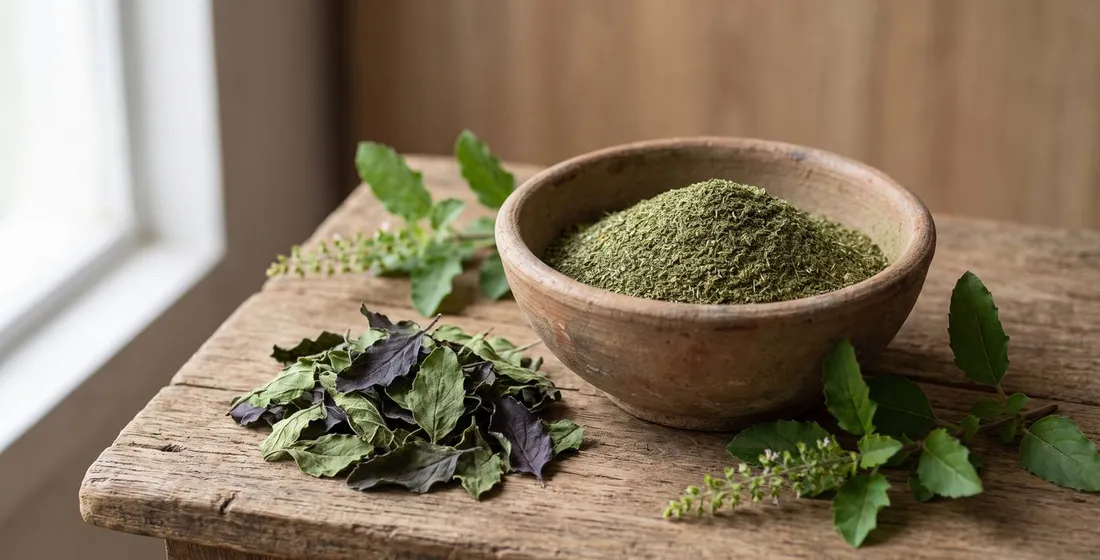
Buyer’s snapshot
- In an HPLC study of eight Ocimum species grown in one Brazilian garden, dried tulsi (Ocimum tenuiflorum) leaf measured 2.02 percent ursolic acid against 0.29 percent in sweet basil (O. basilicum), roughly seven times higher. One site and one harvest, so treat it as a direction, not a guaranteed assay.
- A 2022 DNA study of Tulsi sold and shared in the United Kingdom found eight community samples supplied as Tulsi were O. gratissimum, and 34 of 47 commercial products returned no readable DNA. Identity has to be proven on the raw leaf, before processing.
- Essential oil in green tulsi ran 75.5 percent eugenol in one Indian study, while a purple type carried 17.7 percent methyleugenol. Sweet basil led with methyl chavicol at 46.0 percent.
- Silk Route Ventures supplies bulk tulsi from a Matale facility under BRCGS and FSSC 22000 V6, at a 25 kg MOQ per SKU, with a certificate of analysis on request.
- The identity table and the RFQ list below are the procurement-actionable sections.
A tulsi purchase order usually fails on the first line. “Tulsi powder, green, fine” describes colour and texture, not which Ocimum is in the sack, and the genus has enough look-alikes that the answer is not safe to assume. A buyer launching an adaptogen tea or capsule needs the botanical name, a marker assay that separates the species, and a serving-size-aware limit sheet before price enters the conversation.
Which Ocimum is actually in the bag?
Ocimum tenuiflorum L. (synonym O. sanctum) is the holy basil of Ayurvedic practice. It shares a genus with sweet basil (O. basilicum) and with O. gratissimum, sold in India and elsewhere as Vana tulsi, and the three are routinely confused in trade, in gardens and on labels. Sinhala trade names do not settle it: Maduruthala can be applied to more than one Ocimum locally, so write the botanical name on the PO.
| Species | Common trade name | Dominant essential oil constituents reported (Rana and Blazquez, 2015) |
|---|---|---|
| O. tenuiflorum, green type | Rama or Raam tulsi | Eugenol 75.5%, beta-elemene 9.9%, beta-caryophyllene 9.6% |
| O. tenuiflorum, purple type | Krishna or Shyam tulsi | Eugenol 33.8%, beta-caryophyllene 21.3%, beta-elemene 15.7%, methyleugenol 17.7% |
| O. basilicum | Sweet basil | Methyl chavicol 46.0%, trans-methyl cinnamaldehyde 20.0%, linalool 16.7% |
| O. gratissimum | Vana tulsi, clove basil | Not part of that comparison; confirm by assay |
The percentages are one study’s chemotypes, and other studies report different dominant constituents. Composition moves with cultivar, harvest month and origin, so a single GC figure cannot stand in for identity.
In 2022, Bhamra and colleagues published a DNA barcoding study in Plants using the ITS and trnH-psbA regions. Eight community samples handed over as Tulsi, five of them labelled Raam, turned out to be O. gratissimum. The ten commercial products labelled Tulsi that did amplify were all O. tenuiflorum. The larger finding is the other one: 34 of 47 commercial products, mostly capsules, tablets, syrups and oils, returned no amplifiable DNA after processing, so a barcode test on finished product often cannot prove identity.
That moves the control point upstream. Require botanical identity at raw-material intake: macroscopic and microscopic confirmation against a vouchered reference, an HPTLC fingerprint against a reference standard, and, where the budget allows, DNA on the unprocessed leaf. Ask for it in writing, per lot.
What can a marker assay prove, and what can it not?
Ursolic acid and eugenol are the two numbers tulsi suppliers quote most. They do different jobs.
The 2008 Molecules paper by Silva and colleagues measured ursolic acid by reversed-phase HPLC in dried leaves of eight species collected in April 2005 from one garden at the Federal University of Ceará. O. tenuiflorum returned 2.02 percent, O. basilicum 0.29 percent, and O. gratissimum 1.04 percent. The gap between tulsi and sweet basil is wide enough to be useful as a screen. The gap between tulsi and O. gratissimum is only about twofold, which cannot separate them reliably across lots, seasons and cultivars. The paper reports no replicate variance, so it should not become a floor on a specification.
Eugenol is volatile and swings between 34 and 76 percent of the oil across two tulsi types in one study, so it works better as a fingerprint than a pass-fail line.
Spec snapshot: tulsi leaf powder, bulk supply Species: Ocimum tenuiflorum, botanical name and plant part (leaf) stated on the specification Identity: macroscopic and microscopic report plus HPTLC fingerprint against a reference, per lot Marker: ursolic acid by HPLC, method named, reported per batch rather than guaranteed Methyleugenol: reported per batch by GC, with the limit set from the buyer’s destination market and product form Moisture and water activity: stated maximums Microbiology: standard, edition and row named on the specification Metals: ceiling derived from the buyer’s serving size Silk Route Ventures MOQ: 25 kg per SKU for dried herbs; lead time 2 to 3 weeks PO to dispatch for standard SKUs
Methyleugenol deserves its own line, which most tulsi briefs omit. The International Agency for Research on Cancer classified methyleugenol as Group 2A, probably carcinogenic to humans, in its Volume 134 monographs (working group met June 2023, volume published 2024), on sufficient evidence in experimental animals and strong mechanistic evidence. IARC judged the human evidence inadequate. That is not a statement that tulsi tea is unsafe. It is a reason to ask for the number, since a purple-type lot carrying 17.7 percent methyleugenol in its oil is a different regulatory conversation from a green-type lot with none among its main oil constituents, particularly for EU flavouring and food rules. Report it per batch, and have your regulatory adviser set the limit for your market and product form.
Leaf cut or powder: what changes between a tea SKU and a capsule SKU?
The same leaf is specified twice in practice. A tea bag wants a sifted cut that infuses cleanly. A capsule wants a powder that flows and fills to weight. Running both from one line item is the mistake.
| Spec line | Tea-bag cut | Capsule powder |
|---|---|---|
| Form | Cut leaf, sifted to remove fines and stem | Milled powder |
| Particle size | Cut size stated per bag format, agreed against a sample | 80 to 100 mesh as a starting position, ASTM E11 or ISO 3310-1 named |
| Stem and foreign matter | Stated maximum, agreed against a sample | Stated maximum, agreed against a sample |
| Bulk density | Secondary, affects bag fill | Primary, sets fill weight per shell size |
| Colour | Visible through paper, tight tolerance | Loose, the shell is opaque |
| Moisture | Stated maximum | Stated maximum |
| Packaging | Opaque, high-barrier | Opaque, high-barrier |
The mesh figure is trade practice, not a published standard, so negotiate it against a sample. The fill-weight arithmetic behind a capsule spec is worked through in the capsule size and fill weight guide, and bag formats are in the Ceylon tea bag formats primer.
Buyers building a blend will find the closest sibling in the Ranawara sourcing spec for diabetes-support teas, which handles the same claim-led brief, and in the Ceylon silver tips white tea spec when tulsi is paired with a camellia base.
How much evidence sits behind an adaptogen claim?
Less than the shelf suggests. Jamshidi and Cohen reviewed human tulsi studies in Evidence-Based Complementary and Alternative Medicine in 2017 and found 24 clinical studies with 1,111 participants in total. Only three trials had 100 or more participants, trial durations ran from 2 to 13 weeks, and the authors state that only a minority were high quality and that effects may be overestimated. Leaf powder doses ran 1 to 2.5 g daily. Cultivar, dosage form and quality control were often unreported, and no tea infusion trial was included.
Fifteen of the 24 studies reported no adverse events, eight did not describe them, and one reported occasional mild nausea. The longest trial ran 13 weeks, so the authors say long-term effects cannot be ruled out.
For a buyer, the consequence is practical. A label claim has to rest on the form and dose actually studied, not on tulsi in general, and a tea SKU has no direct trial support in that review. Keep structure-function language conservative and have a regulatory adviser review it before printing.
Microbiology and metals: the serving size decides
A line reading “meets microbiological limits” means little, because the recognised documents disagree. The American Herbal Products Association’s 2022 comparison sets dried unprocessed herbs at 10,000,000 cfu/g total aerobic count and 100,000 cfu/g yeast and mould, with E. coli not detected in 10 g and Salmonella not detected in 25 g. The United States Pharmacopeia rows for dried or powdered botanicals sit at 100,000 and 1,000 cfu/g. A supplier can be compliant under one and out under the other on the same lot, so name the standard, edition and row.
For lead, California’s Proposition 65 lists a maximum allowable dose level of 0.5 micrograms per day. That is an intake figure, so serving size converts it into a concentration. At 1 g of tulsi powder a day it allows about 0.5 mg/kg in the powder. At 2.5 g a day, the top of the leaf-powder range in the review, it allows about 0.2 mg/kg. The lot is identical and the ceiling moves two and a half times with the serving, so record the serving size beside each limit. The certificate itself is covered in how to read a per-lot heavy metal and pesticide COA.
A tea SKU should state how its limits were derived rather than borrow the capsule figure.
Where SRV’s tulsi supply does not fit A brand that wants a guaranteed ursolic acid number without per-lot assay, a species name that reads “tulsi” with no botanical name behind it, or a front-panel adaptogen claim the clinical record does not support for its form and dose. Silk Route Ventures supplies tulsi to buyers who will name the species, state the serving size and test per lot.
What belongs on a tulsi RFQ
Nine lines, in the order a quality manager reads them.
- Botanical species and plant part, Ocimum tenuiflorum leaf, with cultivar type (green or purple) if it matters to the claim.
- Identity method: microscopy plus HPTLC fingerprint against a named reference, with DNA on raw leaf where required.
- Particle size or cut, mesh plus sieve standard or agreed against a sample, by application, with a stem and foreign matter maximum.
- Ursolic acid by HPLC, method named, reported per batch.
- Methyleugenol by GC, reported per batch, with the limit set for the destination market.
- Moisture and water activity ceilings, both stated.
- Microbiology with standard, edition and row cited.
- Heavy metal ceilings derived from your serving size.
- Packaging format, shelf life claimed against it, and destination documents.
The same discipline across several botanicals is in the direct sourcing spec guide for EU and Japan. Dried herbs from Sri Lanka are collected on the Ayurvedic herbs supplier page, and the SKU for this post is the tulsi powder.
Frequently asked questions
How can a buyer tell tulsi from sweet basil or Vana tulsi?
Not by colour or smell alone. Require identity per lot by microscopy and an HPTLC fingerprint against a reference, and use ursolic acid by HPLC as a screen: 2.02 percent in tulsi against 0.29 percent in sweet basil in one study, though O. gratissimum at 1.04 percent is far closer.
Does tulsi contain methyleugenol, and does it matter?
It can. A purple-type O. tenuiflorum oil in one Indian study carried 17.7 percent methyleugenol, while the green type listed none among its main constituents. IARC classifies methyleugenol as Group 2A, so ask for a per-batch result and set the limit for your market and product form.
What does the clinical evidence support for tulsi capsules and tea?
A 2017 systematic review found 24 human studies, lasting 2 to 13 weeks, with few high-quality trials and no tea infusion trial. Claims should match the studied form and dose.
Does Silk Foods Ceylon supply tulsi powder and tea cut to a buyer’s specification?
Silk Foods Ceylon (SFC) mills and supplies bulk tulsi from its Matale facility under BRCGS and FSSC 22000 V6, with USDA Organic and EU Organic on selected SKUs, confirmed per SKU; tulsi is not assumed to be on a current organic certificate. MOQ is 25 kg per SKU, samples are free for evaluation (you cover the courier), and lead time is 2 to 3 weeks from purchase order to dispatch for standard SKUs, with 4 to 6 weeks for private label, custom specifications and organic orders.
How Silk Route Ventures can help
Silk Route Ventures (SRV) supplies bulk Ayurvedic and functional botanicals, tulsi among them, to wellness and nutraceutical brands in the United States, European Union and Australia. Leaf and powder are shipped against the buyer’s own specification from the Silk Foods Ceylon facility in Matale, which holds BRCGS and FSSC 22000 V6, with USDA Organic and EU Organic on selected SKUs, confirmed per SKU, and a certificate of analysis on request. Bulk MOQ is 25 kg per SKU, trial quantities start from 10 kg, and the trade desk writes the spec by application, tea cut or capsule powder, rather than one document for two products. Capsule MOQ is confirmed on your quote. Contact us to send an inquiry or request a sample.
Sources
- Silva, M.G.V. et al., “Variation of Ursolic Acid Content in Eight Ocimum Species from Northeastern Brazil,” Molecules 13(10):2482-2487, 2008. Retrieved 21 October 2026. https://pmc.ncbi.nlm.nih.gov/articles/PMC6245192/
- Rana, V.S. and Blazquez, M.A., “Essential Oil Composition of the Aerial Parts of Five Ocimum species from Western India,” Journal of Essential Oil-Bearing Plants, 2015. Retrieved 21 October 2026. https://agris.fao.org/search/ar/records/65e01a460f3e94b9e5df3f2f
- Bhamra, S.K., Heinrich, M., Johnson, M.R.D., Howard, C. and Slater, A., “The Cultural and Commercial Value of Tulsi (Ocimum tenuiflorum L.): Multidisciplinary Approaches Focusing on Species Authentication,” Plants 11(22):3160, 2022. Retrieved 21 October 2026. https://pmc.ncbi.nlm.nih.gov/articles/PMC9692689/
- Jamshidi, N. and Cohen, M.M., “The Clinical Efficacy and Safety of Tulsi in Humans: A Systematic Review of the Literature,” Evidence-Based Complementary and Alternative Medicine 2017:9217567. Retrieved 21 October 2026. https://pmc.ncbi.nlm.nih.gov/articles/PMC5376420/
- International Agency for Research on Cancer, IARC Monographs Volume 134: Aspartame, Methyleugenol and Isoeugenol. Retrieved 21 October 2026. https://www.iarc.who.int/news-events/iarc-monographs-volume-134-aspartame-methyleugenol-and-isoeugenol
- American Herbal Products Association, Recommended Microbial Limits for Botanical Ingredients (AHPA 2022, current as of June 2022). Retrieved 21 October 2026. https://www.ahpa.org/Files/Document%20Library/AHPAGuidancePolicies/AHPA_micro_limits_comparisons.pdf
- California Office of Environmental Health Hazard Assessment, Proposition 65: Lead. Retrieved 21 October 2026. https://oehha.ca.gov/proposition-65/chemicals/lead
Written by the Silk Route Ventures Trade Team. Silk Route Ventures (E-Silk Route Ventures (Pvt) Ltd) is a Sri Lankan B2B supply-chain operator for the Food, Beverage, Wellness and Nutraceuticals sectors. The Silk Foods Ceylon manufacturing arm operates under BRCGS and FSSC 22000 V6. Questions or to request a sample: Contact us or email info@esilkroute.com.lk.