
Natural Colours from Sri Lankan Botanicals: Beetroot, Butterfly Pea, Turmeric and More
By the Silk Route Ventures Trade Team | 27 November 2026
Buyer’s snapshot
- Four Sri Lankan powders cover the colour wheel a clean-label brief asks for: beetroot (red), blue pea (blue), turmeric (yellow) and moringa leaf (green). Each one fails in a different way, and the failure is set by pH, heat and light, not by the supplier.
- Published work on red beet betalains finds the pigment holds best around pH 5; at 85 °C and pH 3, betanin retention fell to 3 to 6 percent in an acetate buffer (Molecules, 2022). Butterfly pea anthocyanin at pH 7 lost 63.6% of its colour absorbance in 27 days at 50 °C (PMC8622631, 2021).
- The EU and the US draw the colour line in different places. In the EU the test is how selectively the pigment was extracted, so a whole milled powder and a concentrated extract can carry different labels. In the US each colour is a listed additive or it is not. Dried blue pea flower has no EU novel food route as of February 2026.
- Silk Route Ventures (SRV) supplies all four powders from the Silk Foods Ceylon (SFC) facility in Matale, with first orders from 25 kg per SKU for herbs and 100 kg per SKU for beetroot and turmeric.
- This hub is for CPG scale-ups and brand owners in the EU, UK and US writing a natural colour brief. For a single bright shade that must survive a hot, acidic, long-shelf-life drink, read the “where SRV walks away” box first.
A natural colour brief usually arrives as a hue and nothing else: “natural red,” “blue that stays blue,” “a green like matcha.” What decides whether the pack looks right in month six is the process around the powder: the pH of the matrix, the hottest step it sees, how much light the shelf gives it, and which market’s label rules apply. Four Sri Lankan botanical powders can carry red, blue, yellow and green, and each has a boundary condition that belongs in the RFQ. This guide maps all four, so a formulator can pick the right powder for the right application before the first sample request.
Which natural colours can Sri Lankan botanical powders supply?
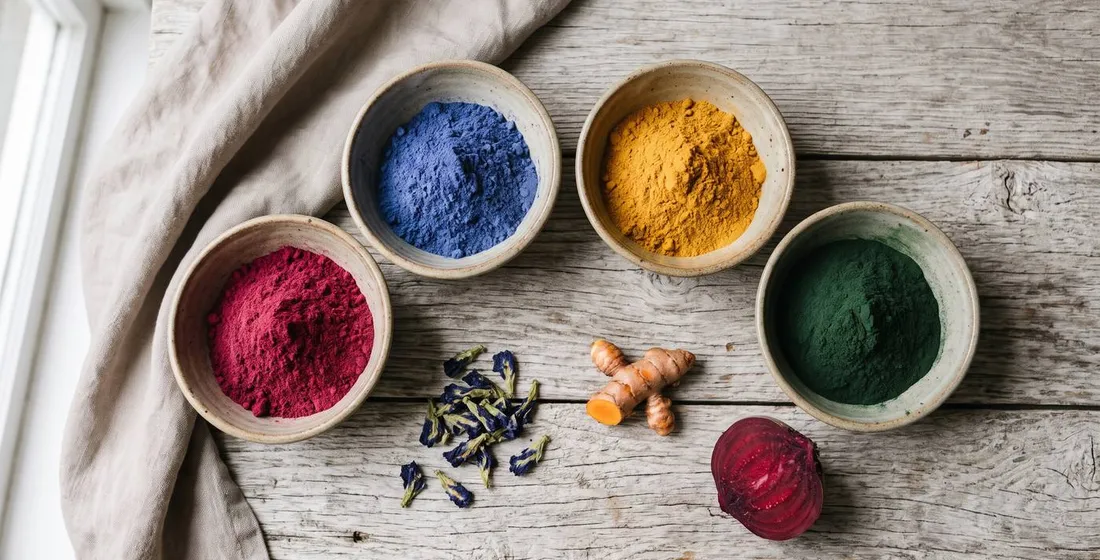
Red from beetroot (Beta vulgaris), blue from butterfly pea flower (Clitoria ternatea), yellow from turmeric (Curcuma longa) and green from moringa leaf (Moringa oleifera) are the four shades Silk Foods Ceylon (SFC) mills as powders. Hibiscus calyx (Hibiscus sabdariffa) adds a tart magenta-red where the matrix is acidic. These are whole-food ingredients that also colour, not standardised pigments, so colour strength moves with variety, harvest and drying.
| Colour | Powder | Pigment family | Works best in | Breaks down in | Regulatory line to check |
|---|---|---|---|---|---|
| Red | Beetroot | Betalains (betanin) | Dry mixes, dairy-free premixes, coatings, cold bases near pH 5 | Hot, strongly acidic or alkaline wet systems | US: dehydrated beets listed (21 CFR 73.40). EU: colouring food or E162 depending on processing |
| Magenta-red | Hibiscus | Anthocyanins | Acidic beverages and blends | Neutral or alkaline matrices, which shift it toward purple or grey | Established tea ingredient; check the claim, not the plant |
| Blue to purple | Blue pea | Ternatin anthocyanins | Neutral-pH drinks, rice, noodles, bakery colouring | Acid (turns purple or magenta), warm storage, light | US: extract listed (21 CFR 73.69). EU: no novel food route for the dried flower |
| Yellow | Turmeric | Curcuminoids | Acidic and neutral foods, dry seasonings, rice, coatings | Alkaline matrices and direct light | US: ground turmeric listed (21 CFR 73.600). EU: curcumin E100 is an additive |
| Green | Moringa leaf | Chlorophyll | Dry blends, cold-set bars, short-shelf-life products | Heat plus acid, which turns it olive-brown | Sold as a food ingredient; confirm any colour claim |
A fifth route sits outside the table: standardised extracts from colour houses. They cost more per kilo of colour, but they carry a stated colour value and are the better answer when a clear drink or a very uniform hue is the brief. SRV does not pretend powders replace them everywhere.
What does beetroot powder do as a natural red?
Beetroot powder is the most forgiving of the four in dry and cold systems, and the least forgiving in hot, wet ones. Its betalains are water-soluble, so the powder dissolves into aqueous bases and tints fat-free matrices without needing oil. The cost is heat sensitivity: in the 2022 Molecules study, betanin and isobetanin retention at 85 °C and pH 3 fell to 3 to 6 percent, while cooler 30 and 50 °C conditions held the pigment far better under acid.
That translates into a simple rule for a pink bakery crumb: it will usually go grey-brown in the oven, because long heat and chemical leaveners push the crumb toward alkaline pH. The reliable fixes are adding the colour after the bake or using a pH-adjusted filling. The full pH and heat grid is in the beetroot powder stability guide, and the label consequence in each market is covered further down this page.
A pattern at the SRV procurement desk: colour requests arrive as a shade, and the useful follow-up question is always “what is the hottest step?” Moving the beetroot addition later in the process changes the outcome more often than changing the powder. A betalain colour that retains 3 to 6 percent of its pigment after a hot acidic step was never going to hold, whoever supplied it.
Is butterfly pea powder a reliable natural blue?
Blue pea is the most stable plant blue in this set, and the only true blue, but it is a pH indicator before it is a colour. The pigment comes from polyacylated delphinidin anthocyanins (ternatins), whose acyl side chains help protect the blue form. Across published work the pattern is blue near neutral pH, purple around pH 4 to 5 and red to magenta in strong acid (PMC8622631, 2021; PMC10255602, 2023). A lemon-tea serve at pH 3 will not be blue however good the flower is.
Storage matters as much as pH. In the 2021 stability study at pH 7, the pigment lost 4.7%, 32.8%, 51.7% and 63.6% of its absorbance over 27 days at 4, 25, 37 and 50 °C. A product piloted in a cool laboratory and shipped in a hot container is a colour specification failure, not a supplier failure. The blue pea tea-bag cut and colour spec writes out the test infusion, fines ceiling and regulatory position in full.
For food colouring rather than infusion, the format is the fine powder. SFC lists blue pea powder alongside the tea-bag cut and whole flower, and the powder is the one that tints rice, noodles, bakery and dairy-free bases without an extraction step. Its limit is speckling in clear liquids.
What can turmeric do as a natural yellow?
Turmeric is the only one of the four that likes acid. The JECFA monograph for curcumin describes the pigment as stable in acids and at high temperature, unstable in alkali and in light, with a shift toward red above about pH 7.5 (FAO JECFA, Curcumin monograph). For a formulator that means turmeric yellow suits acidic dressings, sauces, pickles and neutral rice, and it fades in alkaline bakery systems and in clear packs on a lit shelf.
Turmeric powder is also a spice with a flavour. Whole ground rhizome brings earthy, peppery notes that purified curcumin does not, so a colour-only brief may need a lower dose than the shade target implies, or a different route entirely. The more important buyer risk sits elsewhere: colour-driven adulteration. Ceylon turmeric is bought on a curcuminoid assay and a contaminant screen, and the Ceylon versus Indian turmeric lead risk guide explains why a heavy metals panel belongs on every turmeric RFQ. SFC lists Ceylon turmeric powder for colour and spice applications.
Can moringa leaf powder deliver a natural green?
Green is the hardest shade, and moringa is best treated as a green-tinted functional ingredient, not a bright colour. The pigment is chlorophyll, which loses its central magnesium when heated in acid and shifts to olive-brown pheophytin. A study on blanched green peas tracked that colour loss as a first-order reaction across pH 5.5, 6.5 and 7.5 and temperatures of 70 to 100 °C (Koca et al., FAO AGRIS record), and the pattern holds for leaf powders: acid and heat dull the green.
In practice, moringa leaf powder holds a muted, natural green in dry blends, cold-set bars, smoothie bases and seasonings, and it is a poor choice for a hot, acidic, shelf-stable product that must stay bright. Buyers who want a vivid green usually need a different pigment source or a standardised extract. The moringa leaf powder spec for greens blends covers mesh, colour assessment and contaminant screening, and the hibiscus route for reds is in the hibiscus cut grades guide.
How do pH, heat and light decide which powder works?
The fastest way to choose a colour is to write the process first. The matrix below is a screening tool, not a stability guarantee: every cell needs a trial in the buyer’s own formulation.
| Process condition | Beetroot red | Hibiscus magenta | Blue pea blue | Turmeric yellow | Moringa green |
|---|---|---|---|---|---|
| Acidic (pH 3 to 4) | Weak | Strong | Shifts to purple | Strong | Dulls with heat |
| Near neutral (pH 6 to 7) | Fair | Shifts toward purple | Strong | Fair | Fair |
| Alkaline (pH 8 and above) | Browns | Greys | Degrades | Shifts red, fades | Holds better |
| Hot step (85 °C and above) | Large loss | Moderate loss | Moderate loss | Holds well | Olive-brown |
| Light exposure | Gradual fade | Moderate | Weak photostability | Fades | Fades |
| Dry, low-moisture matrix | Best case | Good | Good | Good | Good |
Two patterns stand out. First, a dry, low-moisture matrix is the use case where all five powders perform, which is why dry mixes, seasoning, coatings and powder premixes carry most of the natural colour volume. Second, no single powder spans the full pH range. A multi-shade range usually pairs beetroot or hibiscus for the acidic side with blue pea or turmeric for the neutral side.
Spec snapshot: a natural colour powder brief Application: matrix, pH, and the hottest step written into the brief Colour target: reference sample or a stated colour value in a defined test medium Moisture: ceiling agreed in writing, with a water activity target Mesh: matched to the application (finer for beverages and premixes, coarser for seasoning) Screening: microbiology, heavy metals, pesticide residue for the destination market, external laboratory on request Packaging: light barrier and low moisture ingress SRV MOQ: 25 kg per SKU for herbs, 100 kg per SKU for beetroot and turmeric, trial quantities from 10 kg
Is a natural colour powder a colouring food or an additive?
The label consequence decides whether a product can say “colour” and carry an E-number, and the two markets draw the line differently.
European Union. Regulation (EC) No 1333/2008 defines a food additive colour as a substance obtained by selective extraction of pigments relative to the nutritive or aromatic constituents. Guidance notes adopted by the Commission’s Standing Committee in late 2013 apply that test to extracts, using the enrichment factor of the pigment to separate colouring foods from additive colours (EU guidance notes on classification of food extracts with colouring properties, via NVWA). The practical reading is that a whole, milled powder keeps the characteristics of its source, while a concentrated pigment extract is an additive colour. Curcumin E100, for example, is obtained by solvent extraction of turmeric and purified by crystallisation, which is clearly additive territory (Directive 2008/128/EC; purity criteria now in Regulation (EU) No 231/2012). Whole ground turmeric used as a spice is a different case, and the classification of a specific product depends on its processing and use.
For blue pea the EU position is stricter. The Commission closed the novel food procedure NF/2023/20953 by Implementing Decision C(2026) 776 final on 12 February 2026 without adding dried Clitoria ternatea flowers to the Union list, after EFSA raised safety objections in 2022. Buyers should not assume the flower is a freely marketable colouring ingredient in the EU. The wider rules that catch botanical ingredients are in the EU botanical sourcing and novel food guide.
United States. Colours are listed, not classified by processing. FDA lists dehydrated beets (beet powder) at 21 CFR 73.40, with volatile matter at 4 percent or less, and turmeric, defined as the ground rhizome of Curcuma longa, at 21 CFR 73.600, in each case as a colour additive exempt from certification. Butterfly pea is listed at 21 CFR 73.69 as an extract made to a stated identity, with uses widened by an FDA order of 12 May 2025, so a flower powder is a different question that the buyer’s regulatory adviser should settle. This guide does not rely on any Part 73 listing for moringa leaf powder, so a colour claim for it needs a separate check. Verify the current rule text before finalising any label.
What does a Sri Lankan natural colour supply programme look like?
Silk Route Ventures (SRV) is the trade desk and Silk Foods Ceylon (SFC) is the manufacturer, so a buyer deals with one party for quotation, sampling and shipment. The SFC spice and herb line runs at 100 to 200 kg per hour, with spray-drying capacity of 50 kg per day for carrier-based powders. The Matale site holds BRCGS (Food Safety Issue 9) and FSSC 22000 Version 6. The BRCGS scope covers herbal and plant-based powders but not spices, so turmeric powder is covered under FSSC 22000 V6. USDA Organic and EU Organic apply on selected SKUs, confirmed per SKU.
Commercial orders start from 100 kg per SKU, dried herbs from 25 kg per SKU and trial quantities from 10 kg. Samples are free for evaluation, and the buyer pays the courier. A COA is available on request, with a certificate of origin, a phytosanitary certificate where the destination requires it and, for organic lots, the import certificate the destination requires. Pricing is FOB Colombo, with CFR and CIF on request. Production runs 2 to 3 weeks from PO to dispatch for standard SKUs and 4 to 6 weeks for private label, custom specifications and organic orders, with sea freight of 3 to 4 weeks to the EU and Australia or 4 to 5 weeks to the US.
For brands building a multi-shade natural colour range, the shared-site advantage is practical: one cert stack, one document pack and one freight schedule for four powders. R&D from a signed brief to an approved formulation runs 3 to 4 weeks at most, so a shade trial and a stability check fit before a first production order. The wider herb range sits on the Sri Lankan herbs supplier page, and the moisture, mesh and sampling checks in the fruit powder RFQ primer apply to every powder in this guide.
Buyer’s checklist: writing a natural colour RFQ
- State the application, matrix pH and the hottest process step before naming a colour.
- Name the destination market and confirm the colouring food or additive position in writing.
- Set a colour target by reference sample or by a stated value in a defined test medium.
- Set moisture and water activity ceilings, and a mesh for the application.
- Require a heavy metals panel (lead, cadmium, arsenic, mercury), plus microbiology and pesticide panels for the destination.
- Run a stability trial in your own matrix at your real storage temperature.
- Plan packaging for light and moisture, and set a colour re-test date.
- Keep a retained sample from the approved lot.
Where Silk Route Ventures walks away Briefs that want one vivid, permanent colour in a hot, acidic, long-shelf-life drink from a whole-food powder alone. EU-first blue pea infusion launches. Buyers shopping a colour purely on price per kilo with no colour test. For those, a standardised extract from a colour house, or a different colour strategy, is the more honest answer.
Frequently asked questions
Which natural powders give red, blue, yellow and green?
Beetroot gives red, butterfly pea gives blue, turmeric gives yellow and moringa leaf gives a muted green. Hibiscus adds a tart magenta in acidic matrices. Each has a pH, heat or light boundary, so the application and process steps should be written into the brief before the shade is chosen.
Is a natural colour powder a colouring food or an additive in the EU?
It depends on selectivity of extraction. Regulation (EC) No 1333/2008 treats colours obtained by selective extraction of pigments as additives, and the 2013 Commission guidance notes use the enrichment factor to separate colouring foods from additives. A minimally processed whole powder generally sits on the food side, while a concentrated pigment extract is an additive. Confirm the case for your exact ingredient.
Can Silk Route Ventures supply private-label natural colour blends?
Yes. Silk Route Ventures supplies bulk and private-label powders from the BRCGS and FSSC 22000 V6 audited Silk Foods Ceylon facility in Matale, including custom colour blends developed in 3 to 4 weeks at most from signed brief to approved formulation. Herb MOQ starts at 25 kg per SKU, beetroot and turmeric at 100 kg, and samples are free for evaluation (you cover the courier).
Which natural colour is the most stable?
Turmeric is the most heat- and acid-tolerant of the set, but it fades in light and alkali. Blue pea is the most stable true blue but depends on near-neutral pH and cool storage. Beetroot is strongest in dry, cold systems. No single powder is best across all conditions, so match the powder to the process.
How Silk Route Ventures can help
Silk Route Ventures supplies natural colour powders (beetroot, blue pea, turmeric, moringa leaf and hibiscus) to CPG scale-ups, specialty brands and distributors across the EU, UK and US, with first orders from 25 kg per SKU for herbs and 100 kg per SKU for beetroot and turmeric, and a COA available on request. The Silk Foods Ceylon facility in Matale mills each lot to the buyer’s written colour, moisture and mesh spec under BRCGS and FSSC 22000 V6, with USDA Organic and EU Organic on selected SKUs, confirmed per SKU. Send an inquiry through the contact form with the application, pH, hottest process step and destination market, and the Trade Team will quote against your brief. Request a sample of blue pea powder or the other powders to run your own stability trial.
Sources
- Betalain stability in red beet extract at varied pH, temperature and metal ions, Molecules, 2022. As cited in the SRV beetroot powder stability guide.
- Spectral Characteristic, Storage Stability and Antioxidant Properties of Anthocyanin Extracts from Flowers of Butterfly Pea (Clitoria ternatea L.), 2021. PMC8622631. Retrieved 16 October 2026.
- A Systematic Review of Butterfly Pea Flower (Clitoria ternatea L.): Extraction and Application as a Food Freshness pH-Indicator, 2023. PMC10255602. Retrieved 16 October 2026.
- FAO/WHO JECFA, Curcumin, Combined Compendium of Food Additive Specifications. fao.org/fileadmin/templates/agns/pdf/jecfa/cta/61/Curcumin.pdf. Retrieved 27 November 2026.
- Koca et al., Effect of pH on chlorophyll degradation and colour loss in blanched green peas, agris.fao.org record 65df12c563b8185d9caa9f4a. Retrieved 27 November 2026.
- European Commission, Guidance notes on the classification of food extracts with colouring properties, via NVWA. english.nvwa.nl/documents/food/safety/documents/guidance-notes-on-the-classification-of-food-extracts-with-colouring-properties-eu. Retrieved 27 November 2026.
- Regulation (EC) No 1333/2008 on food additives, Article 3(2)(a); Commission Directive 2008/128/EC and Regulation (EU) No 231/2012, curcumin E100 specification. Retrieved 27 November 2026.
- U.S. Code of Federal Regulations, 21 CFR 73.40 (dehydrated beets), 73.600 (turmeric) and 73.69 (butterfly pea flower extract). law.cornell.edu/cfr/text/21/73.600. Retrieved 27 November 2026.
- U.S. Food and Drug Administration, Listing of Color Additives Exempt From Certification; Butterfly Pea Flower Extract, Federal Register, 12 May 2025.
- European Commission, Novel food: decisions terminating the procedure, NF/2023/20953, C(2026) 776 final, 12 February 2026. Retrieved 16 October 2026.
- EFSA, Notification of dried flowers of Clitoria ternatea L. as a traditional food, EFSA Supporting Publications, 2022, EN-7084.
Written by the Silk Route Ventures Trade Team.