
Karavila (Bitter Gourd) Capsules: Powder Spec, Extract Options and Claim Limits
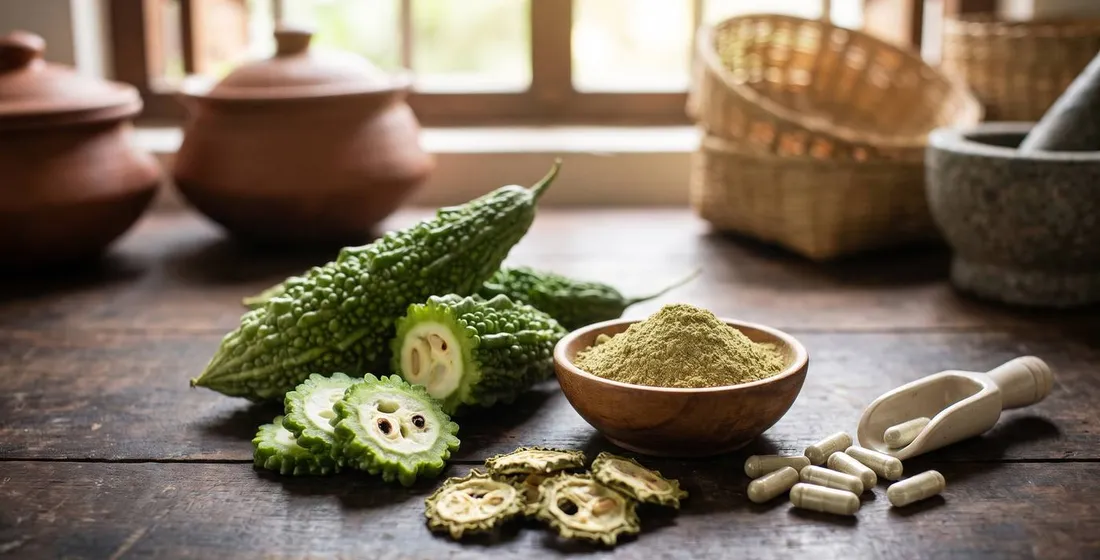
RFQ snapshot
- A Cochrane review of Momordica charantia for type 2 diabetes (Ooi and colleagues, 2012) found only four trials of low overall quality and no significant difference in glycaemic control against placebo. Evidence has moved since, but the claim ceiling for a bitter gourd capsule is still low.
- The early marker compounds, charantin and vicine, are now treated as weak. A 2022 review in Frontiers in Pharmacology points to cucurbitane-type triterpenoids instead, and reports that market products delivered anywhere from 17 to 6,927 micrograms of them per day.
- Fruit powder and a standardized extract are different ingredients with different claims, costs and fill weights. The spec has to name the form, the plant part and the assay method before it names a price.
- Silk Foods Ceylon (SFC) encapsulates karavila from dried green fruit at its Matale facility under BRCGS and FSSC 22000 V6. Dried herbs start from 25 kg per SKU, trial quantities from 10 kg, and the capsule MOQ is confirmed on your quote.
- This post is for wellness and nutraceutical brands in the US, Australia, the EU and the UK writing a private-label brief. It is not for brands that want a disease claim.
Karavila is the Sri Lankan name for bitter gourd, and it is one of the most requested single herbs in blood-sugar-adjacent capsule briefs. It is also one of the easiest to specify badly. The fruit is cheap, the story is old, and the temptation is to order a powder, pick a number off a competitor’s label and write a claim on top. The evidence base does not support that, and the regulators in the main target markets will not let the claim travel anyway. Here is what a defensible karavila spec looks like, and where the label has to stop.
What exactly is karavila, and which part goes in the capsule?
Karavila is the unripe green fruit of Momordica charantia, a Cucurbitaceae vine grown across South Asia and eaten as a vegetable. The sharp bitterness that defines it comes largely from cucurbitane-type triterpenoids, a family of roughly 200 reported structures, collectively called momordicosides and, in some papers, karavilosides or kuguacins.
The plant part matters more than most briefs admit. Fruit is the standard capsule input. Seeds carry vicine, which can trigger favism in people with G6PD deficiency, and a mildly toxic lectin in the seeds and outer rind. A 2022 review (Çiçek, Frontiers in Pharmacology) suggests seedless fruit may lower risk. For a US or EU buyer, that makes “fruit only, seeds removed or declared” a line worth writing into the RFQ, not an assumption.
Silk Foods Ceylon’s karavila capsules are filled from the dried green fruit, milled to a fine powder. The buyer chooses deseeded fruit, whole fruit or an extract before the first sample.
Is the clinical evidence strong enough to build a claim on?
No, and that is the most useful thing a buyer can know at the start. The 2012 Cochrane review by Ooi, Yassin and Hamid pooled four low-quality trials, found no statistically significant glycaemic benefit against placebo, and recorded no serious adverse effects.
When that review was published in August 2012, the procurement question shifted: it stopped being whether bitter gourd is traditional and became whether the specific preparation has any trial behind it. A later systematic review (Peter and colleagues, 2019, ten studies) reported lower fasting glucose and HbA1c, but graded the evidence as low quality. The 2022 Frontiers review concludes that most trials used unstandardized fruit powder, with varying triterpenoid content, which is a plausible reason the results stayed muddy.
For a brand, the takeaway is practical. The trials that exist do not reliably transfer to your capsule, because your capsule is a different preparation from theirs. That is a reason to spec the ingredient tightly and keep the claim modest, not a reason to abandon the category.
Fruit powder or standardized extract: which should the spec name?
Fruit powder is milled dried fruit. It is the simplest, lowest-cost input, it suits traditional-use and whole-food positioning, and its triterpenoid content shifts with variety, maturity and drying. A standardized extract is concentrated and assayed, which lets a formulator hold a marker constant capsule to capsule, at higher cost and a different regulatory profile in some markets.
| Attribute | Dried fruit powder | Standardized extract |
|---|---|---|
| Plant part | Unripe green fruit (seeds removed or declared) | Fruit, extraction solvent and ratio stated |
| Marker | None guaranteed unless assayed per lot | Stated marker and assay method |
| Dose control | Approximate | Calculable per capsule |
| Fill weight | Higher, so fewer capsules fit a bottle serving | Lower for the same actives |
| Best-fit positioning | Traditional use, whole-food, culinary-herb range | Actives-led SKU with defined intake |
| Relative cost per kg | Lower | Higher |
Source: SRV trade desk, with marker context from the 2022 Frontiers in Pharmacology review.
Do not default to a charantin percentage. Charantin is a mixture of two plant sterol glucosides, and the 2022 review calls the evidence for it as an active principle very low. Its aglycones showed no effect in the mouse study the review cites. A charantin figure on a spec sheet therefore tells you about a sterol fraction, not about the bitterness chemistry the research now focuses on.
If the SKU needs a marker, ask for cucurbitane triterpenoids by HPLC, and name the method. The review favours two published HPLC approaches and points to a 2012 survey of ten commercial products where daily triterpenoid intake ran from 17 to 6,927 micrograms. That is roughly a 400-fold spread between products all sold as bitter gourd. If the supplier cannot say what is in each lot, the range on your label will be a guess.
How capsule size and fill weight interact with bulk density is covered in the capsule fill weight and bulk density guide, which matters here because fruit powder is bulky.
Spec snapshot: karavila (bitter gourd) fruit powder for capsules
- Botanical identity: Momordica charantia L., unripe green fruit, confirmed in writing
- Plant part: fruit; seeds removed or declared on the spec
- Marker: none for plain powder unless assayed; cucurbitane triterpenoids by named HPLC method for an extract
- Particle size and bulk density: set for your capsule size and fill weight
- Moisture: stated on the spec and confirmed on the COA
- Contaminants: heavy metals, pesticide residues and microbiology tested through an external laboratory on request
- SFC MOQ: dried herbs from 25 kg per SKU, trial quantities from 10 kg, capsule MOQ confirmed on the quote
What can a bitter gourd capsule claim in the US, EU and Australia?
Less than most briefs assume. In the US, dietary supplement claims cannot reference or imply the treatment of a disease. FDA’s structure/function guidance treats wording such as “lowers blood sugar” as implying a disease claim because it is so closely tied to diabetes, and any mention of diabetes is out. Maintenance-style language about healthy blood sugar levels, with the standard disclaimer and substantiation on file, is the range brands generally work in, subject to counsel review.
In the EU, health claims on botanicals remain on hold under Regulation (EC) No 1924/2006. To our knowledge there is no authorised blood-glucose claim a bitter gourd capsule can rely on, so confirm the current register before any artwork is drawn. A US-style structure/function line does not carry across to a European label.
Australia and the UK run their own regimes; the logic of each is set out in the botanical capsule claims guide for the US, EU and Australia. For a blood-sugar-adjacent botanical, the practical step is to brief a regulatory adviser in the destination market before the form and dose are fixed.
The same claim discipline applies to the other glucose-adjacent botanicals SRV supplies; see cinnamon capsules for blood sugar SKUs and the gymnema (gurmar) sourcing spec.
Which safety cautions belong on the label and in the spec?
Three cautions come up in the literature, and a responsible label addresses each. First, bitter gourd can lower blood glucose, so users on glucose-lowering medication should talk to their prescriber before taking it. Second, fresh fruit juice caused uterine bleeding in pregnant rats and rabbits in the studies cited by the 2022 review, and the author concludes preparations should be avoided in pregnancy. Third, seeds contain vicine, relevant for anyone with G6PD deficiency.
None of this makes a fruit-powder capsule unsuitable; it makes the caution panel part of the spec. Buyers building a full label should also check how the botanical capsule moisture and bottle choices affect shelf life, since a bulky, hygroscopic powder is less forgiving than a dense one.
Buyer’s checklist: karavila (bitter gourd) capsule RFQ
- Form stated first: dried fruit powder or standardized extract
- Botanical identity in writing: Momordica charantia L., unripe green fruit
- Seed policy: removed, or declared on the spec
- Marker and method for extract: named, preferably cucurbitane triterpenoids by HPLC, not charantin alone
- Particle size and bulk density for your capsule size and fill weight
- Moisture stated, and a moisture-barrier bottle plan
- Heavy metals, pesticide residues and microbiology to destination limits, tested through an external laboratory on request
- COA available on request for each lot you buy
- Destination-market claim and caution panel agreed before form and dose are fixed
- Sample evaluated against the spec before any purchase order
How does Silk Foods Ceylon supply karavila capsules?
Silk Foods Ceylon (SFC) mills karavila from dried green fruit and fills it into capsules at its Matale facility, which holds BRCGS (Food Safety Issue 9) and FSSC 22000 Version 6. The capsule line runs 100,000 capsules per single shift and 200,000 per day, with the capsule MOQ confirmed on each quote. Dried herbs start from 25 kg per SKU and trial quantities from 10 kg.
Samples are free for evaluation, and the buyer pays the courier. Lead time from purchase order to dispatch is 2 to 3 weeks for standard SKUs and 4 to 6 weeks for private label, custom specifications and organic orders. Organic status is confirmed per SKU: bitter gourd should not be assumed to be certified organic, so ask for the status of the specific SKU you need. Sea freight runs 4 to 5 weeks to the US and 3 to 4 weeks to the EU and Australia.
Where a brand wants karavila in a blend, the Silk Route Ventures (SRV) R&D and NPD team takes a signed brief to an approved formulation in three to four weeks at most, then production follows on the lead times above. The karavila capsules product page lists the current format.
Frequently asked questions
Does bitter gourd lower blood sugar?
The evidence is mixed and low quality. The 2012 Cochrane review found no significant glycaemic difference against placebo across four trials, while a 2019 systematic review of ten studies reported lower fasting glucose and HbA1c with low-quality evidence. Preparations varied widely, so results do not transfer reliably to a specific capsule.
Is karavila the same as bitter gourd and bitter melon?
Yes. Karavila (or karawila) is the Sri Lankan name for Momordica charantia, sold as bitter gourd or bitter melon in other markets. Capsule inputs usually come from the unripe green fruit, though extracts can be made from other parts, so the plant part belongs on the spec.
What marker should I specify for a bitter gourd extract?
Ask for cucurbitane-type triterpenoids by a named HPLC method rather than a charantin percentage alone. Charantin is a sterol glucoside mixture that a 2022 review treats as a weak active marker. A 2012 survey of ten market products found daily triterpenoid intake from 17 to 6,927 micrograms.
Who should avoid bitter gourd supplements?
Cautions in the literature cover people on glucose-lowering medication, who should consult a prescriber, pregnant women, because fruit juice caused uterine bleeding in animal studies, and people with G6PD deficiency, because seeds contain vicine. A label should carry the cautions the destination market requires.
Does Silk Route Ventures offer private label karavila capsules?
Yes. Silk Route Ventures supplies karavila capsules for private label from the BRCGS and FSSC 22000 V6 audited Silk Foods Ceylon facility in Matale. The capsule MOQ is confirmed on your quote, dried herbs start from 25 kg per SKU, and private-label lead time is 4 to 6 weeks from purchase order to dispatch.
How Silk Route Ventures can help
Silk Route Ventures (SRV) manufactures nutraceutical capsules and supplies bulk Ayurvedic and functional botanicals to wellness brands in the US, Australia, the EU and the UK. The Silk Foods Ceylon (SFC) facility in Matale holds BRCGS and FSSC 22000 V6 covering encapsulation, with USDA Organic and EU Organic on selected SKUs, confirmed per SKU. Capsule MOQ is confirmed on your quote, dried herbs start from 25 kg per SKU, and samples are free for evaluation (you cover the courier). For a first quote, start with SRV’s Sri Lankan herb supply range.
For brands building a karavila SKU, the team specs form, plant part, marker method and caution panel with you before the sample run, and develops blends through its R&D and NPD desk where needed. Contact Silk Route Ventures to send an inquiry or request a sample.