
Ginger and Fruit Immunity Shots: Glass-Bottle Co-Packing for January Wellness Ranges
Buyer’s snapshot
- Analyst estimates put the global functional shots market at about USD 645 million in 2024, growing at roughly 10.65% a year to 2033 (IMARC Group, 2025). Immunity and energy are the two segments that dominate it.
- A shot is a small-volume, high-spec product. The commercial risk sits in three places: the heat treatment that makes a juice and ginger base safe, the glass format, and the claim wording on the label.
- In the EU, “supports immunity” is a regulated claim. Vitamin C carries an authorised immune-function claim; ginger does not, and botanical claims have been on hold since 2010.
- Silk Foods Ceylon runs its beverage line at 2,500 bottles of 200 ml per day, single shift, from a BRCGS and FSSC 22000 V6 audited site in Matale. Shot fill size and unit minimums are confirmed on your quote.
- This piece is for CPG brand owners planning a shot range, not for buyers who need a fully filled container at the lowest price per bottle.
Most contract fillers in South Asia quote juice in cartons or cans. A smaller number fill glass. Fewer still will develop a functional shot from a brief, where ginger heat, fruit acidity, heat treatment and label claim have to be settled together before a single bottle is filled. This piece walks through how that development works at Silk Route Ventures (SRV) and Silk Foods Ceylon (SFC), what the glass format changes, and the claim limits that decide what your front label can say.
What does a ginger and fruit shot co-packer actually develop?
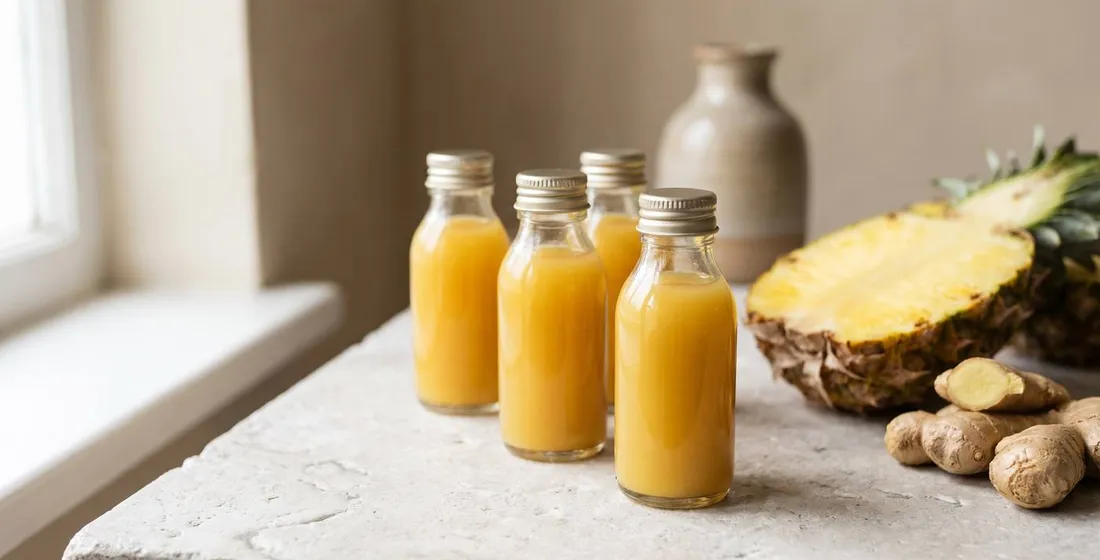
A shot is a concentrated, single-serve drink, usually 50 to 100 ml, built from a fruit juice or pulp base with a high dose of ginger. The formula looks simple. It is not. Ginger gives heat and a cloudy, fibrous body that settles. Pineapple, passionfruit or citrus gives acid, sweetness and colour, and most of the shelf life, because pH is the first control on microbial growth.
The development brief therefore covers four decisions at once:
| Decision | What it sets | Typical options |
|---|---|---|
| Base | Flavour, acidity, cost per bottle | Pineapple, passionfruit, lime, mixed fruit juice or pulp |
| Ginger form | Heat level, sediment, clarity | Fresh juice, extract, or milled ginger in suspension |
| Heat treatment | Safety, shelf life, flavour loss | Hot fill, tunnel pasteurisation, or a chilled-only route |
| Format | Fill size, closure, freight | Small glass bottle with metal cap, fill size confirmed per brief |
SFC’s published range already shows the pattern: the Pineapple Ginger Immunity Shot pairs sweet pineapple with peppery ginger in a single-serve bottle, and the same catalogue carries pineapple and passionfruit shots. Those are the starting points for a private-label range, not a fixed menu. R&D, from signed brief to approved formulation, runs 3 to 4 weeks at most.
How does heat treatment decide the shelf life?
A juice and ginger shot sits well below pH 4.6, so it is a high-acid product and does not need low-acid retort conditions. That is the good news. The condition is that the process still has to be validated.
In the US, juice processors work under the FDA juice HACCP rule (21 CFR Part 120), which requires a process that delivers at least a 5-log reduction of the most resistant relevant pathogen, and requires that the process is validated rather than assumed (FDA, 21 CFR Part 120, 2001, current text on eCFR). Fruit-surface treatment can count for citrus only. For a pineapple and ginger blend, the treatment has to act on the expressed juice, so the heat step is the control point your buyer’s auditor will ask about.
Three routes are used for small glass bottles:
- Hot fill. The product is heated, filled hot, capped and inverted or held so the heat treats the closure. Lowest capital cost, works for high-acid bases, and is hardest on fresh ginger aroma.
- Tunnel pasteurisation. Capped bottles travel through heated and cooled zones. Glass limits the cooling gradient, so the cooling profile, not the heating, is the constraint.
- Chilled, unpasteurised or lightly treated. Best on flavour, shortest on life, and a poor fit for sea freight from Colombo.
Shelf life is not a number to quote in advance. It comes out of a stability programme on your own recipe: sensory, colour, ginger sediment, pH and microbiology tested over time. Published hot-fill studies on glass-packed juice show lives from weeks to many months depending on the fruit and the oxygen picked up at filling, so any supplier quoting a flat figure before testing is guessing. SFC confirms the heat route and the tested life at the end of R&D, per recipe.
What does glass change for a shot?
Glass costs more to ship and more to fill than PET, and it is the format wellness buyers still prefer for a premium shelf. It also constrains the process.
Spec snapshot: glass shot co-packing at Silk Foods Ceylon
- Line: beverage line, 2,500 bottles of 200 ml per day, single shift; shot fill size confirmed per brief
- Format: small glass bottle with metal closure, unbranded or brand-labelled
- First-order unit minimum: confirmed on your quote
- Lead time: 2 to 3 weeks from purchase order to dispatch for standard SKUs; 4 to 6 weeks for private label and custom specifications
- Sea freight: 3 to 4 weeks to the EU and Australia, 4 to 5 weeks to the US
- Certification: BRCGS and FSSC 22000 V6, with USDA Organic and EU Organic on selected SKUs, confirmed per SKU
A smaller bottle does not automatically mean a faster line. Fill valves, neck handling and capping are tuned to a bottle size, which is why the daily figure above is stated for the 200 ml format and the shot figure is confirmed per brief. The honest planning number for a launch range is a short run of a few flavours, not a national volume.
Freight is the other glass tax. Small bottles pack densely but weigh heavily, and a pallet of filled glass carries a lot of dead weight per millilitre of product. If landed cost per shot decides the range, cost the glass freight before you cost the juice.
Which claims can the label actually carry?
This is the section most co-packing pages skip, and it decides whether your January range clears review.
In the EU, nutrition and health claims fall under Regulation (EC) No 1924/2006, and only claims on the authorised list can be used. The list sits in Commission Regulation (EU) No 432/2012. Vitamin C is on it, with the wording “contributes to the normal function of the immune system”, and the claim applies only where the product carries a significant amount of the vitamin, which is 15% of the nutrient reference value per 100 ml or per portion.
Ginger is different. In 2010 the European Commission decided not to continue assessing health claims for plant and herbal substances, and those claims remain on hold, so a front label that says ginger “boosts immunity” is not an authorised claim in the EU. The compliant route is to build the vitamin C level into the recipe, claim only that, and let the ginger and fruit carry the flavour story. In the US the framework differs and a structure-function statement has its own rules, so the claim set is market-specific.
For a pineapple and ginger base, the practical point is that a small shot may not reach 15% of the reference value of vitamin C from fruit alone. A recipe that has to carry the claim may need a fortification step, which changes the ingredient declaration and the specification. Decide that in the first week of R&D, not the week before artwork.
What does the timeline look like for a January range?
Work back from the shelf date. The SRV procurement desk sees the same pattern on functional-range briefs: the products that miss their window are rarely held up by the filling line. They are held up by claim wording settled last, after the recipe is frozen.
| Stage | Time |
|---|---|
| R&D, signed brief to approved formulation | 3 to 4 weeks at most |
| Production, purchase order to dispatch | 2 to 3 weeks standard, 4 to 6 weeks for private label or custom |
| Sea freight to the EU or Australia | 3 to 4 weeks |
| Sea freight to the US | 4 to 5 weeks |
Added up, that is about 10 to 15 weeks from signed brief to a container arriving, before artwork approval and import clearance. A January shelf date means a brief in the early autumn of the year before, with the label claim agreed during R&D rather than after it.
Sourcing the ginger
For brands that want the ginger itself specified, the milled and cut formats are described in the dried ginger formats guide. Bulk ginger and the wider Ceylon spices supplier range are supplied separately from the shot programme, so a brand can buy the spice for its own formulations or have the finished shot produced.
Frequently asked questions
Does Silk Route Ventures co-pack or private label functional shots?
Yes. SFC develops and fills ginger and fruit shots in glass for private-label ranges from a BRCGS and FSSC 22000 V6 audited site in Matale. R&D from signed brief to approved formulation takes 3 to 4 weeks at most, and unit minimums are confirmed on your quote.
How long does a glass-bottled ginger and fruit shot last?
It depends on the recipe and the heat route. High-acid shots under pH 4.6 can be hot filled or tunnel pasteurised for ambient storage, and the tested life is set by a stability programme on your formulation. SFC confirms it per recipe at the end of R&D rather than quoting a standard figure.
Can the label say a ginger shot supports immunity?
Not on ginger alone in the EU. Vitamin C has an authorised immune-function claim under Regulation (EU) No 432/2012 at 15% of the reference value per 100 ml or portion. Botanical claims such as ginger remain on hold. Build the claim around vitamin C and have the label reviewed for each target market.
What shot fill size and minimum order can the line handle?
The published beverage line figure is 2,500 bottles of 200 ml per day, single shift. The shot fill size and the first-run unit minimum are confirmed on the quote for your brief, because both depend on the bottle, closure and heat route chosen.
What lead time should a January launch plan for?
Allow about 10 to 15 weeks from signed brief to arrival: R&D 3 to 4 weeks at most, production 2 to 3 weeks for standard SKUs or 4 to 6 weeks for private label, then 3 to 5 weeks of sea freight depending on destination.
How Silk Route Ventures can help
Silk Route Ventures (SRV) contract-manufactures functional beverages in glass at the Silk Foods Ceylon (SFC) facility in Matale, under BRCGS and FSSC 22000 V6, with USDA Organic and EU Organic on selected SKUs, confirmed per SKU. For a shot range, the team runs R&D in 3 to 4 weeks at most, fills on a line rated at 2,500 bottles of 200 ml per day with shot fill size and unit minimums confirmed on your quote, and ships against a 2 to 3 week standard lead time (4 to 6 weeks for private label). Samples are free for evaluation, and you cover the courier. To brief a shot range, contact us with your base, target market and claim.
Sources
- IMARC Group, “Functional Shots Market Size, Share, Trends and Forecast 2025-2033” (2025). Retrieved 2026-11-09. https://www.imarcgroup.com/functional-shots-market
- US Food and Drug Administration, “Juice HACCP, 21 CFR Part 120, Hazard Analysis and Critical Control Point (HACCP); Procedures for the Safe and Sanitary Processing and Importing of Juice” (2001, current text). Retrieved 2026-11-09. https://www.ecfr.gov/current/title-21/chapter-I/subchapter-B/part-120
- European Parliament and Council, “Regulation (EC) No 1924/2006 on nutrition and health claims made on foods” (2006). Retrieved 2026-11-09. https://eur-lex.europa.eu/eli/reg/2006/1924/oj
- European Commission, “Commission Regulation (EU) No 432/2012 establishing a list of permitted health claims made on foods” (2012). Retrieved 2026-11-09. https://www.legislation.gov.uk/eur/2012/432/contents/data.html
Further reading
- Silk Route Ventures, “Single-serve plant milk co-packing: 200 ml glass bottle economics” -> https://www.esilkroute.com.lk/blog/single-serve-plant-milk-co-packing-200-ml-glass-bottle-economics/
- Silk Route Ventures, “Vegan kombucha co-packing in Sri Lanka” -> https://www.esilkroute.com.lk/blog/vegan-kombucha-co-packing-in-sri-lanka-format-moq-and-shelf-life/
- Silk Route Ventures, “Coconut water and fruit beverage bases: the RFQ spec primer” -> https://www.esilkroute.com.lk/blog/coconut-water-and-fruit-beverage-bases-the-rfq-spec-primer/
Written by the Silk Route Ventures Trade Team. Silk Route Ventures (E-Silk Route Ventures (Pvt) Ltd) is a Sri Lankan B2B supply-chain operator for the Food, Beverage, Wellness, and Nutraceuticals sectors. The Silk Foods Ceylon manufacturing arm holds BRCGS and FSSC 22000 V6 certifications. Questions or to request a sample: Contact us or email info@esilkroute.com.lk.